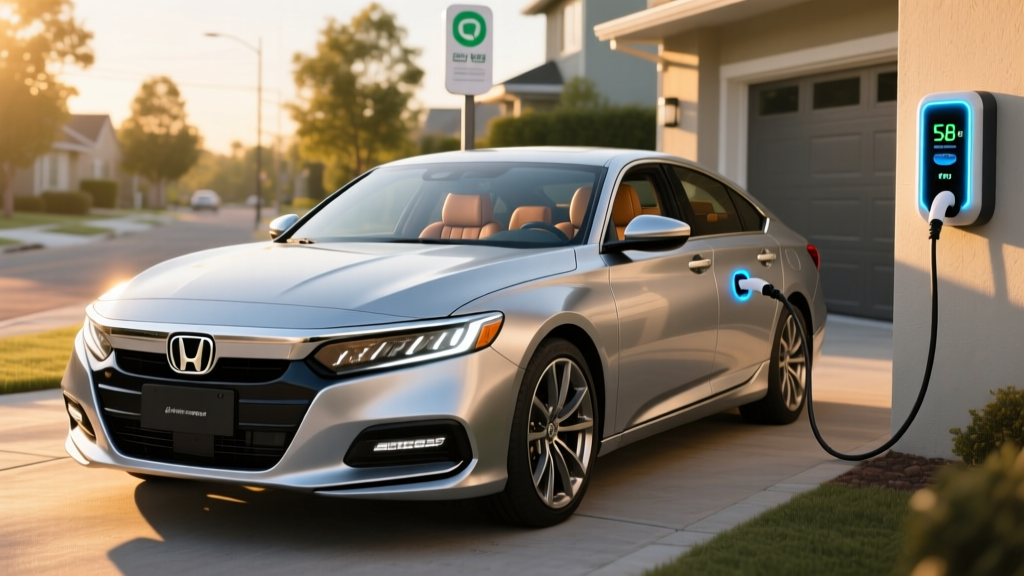
Quick Verdict: The Accord Hybrid Touring Still Sets the Sedan Benchmark
The 2026 Honda Accord Hybrid Touring remains one of the most compelling midsize hybrid sedans on the market — and for good reason. With an EPA-estimated 48 MPG combined, a refined two-motor hybrid powertrain producing 192 horsepower, and Honda's strongest suite of driver-assistance tech, the Touring trim delivers near-luxury content without the luxury fuel bill. For buyers weighing a hybrid against a full battery-electric vehicle (BEV), the Accord Hybrid eliminates charging logistics while still cutting fuel costs dramatically versus a gas-only competitor.
This is a conventional hybrid (HEV), not a plug-in hybrid (PHEV). You never plug it in — the gasoline engine and regenerative braking keep the small lithium-ion battery charged. That distinction matters, and we break it down fully below.
| Spec | Value |
|---|---|
| Powertrain | 2.0L 4-cyl Atkinson + 2-motor hybrid system |
| Combined Horsepower | 204 hp (146 lb-ft engine torque + 247 lb-ft motor torque) |
| Transmission | e-CVT (direct-drive, no traditional belts) |
| EPA MPG (City / Hwy / Combined) | 51 / 44 / 48 |
| Fuel Tank | 12.8 gallons |
| Total Driving Range | ~614 miles (EPA est.) |
| Battery Type | Lithium-ion (approx. 1.1 kWh, HEV — not plug-in) |
| 0–60 mph | ~7.0 seconds (est.) |
| Drivetrain | Front-wheel drive |
| MSRP (Touring trim) | $40,395 (incl. destination) |
| Federal Tax Credit (§30D) | Not eligible — conventional HEV |
| Hybrid Battery Warranty | 8 years / 100,000 miles (10 yr / 150,000 mi in CARB states) |
Fuel Economy: EPA Numbers vs. Real-World MPG
The EPA rates the 2026 Accord Hybrid at 51 city / 44 highway / 48 combined MPG for the Touring trim (the lighter Sport and EX-L trims earn slightly higher highway figures due to smaller wheels and less weight). These numbers come from fueleconomy.gov, the official EPA database.
| Trim | City MPG | Highway MPG | Combined MPG |
|---|---|---|---|
| Sport | 51 | 44 | 48 |
| EX-L | 51 | 44 | 48 |
| Sport-L | 51 | 44 | 48 |
| Touring | 51 | 44 | 48 |
Real-World MPG: What to Actually Expect
Honda's two-motor hybrid system excels in city and suburban driving, where the electric motor handles low-speed propulsion and the engine acts primarily as a generator. In real-world testing, owners and reviewers consistently report 50–55 MPG in mixed city driving, often exceeding the EPA city estimate. This is typical of Honda and Toyota hybrid systems — regenerative braking and frequent electric-only operation in stop-and-go traffic boost real-world city economy beyond the sticker.
Highway driving tells a different story. At sustained 70–80 mph speeds, expect 40–43 MPG, slightly below the EPA highway figure. The Atkinson-cycle 2.0L engine is optimized for efficiency, not high-speed power, and aerodynamic drag reduces the hybrid system's advantage at freeway speeds. In cold weather (below 30°F), overall MPG can dip 5–10% as the engine runs more frequently to provide cabin heat and warm the catalytic converter.
Bottom line: If your commute is mostly city and suburban, plan on 50+ MPG. Heavy highway commuters should expect low-to-mid 40s. Either way, the Accord Hybrid dramatically undercuts a comparable gas sedan (the discontinued 1.5T Accord rated 29/37/32 MPG).
Hybrid Powertrain: How Honda's Two-Motor System Works
The Accord Hybrid uses Honda's fourth-generation two-motor hybrid system, which is fundamentally different from a traditional parallel hybrid like older Toyota designs. Here's the architecture:
- Propulsion motor: A 135 kW (181 hp) electric motor drives the front wheels directly during most city and suburban driving.
- Generator motor: A second motor acts as a generator, converting engine output into electricity to feed the propulsion motor or charge the battery.
- 2.0L Atkinson-cycle engine: Produces 146 hp and 134 lb-ft on its own, but primarily serves as a generator at low speeds. At highway cruising (typically above 50 mph), a lock-up clutch connects the engine directly to the wheels for maximum efficiency.
- Lithium-ion battery pack: Approximately 1.1 kWh capacity — small by PHEV or BEV standards, but sufficient to buffer energy for electric-only bursts up to about 1 mile at low speeds and to smooth power delivery.
The combined system output is 204 horsepower, with the electric motor delivering 247 lb-ft of torque from a standstill. This gives the Accord Hybrid surprisingly responsive off-the-line acceleration — the electric motor fills the torque gap that a naturally aspirated Atkinson-cycle engine would otherwise leave. The e-CVT is a direct-drive unit with a single fixed gear ratio (plus the engine lock-up clutch), so there's no rubber-band effect typical of older belt-driven CVTs.
HEV vs. PHEV vs. EV: Which Powertrain Fits You?
The Accord Hybrid Touring is a conventional hybrid (HEV). It cannot be plugged in and has no meaningful electric-only range. If you're cross-shopping, here's how the three electrified powertrain types compare:
| Factor | HEV (Accord Hybrid) | PHEV (e.g., Toyota Prius Prime) | BEV (e.g., Tesla Model 3) |
|---|---|---|---|
| Plug-in required? | No | Yes (for EV range) | Yes (always) |
| Electric-only range | ~0.5 mi at low speed | 25–44 mi typical | 250–360+ mi |
| Fuel/energy cost per mile | ~$0.07 (at $3.30/gal) | ~$0.04 (electric) / ~$0.08 (gas) | ~$0.04 (electric) |
| Home charging needed? | No | Recommended | Essential |
| Federal tax credit (§30D) | Not eligible | Up to $7,500 (if eligible) | Up to $7,500 (if eligible) |
| Best for | No charging access, long highway trips | Short commute + home charging + road trips | Home charging + mostly under 300 mi/day |
| Upfront cost premium | Low (~$1,500 over gas equivalent) | Moderate ($4,000–$8,000) | Higher ($5,000–$15,000+) |
Choose the Accord Hybrid (HEV) if: You don't have access to home or workplace charging, you take frequent long road trips, or you want maximum simplicity with zero behavior change from a gas car.
Choose a PHEV if: You have a garage or driveway with a 120V or 240V outlet, your daily commute is under 40 miles round-trip, but you still want a gas engine for weekend road trips.
Choose a BEV if: You can install a Level 2 home charger, your daily driving is under 250 miles, and you want the lowest per-mile energy cost and zero tailpipe emissions.
Pricing, Tax Credits, and Total Ownership Cost
The 2026 Honda Accord Hybrid Touring carries an MSRP of $40,395 including the $1,195 destination charge. This positions it at the top of the Accord Hybrid lineup:
- Sport Hybrid: ~$34,595
- EX-L Hybrid: ~$36,495
- Sport-L Hybrid: ~$37,095
- Touring Hybrid: ~$40,395
The Touring adds features that justify the premium for many buyers: a 12.3-inch infotainment display with wireless Apple CarPlay and Android Auto, a 12-speaker Bose premium audio system, heated and ventilated front seats, heated rear seats, a head-up display, wireless phone charging, Google built-in (navigation, Google Assistant), and low-speed braking control.
Tax Credit Eligibility
The Accord Hybrid is a conventional HEV and does not qualify for the federal §30D Clean Vehicle Credit. That credit — up to $7,500 for new vehicles — is reserved for plug-in hybrids (PHEVs) and battery-electric vehicles (BEVs) that meet battery sourcing, critical minerals, MSRP cap, and buyer income requirements per IRS guidelines.
Some states offer separate incentives for conventional hybrids, but these are increasingly rare as state programs shift focus to PHEVs and BEVs. Check your state's energy office or DMV website for current programs.
5-Year Fuel Cost Comparison
Here's where the Accord Hybrid earns its keep. At 15,000 miles per year and $3.30/gallon (national average):
- Accord Hybrid (48 MPG): ~$7,734 over 5 years
- Comparable gas sedan (30 MPG): ~$12,375 over 5 years
- Annual savings: ~$928/year vs. a 30 MPG gas sedan
Over a typical 5-year ownership period, the fuel savings alone offset most of the hybrid premium over a base gas trim. Factor in the Accord Hybrid's strong resale value — hybrids consistently retain value better than gas counterparts in the current market — and the total cost of ownership is compelling even without a tax credit.
Hybrid Battery Warranty, Lifespan, and Replacement Cost
Honda Hybrid Battery Warranty
- Standard coverage: 8 years / 100,000 miles
- CARB-state coverage: 10 years / 150,000 miles (California, New York, Massachusetts, and other states adopting CARB emissions standards)
- Coverage threshold: Honda covers the hybrid battery if it loses capacity below a functional threshold (typically inability to hold sufficient charge for hybrid system operation)
How Long Do Honda Hybrid Batteries Last?
Honda's hybrid battery packs have proven remarkably durable. The small 1.1 kWh lithium-ion pack in the Accord Hybrid operates within a narrow state-of-charge window — Honda's battery management system never fully charges or fully depletes it, which dramatically reduces degradation stress. Real-world data from previous-generation Accord and Civic Hybrids shows most batteries lasting 150,000–200,000+ miles without significant issues.
The battery is also much smaller and simpler than a PHEV or BEV pack, which means replacement costs are proportionally lower. If a replacement is needed out of warranty:
- OEM replacement battery: ~$2,000–$3,500 (parts)
- Labor: ~$500–$800
- Total out-of-pocket: ~$2,500–$4,300
Third-party refurbished and aftermarket hybrid batteries are also available for $1,200–$2,000, further reducing cost. Compare this to BEV battery replacements ($8,000–$20,000+), and the hybrid's lower-stress, smaller-capacity battery becomes a clear financial advantage for risk-averse buyers.
Reliability Track Record
Honda's hybrid system has a strong reliability record, and the Accord nameplate consistently earns high marks from IIHS (Top Safety Pick+ expected for 2026 with standard Honda Sensing suite). The e-CVT design has fewer moving parts than a conventional automatic transmission — no torque converter, no clutch packs, no planetary gearsets — which reduces long-term mechanical failure points. Consumer Reports and J.D. Power data on Honda hybrid systems consistently show above-average reliability ratings.
Who Should Buy the 2026 Accord Hybrid Touring?
Strengths
- Exceptional real-world city MPG (often exceeds EPA 51 city)
- No charging infrastructure required — zero lifestyle change
- 614-mile total range eliminates refueling stops on road trips
- Strong 204 hp with instant electric torque off the line
- Touring trim offers near-luxury features at mainstream pricing
- Proven hybrid reliability with 8–10 year battery warranty
- Excellent IIHS safety ratings with standard Honda Sensing 2.0
Limitations
- No federal tax credit eligibility (HEV, not PHEV/BEV)
- Highway MPG drops to low 40s at 75+ mph
- FWD only — no all-wheel-drive option
- Touring trim pushes $40K+ without AWD or turbo power
- Electric-only driving limited to ~0.5 mi at low speeds
- 12.8-gallon tank means more frequent stops vs. some competitors
The 2026 Accord Hybrid Touring is the right choice if you want a fuel-efficient, tech-loaded midsize sedan and you cannot or do not want to charge at home. It's ideal for apartment dwellers, frequent road-trippers, and buyers in regions with limited public charging infrastructure. The Touring trim specifically targets buyers who want premium features — Bose audio, ventilated seats, head-up display, Google built-in — without stepping into BMW or Lexus pricing.
If you have reliable home charging and a short commute, a PHEV like the Toyota Prius Prime (44 miles electric-only, up to $7,500 tax credit) might save you more on daily driving. If you're ready for full electric, the Tesla Model 3 or Hyundai Ioniq 6 offer lower per-mile energy costs. But for pure simplicity, the Accord Hybrid remains unmatched.
Frequently Asked Questions
How many MPG does the 2026 Honda Accord Hybrid Touring get?
The EPA rates it at 51 city / 44 highway / 48 combined MPG. In real-world city driving, many owners report 50–55 MPG. Highway driving at 70+ mph typically yields 40–43 MPG. Cold weather can reduce overall economy by 5–10%.
Does the Accord Hybrid need to be plugged in?
No. The Accord Hybrid is a conventional hybrid (HEV). The gasoline engine and regenerative braking system keep the lithium-ion battery charged automatically. You simply fill it with gas like any other car.
Does the 2026 Accord Hybrid qualify for any federal tax credit?
No. The federal §30D Clean Vehicle Credit applies only to plug-in hybrids (PHEVs) and battery-electric vehicles (BEVs) that meet specific battery sourcing and MSRP requirements. The Accord Hybrid is a conventional HEV and is not eligible. Some state-level incentives may apply — check your state energy office.
How long does the Honda hybrid battery last and what does replacement cost?
Honda warranties the hybrid battery for 8 years/100,000 miles (10 years/150,000 miles in CARB states). Real-world data suggests most batteries last 150,000–200,000+ miles. Out-of-warranty replacement runs approximately $2,500–$4,300 for an OEM battery including labor — significantly less than a BEV battery replacement.
Hybrid vs. PHEV vs. EV — which should I choose?
Choose the Accord Hybrid (HEV) if you lack home charging access or take frequent long road trips. Choose a PHEV if you have home charging and a short daily commute but want gas-engine flexibility for longer trips. Choose a BEV if you have reliable home charging, drive under 250 miles daily, and want the lowest per-mile energy cost. The Accord Hybrid is the lowest-risk, zero-behavior-change option.
Is the Accord Hybrid Touring worth the premium over lower trims?
The Touring adds roughly $4,000–$6,000 over the Sport Hybrid trim but includes a 12.3-inch display, Bose 12-speaker audio, ventilated front seats, heated rear seats, head-up display, wireless charging, and Google built-in. If you value these features, the premium is reasonable. If you prioritize value, the EX-L Hybrid at ~$36,495 offers leather, heated seats, and most core tech for significantly less.
Can the Accord Hybrid drive on electric power alone?
Only briefly. The hybrid system can operate in electric-only (EV) mode for roughly half a mile at speeds under 25 mph — typically in parking lots or stop-and-go traffic. The engine kicks in seamlessly when more power is needed or the battery buffer depletes. This is not a plug-in hybrid with meaningful electric-only range.