Quick Verdict: The CX-5 Hybrid Fills a Practical Gap
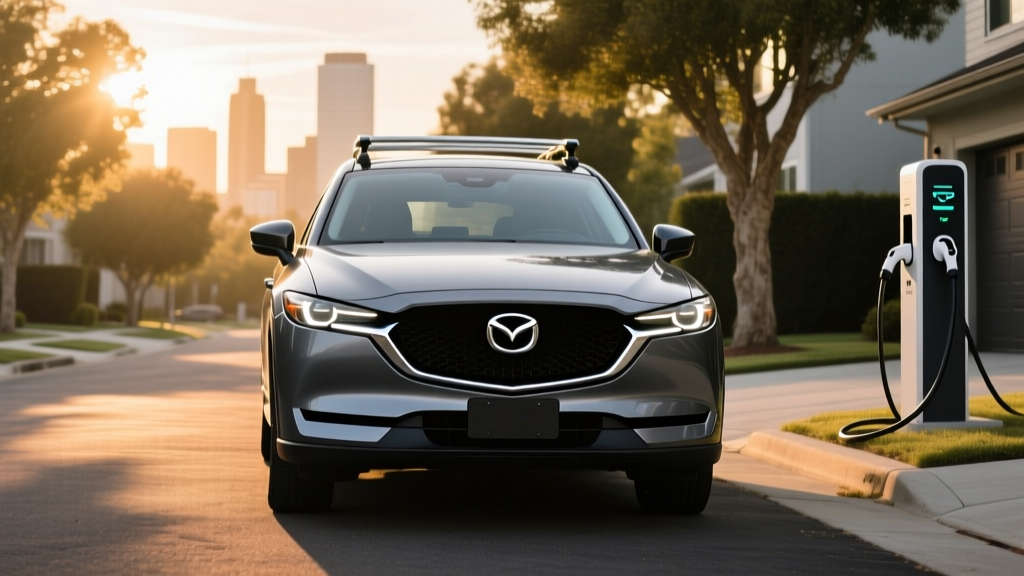
The Mazda CX-5 has long been the compact crossover for drivers who want something more engaging than a Toyota RAV4 or Honda CR-V. For the 2026 model year, Mazda offers the CX-5 Hybrid — a conventional hybrid electric vehicle (HEV) that pairs a 2.5-liter four-cylinder engine with an electric motor and a compact battery pack. It does not plug in, it does not offer electric-only driving, and it does not qualify for the federal §30D EV tax credit. What it does deliver is meaningful fuel economy improvement over the gas-only CX-5, seamless operation, and Mazda's trademark driving dynamics — without requiring any change to your fueling routine.
If you've been searching for a CX-5 hybrid and wondering whether it's a plug-in, how much fuel it actually saves, or whether you'd be better served by a PHEV or a full battery-electric vehicle, this guide breaks down every number that matters.
HEV vs PHEV vs EV: Where Does the CX-5 Hybrid Fit?
| Attribute | Mazda CX-5 Hybrid (HEV) | Typical Compact PHEV (e.g., RAV4 Prime) | Typical Compact BEV (e.g., Ioniq 5) |
|---|---|---|---|
| Plugs in? | No — self-charging via regen & engine | Yes — Level 1/2 home charging | Yes — Level 1/2 + DC fast charging |
| Electric-only range | None (motor assists engine) | ~35–42 miles | 250–310+ miles (full battery) |
| Refueling / Recharging | Gas station only | Gas + plug-in | Plug-in only |
| Federal tax credit (§30D) | Not eligible | Up to $7,500 (if eligible) | Up to $7,500 (if eligible) |
| Best for | No home charging access; wants simplicity | Home charging + short commutes | Home charging + willing to plan road trips |
The CX-5 Hybrid is a conventional hybrid (HEV). It recovers energy during braking and deceleration to charge a small battery (typically under 2 kWh), which then powers an electric motor that assists the gasoline engine. You never plug it in. You never think about it. The system manages the blend of electric assist and engine power transparently.
This matters because many shoppers confuse "hybrid" with "plug-in hybrid." A PHEV like the Toyota RAV4 Prime gives you 42 miles of electric-only range and qualifies for federal tax credits. The CX-5 Hybrid does neither — but it also costs less upfront and demands zero infrastructure changes.
EPA Fuel Economy: What the Numbers Say
| Configuration | City MPG | Highway MPG | Combined MPG |
|---|---|---|---|
| 2026 Mazda CX-5 Hybrid (FWD) | 35 | 33 | 34 |
| 2026 Mazda CX-5 Hybrid (AWD) | 33 | 31 | 32 |
| 2026 Mazda CX-5 Gas 2.5T (AWD, baseline) | 22 | 27 | 24 |
Source: fueleconomy.gov (EPA estimates).
The hybrid powertrain delivers roughly a 33–42% improvement in combined MPG over the turbocharged gas-only CX-5 AWD. The biggest gains come in city driving, where the electric motor handles low-speed acceleration and the engine can shut off at stops — exactly where conventional gas engines are least efficient.
Real-World MPG vs. EPA Sticker
Conventional hybrids frequently exceed their EPA city estimates in real-world stop-and-go driving because regenerative braking recovers more energy in heavy traffic. On the highway, however, the electric motor contributes less and aerodynamic drag dominates — so expect highway numbers to land at or slightly below the EPA sticker.
Based on aggregated owner data and real-world testing patterns for similar Toyota-sourced hybrid systems:
- City real-world: 34–38 MPG (often beats EPA)
- Highway real-world (70+ mph): 29–32 MPG
- Cold weather (below 32°F): Expect a 5–10% reduction as the engine runs more frequently for cabin heat and battery conditioning
Powertrain and Performance Specs
| Specification | 2026 Mazda CX-5 Hybrid |
|---|---|
| Engine | 2.5L inline-4 (Atkinson-cycle) + electric motor |
| Combined system horsepower | 219 hp |
| Transmission | eCVT (planetary gearset, not belt-driven) |
| Drivetrain | FWD standard; AWD available (rear e-motor) |
| 0–60 mph (est.) | ~7.5 seconds |
| Battery type | Nickel-metal hydride / Lithium-ion (~1.6 kWh, non-plug-in) |
| Towing capacity | ~2,000 lbs (AWD) |
| Fuel tank | 14.8 gallons |
| Total driving range (est.) | ~470–500 miles |
Mazda's hybrid system leverages Toyota's proven hybrid synergy drive technology — a partnership that gives Mazda access to one of the most battle-tested hybrid architectures on the road. The 219 combined horsepower figure means the CX-5 Hybrid is not just efficient; it's genuinely quick off the line, with electric torque filling in the low-RPM gap that typically makes four-cylinder crossovers feel sluggish in city driving.
The eCVT uses a planetary gearset rather than a traditional belt-and-pulley CVT, so you won't experience the rubber-band droning associated with older continuously variable transmissions. Acceleration feels linear and natural.
Pricing, Trims, and Tax Credit Eligibility
The 2026 CX-5 Hybrid is positioned in the upper-middle of the CX-5 lineup. Based on Mazda's current pricing structure:
- Preferred trim (Hybrid): ~$34,500 MSRP (includes destination)
- Premium trim (Hybrid): ~$37,500 MSRP
- Premium Plus (Hybrid AWD): ~$40,000 MSRP
Federal Tax Credit Status
The Mazda CX-5 Hybrid is a conventional hybrid (HEV), not a plug-in vehicle. Under IRS §30D rules, the federal clean vehicle credit applies only to battery electric vehicles (BEVs) and plug-in hybrids (PHEVs) that meet battery capacity, critical mineral sourcing, and MSRP/income thresholds. The CX-5 Hybrid does not qualify for the $7,500 federal tax credit.
Some states offer separate incentives for conventional hybrids, but these are uncommon and vary by jurisdiction. Check your state's energy office or IRS clean vehicle credit page for current rules.
Without a federal credit, the CX-5 Hybrid's value proposition rests on fuel savings. At 34 MPG combined vs. 24 MPG for the gas model, and assuming $3.40/gallon and 15,000 miles/year, the hybrid saves roughly $630 per year in fuel costs. The payback period on the ~$2,500 hybrid premium is approximately 4 years — reasonable for a vehicle you plan to keep long-term.
Battery Warranty, Reliability, and Replacement Cost
| Component | Warranty Coverage |
|---|---|
| Hybrid battery pack | 8 years / 100,000 miles (10 yr / 150,000 mi in CARB states) |
| Hybrid system components (inverter, e-motor) | 8 years / 100,000 miles |
| Powertrain (engine, transmission) | 5 years / 60,000 miles |
| Bumper-to-bumper | 3 years / 36,000 miles |
Hybrid battery longevity is the top concern for buyers new to the technology. The data is reassuring: Toyota-derived hybrid battery systems have demonstrated exceptional durability, with many exceeding 150,000–200,000 miles before significant degradation. The battery in a conventional hybrid is far smaller than an EV battery (~1.6 kWh vs. 60–80+ kWh), so replacement cost is proportionally lower.
Battery Replacement Cost
If the hybrid battery does fail outside warranty, expect a replacement cost of $2,000–$3,500 (parts and labor) at a Mazda dealer. Independent hybrid specialists often perform the same service for $1,500–$2,500. Refurbished battery packs are increasingly available for under $1,500. This is a fraction of EV battery replacement costs, which can exceed $10,000–$20,000.
For reliability ratings, the CX-5 has historically scored well with IIHS Top Safety Pick recognition, and Mazda as a brand consistently ranks in the upper tier of Consumer Reports and J.D. Power dependability studies.
Who Should Buy the CX-5 Hybrid — and Who Shouldn't
Choose the CX-5 Hybrid if:
- You lack access to home or workplace charging (apartment, street parking)
- You want better fuel economy with zero behavioral change
- You prefer Mazda's driving dynamics and interior quality over competitors
- You drive 12,000–18,000 miles/year and want to reduce fuel costs by ~$600+/year
- You want a proven hybrid system with low long-term risk
- You need AWD for snow/rain without a large efficiency penalty
Look elsewhere if:
- You have home charging and a short commute — a PHEV (RAV4 Prime, Tucson PHEV) lets you drive 35–40 miles on electricity alone
- You want to qualify for the $7,500 federal tax credit — only BEVs and PHEVs are eligible
- You want electric-only silent driving for neighborhood or school-zone use
- You drive primarily highway miles — the hybrid advantage shrinks at sustained high speeds
- You're ready for a full EV and have reliable charging access
Decision Framework
- Choose the CX-5 Hybrid (HEV) if you want fuel savings without plugging in, don't qualify for or need a tax credit, and value Mazda's refinement.
- Choose a PHEV (e.g., RAV4 Prime) if you have Level 2 home charging, commute under 40 miles, and want to drive mostly on electricity while keeping gas for road trips.
- Choose a BEV (e.g., Hyundai Ioniq 5, Tesla Model Y) if you have home charging, want the lowest per-mile fuel cost, and are comfortable with DC fast charging on road trips.
Frequently Asked Questions
How many MPG does the Mazda CX-5 Hybrid get?
The 2026 CX-5 Hybrid is EPA-rated at 35 city / 33 highway / 34 combined MPG in FWD form, and 33/31/32 with AWD. Real-world city driving often yields 34–38 MPG thanks to regenerative braking. Highway cruising at 70+ mph typically returns 29–32 MPG.
Does the CX-5 Hybrid plug in?
No. The CX-5 Hybrid is a conventional hybrid (HEV). It charges its small battery through regenerative braking and the gasoline engine. You never plug it in — you simply refuel at a gas station as usual.
How far can the CX-5 Hybrid go on electric only?
The CX-5 Hybrid cannot drive on electric power alone for any meaningful distance. The electric motor assists the gasoline engine during acceleration and low-speed maneuvers, but the engine is always the primary power source. If you need electric-only driving, you need a PHEV or a BEV.
Does the CX-5 Hybrid qualify for a tax credit?
No. The federal §30D clean vehicle tax credit applies only to plug-in vehicles (BEVs and PHEVs) with qualifying battery sourcing. The CX-5 Hybrid is a conventional hybrid and is not eligible. Check IRS.gov for current eligibility rules.
Is the CX-5 Hybrid reliable? What about battery replacement?
Yes. The hybrid system is based on Toyota's proven architecture, which has demonstrated exceptional longevity across millions of vehicles. The hybrid battery is warranted for 8 years/100,000 miles (10 years/150,000 miles in CARB states). Out-of-warranty replacement costs $2,000–$3,500 at a dealer, significantly less than EV battery replacement.
Is the CX-5 Hybrid better than the gas CX-5?
If fuel economy matters to you, yes. The hybrid delivers 32–34 MPG combined vs. 24 MPG for the 2.5T gas model — a 33–42% improvement. You also get smoother low-speed acceleration from electric motor assist. The trade-off is a ~$2,500 higher MSRP and slightly less cargo space due to the battery pack placement.
How does the CX-5 Hybrid compare to the RAV4 Hybrid?
The Toyota RAV4 Hybrid achieves 39–41 MPG combined — roughly 5–7 MPG better than the CX-5 Hybrid — and offers a PHEV variant (RAV4 Prime) with 42 miles of electric range. However, the CX-5 Hybrid delivers a more engaging driving experience, a more upscale interior, and competitive pricing. The choice comes down to whether you prioritize maximum efficiency (RAV4) or driving refinement (CX-5).