Ford's Hybrid Strategy: Three Distinct Paths to Electrification
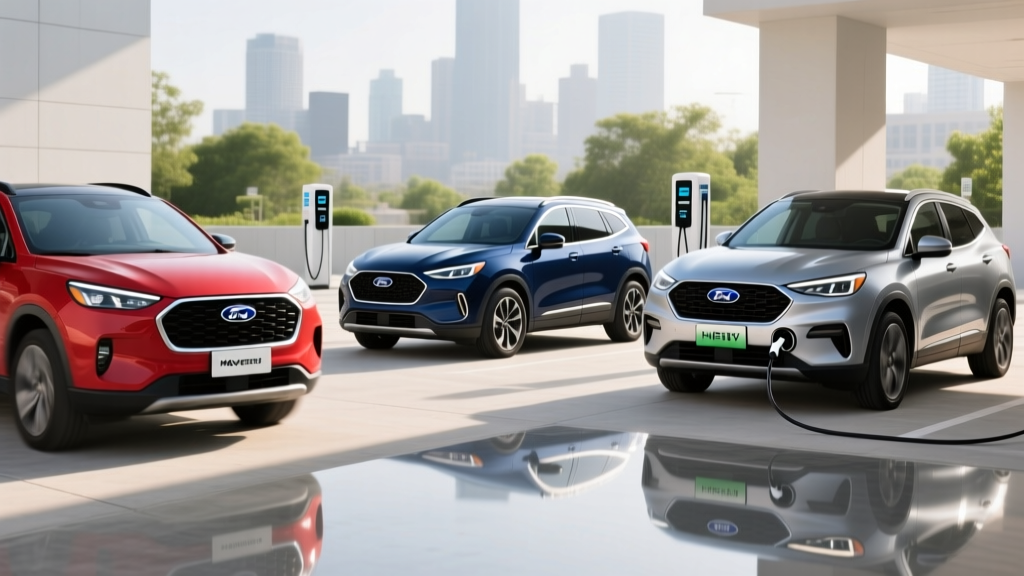
If you're researching a Ford hybrid car in 2026, you're choosing among three fundamentally different powertrains across two nameplates. Ford has consolidated its hybrid offerings around the Maverick compact pickup and the Escape crossover — but within those, the engineering diverges sharply. The Maverick Hybrid is a conventional hybrid (HEV) tuned for city efficiency. The Escape Hybrid is an HEV optimized for all-wheel-drive versatility. And the Escape PHEV is a plug-in hybrid that can commute on electricity alone before its gas engine ever fires.
Understanding which Ford hybrid car fits your driving pattern — and your charging situation — requires parsing real EPA data, not marketing blurbs. Below, we break down every 2026 Ford hybrid with exact MPG figures, battery specs, pricing, and the tax-credit landscape that changes the math.
HEV vs. PHEV: The Critical Distinction
Conventional Hybrid (HEV): The Maverick Hybrid and Escape Hybrid are self-charging systems. A small battery (1.1–1.5 kWh) is replenished by regenerative braking and the gasoline engine. You never plug in. You simply fuel up at any gas station and drive. The electric motor assists the engine and enables low-speed electric-only creeping, but range is unlimited — it's a gas car that happens to be very efficient.
Plug-in Hybrid (PHEV): The Escape PHEV carries a much larger battery (14.4 kWh usable) that you charge via a standard 120V outlet or a 240V Level 2 home charger. It delivers a genuine electric-only range for daily commuting — then operates as a conventional hybrid once the battery depletes. If you can charge at home or work, a PHEV effectively functions as an EV for short trips and a hybrid for long ones.
Spec-by-Spec: Every 2026 Ford Hybrid Car
| Specification | Maverick Hybrid (FWD) | Escape Hybrid (AWD) | Escape PHEV (FWD) |
|---|---|---|---|
| Powertrain Type | HEV | HEV | PHEV |
| Engine | 2.5L I4 Atkinson-cycle | 2.5L I4 Atkinson-cycle | 2.5L I4 Atkinson-cycle |
| Combined Horsepower | 191 hp | 210 hp | 210 hp |
| Battery Capacity | 1.5 kWh (NiMH) | 1.1 kWh (Li-ion) | 14.4 kWh (Li-ion NMC) |
| Drivetrain | FWD (eCVT) | AWD (eCVT) | FWD (eCVT) |
| EPA City MPG | 42 MPG | 42 MPG | 44 MPG (hybrid mode) / 105 MPGe (electric) |
| EPA Highway MPG | 33 MPG | 36 MPG | 37 MPG (hybrid mode) |
| EPA Combined MPG | 37 MPG | 39 MPG | 40 MPG (hybrid mode) |
| Electric-Only Range | N/A | N/A | 37 miles |
| Total Combined Range | ~500 miles | ~520 miles | ~520 miles (37 electric + ~483 gas) |
| Level 1 Charge (120V) | N/A | N/A | ~10–12 hours (full) |
| Level 2 Charge (240V) | N/A | N/A | ~3.5 hours (full) |
| DC Fast Charging | N/A | N/A | Not supported |
| 0–60 mph | ~7.8 sec | ~7.1 sec | ~7.5 sec |
| Towing Capacity | 2,000 lbs | 1,500 lbs | Not rated |
| Base MSRP (2026) | $28,990 | $35,495 | $40,495 |
Fuel Economy Deep Dive: EPA Numbers vs. Real-World MPG
| Model | EPA City | EPA Highway | EPA Combined | Real-World Expectation |
|---|---|---|---|---|
| Maverick Hybrid | 42 | 33 | 37 | 38–44 city; 30–33 highway |
| Escape Hybrid AWD | 42 | 36 | 39 | 40–46 city; 33–36 highway |
| Escape PHEV (hybrid mode) | 44 | 37 | 40 | 42–48 city; 34–37 highway |
Hybrids consistently outperform their EPA city estimates in real-world stop-and-go driving. This is because city driving maximizes regenerative braking, which recaptures kinetic energy and feeds it back into the small battery. On the highway, where regen opportunities are scarce and aerodynamic drag dominates, hybrids lose their advantage and typically match or slightly underperform their EPA highway numbers.
For the Maverick Hybrid, owners regularly report 40–44 MPG in mixed suburban commuting according to fueleconomy.gov user data. The Escape Hybrid AWD delivers similar city results despite its heavier curb weight, thanks to a slightly more aggressive regen profile. The Escape PHEV, when its battery is depleted and it operates purely as a hybrid, posts the highest city numbers of the three — its larger battery buffer allows more aggressive electric assist at low speeds.
Cold-weather caveat: Expect a 10–15% MPG reduction in sustained sub-30°F driving. The engine runs more frequently to provide cabin heat, and battery chemistry slows. This affects all three models proportionally.
Escape PHEV: The Electric Commute Case
The Escape PHEV's 37-mile electric-only range is the defining feature that separates it from Ford's conventional hybrids. For context, the average American one-way commute is roughly 16 miles (U.S. Census Bureau). That means a substantial portion of PHEV owners can complete their daily round-trip commute without burning a drop of gasoline — provided they charge at home overnight.
Charging is straightforward but slow by EV standards. The Escape PHEV uses a standard J1772 connector and accepts up to 3.3 kW on Level 2 (240V). A full charge from empty takes approximately 3.5 hours on a Level 2 home charger, or 10–12 hours on a standard 120V household outlet. There is no DC fast-charging capability — this is typical for PHEVs, whose smaller batteries don't justify the cost and weight of DC hardware.
The 14.4 kWh usable battery is an NMC (nickel manganese cobalt) lithium-ion pack. In daily use, most owners will cycle between 20% and 100% state of charge, which is well within the battery's design envelope. Ford's battery management system maintains thermal conditioning to prevent extreme-temperature degradation.
Ford Hybrid & PHEV Battery Warranty
All 2026 Ford hybrid and PHEV models carry a hybrid battery warranty of 8 years / 100,000 miles (whichever comes first), covering defects and capacity loss below a defined threshold. In states that follow California Air Resources Board (CARB) standards — including CA, NY, MA, WA, OR, CO, and several others — the warranty extends to 10 years / 150,000 miles.
Ford defines the failure threshold as the battery's inability to hold sufficient charge to power the hybrid system, not a specific percentage degradation figure. In practice, Toyota and Ford hybrid batteries from the past decade have demonstrated strong longevity, with most lasting well beyond 150,000 miles before requiring service.
Out-of-warranty replacement cost: Maverick Hybrid battery pack replacement runs approximately $3,000–$4,500 (parts and labor). Escape PHEV battery replacement is higher, estimated at $6,000–$9,000, due to the larger NMC pack. These figures are based on current dealer pricing and may vary.
Pricing, Trims, and Tax Credit Eligibility
Here's where the purchase decision gets interesting — and where the rules require careful reading.
Maverick Hybrid starts at $28,990 for the XL trim with the 2.5L hybrid powertrain and FWD. The XLT Hybrid begins around $31,490, and the Lariat Hybrid tops out near $37,500. The Maverick Hybrid does not qualify for the federal §30D new clean vehicle tax credit because it is a conventional HEV, not a plug-in vehicle. The §30D credit applies exclusively to BEVs and PHEVs with sufficient battery capacity.
Escape Hybrid (conventional HEV, AWD) starts at $35,495 for the Base trim. The Active trim is approximately $37,995, and the Platinum reaches ~$42,500. Like the Maverick, the Escape Hybrid does not qualify for the §30D federal credit.
Escape PHEV starts at $40,495 and is available in Select and Premium trims, reaching approximately $46,500 fully loaded. As a plug-in hybrid with a 14.4 kWh battery, the Escape PHEV may qualify for the federal §30D tax credit — but eligibility is conditional and changes frequently based on battery sourcing and critical mineral requirements.
§30D Federal Tax Credit Checklist (Escape PHEV)
- Vehicle requirement: Must be a new plug-in vehicle with ≥7 kWh battery capacity. The Escape PHEV (14.4 kWh) qualifies on this basis.
- MSRP cap: Vans, SUVs, and pickups are capped at $80,000 MSRP. The Escape PHEV clears this easily.
- Buyer income cap: Modified AGI must not exceed $150,000 (single), $225,000 (head of household), or $300,000 (joint filers).
- Battery sourcing: As of 2026, an increasing percentage of critical minerals and battery components must be sourced from the U.S. or free-trade-agreement countries. The credit amount phases based on compliance — the full $7,500 requires meeting both the critical-minerals and battery-component thresholds. Partial credit ($3,750) is available if only one threshold is met.
- Point-of-sale transfer: Eligible buyers can transfer the credit to the dealer at purchase, reducing the sale price directly rather than waiting for a tax refund.
- Verification: Always confirm current eligibility at IRS.gov's qualifying vehicle list before purchasing. Rules and eligible model lists update regularly.
Bottom line on credits: The Maverick Hybrid and Escape Hybrid receive no federal purchase incentive. The Escape PHEV may qualify for up to $7,500 (or $3,750 partial) depending on current-year sourcing rules and your income. Consult a tax professional for your specific situation.
Who Should Buy Which Ford Hybrid?
Maverick Hybrid — Choose This If:
- You want a compact pickup with best-in-class city fuel economy (42 MPG)
- Your driving is primarily urban and suburban
- You need a truck bed for occasional hauling (2,000-lb tow rating)
- You want the lowest entry price ($28,990) in Ford's hybrid lineup
- You don't want to think about charging — ever
Escape PHEV — Choose This If:
- Your daily round-trip commute is under 37 miles
- You have reliable access to a 120V or 240V outlet at home or work
- You want EV-like daily driving without range anxiety on road trips
- You may qualify for the §30D tax credit, narrowing the price gap with the HEV
- You want the lowest per-mile operating cost for short trips
Hybrid vs. PHEV vs. Full EV — Which Fits You?
Choose the HEV (Maverick or Escape Hybrid) if: You lack home charging access, your daily mileage is unpredictable, or you regularly take long road trips where charging infrastructure is sparse. An HEV requires zero behavioral change from a gas car — just better fuel economy.
Choose the PHEV (Escape PHEV) if: You can charge at home, your commute is under ~35 miles, and you still want the security of a gas engine for weekend road trips. A PHEV gives you the best of both worlds — but only if you actually plug it in. An uncharged PHEV is just a heavier, more expensive hybrid.
Choose a full BEV (e.g., Ford Mustang Mach-E) if: You have reliable home Level 2 charging, your daily driving is under 250 miles, and you want to eliminate gasoline entirely. BEVs offer lower per-mile fuel costs, zero tailpipe emissions, and less maintenance — but require a charging plan for longer trips.
Reliability and Long-Term Ownership Costs
Ford's hybrid powertrains, particularly the 2.5L Atkinson-cycle engine paired with an eCVT (electronically controlled continuously variable transmission), have proven durable. The eCVT is a planetary gearset design — not a belt-driven CVT — which eliminates a common failure point found in some competitors. There are no traditional transmission clutches or bands to wear out.
The hybrid battery packs in the Maverick and Escape HEV are small and lightly stressed. They rarely cycle deeply, which is ideal for longevity. Real-world data from earlier Ford Fusion Hybrid and C-Max Hybrid models (which used similar architectures) shows most batteries lasting 150,000–200,000+ miles before significant degradation. The Escape PHEV's larger NMC pack undergoes deeper daily cycling but benefits from active thermal management.
On the maintenance side, hybrids typically cost less to maintain than conventional gas cars over time. Regenerative braking significantly reduces brake pad wear — many hybrid owners report original brake pads lasting 80,000–100,000 miles. There's no starter motor to fail (the hybrid motor starts the engine), and the Atkinson-cycle engine operates under less thermal stress than a conventional Otto-cycle engine.
Insurance costs for Ford hybrids are generally comparable to their gas counterparts, with the Escape PHEV commanding a modest premium (typically 5–10% higher) due to its higher replacement value and more complex powertrain.
Frequently Asked Questions
How many MPG does the Ford Maverick Hybrid get?
The 2026 Maverick Hybrid is EPA-rated at 42 city / 33 highway / 37 combined MPG. In real-world city and suburban driving, owners frequently report 40–44 MPG. Highway-only driving at 75+ mph may return 29–32 MPG. Cold weather (below 30°F) reduces these figures by roughly 10–15%.
How far can the Escape PHEV go on electric only?
The 2026 Escape PHEV has an EPA-rated electric-only range of 37 miles. In mild weather at moderate speeds (under 50 mph), some drivers report 39–41 miles before the engine engages. At highway speeds or in cold weather, expect 30–34 miles of electric range. Once depleted, the PHEV operates as a conventional hybrid at 40 MPG combined.
Do Ford hybrids need to be plugged in?
No — the Maverick Hybrid and Escape Hybrid are conventional HEVs that charge their own batteries through regenerative braking and the gasoline engine. You never plug them in. Only the Escape PHEV requires plugging in to access its electric-only range. If you don't plug in a PHEV, it still functions perfectly as a hybrid — you just forfeit the electric commuting benefit.
Is the Ford hybrid battery reliable, and what does replacement cost?
Ford's hybrid batteries are covered by an 8-year/100,000-mile warranty (10 years/150,000 miles in CARB states). Real-world longevity typically exceeds 150,000 miles. Out-of-warranty replacement costs approximately $3,000–$4,500 for the Maverick/Escape HEV battery and $6,000–$9,000 for the Escape PHEV battery pack.
Does the Ford Maverick Hybrid qualify for a tax credit?
No. The federal §30D clean vehicle tax credit applies only to plug-in electric vehicles (BEVs and PHEVs). The Maverick Hybrid is a conventional HEV and does not qualify. The Escape PHEV may qualify for up to $7,500 depending on battery sourcing rules, your income, and current IRS eligibility lists. Check IRS.gov before purchasing.
Which Ford hybrid is best for city driving?
The Maverick Hybrid and Escape Hybrid both deliver 42 MPG city, making them equally efficient in stop-and-go traffic. Choose the Maverick if you want a truck bed and a lower starting price. Choose the Escape Hybrid if you prefer a crossover with AWD and more rear-seat passenger space. If your city commute is short and you can charge at home, the Escape PHEV lets you do most city driving on electricity alone.
Can the Escape PHEV DC fast charge?
No. The Escape PHEV supports Level 1 (120V, ~10–12 hours full charge) and Level 2 (240V, ~3.5 hours full charge at 3.3 kW) AC charging only. DC fast charging is not available on any current Ford PHEV. This is standard across the PHEV segment — the smaller battery doesn't justify DC hardware.
Sources: EPA fuel economy data via fueleconomy.gov; Ford Motor Company 2026 specification sheets; IRS §30D credit guidance at irs.gov. Pricing and credit eligibility are subject to change; verify with your dealer and tax professional before purchase.