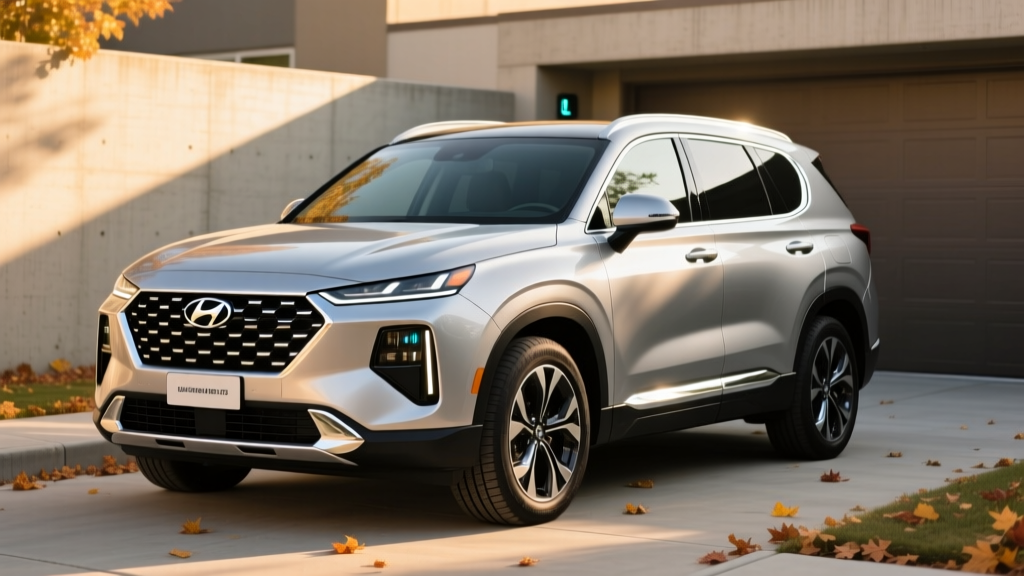
Quick Verdict: Who Is the 2026 Hyundai Santa Fe Hybrid SE FWD For?
The 2026 Hyundai Santa Fe Hybrid SE FWD is the value-oriented entry point into Hyundai's three-row midsize SUV lineup. It pairs a turbocharged 1.6-liter four-cylinder with a single electric motor and a compact lithium-ion battery to deliver 232 combined horsepower and an EPA-estimated 36 MPG combined. At a base MSRP near $39,950 (including destination), the SE FWD trim undercuts all-wheel-drive and higher-trim Santa Fe Hybrids by several thousand dollars while retaining the core efficiency advantage.
This is a conventional hybrid (HEV), not a plug-in hybrid. You never plug it in — it generates electricity through regenerative braking and the gasoline engine. If you want electric-only driving, Hyundai offers the Santa Fe Plug-in Hybrid (PHEV) as a separate model, which we compare below.
The SE FWD is the right choice for buyers who want three-row SUV practicality and strong city fuel economy without the price premium of AWD, the charging logistics of a full EV, or the fuel cost of a gas-only midsize SUV. It's the wrong choice if you need serious towing (the FWD hybrid is limited to 2,000 lbs) or regularly drive on unplowed roads where AWD matters.
EPA Fuel Economy and Real-World MPG
The 2026 Santa Fe Hybrid SE FWD carries an EPA rating of 36 MPG city / 35 MPG highway / 36 MPG combined, according to fueleconomy.gov. These figures are strong for a three-row SUV weighing over 4,300 lbs.
| Cycle | EPA MPG | Real-World Expectation |
|---|---|---|
| City | 36 MPG | 37–40 MPG (hybrids excel in stop-and-go) |
| Highway | 35 MPG | 30–33 MPG (sustained 70+ MPH, headwinds) |
| Combined | 36 MPG | 33–36 MPG (mixed driving) |
For context, the gas-only 2026 Santa Fe with the turbocharged 2.5T engine rates around 23 MPG combined. That's a 57% improvement in fuel economy from the hybrid powertrain, translating to roughly $500–$700 in annual fuel savings for a driver covering 15,000 miles per year at $3.30/gallon regular unleaded.
Powertrain Specs: Engine, Motor, and Combined Output
| Specification | Detail |
|---|---|
| Engine | 1.6L turbocharged inline-4 (Smartstream G1.6 T-GDi) |
| Engine Output | 178 HP / 195 lb-ft torque |
| Electric Motor | 47.7 kW (64 HP) permanent-magnet synchronous |
| Combined System Output | 232 HP / 271 lb-ft torque |
| Transmission | 6-speed automatic |
| Drivetrain | Front-wheel drive (FWD) |
| Hybrid Battery | ~1.49 kWh lithium-ion (non-plug-in) |
| 0–60 MPH | ~7.8 seconds (est.) |
| Towing Capacity | 2,000 lbs (FWD hybrid) |
The 1.6L turbo four-cylinder is paired with a 6-speed automatic transmission — not a CVT. This is a deliberate choice by Hyundai that delivers more natural acceleration feel compared to the rubber-band sensation of continuously variable transmissions found in the Toyota Highlander Hybrid and some competitors. The trade-off is marginally less seamless low-speed electric assist, though in practice the shifts are smooth and well-timed.
The 232 HP combined output is competitive in the segment. The Highlander Hybrid offers 243 HP with standard AWD; the Kia Sorento Hybrid (which shares the same powertrain architecture) produces an identical 232 HP. For daily driving and highway merging, the Santa Fe Hybrid SE FWD feels adequately quick — it's not sporty, but it never feels strained.
HEV vs PHEV: Which Santa Fe Hybrid Should You Consider?
Hyundai sells the Santa Fe in three electrified configurations. Understanding the difference between a conventional hybrid (HEV) and a plug-in hybrid (PHEV) is critical before you buy.
| Attribute | Santa Fe Hybrid (HEV) | Santa Fe Plug-in Hybrid (PHEV) |
|---|---|---|
| Plugs In? | No — self-charging via regen + engine | Yes — Level 2 AC charging |
| Battery Size | ~1.49 kWh | ~13.8 kWh |
| Electric-Only Range | None (EV assist only at low speeds) | ~30 miles EPA est. |
| Combined MPG / MPGe | 36 MPG combined | ~79 MPGe (elec+gas) / ~33 MPG (gas only) |
| Total Range | ~560 miles | ~430 miles (30 elec + 400 gas) |
| DC Fast Charge | N/A | No (AC Level 2 only, ~2 hrs to full) |
| Federal Tax Credit | Not eligible (§30D requires plug-in) | May qualify up to $3,750 (battery sourcing dependent) |
| Starting MSRP (2026) | ~$39,950 (SE FWD) | ~$45,500+ (SEL AWD) |
The HEV makes sense if you lack reliable access to a home charger or workplace charging. The PHEV makes sense if you have a Level 2 charger at home, a short commute (under 30 miles), and want to drive mostly on electricity during the week while keeping gas-engine range for longer weekend trips.
Pricing, Trims, and Tax Credit Eligibility
The 2026 Hyundai Santa Fe Hybrid SE FWD starts at an estimated $39,950 MSRP (including $1,495 destination charge). This is the base hybrid trim and the only one available with front-wheel drive — all other Santa Fe Hybrid trims (SEL, Limited) come with standard HTRAC all-wheel drive, which adds roughly $1,800 to the price and drops combined fuel economy by about 1 MPG.
| Trim | Drivetrain | Est. MSRP | EPA Combined MPG |
|---|---|---|---|
| SE | FWD | $39,950 | 36 MPG |
| SE | AWD (HTRAC) | $41,750 | 35 MPG |
| SEL | AWD (HTRAC) | $44,150 | 35 MPG |
| Limited | AWD (HTRAC) | $48,500 | 35 MPG |
Some states offer additional rebates for hybrids. California's Clean Fuel Reward, for example, has historically offered modest incentives for PHEVs but not conventional HEVs. Check your state energy office or the Alternative Fuels Data Center for current local incentives.
Battery Warranty, Reliability, and Replacement Cost
Hybrid battery reliability has improved dramatically over the past decade. Toyota's early Prius batteries (2001–2005) had notable failure rates, but modern lithium-ion hybrid packs from Hyundai, Toyota, and Honda are engineered for longevity. The Santa Fe's 1.49 kWh battery operates within a conservative state-of-charge window (roughly 40%–80%), which minimizes degradation. Most hybrid batteries now outlast the vehicle itself — failure before 150,000 miles is uncommon based on fleet data.
If the hybrid battery does need replacement outside of warranty, expect a cost of $2,000–$4,000 for the pack plus labor at a dealership. Independent hybrid specialists can often source refurbished packs for $1,500–$2,500. This is far less expensive than a full EV battery replacement ($8,000–$20,000+) because the hybrid pack is much smaller.
The conventional powertrain (engine, transmission) carries Hyundai's standard 5-year / 60,000 mile bumper-to-bumper warranty and 10 year / 100,000 mile powertrain warranty — among the best in the industry. IIHS testing for the Santa Fe has historically yielded Top Safety Pick ratings, though 2026 model-year crash test results should be confirmed as they're published.
Who Should Buy the 2026 Santa Fe Hybrid SE FWD — And Who Shouldn't
Choose the Santa Fe Hybrid SE FWD if:
- You want a three-row SUV under $40K with best-in-class city fuel economy
- You drive mostly in urban or suburban conditions where hybrid efficiency peaks
- You don't have access to home or workplace charging (making a PHEV or BEV impractical)
- You value a conventional automatic transmission over a CVT
- You want Hyundai's 10-year powertrain and hybrid battery warranty
Look elsewhere if:
- You need AWD for snow, mud, or mountain driving (choose the SE AWD or SEL AWD trim)
- You want electric-only commuting (consider the Santa Fe PHEV or a full BEV like the Ioniq 5)
- You tow more than 2,000 lbs regularly (the gas-only Santa Fe 2.5T tows 3,500 lbs)
- You prioritize driving dynamics over efficiency (the Mazda CX-70 or Ford Explorer ST are sportier, thirstier options)
| Attribute | 2026 Santa Fe Hybrid SE FWD | 2026 Toyota Highlander Hybrid LE FWD | 2026 Kia Sorento Hybrid LX FWD |
|---|---|---|---|
| EPA Combined MPG | 36 MPG | 36 MPG | 37 MPG |
| Combined HP | 232 HP | 243 HP | 232 HP |
| Seating | 7 passengers | 8 passengers | 7 passengers |
| Transmission | 6-speed auto | eCVT | 6-speed auto |
| Est. Base MSRP | $39,950 | $41,500 | $38,490 |
| Battery Warranty | 10 yr / 100K mi | 10 yr / 150K mi | 10 yr / 100K mi |
The Highlander Hybrid offers 8-passenger seating and slightly more horsepower, but at a higher starting price and with a CVT that some drivers find less engaging. The Sorento Hybrid is mechanically similar (Hyundai and Kia share the powertrain platform) and undercuts the Santa Fe by ~$1,500, but the Santa Fe offers a more premium interior design and a boxier, more spacious cargo area. Your choice among these three largely comes down to styling preference, third-row space needs, and local dealer pricing.
Ownership Costs: 5-Year Estimate
| Category | Est. Cost |
|---|---|
| Purchase Price (MSRP) | $39,950 |
| Fuel (15K mi/yr, 36 MPG, $3.30/gal) | $10,313 |
| Insurance (avg.) | $8,500 |
| Maintenance (oil, filters, brakes) | $2,800 |
| Estimated Depreciation (5 yr) | -$16,000 |
| Net 5-Year Cost | ~$45,563 |
The Santa Fe Hybrid's 36 MPG combined yields meaningful fuel savings versus the gas-only Santa Fe 2.5T (~23 MPG combined), which would cost approximately $16,000 in fuel over the same 75,000 miles — a $5,700 fuel savings for the hybrid. Maintenance costs are comparable to a conventional gasoline vehicle; the hybrid system adds no routine service items beyond the standard oil changes, tire rotations, and cabin air filter replacements. Regenerative braking extends brake pad life significantly — many hybrid owners report original brake pads lasting 80,000+ miles.
Frequently Asked Questions
How many MPG does the 2026 Hyundai Santa Fe Hybrid SE FWD get?
The EPA rates it at 36 MPG city, 35 MPG highway, and 36 MPG combined. In real-world city driving with frequent stops, many owners report 37–40 MPG thanks to the hybrid system's regenerative braking. Highway driving at sustained speeds above 70 MPH typically yields 30–33 MPG.
Does the Santa Fe Hybrid need to be plugged in?
No. The Santa Fe Hybrid (HEV) is a conventional, self-charging hybrid. It generates electricity through regenerative braking and the gasoline engine. You fuel it like any other car — at a gas station. Only the Santa Fe Plug-in Hybrid (PHEV) requires plugging in.
Hybrid vs PHEV vs EV — which Santa Fe should I buy?
If you have no home charging and want maximum simplicity, choose the HEV (this model). If you have a Level 2 home charger and a short commute, the PHEV lets you drive ~30 miles on electricity daily while keeping gas-engine range for road trips. If you have reliable home charging, a shorter daily commute, and want zero tailpipe emissions, consider a full BEV like the Hyundai Ioniq 5 — but accept the trade-off of needing public charging for longer trips.
Is the Santa Fe Hybrid reliable, and what does a battery replacement cost?
Hyundai's hybrid system has proven reliable in the Tucson Hybrid and Sorento Hybrid, which share the same architecture. The hybrid battery is warrantied for 10 years / 100,000 miles. Out-of-warranty replacement runs $2,000–$4,000 at a dealer, or $1,500–$2,500 from independent hybrid specialists — far less than a full EV battery replacement.
Does the 2026 Santa Fe Hybrid qualify for a federal tax credit?
No. The conventional Santa Fe Hybrid (HEV) does not qualify for the IRS §30D federal clean vehicle tax credit, which requires a plug-in vehicle with a battery of at least 7 kWh. Only the Santa Fe Plug-in Hybrid (PHEV) may qualify, for up to $3,750 depending on battery sourcing and buyer income. Always verify current rules at IRS.gov before purchasing.
Can the Santa Fe Hybrid SE FWD tow?
Yes, but modestly. The FWD hybrid is rated for 2,000 lbs of towing capacity — enough for a small utility trailer or a pair of jet skis, but not a camper or boat. If you need 3,500-lb towing, you'll need the gas-only Santa Fe 2.5T with AWD.