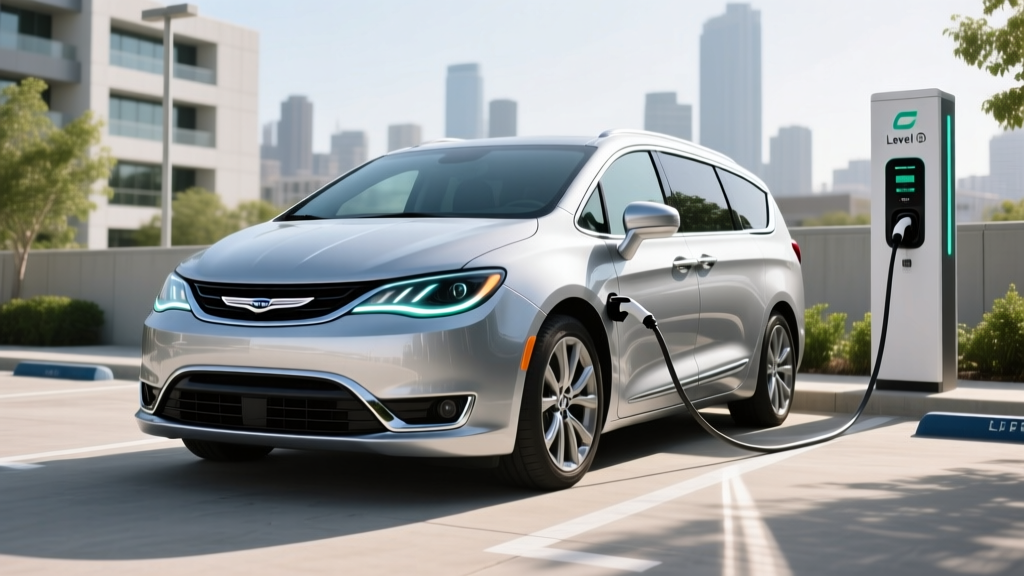
The 2025 Chrysler Pacifica Hybrid Pinnacle sits at a crossroads that few vehicles can claim: it's the only plug-in hybrid minivan on the US market, and in its top-tier Pinnacle trim, it's also the most luxurious. For families who need three rows of seating, want to do school runs and grocery trips on battery power alone, but can't commit to a full battery-electric vehicle (BEV) due to road-trip needs or charging-access constraints, the Pacifica Hybrid Pinnacle is essentially a segment of one.
But does the math actually work? Below, we break down the real-world efficiency, the 16-kWh battery system, charging logistics, federal tax-credit status, and long-term ownership costs so you can decide whether Chrysler's flagship PHEV minivan earns its ~$54,000 sticker.
HEV vs PHEV: What the Pacifica Hybrid Actually Is
Before diving into specs, a critical distinction. The Pacifica Hybrid is a plug-in hybrid electric vehicle (PHEV), not a conventional hybrid (HEV). Here's why that matters:
Conventional Hybrid (HEV)
- Small battery (~1–2 kWh), charged only by the engine and regenerative braking
- No plug — you never charge it externally
- Electric motor assists the gas engine; no meaningful electric-only driving
- Example: Toyota Sienna Hybrid (36 MPG combined, no plug)
Plug-In Hybrid (PHEV)
- Larger battery (Pacifica: 16 kWh), charged via plug or engine
- Plug in at home or public chargers for full battery benefit
- Drives on electricity alone for a meaningful range before the gas engine kicks in
- Example: Chrysler Pacifica Hybrid (32 mi electric-only, then 30 MPG gas)
If you never plug the Pacifica Hybrid in, it functions as a heavy conventional hybrid — you'll still get roughly 30 MPG combined, but you're carrying around a 16-kWh battery and two electric motors you're not leveraging. Plugging in is the entire point.
EPA MPG, MPGe, and Electric-Only Range
The Pacifica Hybrid's efficiency is measured two ways by the EPA: MPGe when operating on electricity + gasoline combined, and standard MPG once the battery is depleted.
| Metric | EPA Rating | Real-World Expectation |
|---|---|---|
| Combined MPGe (charge-sustaining + electric) | 82 MPGe | 70–85 MPGe depending on plug-in frequency |
| Gas-only combined MPG (battery depleted) | 30 MPG | 27–31 MPG (hybrids often beat EPA in city) |
| Gas-only city MPG | 29 MPG | 28–32 MPG (regen braking helps in stop-and-go) |
| Gas-only highway MPG | 30 MPG | 26–29 MPG (less regen benefit at sustained speed) |
| Electric-only range | 32 miles | 25–30 mi (highway/cold); 30–34 mi (city/mild weather) |
| Total combined range (full tank + full charge) | ~460 miles | ~400–450 mi real-world |
The 32-mile electric range is the Pacifica Hybrid's killer stat for families. The average American drives roughly 37 miles per day, and most family minivan duty — school drop-offs, grocery runs, extracurriculars — falls well within that envelope. Plug in overnight at a Level 2 home charger, and the majority of your daily miles cost you nothing in gasoline.
Powertrain Specs: Engine, Motors, and Horsepower
| Specification | 2025 Pacifica Hybrid Pinnacle |
|---|---|
| Engine | 3.6L Pentastar V6 (Atkinson cycle) |
| Electric Motors | Two permanent-magnet motors integrated into eFlite CVT |
| Combined System Horsepower | 260 hp |
| Transmission | eFlite electrically variable transmission (single-speed, no traditional gears) |
| Drivetrain | Front-wheel drive (FWD only — no AWD on Hybrid) |
| Battery Capacity | 16 kWh (lithium-ion, NMC chemistry) |
| Usable Battery Capacity | ~13 kWh (buffer protects longevity) |
| 0–60 mph | ~7.1 seconds |
| Fuel Tank | 14.5 gallons |
| Towing Capacity | Not rated for towing (gas Pacifica: 3,600 lbs) |
The Atkinson-cycle V6 sacrifices some peak output for thermal efficiency, but the two electric motors fill in torque immediately off the line. The result is a minivan that feels surprisingly eager from stoplights and merges confidently at highway speed. The eFlite transmission uses a planetary gearset rather than a traditional belt-and-pulley CVT, which eliminates the "rubber-band" drone common in competitors. One notable limitation: the Pacifica Hybrid is FWD only. If you need all-wheel drive, you'll have to look at the gas Pacifica or the Toyota Sienna Hybrid (which offers AWD but is a conventional HEV, not a PHEV).
Charging: Level 1, Level 2, and the DC Fast-Charging Gap
The Pacifica Hybrid uses a J1772 connector for AC charging. Here's what charging looks like in practice:
| Charging Level | Power | Time (0–100%) | Practical Use |
|---|---|---|---|
| Level 1 (120V household outlet) | ~1.4 kW | ~14 hours | Emergency/trickle top-up only |
| Level 2 (240V, included cord at 3.3 kW) | 3.3 kW | ~5 hours | Overnight home charging (standard) |
| Level 2 (240V wall charger at 6.6 kW) | 6.6 kW | ~2.5 hours | Upgraded home/public Level 2 stations |
| DC Fast Charging | — | Not supported | N/A — the Pacifica Hybrid has no DC fast-charge port |
Critical note on DC fast charging: The Pacifica Hybrid cannot DC fast charge. There is no CCS or CHAdeMO port for DC charging. This is typical for PHEVs — the 16-kWh battery is small enough that Level 2 charging fills it in a few hours, and Chrysler has opted not to add the cost and weight of DC hardware. For daily use, a Level 2 home charger is all you need. Plug in when you get home, wake up to a full 32-mile electric range.
The onboard charger is rated at 6.6 kW (up from 3.3 kW on pre-2021 models). On a 240V/30A home circuit, you'll replenish the full battery in roughly 2.5 hours — fast enough that you could top up mid-day if needed.
2025 Pacifica Hybrid Pinnacle Pricing and Tax-Credit Eligibility
| Trim | MSRP (incl. destination) | Federal §30D Credit Eligibility |
|---|---|---|
| Pacifica Hybrid Select | ~$47,695 | Eligible — up to $7,500 (subject to sourcing/income rules) |
| Pacifica Hybrid Pinnacle | ~$54,095 | Eligible — up to $7,500 (subject to sourcing/income rules) |
- Vehicle MSRP cap: Vans/SUVs/trucks must be ≤$80,000 (Pacifica qualifies)
- Buyer income cap: AGI ≤$150,000 (single) / ≤$300,000 (joint) / ≤$225,000 (head of household)
- Battery sourcing: Critical minerals and battery components must meet phased-in percentage thresholds per IRS guidelines — verify current-year Pacifica eligibility on IRS.gov before purchase
- Point-of-sale transfer: You can transfer the credit to the dealer for an immediate price reduction at purchase
- Battery capacity: Must be ≥7 kWh (Pacifica's 16 kWh qualifies)
The Pacifica Hybrid has historically qualified for the full $7,500 federal tax credit, but the Inflation Reduction Act's battery-sourcing requirements tighten annually. Always verify current eligibility on the IRS Clean Vehicle credit page before committing. If eligible, the Pinnacle's effective price drops from ~$54,095 to ~$46,595 — a significant offset. Some states (California, Colorado, New York, and others) offer additional PHEV rebates that can stack on top; check your state energy office for current programs.
Battery Warranty, Degradation, and Replacement Cost
- Federal emissions warranty: 8 years / 100,000 miles (10 years / 150,000 miles in CARB states: CA, CO, CT, ME, MD, MA, NJ, NY, OR, RI, VT, WA)
- Capacity retention threshold: Chrysler warrants the battery will retain sufficient capacity to deliver at least 70% of its original electric range during the warranty period
- Powertrain warranty: 5 years / 60,000 miles
Is the Pacifica Hybrid reliable? The Pacifica Hybrid's powertrain has been in production since the 2017 model year, and early recall issues (primarily related to a 12V battery fire risk addressed in 2020–2021 recalls) have been resolved. The high-voltage battery pack uses proven NMC (nickel-manganese-cobalt) lithium-ion chemistry. Real-world degradation data from long-term owners suggests roughly 5–8% capacity loss over the first 5 years / 60,000 miles — meaning your 32-mile electric range might drop to ~29–30 miles after half a decade. This is well within the warranty threshold.
Battery replacement cost: Out of warranty, a Pacifica Hybrid high-voltage battery replacement runs approximately $6,000–$8,500 (parts + labor) based on dealer estimates. This is a significant sum, but the 8–10 year warranty coverage and gradual degradation curve mean most owners will sell or trade the vehicle before facing this expense. The hybrid system's electric motors and eFlite transmission carry separate warranty coverage and have proven durable in service.
Who Should Buy the Pacifica Hybrid Pinnacle?
Choose the Pacifica Hybrid Pinnacle if:
- You need three rows + a plug-in electric drivetrain (it's the only PHEV minivan available)
- Your daily driving is under 30 miles and you can charge at home overnight
- You take road trips where a full EV's charging logistics don't work for your family
- You want luxury minivan features (quilted Nappa leather, 360° camera, dual-pane sunroof) in a PHEV
Choose a full BEV (e.g., Kia EV9, Tesla Model X) if:
- Your daily mileage regularly exceeds 40+ miles and you want to eliminate gas entirely
- You have reliable home and/or workplace charging and access to DC fast-charging corridors
- You want lower long-term maintenance (no oil changes, no gas engine)
Choose the Toyota Sienna Hybrid (HEV) if:
- You can't charge at home and want hybrid efficiency without plugging in
- You need AWD (available on Sienna Hybrid, not on Pacifica Hybrid)
- You want higher combined MPG (36 MPG) without managing plug-in routines
Pros
- Only PHEV minivan — 32 mi electric covers most family daily trips
- 82 MPGe when charged regularly; 30 MPG even without plugging in
- Pinnacle trim is genuinely luxurious for a minivan
- Federal tax credit eligible — up to $7,500 off
- No range anxiety — gas engine covers long trips seamlessly
- Stow 'n Go second-row seats fold flat (unique among PHEVs)
Cons
- FWD only — no AWD option on the Hybrid
- No DC fast charging — Level 2 only
- Not rated for towing (gas Pacifica tows up to 3,600 lbs)
- Pinnacle MSRP crosses $54k before incentives
- Third-row space is tighter than Honda Odyssey or Toyota Sienna
- Infotainment system trails competitors in responsiveness
Frequently Asked Questions
How many MPG does the 2025 Chrysler Pacifica Hybrid get?
The EPA rates the Pacifica Hybrid at 30 MPG combined (29 city / 30 highway) when running on gasoline after the battery is depleted. When factoring in electric-only driving, the combined rating is 82 MPGe. In real-world driving, owners frequently report 31–34 MPG in city conditions thanks to regenerative braking, with highway MPG closer to 27–29.
How far can the Pacifica Hybrid go on electric power alone?
The EPA rates the Pacifica Hybrid at 32 miles of electric-only range. Real-world results vary: expect 25–28 miles in cold weather or at highway speeds, and up to 34 miles in mild weather on flat city routes. The vehicle seamlessly switches to hybrid mode once the battery is depleted — no driver action required.
Does the Pacifica Hybrid qualify for the $7,500 federal tax credit?
The Pacifica Hybrid has historically qualified for the full $7,500 §30D Clean Vehicle Credit. However, eligibility depends on your income (AGI caps apply), the vehicle's battery-component and critical-minerals sourcing percentages (which shift annually), and the MSRP cap ($80,000 for vans — the Pacifica qualifies). Verify current-year eligibility on the IRS website before purchasing. The credit can be transferred to the dealer at point of sale for an immediate price reduction.
Is the Pacifica Hybrid reliable, and what does a battery replacement cost?
The Pacifica Hybrid powertrain has been in production since 2017 with iterative improvements. Early-model recalls have been addressed. The high-voltage battery is covered by an 8-year/100,000-mile warranty (10yr/150,000mi in CARB states) with a 70% capacity-retention guarantee. Real-world degradation averages 5–8% over 5 years. Out-of-warranty battery replacement costs approximately $6,000–$8,500 at a dealer, though most owners will not face this expense within the warranty window.
Hybrid vs PHEV vs EV — which is right for my family?
A conventional hybrid (HEV) like the Toyota Sienna Hybrid is best if you can't charge at home and want set-it-and-forget-it efficiency (36 MPG). A PHEV like the Pacifica Hybrid is ideal if you can charge at home and want electric-only daily driving with a gas-engine safety net for road trips. A full BEV like the Kia EV9 or Tesla Model X makes sense if you want zero gasoline, have reliable charging access, and are comfortable planning longer trips around DC fast-charging stops. The PHEV is the bridge option — maximum flexibility with minimum behavioral change.
Can I charge the Pacifica Hybrid at a public DC fast charger?
No. The Pacifica Hybrid does not support DC fast charging. It uses a J1772 connector for Level 1 (120V) and Level 2 (240V) AC charging only. At a 6.6 kW public Level 2 station, a full charge takes roughly 2.5 hours. For most owners, overnight home charging on a 240V outlet is the primary charging method.
Does the Pacifica Hybrid have all-wheel drive?
No. The Pacifica Hybrid is front-wheel drive only across all trims, including the Pinnacle. If AWD is essential, the gas-powered Pacifica offers an AWD option (not available on the Hybrid), and the Toyota Sienna Hybrid offers AWD (but as a conventional HEV, not a PHEV).