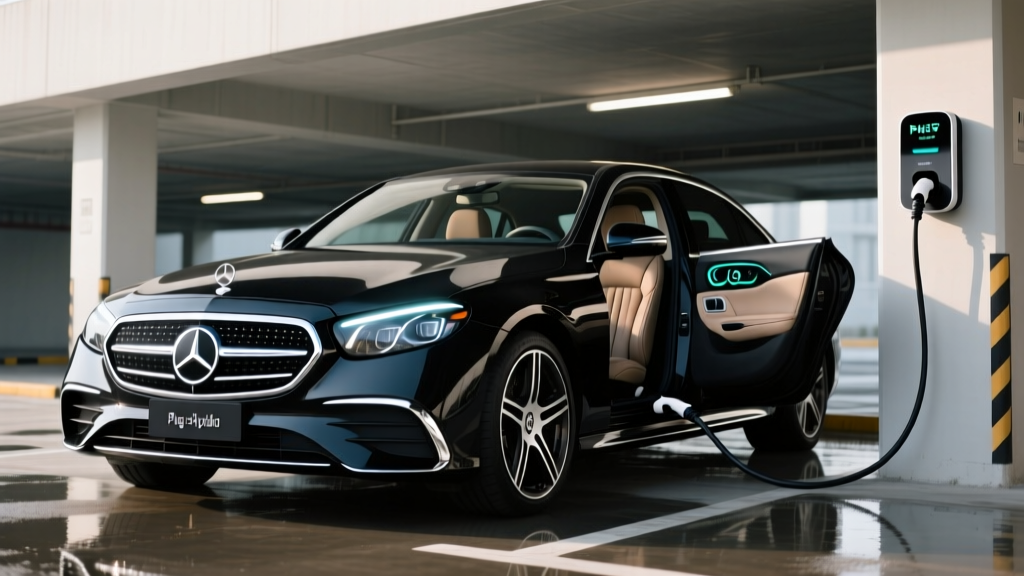
The 2026 Mercedes-Benz E-Class has long been the benchmark midsize luxury sedan, but the electrified variant — the E 350e 4MATIC plug-in hybrid — is where efficiency meets executive comfort. Unlike a conventional hybrid that relies solely on regenerative braking to charge a small battery, the E 350e is a true plug-in hybrid (PHEV), offering substantial electric-only driving before its turbocharged four-cylinder engine ever fires up. For buyers weighing the Mercedes E-Class hybrid against full EVs or gas-only luxury sedans, this guide breaks down every number that matters.
HEV vs PHEV: What the Mercedes E-Class Hybrid Actually Is
Mercedes-Benz does not currently sell a conventional hybrid (HEV) version of the E-Class in the United States. The electrified E-Class is offered exclusively as the E 350e 4MATIC PHEV. Here's what that distinction means in practice:
| Feature | Conventional Hybrid (HEV) | Mercedes E 350e (PHEV) |
|---|---|---|
| Plug-in charging | No — charges via regen/engine | Yes — plug in at home or public stations |
| Battery size | 1–2 kWh | 25.4 kWh (total) / ~21 kWh usable |
| Electric-only range | 0–1 mile at low speed | EPA-est. 48 miles |
| Fuel savings potential | Modest (5–15% vs gas) | High if charged daily (50–80% less gas) |
| Tax credit eligible | No | Potentially up to $3,750 (§30D) |
If you've searched for a "Mercedes E-Class hybrid" expecting a self-charging HEV like a Toyota Camry Hybrid, know that Mercedes has gone all-in on the PHEV architecture for this model. The larger battery and plug-in capability are the entire value proposition.
Powertrain and Performance Specs
| Specification | 2026 Mercedes E 350e 4MATIC |
|---|---|
| Engine | 2.0L turbocharged inline-4 |
| Engine output | 201 HP / 236 lb-ft torque |
| Electric motor | 127 HP / 325 lb-ft (integrated in transmission) |
| Combined system output | 308 HP / 516 lb-ft torque |
| Transmission | 9-speed automatic (9G-TRONIC) |
| Drivetrain | 4MATIC all-wheel drive |
| 0–60 mph | 5.9 seconds (mfg. estimate) |
| Battery (total / usable) | 25.4 kWh / ~21 kWh |
| Battery chemistry | NMC (nickel manganese cobalt) |
| Base MSRP | $68,100 (excl. destination) |
The E 350e pairs a refined 2.0L turbo four with a permanently excited synchronous motor housed within the transmission housing. The combined 308 HP and massive 516 lb-ft of torque deliver brisk acceleration — the electric motor's instant torque fills the low-RPM gap that turbo lag typically creates. Mercedes estimates a 0–60 mph time around 5.9 seconds, which feels quicker in practice thanks to the electric motor's immediate shove off the line.
Electric-Only Range and Total Driving Range
EPA-estimated electric-only range: 48 miles
EPA-estimated combined range (electric + gas): ~430 miles
Real-world electric range expectation: 38–45 miles in mixed driving; 30–35 miles at sustained highway speeds above 70 mph or in cold weather below 40°F.
The E 350e's 48-mile EPA electric range is among the best in the luxury PHEV segment. Most daily commutes in the U.S. average under 40 miles round-trip, meaning many owners could drive weeks without the gasoline engine engaging — provided they charge at home nightly.
When the battery depletes, the E 350e operates as a conventional hybrid, blending engine and motor power. The 17.4-gallon fuel tank extends total range well beyond 400 miles, eliminating any range anxiety for road trips where charging stops aren't practical.
Fuel Economy: EPA MPG and Real-World Expectations
| Metric | EPA Estimate | Real-World Expectation |
|---|---|---|
| Combined MPGe (charge-sustaining + electric) | 68 MPGe | 55–65 MPGe with regular charging |
| Gas-only combined MPG (battery depleted) | 29 MPG | 26–28 MPG highway; 30–32 MPG city |
| City MPG (gas-only) | 30 MPG | 28–31 MPG |
| Highway MPG (gas-only) | 28 MPG | 25–27 MPG at 75+ mph |
| Electric efficiency | 38 kWh/100 mi | 35–42 kWh/100 mi depending on conditions |
The critical number for PHEV buyers is charge-sustaining MPG — how efficiently the car runs once the battery is depleted. At 29 MPG combined, the E 350e is respectable for a 4,600-lb luxury sedan but not class-leading. A gas-only E 350 4MATIC returns roughly 26 MPG combined, so even without plugging in, the PHEV saves a modest amount at the pump.
The real savings come from maximizing electric driving. If your commute is under 45 miles and you charge nightly, you might use only 2–3 gallons of gas per week. According to fueleconomy.gov, the E 350e's combined MPGe of 68 reflects a blend of electric and gasoline operation — but your actual fuel consumption depends entirely on your charging habits.
Charging: Battery Size, Speeds, and Home Setup
The E 350e's 25.4 kWh battery pack is one of the largest in any luxury PHEV sedan, and it unlocks both the generous electric range and DC fast-charging capability — a feature many competitors lack.
| Charging Level | Power | Time (10–100%) | Notes |
|---|---|---|---|
| Level 1 (120V household) | ~1.4 kW | ~18 hours | Emergency/top-up only |
| Level 2 (240V home/public) | 7.4 kW (onboard charger) | ~3.5 hours | Ideal for overnight home charging |
| DC Fast Charge (CCS) | Up to 55 kW peak | ~30 min (10–80%) | Optional DC capability; rare on PHEVs |
The 7.4 kW onboard AC charger is adequate for overnight replenishment on a Level 2 home station. Most owners will plug in after work and wake to a full battery. The available 55 kW DC fast-charging capability (via CCS connector) is a genuine differentiator: it lets you add ~30 miles of electric range during a 20-minute highway rest stop. However, this is an option on some trims — confirm its inclusion when ordering.
One practical note: at 55 kW peak, the E 350e's DC charging curve tapers significantly above 80% state of charge (SoC), which is standard for NMC lithium-ion packs. Charging from 80–100% on DC can take nearly as long as the 10–80% portion. For battery longevity, routinely charging to 80% and using the scheduled departure timer to reach 100% only when needed is a sound strategy.
Pricing, Trims, and Federal Tax Credit Eligibility
The 2026 E 350e 4MATIC starts at $68,100 (excluding $1,150 destination), placing it roughly $3,500 above the gas-only E 350 4MATIC. That premium buys the larger battery, electric motor, and the ability to drive up to 48 miles without gasoline.
Does the Mercedes E 350e qualify for the federal EV tax credit (§30D)?
- Credit amount: Up to $3,750 (partial credit — battery sourcing requirements determine exact amount)
- MSRP cap: Sedan cap is $55,000 — the E 350e at $68,100 exceeds this cap
- Result: The E 350e does NOT qualify for the federal §30D new clean vehicle credit due to exceeding the $55,000 MSRP cap for sedans
- State incentives: Some states (CA, CO, NY, MA) offer separate PHEV rebates of $1,000–$4,000 that may apply regardless of MSRP caps — check your state's clean vehicle program
- Point-of-sale transfer: Not applicable if the vehicle doesn't qualify
Source: IRS §30D Clean Vehicle Credit rules. Tax credit eligibility is subject to change. Consult a tax professional for your specific situation.
The MSRP cap is the dealbreaker here. Under current IRS rules, sedans must be priced at or below $55,000 to qualify for the federal credit. The E 350e's starting price eliminates it from federal incentive eligibility, though state-level programs may partially offset the cost. Buyers in states with robust PHEV incentives should investigate local programs before purchase.
Battery Warranty, Reliability, and Replacement Cost
High-voltage battery warranty: 8 years / 62,000 miles (whichever comes first)
Capacity retention guarantee: Mercedes-Benz warrants the battery against defects and excessive capacity loss (typically below 70% state of health) during the warranty period.
Powertrain warranty: 4 years / 50,000 miles
Estimated out-of-warranty battery replacement: $8,000–$14,000 (based on current PHEV pack pricing for similar NMC packs in the 20–25 kWh range)
Mercedes-Benz has been building PHEVs since the W212-generation E-Class in 2015, and the high-voltage battery technology is now in its third generation. NMC chemistry in this application is managed conservatively — the usable buffer (roughly 4 kWh reserved at the top and bottom of the pack) reduces stress on cells and slows degradation.
Real-world data from earlier Mercedes PHEV models suggests 8–12% capacity loss over 5 years / 60,000 miles under normal use. Cold-climate owners who frequently DC fast-charge may see slightly higher degradation. The 8-year warranty provides meaningful protection, and most PHEV batteries outlast the warranty period with 75–85% capacity retention at 10 years.
For reliability broadly, the E-Class platform carries average-to-above-average ratings from major evaluators. The complexity of combining a turbocharged engine, electric motor, and high-voltage system means more potential failure points than a pure EV or a simple gas car — but Mercedes' dealer network and warranty coverage mitigate this risk for the original owner. Check IIHS and NHTSA for the latest safety test results.
Who Should Choose the E 350e vs a Full EV or Gas E-Class?
Choose the Mercedes E 350e PHEV if:
- Your daily commute is under 45 miles round-trip and you have home Level 2 charging
- You take 4+ road trips per year and don't want to plan around DC fast-charging stops
- You want luxury sedan refinement with significantly reduced fuel costs
- Your household has one car and it must do everything — commuting, road trips, and errands
Choose a full EV (e.g., Mercedes EQE, BMW i5, Tesla Model S) if:
- You have reliable home charging and your trips rarely exceed 250 miles without a stop
- You want minimal maintenance (no oil changes, no spark plugs, fewer moving parts)
- You want to maximize fuel cost savings and eliminate gasoline entirely
Choose the gas-only E 350 4MATIC if:
- You cannot install a Level 2 home charger (apartment, no garage, electrical panel limitations)
- You drive over 20,000 miles/year, mostly highway, where PHEV electric-range benefits diminish
- You want the lowest purchase price and simplest powertrain
The E 350e occupies a specific niche: luxury sedan buyers who want electric commuting without sacrificing the go-anywhere flexibility of a gasoline engine. If you can charge at home and your weekday driving stays within the 48-mile electric envelope, the E 350e effectively functions as an EV Monday through Friday and a grand tourer on weekends.
Pros and Cons at a Glance
Pros
- 48-mile EPA electric range covers most daily commutes
- DC fast charging available (55 kW) — rare among PHEVs
- 308 HP combined with seamless engine/motor transitions
- Over 430 miles total range eliminates road-trip anxiety
- Genuine luxury: MBUX infotainment, air suspension available, superb cabin materials
- 4MATIC AWD standard for all-weather capability
Cons
- $68,100 MSRP exceeds federal tax credit sedan cap ($55,000)
- 29 MPG gas-only is unremarkable for a PHEV in this price range
- Trunk space reduced by battery placement (~13.6 cu ft vs 15.9 cu ft in gas model)
- DC fast charging is optional, not standard on all trims
- Heavier than gas E-Class (~4,600 lbs) affects tire wear and braking distances
- No conventional HEV option for buyers who can't plug in
Frequently Asked Questions
How many MPG does the Mercedes E-Class hybrid get?
The 2026 E 350e 4MATIC is rated at 68 MPGe combined (blending electric and gasoline operation) and 29 MPG combined when running on gasoline alone after the battery is depleted. In real-world driving, expect 26–28 MPG on the highway and 30–32 MPG in city driving in gas-only mode. Your actual fuel consumption depends heavily on how often you charge — daily charging can reduce gasoline use by 60–80%.
How far can the E 350e go on electric only?
The EPA rates the E 350e at 48 miles of electric-only range. In real-world conditions, expect 38–45 miles in mixed driving, dropping to 30–35 miles at sustained highway speeds above 70 mph or in temperatures below 40°F. This range is sufficient for most daily commutes without the gasoline engine engaging.
Does the Mercedes E-Class hybrid qualify for a tax credit?
The E 350e does not qualify for the federal §30D clean vehicle credit because its $68,100 MSRP exceeds the $55,000 sedan cap set by the IRS. However, state-level incentives may apply — states like California (CVRP), Colorado, and New York offer separate PHEV rebates that may not enforce the same MSRP limits. Always verify current eligibility with your state's clean vehicle program and consult a tax professional.
Is the E 350e PHEV reliable, and what does battery replacement cost?
Mercedes-Benz's third-generation PHEV system benefits from a decade of development. The high-voltage battery is warrantied for 8 years / 62,000 miles against defects and excessive capacity loss. Out-of-warranty replacement is estimated at $8,000–$14,000 based on current NMC pack pricing. Most PHEV batteries retain 75–85% capacity at the 10-year mark under normal use, and the conservative buffer management in Mercedes' system helps prolong cell life.
Can I charge the E 350e at home on a regular outlet?
Yes, but slowly. A standard 120V Level 1 outlet delivers roughly 1.4 kW, requiring about 18 hours for a full charge — impractical for daily use. A 240V Level 2 home charger at 7.4 kW fully replenishes the battery in approximately 3.5 hours, making overnight charging convenient. We strongly recommend installing a Level 2 station (typically $500–$2,000 including electrician labor) for any PHEV owner.
Hybrid vs PHEV vs EV — which is right for me?
A conventional hybrid (HEV) is best if you can never plug in and want modest fuel savings. A PHEV like the E 350e is ideal if you can charge at home and want electric commuting with gas-engine flexibility for longer trips. A full battery-electric vehicle (BEV) suits buyers who want zero tailpipe emissions, minimal maintenance, and can rely on DC fast-charging networks for road trips. The PHEV is the bridge solution — it demands less lifestyle change than a BEV while delivering far greater fuel savings than an HEV.