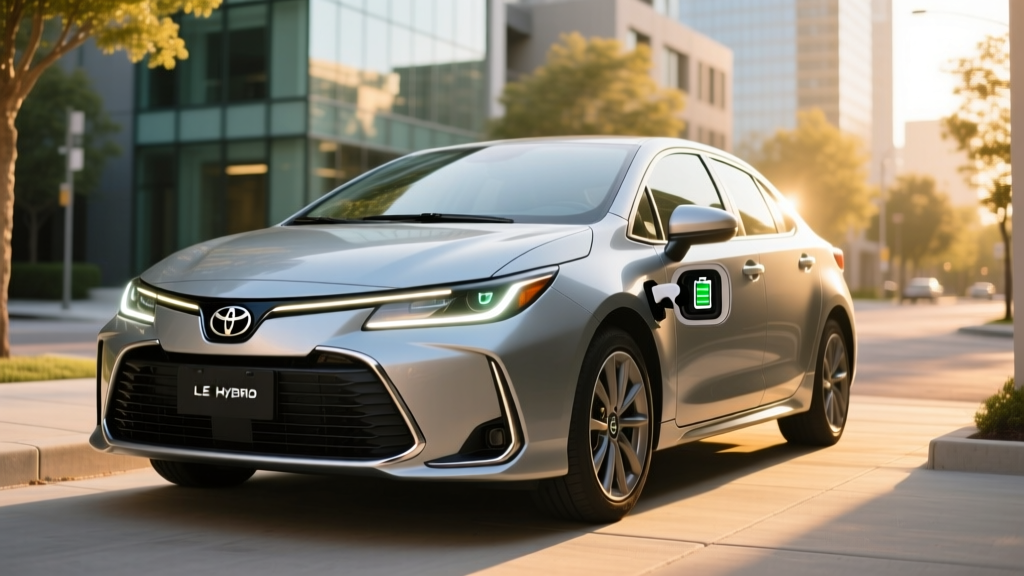
The Toyota Corolla Hybrid has quietly become one of the most efficient vehicles sold in America without requiring a single lifestyle change from its owner. No plugs, no range anxiety, no charging apps — just a conventional hybrid sedan that squeezes extraordinary mileage from every gallon. The 2026 Toyota Corolla LE Hybrid continues that formula with Toyota's fifth-generation hybrid system, a starting price under $25,000, and EPA-estimated fuel economy that rivals plug-in vehicles on a cost-per-mile basis.
But the LE trim sits at the base of the Corolla Hybrid lineup, and that raises practical questions: What do you sacrifice at the entry level? Does the real-world MPG match the sticker? And with federal tax credits reshaping the EV landscape, does a conventional hybrid still make financial sense in 2026?
We've analyzed EPA data, real-world driving reports, and Toyota's current powertrain specifications to give you the complete picture.
2026 Corolla LE Hybrid: Key Specifications at a Glance
| Specification | 2026 Toyota Corolla LE Hybrid |
|---|---|
| Powertrain | 1.8L 4-cylinder + 2 electric motors (5th-gen hybrid) |
| Combined Horsepower | 138 hp (net system) |
| Transmission | Electronic Continuously Variable (eCVT) |
| Drivetrain | Front-Wheel Drive (AWD-e available on SE/XLE) |
| EPA City MPG | 53 mpg |
| EPA Highway MPG | 46 mpg |
| EPA Combined MPG | 50 mpg |
| Fuel Tank Capacity | 11.4 gallons |
| Total Range | ~570 miles |
| Hybrid Battery | Lithium-ion, ~1.3 kWh (self-charging, no plug) |
| 0–60 mph | ~9.2 seconds |
| Base MSRP (LE trim) | $24,795 (incl. destination) |
| Hybrid Battery Warranty | 10 years / 150,000 miles |
| Federal Tax Credit | Not eligible (§30D requires plug-in capability) |
Real-World Fuel Economy: Does 50 MPG Hold Up?
The EPA rates the 2026 Corolla LE Hybrid at 53 city / 46 highway / 50 combined mpg, according to fueleconomy.gov. That city-heavy advantage is the hallmark of Toyota's hybrid system: regenerative braking recovers energy in stop-and-go traffic, and the electric motor handles low-speed propulsion where gasoline engines are least efficient.
- City / suburban driving: 48–55 mpg (many owners exceed the EPA city estimate in moderate climates)
- Highway cruising (70–75 mph): 42–46 mpg (aerodynamic drag and sustained engine load reduce the hybrid advantage)
- Cold weather (below 30°F): 40–45 mpg combined (engine runs longer for cabin heat and battery warm-up)
- Mixed daily commute: 47–52 mpg is typical for most owners
Hybrids often exceed their EPA city estimates because the test cycle doesn't fully capture how aggressively regenerative braking can recover energy in real traffic. Conversely, highway mileage tends to fall short because the gasoline engine carries most of the load at sustained speeds. If your commute is 80% city and suburban, you'll likely see numbers at or above the 50 mpg combined sticker. If you're primarily a highway driver, expect mid-40s.
Hybrid (HEV) vs. Plug-In Hybrid (PHEV): Where the Corolla Fits
This is a critical distinction that trips up many shoppers. The Corolla Hybrid is a conventional hybrid (HEV) — it has no plug, no charging port, and no electric-only driving range to speak of. The small lithium-ion battery (~1.3 kWh) recharges itself through regenerative braking and the gasoline engine. You fuel it exactly like any other car.
| Feature | HEV (Corolla Hybrid) | PHEV (e.g., Prius Prime) | BEV (e.g., Tesla Model 3) |
|---|---|---|---|
| Plug-in Charging | No | Yes (Level 1/2) | Yes (Level 1/2/DC) |
| Electric-Only Range | ~1 mile at low speed | 35–44 miles | 250–350+ miles |
| Total Range | ~570 miles | ~440 miles (EV + gas) | 250–350 miles |
| Refuel / Recharge | Gas station only | Gas + plug | Plug only |
| Federal Tax Credit (§30D) | Not eligible | Up to $7,500 (if eligible) | Up to $7,500 (if eligible) |
| Home Charger Needed | No | Recommended | Essential |
| Typical Starting Price | ~$24,800 | ~$33,000 | ~$38,000+ |
Toyota does not offer a Corolla Plug-In Hybrid in the United States. If you want a Toyota PHEV, the Prius Prime is the closest alternative, offering up to 44 miles of electric-only range and eligibility for the federal §30D tax credit — but at a starting price roughly $8,000–$9,000 higher than the Corolla LE Hybrid.
Powertrain Deep Dive: Toyota's Fifth-Generation Hybrid System
The 2026 Corolla LE Hybrid uses Toyota's latest iteration of its Hybrid Synergy Drive, pairing a 1.8-liter Atkinson-cycle four-cylinder engine with two motor-generators and a planetary gearset that functions as an eCVT. Net system output is 138 horsepower, which is modest but adequate for a 3,050-pound sedan.
Here's what the fifth-generation system improves over earlier Corolla Hybrids:
- Lighter, more compact transaxle: Reduced internal friction losses by approximately 10%
- Higher-output electric motors: Stronger low-speed torque delivery for more responsive acceleration from stops
- Updated lithium-ion battery pack: Lighter than the nickel-metal hydride packs used in earlier model years, with faster charge/discharge rates
- Improved thermal management: The battery and power electronics run cooler, contributing to longevity
The result is a 0–60 mph time of roughly 9.2 seconds — not quick by any measure, but the electric motor's instant torque makes the car feel more responsive around town than that number suggests. Merging onto highways requires planning; this is a car optimized for efficiency, not passing power.
Battery Warranty, Lifespan, and Replacement Costs
Battery longevity is the single most common concern among first-time hybrid buyers. Here's what the data shows:
- Expected lifespan: Toyota's hybrid batteries routinely last 150,000–200,000+ miles before significant degradation. Many first-generation Prius taxis exceeded 300,000 miles on original battery packs.
- Degradation pattern: Unlike EV batteries, the Corolla's small hybrid pack operates in a narrow state-of-charge window (roughly 40–80% SoC), which dramatically reduces stress and extends cycle life.
- Replacement cost: If the battery does fail outside warranty, a new OEM hybrid battery pack for the Corolla Hybrid typically costs $2,000–$3,500 installed. Refurbished packs are available for $1,000–$1,800.
- Individual cell repair: In some cases, a single failed module within the pack can be replaced for $200–$500 rather than replacing the entire assembly.
The key engineering insight: Toyota's hybrid system never fully charges or fully depletes the battery. This "shallow cycling" strategy is why hybrid batteries often outlast the vehicles themselves. It's a fundamentally different wear pattern than a full EV battery that regularly cycles from 10% to 90%.
Pricing, Trims, and Tax Credit Eligibility
The 2026 Toyota Corolla LE Hybrid starts at $24,795 including destination charges. The LE is the base trim and includes:
- 8-inch touchscreen with wireless Apple CarPlay and Android Auto
- Toyota Safety Sense 3.0 (adaptive cruise control, lane-keeping assist, automatic emergency braking, blind-spot monitoring)
- LED headlights and taillights
- Smart Key with push-button start
- Automatic climate control
Higher trims add features but raise the price:
| Trim | MSRP | Key Additions |
|---|---|---|
| LE (FWD) | $24,795 | Base hybrid — full TSS 3.0 suite |
| SE (FWD) | $27,295 | Sport-tuned suspension, 18" alloys, paddle shifters |
| SE (AWD-e) | $28,695 | Electronic on-demand AWD via rear motor |
| XLE (FWD) | $29,195 | SofTex seats, 10.5" display, wireless charging |
Does the Corolla Hybrid Qualify for a Federal Tax Credit?
No. The federal §30D Clean Vehicle Credit requires a vehicle to have plug-in capability with a minimum battery capacity of 7 kWh. The Corolla Hybrid's ~1.3 kWh self-charging battery does not meet this threshold. The credit is designed for plug-in hybrids (PHEVs) and battery electric vehicles (BEVs) only.
However, several states and local utilities offer incentives for high-efficiency hybrids. Check your state's energy office or utility provider for potential rebates — some programs offer $500–$1,500 for vehicles exceeding 45 mpg combined. Always verify current eligibility on irs.gov for federal rules and your state's department of revenue for local programs.
Corolla LE Hybrid vs. the Competition
The Corolla Hybrid competes in a small but growing segment of ultra-efficient compact sedans:
| Vehicle | Combined MPG | HP | Base MSRP | Hybrid Type |
|---|---|---|---|---|
| Toyota Corolla LE Hybrid | 50 mpg | 138 | $24,795 | HEV |
| Honda Civic Hybrid Sport | 49 mpg | 200 | $29,845 | HEV |
| Hyundai Elantra Hybrid Blue | 54 mpg | 139 | $26,250 | HEV |
| Toyota Prius LE | 57 mpg | 194 | $28,545 | HEV |
The Corolla LE Hybrid occupies a specific niche: it's the cheapest way to get 50 mpg from a mainstream brand. The Elantra Hybrid Blue edges it out on fuel economy, the Civic Hybrid offers significantly more power, and the Prius beats both — but all three cost $1,500–$5,000 more at the base level.
Pros
- Lowest price point for 50-mpg capability
- 10-year/150,000-mile hybrid battery warranty
- No plug, no charging infrastructure needed
- Strong city MPG (53 city) benefits commuters
- Toyota Safety Sense 3.0 standard on all trims
- Proven reliability track record
Cons
- Modest 138 hp — slow highway merging
- No federal tax credit eligibility
- LE trim lacks premium features (cloth seats, 8" screen)
- AWD-e not available on LE (requires SE or higher)
- Highway MPG drops to mid-40s at 75+ mph
- Cargo space slightly reduced vs. gas Corolla (13.1 cu ft)
Who Should Buy the Corolla LE Hybrid — and Who Shouldn't
- Your daily commute involves significant city or stop-and-go driving
- You want maximum fuel savings without installing a home charger
- You live in an apartment or lack access to plug-in charging
- Your budget is firm around $25,000 and you want the lowest cost-per-mile
- You plan to keep the car 8–10+ years and want proven long-term reliability
- Your commute is under 40 miles round-trip and you can charge at home
- You want to qualify for the federal §30D tax credit (up to $7,500)
- You want some electric-only driving for short errands
- You have reliable home Level 2 charging
- Your daily driving is under 200 miles
- You want to eliminate gasoline costs and maintenance entirely
- You qualify for federal and state EV incentives that offset the higher purchase price
The Corolla LE Hybrid's sweet spot is the buyer who wants EV-like fuel costs without any infrastructure dependency. At $24,795 and 50 mpg combined, the annual fuel cost for a driver covering 15,000 miles is approximately $1,050 (assuming $3.50/gallon). That's roughly $500–$700 less per year than a comparable 30-mpg gas compact, and it requires zero behavioral change.
Frequently Asked Questions
How many MPG does the Toyota Corolla LE Hybrid get?
The EPA rates it at 53 city / 46 highway / 50 combined mpg. In real-world driving, most owners report 47–55 mpg depending on driving mix. City-heavy commutes tend to exceed the EPA estimate, while sustained highway driving at 75+ mph typically yields low-to-mid 40s.
Does the Corolla Hybrid need to be plugged in?
No. The Corolla Hybrid is a conventional (self-charging) hybrid. Its small battery recharges through regenerative braking and the gasoline engine. You refuel it at a gas station like any other car — there is no charging port.
Is the Corolla Hybrid reliable and what does battery replacement cost?
Toyota's hybrid powertrains have an exceptional reliability record spanning two decades. The hybrid battery is warranted for 10 years/150,000 miles, and real-world data shows these packs commonly last 150,000–200,000+ miles. If replacement is needed out of warranty, expect $2,000–$3,500 for a new OEM pack installed.
Does the Corolla Hybrid qualify for any tax credit?
The Corolla Hybrid does not qualify for the federal §30D Clean Vehicle Credit, which requires plug-in capability and a minimum 7 kWh battery. Some state and utility programs offer smaller rebates for high-MPG hybrids — check your local programs.
How does the Corolla Hybrid compare to the Prius?
The 2026 Prius LE achieves 57 mpg combined and produces 194 hp, but starts at $28,545 — nearly $3,800 more than the Corolla LE Hybrid. The Prius offers more power and efficiency; the Corolla Hybrid offers a significantly lower entry price. For pure cost-per-mile value, the Corolla LE Hybrid is difficult to beat.
Can I get AWD on the Corolla LE Hybrid?
No. Toyota's electronic on-demand AWD (AWD-e) is available on the SE and XLE trims but not the base LE. If AWD is essential, budget for the SE AWD-e at $28,695.