If you need a three-row minivan but want to cut fuel costs without committing to a full battery-electric vehicle, the Chrysler Pacifica Hybrid remains the only plug-in hybrid minivan on the US market. Its dual nature — part electric commuter, part gas-powered family hauler — makes it a compelling bridge for households not ready to go fully electric. But what does the Chrysler Pacifica Hybrid gas mileage actually look like once you leave the EPA sticker behind?
We break down the official numbers, real-world expectations, charging logistics, and total ownership picture so you can decide whether this PHEV minivan fits your garage.
HEV vs PHEV: Where the Pacifica Hybrid Fits
Before evaluating the numbers, it's critical to understand what the Pacifica Hybrid actually is. Chrysler offers the Pacifica in two distinct powertrain configurations:
Conventional Gas Pacifica (HEV-Adjacent)
The standard Pacifica uses a 3.6L V6 with no electric assist. It does not plug in and has no electric-only range. Think of it as a traditional gas minivan — EPA-rated around 22 MPG combined.
Pacifica Hybrid (PHEV)
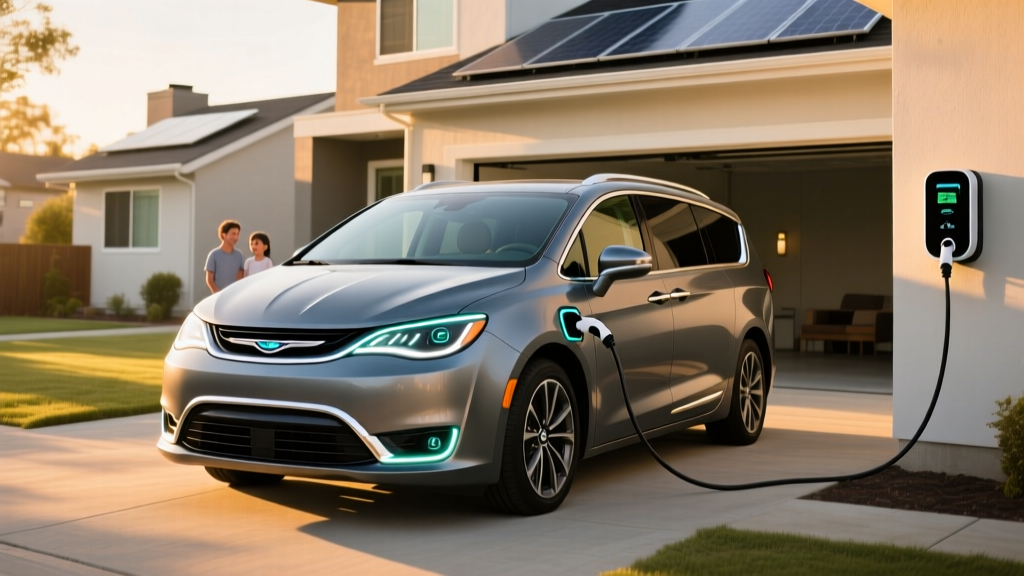
The Pacifica Hybrid is a plug-in hybrid electric vehicle. It carries a 16 kWh battery pack, two electric motors, and the same 3.6L V6. You plug it in to charge, drive up to 32 miles on electricity alone, and when the battery depletes, it seamlessly switches to hybrid gas-electric operation. You never have to plug it in to drive — but you should, to capture the efficiency benefit.
This distinction matters because the Pacifica Hybrid's efficiency story changes dramatically depending on whether you charge it daily.
Chrysler Pacifica Hybrid Gas Mileage: EPA Numbers
The EPA rates the Pacifica Hybrid using two metrics: MPGe (miles per gallon equivalent) when operating on electricity, and traditional MPG when running on gasoline after the battery is depleted. Here's the official breakdown from fueleconomy.gov:
| Mode | City | Highway | Combined |
|---|---|---|---|
| Electric + Gas (MPGe) | — | — | 82 MPGe |
| Gas Only (MPG, battery depleted) | 29 MPG | 30 MPG | 30 MPG |
Electric-only range: 32 miles (EPA estimate)
Total combined range: approximately 430 miles (32 electric + ~398 on a full 16.5-gallon tank)
MPGe can be confusing. It converts the energy in electricity to a gasoline-equivalent figure so you can compare efficiency across powertrains. The 82 MPGe combined figure applies when you're driving within that 32-mile electric window and the battery is contributing energy. Once the battery is depleted, you're looking at the 30 MPG combined gas-only figure — which, for a 4,800-pound minivan, is genuinely impressive.
Real-World MPG: What to Actually Expect
EPA numbers are standardized lab tests. Real driving introduces variables that shift results. Here's what Pacifica Hybrid owners and independent testers consistently report:
- City driving with daily charging: Many owners report spending weeks between gas fill-ups if commutes stay under 30 miles round-trip. In this scenario, gas mileage is almost irrelevant — you're burning electrons, not fuel.
- Highway road trips (battery depleted): Expect 27–29 MPG at 70–75 mph. The regenerative braking system recovers less energy at sustained highway speeds, so the gas engine works harder than in stop-and-go traffic.
- Cold weather (below 30°F): Electric-only range drops to roughly 24–27 miles due to battery chemistry and cabin heating demands. Gas-only MPG can dip to 26–28 MPG combined in winter conditions.
- Hybrid-mode city driving: Once the battery is depleted, the Pacifica Hybrid actually tends to exceed its 29 MPG city EPA rating in warm weather, sometimes hitting 31–33 MPG in heavy traffic where regenerative braking thrives.
Real-World Range Reality: EPA says 32 miles electric-only. Plan for 26–30 miles in moderate temperatures and 22–26 miles in freezing weather with the heater running. On a long road trip with a depleted battery, budget for 27–29 MPG highway, not the 30 MPG sticker.
Powertrain, Battery, and Charging Specs
| Specification | Detail |
|---|---|
| Engine | 3.6L Pentastar V6 (Atkinson cycle) |
| Electric Motors | Dual motor eFlite EVT (electrically variable transmission) |
| Combined System Output | 260 horsepower |
| Battery Capacity | 16 kWh (lithium-ion, NMC chemistry) |
| Usable Battery Capacity | ~13 kWh (system buffer protects longevity) |
| Electric-Only Range (EPA) | 32 miles |
| Level 1 Charging (120V) | ~14 hours (0–100%) |
| Level 2 Charging (240V) | ~2 hours (0–100%) |
| DC Fast Charging | Not supported |
| Charge Port | J1772 (Level 1 & 2) |
| Fuel Tank | 16.5 gallons |
| 0–60 mph | ~7.1 seconds |
| Drivetrain | Front-wheel drive |
The Pacifica Hybrid does not support DC fast charging. This is standard for most PHEVs — the battery is small enough that Level 2 charging fills it quickly, and the cost/weight of DC hardware isn't justified. A 240V home charger replenishes the full pack in about two hours, which means even a quick stop at home between errands can add meaningful electric range.
The dual-motor eFlite transmission is a clever piece of engineering: one motor primarily drives the wheels, while the second can either assist or function as a generator to extend range. The system seamlessly blends electric and gas power without the driver noticing transitions.
Pricing, Trims, and Tax Credit Eligibility
For the current model year, Chrysler offers the Pacifica Hybrid in three trims:
- Hybrid Select (~$51,000 MSRP): Well-equipped base with leatherette seats, 10.1-inch Uconnect infotainment, power sliding doors, and the full PHEV powertrain.
- Hybrid Limited (~$55,000 MSRP): Adds Nappa leather, ventilated front seats, hands-free power liftgate, and upgraded interior trim.
- Hybrid Pinnacle (~$59,000 MSRP): Top-tier luxury with quilted leather, suede headliner, and premium audio.
Federal Tax Credit (§30D) Status
The Chrysler Pacifica Hybrid's eligibility for the $7,500 federal tax credit under IRS §30D depends on current-year battery sourcing and critical mineral requirements. Under the latest IRS rules, PHEVs must meet the same battery-component and critical-minerals thresholds as full BEVs. The Pacifica Hybrid's battery assembly and mineral sourcing have historically met partial or full credit thresholds, but this is subject to change as supply chains shift.
Key eligibility requirements:
- Buyer AGI must not exceed $150,000 (single) / $300,000 (joint)
- Vehicle MSRP must not exceed $80,000 for vans/SUVs/trucks
- Battery must meet critical mineral and component sourcing percentages (thresholds increase annually)
- Credit can be transferred to the dealer at point of sale for an immediate price reduction
Always verify current eligibility on irs.gov before purchasing, and consult a tax professional for your specific situation.
Some states offer additional PHEV rebates or HOV lane access. California's Clean Vehicle Rebate, for example, has historically included qualifying PHEVs, though amounts and eligibility change annually. Check your state's energy or environmental agency for current programs.
Battery Warranty, Reliability, and Replacement Cost
High-Voltage Battery Warranty: Chrysler covers the Pacifica Hybrid's 16 kWh battery pack for 10 years or 100,000 miles (whichever comes first) in most states. In California Air Resources Board (CARB) states, coverage extends to 10 years or 150,000 miles. The warranty guarantees the battery will retain a minimum capacity threshold — typically around 60–70% of original capacity.
The Pacifica Hybrid's powertrain has been in production since the 2017 model year, giving it a substantial real-world track record. Early model years (2017–2019) saw some recalls related to the high-voltage battery system, including a voluntary recall for potential fire risk in certain battery packs. Chrysler addressed these with software updates and, in some cases, battery replacements under warranty.
For current-model buyers, those early issues have largely been resolved through engineering revisions. The eFlite transmission and V6 engine are proven, low-stress components.
Battery replacement cost: If the high-voltage battery fails out of warranty, replacement costs typically range from $7,000 to $9,500 including parts and labor. However, PHEV battery failures outside the warranty period remain uncommon given the conservative buffer Chrysler engineers into the pack (roughly 3 kWh of the 16 kWh total is reserved as buffer to prevent deep discharge damage).
The 12V auxiliary battery — separate from the traction battery — may need replacement every 4–6 years at standard costs (~$200–$350).
Pacifica Hybrid vs Full EV vs Gas Minivan: Which Fits You?
Choose the Pacifica Hybrid (PHEV) if:
- Your daily driving is under 30 miles round-trip and you can charge at home overnight
- You regularly take road trips exceeding 200 miles and don't want to plan around DC fast chargers
- You need a three-row minivan with Stow 'n Go seating flexibility (note: the hybrid's battery eliminates second-row stow-and-go — seats fold but don't disappear into the floor)
- You want EV-like commuting without range anxiety on longer drives
Choose a full BEV (like a Tesla Model X or upcoming electric minivans) if:
- You have reliable home Level 2 charging and your daily needs stay within 250+ miles
- You want zero tailpipe emissions and minimal maintenance (no oil changes, no gas engine upkeep)
- You're comfortable planning road-trip charging stops on networks like Tesla Supercharger or Electrify America
Choose the standard gas Pacifica if:
- You cannot charge at home (apartment, street parking, no garage access)
- Your budget is tighter — the gas Pacifica starts roughly $10,000–$12,000 lower than the Hybrid
- You need second-row Stow 'n Go seating for maximum cargo flexibility
| Factor | Pacifica Hybrid (PHEV) | Gas Pacifica | Full EV Minivan/SUV |
|---|---|---|---|
| Electric-Only Range | 32 miles | 0 miles | 250–350 miles |
| Gas MPG (depleted/combined) | 30 MPG | 22 MPG | N/A |
| Home Charging Needed? | Recommended (not required) | No | Essential |
| Road-Trip Convenience | Gas & go — no planning | Gas & go | Requires DC charger planning |
| Starting MSRP | ~$51,000 | ~$39,000 | $70,000+ (limited options) |
| Annual Fuel Cost (12k mi) | ~$600–$1,100* | ~$2,200 | ~$500–$700 |
*Pacifica Hybrid annual fuel cost assumes daily charging covers most commutes. Without charging, expect ~$1,600–$1,800/year at 30 MPG.
Pros and Cons at a Glance
Pros
- Only PHEV minivan available in the US — no direct competitor
- 32 miles electric covers most school-run and commute loops
- 30 MPG on gas is excellent for a 4,800-lb vehicle
- Seamless gas-electric transitions — no driver intervention needed
- Level 2 charges fully in ~2 hours
- Strong 10-year/100,000-mile battery warranty
- Qualifies for HOV lane access in several states
Cons
- No DC fast charging capability
- Second-row seats don't stow into the floor (battery occupies that space)
- Significant price premium over the gas Pacifica
- All-wheel drive is not available on the Hybrid (gas model offers AWD)
- Electric range drops noticeably in cold weather
- FWD only — less confidence in snow vs. AWD competitors
Frequently Asked Questions
How many MPG does the Chrysler Pacifica Hybrid get?
The EPA rates the Pacifica Hybrid at 30 MPG combined (29 city / 30 highway) when operating on gasoline after the battery is depleted. When factoring in electric-only driving, the combined rating is 82 MPGe. In real-world city driving with daily charging, many owners use very little gasoline at all.
How far can the Pacifica Hybrid go on electric only?
The EPA estimates 32 miles of electric-only range. In practice, expect 26–30 miles in warm weather and 22–26 miles in freezing temperatures. Highway driving at 70+ mph will deplete the battery faster than the EPA test cycle suggests.
Does the Chrysler Pacifica Hybrid qualify for a tax credit?
It may qualify for up to $7,500 under the federal §30D clean vehicle credit, but eligibility depends on current battery sourcing rules, buyer income caps ($300,000 joint / $150,000 single), and the $80,000 MSRP cap for vans. Verify current status at irs.gov before purchasing. The credit can be transferred to the dealer at point of sale.
Is the Pacifica Hybrid reliable, and what does a battery replacement cost?
The Pacifica Hybrid's powertrain has been in production since 2017 with iterative improvements. Early recalls have been addressed. The battery is warrantied for 10 years/100,000 miles (150,000 in CARB states). Out-of-warranty battery replacement runs $7,000–$9,500, though premature failures remain uncommon. Conventional reliability for the V6 and transmission is well-established.
Do I have to plug in the Pacifica Hybrid?
No — the Pacifica Hybrid will drive on gasoline alone if you never plug it in, operating as a conventional hybrid at 30 MPG combined. However, you forfeit the 32 miles of electric range and the associated fuel savings. To get the full benefit, plug in nightly using a standard 120V outlet (~14 hours) or a 240V Level 2 charger (~2 hours).
Does the Pacifica Hybrid have AWD?
No. The Pacifica Hybrid is front-wheel drive only. Chrysler offers all-wheel drive on the conventional gas Pacifica, but the hybrid powertrain's packaging doesn't accommodate the rear drive unit. If AWD is a dealbreaker, the gas Pacifica or a competing AWD minivan (Toyota Sienna, which is a conventional hybrid) may be better fits.
How does the Pacifica Hybrid compare to the Toyota Sienna Hybrid?
The Toyota Sienna is a conventional hybrid (HEV), not a plug-in. It cannot drive on electricity alone but achieves an EPA-estimated 36 MPG combined — higher than the Pacifica Hybrid's 30 MPG gas-only figure. However, the Sienna offers no electric-only mode, no plug-in capability, and no EV-like commuting experience. The Pacifica Hybrid wins on short-trip efficiency and electric commuting; the Sienna wins on gas-only efficiency and AWD availability.