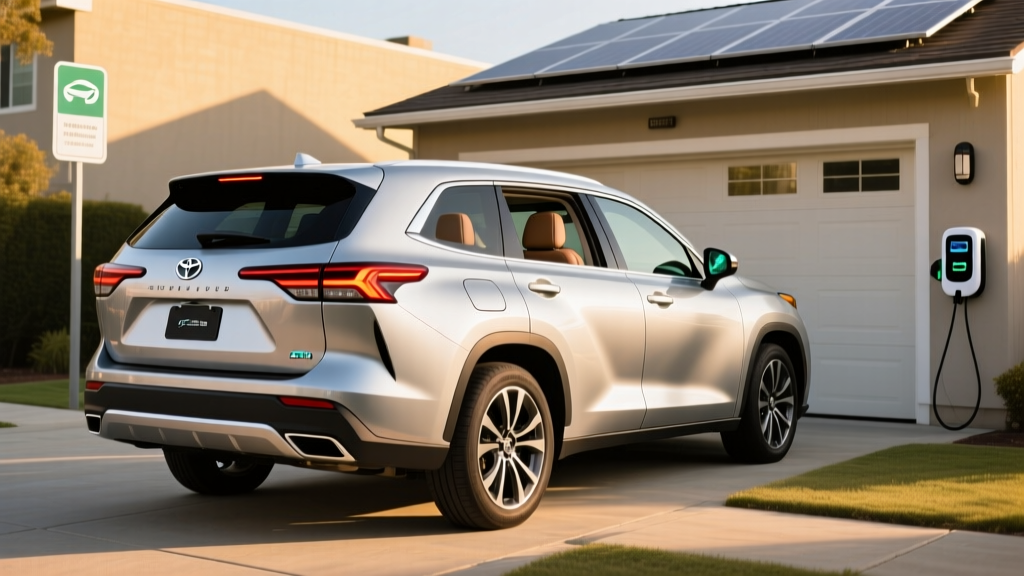
The Toyota Highlander Hybrid occupies a narrow but valuable lane: a three-row family hauler that sips fuel like a compact sedan without requiring a plug, a charger, or any change to your daily routine. For 2026, Toyota continues the fourth-generation Highlander Hybrid with its proven 2.5-liter four-cylinder hybrid powertrain, standard all-wheel drive, and seating for up to eight. If you've been searching for a hybrid Toyota Highlander that balances cargo space, reliability, and genuine fuel savings, this guide covers every number that matters.
Hybrid vs. Plug-In: What the Highlander Actually Is
Before examining specs, it's essential to understand what the Highlander Hybrid is — and what it isn't. Toyota sells this model exclusively as a conventional hybrid electric vehicle (HEV). It does not plug in. There is no Highlander PHEV variant available in the US market, and Toyota has not announced one.
| Feature | HEV (Highlander Hybrid) | PHEV (e.g., RAV4 Prime) | BEV (e.g., Tesla Model X) |
|---|---|---|---|
| Plugs in? | No — refuels at gas station only | Yes — Level 1 or Level 2 | Yes — Level 1, 2, or DC fast |
| Electric-only range | ~1 mile at low speed | 25–42 miles typical | 250–350 miles (full battery) |
| Home charger needed? | No | Recommended (Level 2) | Essential (Level 2) |
| Federal tax credit (§30D) | Not eligible | Up to $7,500 if eligible | Up to $7,500 if eligible |
| Best for | No home charging, long road trips | Home charging + short commutes | Home charging, low running costs |
The Highlander Hybrid recharges its small 1.6 kWh nickel-metal hydride (NiMH) traction battery through regenerative braking and the gasoline engine. You simply fill up at any gas station and drive. This is the core appeal: zero lifestyle change, meaningful fuel savings.
Fuel Economy: EPA Ratings and Real-World MPG
The 2026 Toyota Highlander Hybrid carries an EPA rating of 35 MPG combined, 35 city / 35 highway with standard electronic all-wheel drive (AWD-i), according to fueleconomy.gov. Front-wheel-drive trims (LE, XLE) bump the highway figure to 36 MPG for a 36 combined rating.
| Drivetrain | City MPG | Highway MPG | Combined MPG |
|---|---|---|---|
| FWD (LE, XLE) | 36 | 35 | 36 |
| AWD-i (all trims available) | 35 | 35 | 35 |
| Gas-only Highlander (AWD, for comparison) | 21 | 28 | 24 |
Powertrain: Engine, Motors, and Combined Output
The Highlander Hybrid uses Toyota's fourth-generation hybrid system, pairing a naturally aspirated 2.5-liter inline-four engine with two front electric motor-generators and a rear electric motor for AWD-i trims. Combined system output is 243 horsepower.
| Specification | Detail |
|---|---|
| Engine | 2.5L inline-4, Atkinson cycle, 186 hp / 173 lb-ft |
| Front electric motors | Two motor-generators (MG1 starter/generator, MG2 drive motor, 134 hp) |
| Rear electric motor (AWD-i) | 40 hp, engages on demand for traction |
| Combined system output | 243 hp |
| Transmission | eCVT (planetary gearset, no traditional gears) |
| Traction battery | 1.6 kWh NiMH (sealed, maintenance-free) |
| 0–60 mph | ~7.8 seconds |
| Max towing capacity | 3,500 lbs (hybrid); gas model rates 5,000 lbs |
| Fuel tank | 17.1 gallons |
| Total driving range | ~598 miles (35 MPG × 17.1 gal) |
The eCVT is not a belt-and-pulley CVT — it uses a planetary gearset that seamlessly blends engine and motor power. Acceleration is linear and adequate for merging, though the 243 hp figure trails the turbocharged gas model's 265 hp. The trade-off is fuel economy, not performance. The hybrid's towing capacity drops to 3,500 lbs versus the gas model's 5,000 lbs, which matters if you regularly haul a boat or large trailer.
Pricing, Trims, and Tax Credit Eligibility
For 2026, the Toyota Highlander Hybrid starts at approximately $42,620 for the LE trim (including destination) and climbs to roughly $53,000 for a fully equipped Platinum AWD. Here's the trim-by-trim breakdown:
| Trim | MSRP (est.) | Drivetrain | Key Features |
|---|---|---|---|
| LE | $42,620 | FWD or AWD-i | 8-inch display, TSS 3.0, 8 seats |
| XLE | $46,070 | FWD or AWD-i | SofTex, sunroof, 2nd-row captain's chairs |
| Limited | $50,170 | AWD-i | Leather, 12.3-inch display, JBL audio |
| Platinum | $53,070 | AWD-i | Panoramic roof, head-up display, 360° camera |
Battery Warranty, Reliability, and Replacement Cost
Hybrid battery longevity is consistently the top concern for buyers considering a hybrid Toyota Highlander. Here's what the data shows:
• Hybrid battery: 10 years / 150,000 miles (whichever comes first)
• Hybrid system components (inverter, control module, MG1/MG2): 8 years / 100,000 miles
• Powertrain (engine, transmission): 5 years / 60,000 miles
• Basic bumper-to-bumper: 3 years / 36,000 miles
Toyota's NiMH hybrid batteries have an exceptional longevity track record. The 1.6 kWh pack in the Highlander Hybrid is small and lightly stressed — it never fully depletes or fully charges, operating within a narrow state-of-charge window that dramatically reduces degradation. Real-world evidence from Prius and Camry Hybrids (which use the same chemistry and management strategy) shows these batteries routinely lasting 150,000–200,000+ miles before any capacity loss becomes noticeable.
Replacement cost if out of warranty: A new OEM hybrid battery for the Highlander Hybrid runs approximately $3,000–$4,500 including labor at a Toyota dealer. Third-party refurbished units are available for $1,500–$2,500. Given the 10-year/150,000-mile warranty and the battery's proven durability, this is a low-probability expense for most original owners. According to reliability data tracked by IIHS and owner surveys, the Highlander Hybrid ranks among the most dependable vehicles in its class.
Daily Driving: Cargo, Comfort, and Technology
The hybrid powertrain doesn't compromise interior space. The Highlander Hybrid offers 84.3 cubic feet of cargo volume behind the first row, 48.4 cu ft behind the second row, and 16.1 cu ft behind the third row — identical to the gas model. The battery pack is mounted beneath the rear seats, preserving all cargo and passenger space.
All trims include Toyota Safety Sense 3.0, which bundles adaptive cruise control, lane-keeping assist, automatic emergency braking with pedestrian detection, and road-sign assist. This is an SAE Level 2 driver-assistance system — it supports steering and speed control but requires the driver to remain fully engaged with hands on the wheel and eyes on the road at all times.
The infotainment system runs Toyota's latest Audio Multimedia platform on an 8-inch touchscreen (LE/XLE) or 12.3-inch touchscreen (Limited/Platinum), with wireless Apple CarPlay and Android Auto standard. A Wi-Fi hotspot, Qi wireless charging pad, and six USB-C ports are available across the lineup.
Who Should Buy the Highlander Hybrid (and Who Shouldn't)
✓ Choose the Highlander Hybrid If:
- You need three rows but can't install a home charger
- Your commute is city/suburban (where hybrids shine)
- You want proven reliability with minimal maintenance
- You take regular road trips and don't want to plan around charging stations
- You want ~40% fuel savings over the gas Highlander without any plug-in lifestyle change
✗ Look Elsewhere If:
- You need to tow more than 3,500 lbs (get the gas Highlander or a truck-based SUV)
- You have home charging and want electric-only commuting (consider the RAV4 Prime PHEV or a BEV like the Kia EV9)
- You want the federal §30D tax credit (HEVs don't qualify)
- You prioritize acceleration over efficiency (the turbo gas model or a BEV SUV is quicker)
- You need maximum third-row space (the Grand Highlander offers more room)
If you can charge at home and your daily driving is under 35 miles, a plug-in hybrid like the Toyota RAV4 Prime (42 miles electric-only) or a three-row BEV like the Kia EV9 (279 miles EPA, eligible for the $7,500 credit) may deliver lower operating costs. But if charging access is uncertain or your driving patterns are unpredictable, the Highlander Hybrid remains the most practical three-row efficiency play on the market.
Ownership Costs: 5-Year Fuel Savings Breakdown
| Cost Factor | Highlander Hybrid (35 MPG) | Highlander Gas AWD (24 MPG) | Difference |
|---|---|---|---|
| Total fuel consumed | 2,143 gallons | 3,125 gallons | 982 gal saved |
| Total fuel cost | $7,500 | $10,938 | $3,438 saved |
| Higher purchase price (hybrid premium) | — | — | ~$1,800 more |
| Net 5-year savings | ~$1,638 after accounting for hybrid price premium | ||
The hybrid premium pays for itself within roughly 3 years of average driving. Beyond that, every mile saves money. Maintenance costs are also slightly lower — the hybrid system's regenerative braking reduces wear on brake pads, and the eCVT has no traditional transmission fluid to change on a short interval.
Frequently Asked Questions
How many MPG does the Toyota Highlander Hybrid get?
The 2026 Highlander Hybrid is EPA-rated at 35 MPG combined (35 city / 35 highway) with AWD-i, or 36 combined with FWD. Real-world city driving often yields 37–40 MPG, while sustained highway driving at high speeds may drop to 30–33 MPG. Cold weather typically reduces fuel economy by 2–4 MPG.
Does the Highlander Hybrid need to be plugged in?
No. The Highlander Hybrid is a conventional HEV — it charges its small battery through regenerative braking and the gasoline engine. You refuel it at any gas station exactly like a standard vehicle. There is no plug, no charging cable, and no home charger required.
Is there a plug-in hybrid (PHEV) version of the Highlander?
Not in the US market. Toyota does not currently offer a Highlander PHEV (sometimes called Highlander Prime). If you want a Toyota PHEV with electric-only range, the RAV4 Prime (42 miles electric) and Prius Prime (44 miles electric) are the closest options, though neither offers three rows of seating.
How reliable is the Highlander Hybrid, and what does a battery replacement cost?
Toyota's hybrid system has two decades of proven reliability. The NiMH traction battery is warrantied for 10 years / 150,000 miles, and real-world data shows these batteries frequently lasting 200,000+ miles. Out-of-warranty replacement costs approximately $3,000–$4,500 at a dealer, or $1,500–$2,500 for a refurbished unit. The hybrid system's simplicity (no traditional transmission, reduced brake wear) actually lowers long-term maintenance costs versus the gas model.
Does the Highlander Hybrid qualify for any tax credit?
No. The federal §30D Clean Vehicle Credit applies only to plug-in vehicles (PHEVs and BEVs) that meet battery-sourcing, MSRP, and buyer-income requirements. Conventional hybrids like the Highlander Hybrid are not eligible. Some states may offer small hybrid incentives or HOV-lane stickers — check your state's energy department for current programs.
Can the Highlander Hybrid tow a trailer?
Yes, but with a reduced rating compared to the gas model. The Highlander Hybrid is rated to tow 3,500 lbs, which covers most small boat trailers, utility trailers, and light campers. The gas-only Highlander tows up to 5,000 lbs. If you regularly tow near or above 3,500 lbs, the gas model or a body-on-frame SUV is a better fit.
How does the Highlander Hybrid compare to the Grand Highlander Hybrid?
The Grand Highlander Hybrid is larger, offering significantly more third-row legroom and cargo space (97.5 cu ft max vs 84.3 cu ft). It uses the same hybrid powertrain but is rated at 34 MPG combined — nearly identical efficiency in a bigger package. The Grand Highlander starts about $4,000 higher. If third-row adults are a regular occurrence, the Grand Highlander is worth the premium; for occasional use, the standard Highlander Hybrid is more maneuverable and slightly more efficient.