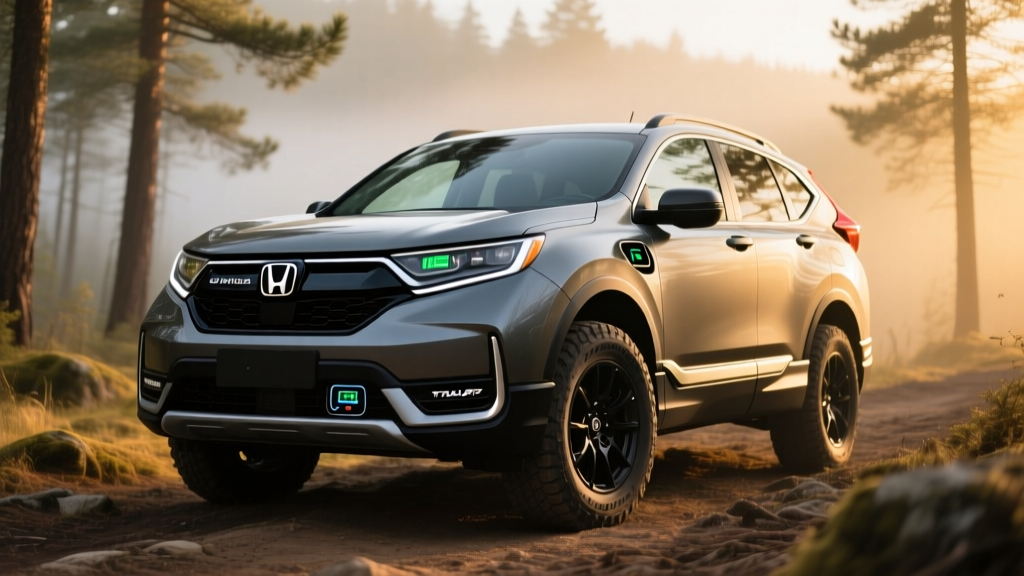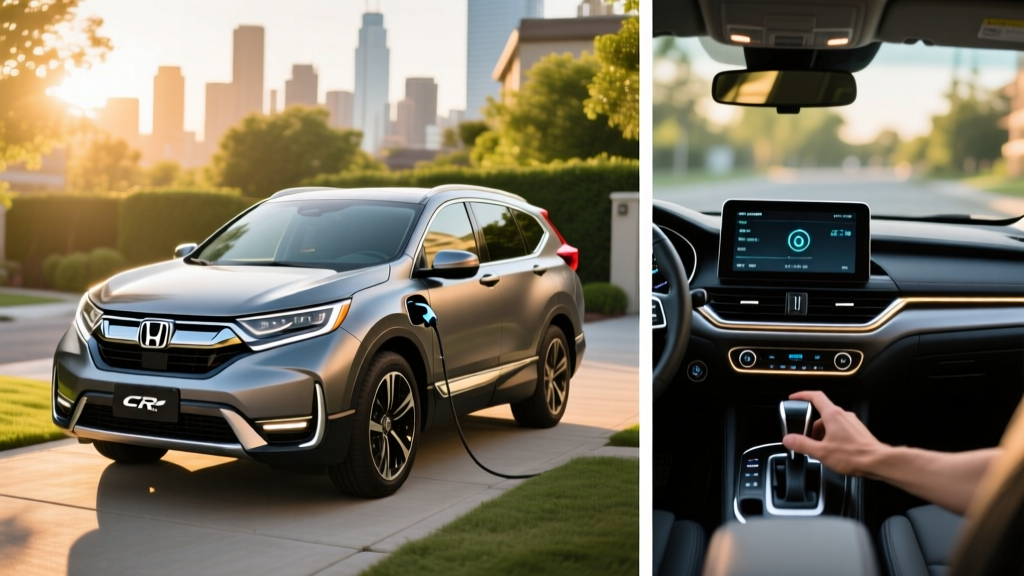
The 2026 Honda CR-V Touring Hybrid sits at the top of one of America's best-selling compact SUV lineups, offering a two-motor hybrid powertrain that prioritizes fuel economy without sacrificing daily practicality. For buyers who want maximum efficiency without plugging in, the CR-V Hybrid eliminates range anxiety entirely while delivering real-world fuel savings that rival much smaller vehicles.
This guide breaks down everything you need to know about the 2026 CR-V Touring Hybrid — from its EPA-rated 40 MPG combined to its premium Touring-trim equipment, battery longevity, and how it stacks up against plug-in hybrids and full EVs in the same price bracket.
2026 Honda CR-V Touring Hybrid: Quick Verdict
The CR-V Touring Hybrid is the right choice for drivers who want a set-it-and-forget-it efficiency upgrade. You never plug it in, you never think about charging, and you still get roughly 40 MPG in mixed driving. The Touring trim adds leather, a premium audio system, wireless Apple CarPlay/Android Auto, a hands-free power tailgate, and Honda's full Honda Sensing suite. At a starting MSRP near $42,350, it competes with the Toyota RAV4 Hybrid Limited and the Hyundai Tucson Hybrid Limited — but Honda's two-motor system gives it a refinement edge in city driving.
| Spec | Value |
|---|---|
| Powertrain | 2.0L Atkinson-cycle 4-cyl + two-motor hybrid system |
| Combined Horsepower | 204 hp |
| Combined Torque | 247 lb-ft (electric motor) |
| Drivetrain | AWD (standard on Touring Hybrid) |
| EPA MPG (City / Hwy / Combined) | 40 / 34 / 37 (AWD) |
| Fuel Tank | 14.0 gallons |
| Total Range | ~518 miles |
| 0–60 mph | ~7.6 seconds |
| Cargo Volume (rear seats up / down) | 36.3 / 76.5 cu ft |
| Towing Capacity | 1,000 lbs |
| Starting MSRP (Touring Hybrid AWD) | ~$42,350 |
| Hybrid Battery Warranty | 8 years / 100,000 miles |
Fuel Economy: EPA Ratings vs. Real-World MPG
The EPA rates the 2026 CR-V Hybrid AWD at 40 city / 34 highway / 37 combined MPG (per fueleconomy.gov). Front-wheel-drive variants achieve slightly higher figures, but the Touring trim comes exclusively with AWD.
| Driving Cycle | EPA Rating | Real-World Expectation |
|---|---|---|
| City | 40 MPG | 38–43 MPG (hybrids often exceed EPA in stop-and-go) |
| Highway | 34 MPG | 30–34 MPG (aero drag and sustained speed reduce hybrid advantage) |
| Combined | 37 MPG | 34–39 MPG depending on driving mix |
| Cold Weather (below 32°F) | N/A | 30–34 MPG (engine runs more for cabin heat) |
Why real-world city MPG can beat the EPA sticker: Honda's two-motor hybrid system operates primarily in electric-drive mode at low speeds, with the gas engine acting as a generator rather than directly turning the wheels. In stop-and-go traffic, regenerative braking recaptures energy that a conventional gas car wastes as heat. Owners who do 70%+ city driving routinely report 40–43 MPG. Highway-heavy commuters should expect numbers closer to 32–34 MPG, where the engine engages more directly and aerodynamic drag dominates.
Cold-weather note: In sub-freezing temperatures, the gasoline engine runs more frequently to provide cabin heat and maintain battery temperature. Expect a 10–15% MPG reduction in winter months, bringing combined figures to roughly 30–34 MPG. This is normal for all hybrids and is not a battery-degradation issue.
HEV vs. PHEV vs. EV: Which Powertrain Fits You?
The CR-V Touring Hybrid is a conventional hybrid (HEV). It does not plug in. The battery recharges through regenerative braking and the gasoline engine. Honda does not currently offer a plug-in hybrid (PHEV) version of the CR-V in the U.S. market for the 2026 model year.
| Factor | HEV (CR-V Hybrid) | PHEV (e.g., RAV4 Prime) | BEV (e.g., Ioniq 5) |
|---|---|---|---|
| Plug in required? | No | Yes (for EV range) | Yes (always) |
| Electric-only range | ~1 mile at low speed | 30–42 miles typical | 250–320 miles typical |
| Home charging needed? | No | Recommended (Level 2) | Essential (Level 2) |
| Fuel cost per mile | ~$0.10–0.12 | ~$0.04 (EV mode) / ~$0.10 (gas) | ~$0.03–0.05 |
| Federal tax credit (§30D) | Not eligible | Up to $7,500 (if eligible) | Up to $7,500 (if eligible) |
| Upfront price premium | +$1,500–2,000 vs gas | +$5,000–8,000 vs gas | +$5,000–15,000 vs gas |
| Best for | No home charging, long trips | Short commutes + home charging | Home charging + mostly under 250 mi/day |
Choose the CR-V Touring Hybrid (HEV) if: You lack access to home or workplace charging, you take frequent road trips over 300 miles, or you want maximum efficiency with zero lifestyle change. The hybrid system works transparently — you simply drive and refuel as normal.
Consider a PHEV instead if: You have a garage or driveway where you can install a Level 2 charger, your daily commute is under 40 miles round-trip, and you want to drive mostly on electricity during the week while keeping gas availability for weekend trips. The Toyota RAV4 Prime (42 miles EV range) is the closest competitor in this segment.
Consider a full EV if: You have reliable home Level 2 charging, your daily driving stays under 200 miles, and you want the lowest per-mile operating cost plus eligibility for the full §30D federal tax credit.
Powertrain Deep Dive: How Honda's Two-Motor Hybrid Works
The 2026 CR-V Hybrid uses Honda's fourth-generation two-motor hybrid system paired with a 2.0-liter Atkinson-cycle four-cylinder engine. Here's how the components break down:
- Gasoline engine: 2.0L Atkinson-cycle I4 producing approximately 146 hp and 134 lb-ft of torque. The Atkinson cycle sacrifices peak power for superior thermal efficiency.
- Drive motor: A single traction motor producing 181 hp and 247 lb-ft of torque. This motor drives the front wheels (with the rear axle motor providing AWD).
- Generator motor: A second motor that acts as a generator, converting engine output to electricity to feed the drive motor or charge the battery.
Combined system output: 204 hp (limited by battery discharge rate and engine-generator capacity, not a simple sum of motor + engine). - Hybrid battery: A lithium-ion pack (approximately 1.1 kWh usable capacity) mounted under the rear cargo floor. This is a small battery by design — it buffers energy for acceleration and regenerative braking, not for sustained electric-only driving.
- Transmission: No traditional gearbox. Honda uses an e-CVT (direct-drive with a lockup clutch for highway cruising), which eliminates shift shock and keeps the engine in its most efficient RPM band.
In practice, the CR-V Hybrid drives like an EV around town — the electric motor handles launches and low-speed acceleration with instant torque. At highway speeds (above ~45 mph), a clutch engages to connect the engine directly to the wheels, bypassing the generator for more efficient cruising. This is why highway MPG drops relative to city: the engine is doing more direct mechanical work.
Touring Trim: What You Get at the Top of the Lineup
The Touring Hybrid is the most expensive CR-V Honda offers, and it loads up on features that justify the premium over the Sport Touring Hybrid (the next trim down). Key Touring-specific equipment includes:
- Perforated leather-trimmed seats with heated front and rear outboard seats
- Heated steering wheel
- 12-speaker Bose premium audio system
- Wireless Apple CarPlay and Android Auto
- 9-inch touchscreen with wireless phone charging pad
- Hands-free power tailgate with walk-away close
- Rain-sensing wipers
- Low Speed Braking Control and Traffic Jam Assist (part of Honda Sensing)
- 19-inch alloy wheels
- Panoramic moonroof (new for 2025/2026 refresh)
Honda Sensing — the brand's ADAS suite — is standard across all trims and includes adaptive cruise control with low-speed follow, lane-keeping assist, road-departure mitigation, and collision-mitigation braking. This is a Level 2 driver-assist system per SAE classification, meaning the driver must remain fully attentive and keep hands on the wheel. It is not autonomous driving.
Battery Longevity, Warranty, and Replacement Cost
Hybrid Battery Warranty
Honda covers the CR-V Hybrid's lithium-ion battery pack for 8 years or 100,000 miles (whichever comes first) in most states. In California Air Resources Board (CARB) states, the warranty extends to 10 years or 150,000 miles. The warranty covers battery capacity loss below a defined threshold and any manufacturing defects.
How long do Honda hybrid batteries actually last? Based on fleet data from earlier-generation Honda hybrids (Insight, Accord Hybrid, previous CR-V Hybrid), the lithium-ion packs routinely exceed 150,000 miles before significant degradation. Unlike full EVs, the CR-V Hybrid's small battery (~1.1 kWh) operates in a narrow state-of-charge window (roughly 40–60%), which dramatically reduces stress on the cells. Honda's battery management system is conservative by design — it sacrifices usable capacity for longevity.
Replacement cost if out of warranty: A Honda hybrid battery replacement runs approximately $2,000–$4,000 including labor at a dealership. Independent hybrid specialists may offer refurbished packs for $1,500–$2,500. Given the battery's track record and the vehicle's typical lifespan, most first and second owners will never face this cost.
The 12V auxiliary battery (a separate, conventional battery that powers electronics and starts the system) typically lasts 3–5 years and costs $150–$250 to replace — the same as any modern vehicle.
Pricing, Tax Credits, and Total Cost of Ownership
The 2026 Honda CR-V Touring Hybrid AWD carries a starting MSRP of approximately $42,350 (including destination charge). Fully loaded with accessories, expect an out-the-door price near $43,500–$44,500 before taxes and registration.
Federal Tax Credit Eligibility
The CR-V Hybrid is a conventional hybrid (HEV), not a plug-in. It does not qualify for the federal §30D Clean Vehicle Credit (up to $7,500), which is reserved for plug-in electric vehicles with a minimum 7 kWh battery capacity. The CR-V Hybrid's battery is approximately 1.1 kWh — well below the threshold.
Some states offer separate incentives for conventional hybrids, but these are uncommon and vary by jurisdiction. Check your state's energy office or Alternative Fuels Data Center for local programs.
| Cost Factor | CR-V Touring Hybrid ($42,350) | CR-V Touring AWD Gas ($40,850) | Hyundai Ioniq 5 SEL AWD (~$48,000) |
|---|---|---|---|
| Purchase Price | $42,350 | $40,850 | $48,000 |
| Federal Tax Credit | $0 | $0 | Up to $7,500* |
| Effective Price After Credit | $42,350 | $40,850 | ~$40,500* |
| Fuel/Energy (5 yr, 75,000 mi) | ~$6,750 (37 MPG, $3.33/gal) | ~$8,550 (28 MPG, $3.33/gal) | ~$2,850 (home charging, $0.14/kWh) |
| Maintenance (5 yr) | ~$2,500 | ~$3,200 | ~$1,500 |
| Insurance (5 yr avg) | ~$8,500 | ~$8,200 | ~$9,500 |
| Estimated Depreciation | ~$18,000 | ~$19,000 | ~$22,000 |
| Approx. 5-Yr Total | ~$78,100 | ~$80,800 | ~$76,850 |
*Ioniq 5 tax credit eligibility depends on MSRP caps, buyer income limits, and battery-sourcing requirements under current IRS §30D rules. Verify eligibility at irs.gov or with a tax professional.
The hybrid saves roughly $2,700 over the gas-only CR-V Touring across five years, primarily through fuel savings and slightly lower maintenance (less brake wear from regenerative braking, no traditional starter motor). The gap narrows if gas prices fall below $2.80/gallon and widens significantly above $4.00/gallon.
Pros and Cons
Pros
- 40 MPG city without plugging in — zero lifestyle change required
- Refined, EV-like low-speed driving feel from the two-motor system
- Standard AWD on Touring Hybrid with no fuel-economy penalty vs FWD in real-world use
- 76.5 cu ft of cargo space — class-leading for the segment
- Strong Honda Sensing ADAS suite standard on all trims
- Proven hybrid battery longevity with 8yr/100k warranty
- Bose 12-speaker audio and premium Touring features
Cons
- No federal tax credit — HEVs are ineligible for §30D
- 1,000-lb towing capacity limits utility vs. truck-based SUVs
- Highway MPG (34) trails city MPG (40) — typical for hybrids but disappointing on road trips
- Touring trim pricing near $43K+ puts it close to PHEV and EV territory
- No spare tire — tire-inflation kit only (cargo floor space taken by hybrid battery)
- Infotainment screen is 9 inches — smaller than some rivals' 12-inch displays
Frequently Asked Questions
How many MPG does the 2026 Honda CR-V Touring Hybrid get?
The EPA rates it at 40 city / 34 highway / 37 combined MPG with AWD. Real-world city driving often yields 38–43 MPG thanks to the hybrid system's regenerative braking advantage. Highway-heavy drivers should expect 30–34 MPG. Cold weather reduces combined MPG to approximately 30–34 due to increased engine operation for cabin heat.
Does the CR-V Hybrid need to be plugged in?
No. The CR-V Hybrid is a conventional hybrid (HEV). The battery charges automatically through regenerative braking and the gasoline engine. There is no plug, no charging cable, and no need for home charging infrastructure. You fuel it at a gas station exactly like a conventional vehicle.
How far can the CR-V Hybrid drive on electric power alone?
Effectively about 1 mile at very low speeds (under 25 mph) on a fully charged hybrid battery. This is not a plug-in hybrid — the small 1.1 kWh battery is designed for energy buffering and acceleration assist, not sustained electric driving. If you want 30+ miles of electric-only range, you need a PHEV like the Toyota RAV4 Prime.
Is the Honda CR-V Hybrid reliable?
Honda's hybrid powertrain has a strong reliability track record. The two-motor system has fewer moving parts than a conventional automatic transmission (no torque converter, no gear shifts under load). The hybrid battery is warrantied for 8 years/100,000 miles and typically lasts well beyond that. Honda received top reliability ratings from Consumer Reports and J.D. Power for the CR-V Hybrid in recent model years.
What does it cost to replace the hybrid battery?
Out-of-warranty replacement costs approximately $2,000–$4,000 at a Honda dealer, including labor. Refurbished packs from independent hybrid specialists run $1,500–$2,500. Given the battery's narrow operating window and conservative management, most owners will never need a replacement during typical ownership (under 150,000 miles).
Does the 2026 CR-V Hybrid qualify for any tax credit?
It does not qualify for the federal §30D Clean Vehicle Credit, which requires a plug-in vehicle with at least 7 kWh of battery capacity. The CR-V Hybrid's battery is approximately 1.1 kWh. Some states may offer minor hybrid incentives — check the Alternative Fuels Data Center for your state's programs.
How does the CR-V Hybrid compare to the RAV4 Hybrid?
The Toyota RAV4 Hybrid (AWD, XLE Premium) achieves 41 city / 38 highway / 40 combined MPG — slightly better highway efficiency than the CR-V Hybrid, partly due to Toyota's series-parallel hybrid architecture. The CR-V Hybrid counters with more cargo volume (76.5 vs. 69.8 cu ft), a more refined driving feel at low speeds, and a more premium Touring cabin. Both are excellent choices; the RAV4 wins on highway MPG, the CR-V wins on space and refinement.
Is the CR-V Hybrid good for road trips?
Yes, with a caveat. Its 14-gallon fuel tank and 37 MPG combined rating give it a real-world range of approximately 500–520 miles between fill-ups — excellent for long-distance driving. The caveat is that highway MPG drops to 32–34 at sustained 75+ mph speeds, so plan for roughly 450–480 highway miles per tank. The Honda Sensing adaptive cruise control makes long drives less fatiguing.
Bottom Line: Who Should Buy the 2026 CR-V Touring Hybrid?
The 2026 Honda CR-V Touring Hybrid is the right vehicle if you want a premium compact SUV that delivers roughly 37–40 MPG without any charging infrastructure, behavioral change, or range planning. It's ideal for apartment dwellers without charging access, frequent road-trippers, and anyone who wants efficiency to be invisible.
If you have home charging and a short commute, a PHEV or full EV will deliver lower per-mile energy costs and potential tax-credit savings that narrow the upfront price gap. But if you simply want to fill up less often and drive a well-equipped, spacious, and proven SUV — the CR-V Touring Hybrid does exactly that, with no compromises beyond its $42,350 entry price and ineligibility for federal EV credits.