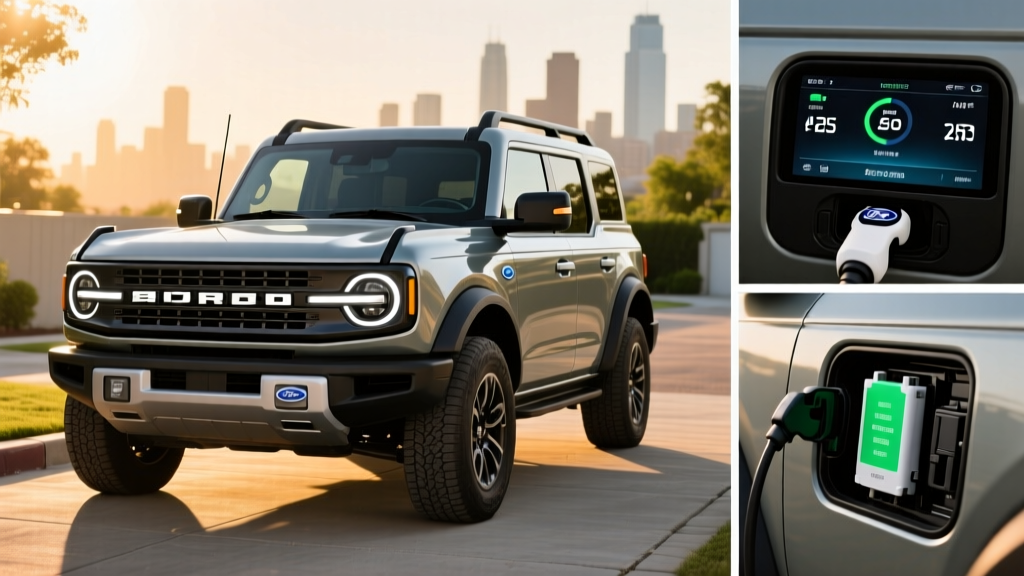
The Ford Bronco has been a staple of the off-road SUV segment since its modern revival, but as fuel prices fluctuate and electrification reshapes the truck and SUV market, buyers are increasingly searching for a more efficient Bronco. Enter the conversation around the 2025 Bronco hybrid — a topic that generates significant interest but also considerable confusion about what Ford actually offers versus what remains on the drawing board.
This guide breaks down exactly where the Bronco stands in Ford's electrification lineup for the 2025 model year, what hybrid technology is available (and what isn't), how it compares to plug-in hybrid and full EV alternatives, and whether waiting for a hybrid Bronco makes sense for your next purchase.
Does a 2025 Ford Bronco Hybrid Actually Exist?
Let's address the most critical question first: as of the 2025 model year, Ford does not offer a hybrid or plug-in hybrid variant of the Bronco. The two-door and four-door Bronco lineup continues with conventional gasoline engines — primarily the 2.3L EcoBoost inline-four and the 2.7L EcoBoost V6, with the high-output 3.0L EcoBoost V6 reserved for the Bronco Raptor.
This stands in contrast to the Bronco Sport, Ford's smaller, unibody crossover sibling, which has been the subject of hybrid powertrain speculation. It also differs from the broader Ford truck lineup, where the F-150 PowerBoost hybrid and the F-150 Lightning EV are well-established options.
HEV vs PHEV: What's the Difference?
Conventional Hybrid (HEV): Uses a small battery (typically 1-2 kWh) charged entirely by the engine and regenerative braking. No plug required. Improves MPG by 20-40% over a gas-only model, especially in city driving.
Plug-In Hybrid (PHEV): Carries a larger battery (typically 12-25 kWh) that can be charged from a wall outlet or public charger. Delivers 20-50 miles of electric-only driving before the gas engine kicks in. Requires regular plug-in charging to realize its efficiency advantage.
Why it matters for Bronco shoppers: A conventional hybrid Bronco would improve fuel economy without changing your fueling habits. A PHEV Bronco would let you commute on electricity but would need home charging access to justify its higher price.
2025 Bronco Gas Engine Lineup: Current MPG and Specs
Since the hybrid Bronco isn't here yet, understanding the current powertrain lineup sets the baseline for what a hybrid variant would need to improve upon. Here are the EPA fuel economy figures for the 2025 Bronco's available engines, sourced from fueleconomy.gov:
| Engine | HP | City MPG | Hwy MPG | Combined MPG | Drivetrain |
|---|---|---|---|---|---|
| 2.3L EcoBoost I4 Turbo | 300 | 20 | 22 | 21 | 4WD |
| 2.7L EcoBoost V6 Turbo | 330 | 18 | 20 | 19 | 4WD |
| 3.0L HO EcoBoost V6 (Raptor) | 418 | 15 | 16 | 15 | 4WD |
These numbers are, frankly, poor by modern standards — but they reflect the Bronco's boxy aerodynamics, heavy body-on-frame construction, and aggressive off-road tires. For context, the Jeep Wrangler 4xe PHEV achieves 49 MPGe combined with its plug-in hybrid system, and 20 MPG combined on gas alone.
Real-world note: Bronco owners frequently report combined fuel economy 1-2 MPG below the EPA sticker, especially with larger tire packages, roof racks, and lifted suspensions. Highway driving at 75+ mph hits the boxy body hard — expect 17-18 MPG from the 2.3L on a flat interstate, not the EPA's 22 MPG highway estimate.
What a Hybrid Bronco Could Look Like: Ford's PowerBoost Blueprint
While Ford hasn't confirmed a hybrid Bronco for 2025 or 2026, the company's existing hybrid technology provides a credible roadmap. The F-150 PowerBoost hybrid pairs a 3.5L EcoBoost V6 with a 35 kW electric motor integrated into the 10-speed automatic transmission, fed by a 1.5 kWh lithium-ion battery. The result: 430 combined horsepower, 570 lb-ft of torque, and an EPA-estimated 23-25 MPG combined — a meaningful improvement over the non-hybrid V6 F-150.
If Ford were to adapt a similar system to the Bronco, here's what a reasonable projection would look like:
| Spec | Current 2.7L V6 Bronco | Projected Hybrid Bronco (Est.) |
|---|---|---|
| Combined HP | 330 | 360-400 |
| Battery Capacity | N/A | ~1.5 kWh (HEV) |
| Combined MPG (EPA est.) | 19 | 22-25 |
| 0-60 mph | ~6.5 sec | ~5.8-6.2 sec |
| Plug-In Required? | N/A | No (HEV) |
A conventional hybrid (HEV) Bronco would require no behavioral change from the driver — you'd fuel up at gas stations exactly as before, while regenerative braking and electric assist would shave fuel consumption, particularly in stop-and-go trail crawling and city driving where the Bronco's current MPG is weakest.
Bronco Sport Hybrid: The More Likely Near-Term Candidate
Industry analysts and Ford watchers have long pointed to the Bronco Sport — the smaller, Escape-platform crossover — as the more probable recipient of Ford's hybrid technology. The Bronco Sport already shares its underpinnings with the Ford Escape, which offers both a conventional hybrid (HEV) and a plug-in hybrid (PHEV) variant.
The Escape Hybrid achieves an EPA-estimated 37-42 MPG combined with its 2.5L Atkinson-cycle four-cylinder and electric motor producing 192 combined horsepower. The Escape PHEV delivers 37 miles of electric-only range from its 14.4 kWh battery, with a combined 210 horsepower.
Translating this to the Bronco Sport platform would likely yield:
- Bronco Sport HEV (projected): ~34-38 MPG combined, ~192 HP, no plug required
- Bronco Sport PHEV (projected): ~30-35 miles electric-only range, 14.4 kWh battery, ~210 HP, Level 2 charging in ~3.5 hours
As of this writing, Ford has not officially confirmed either variant for the 2025 or 2026 model year. Buyers interested in a hybrid compact SUV from Ford are currently better served by the Escape Hybrid or the Maverick hybrid pickup.
Hybrid vs PHEV vs EV: Which Powertrain Fits Your Lifestyle?
Choose a Conventional Hybrid (HEV) If:
- You don't have access to home or workplace charging
- You want better MPG with zero change to your fueling routine
- You regularly tow or off-road and want a proven gas powertrain with electric assist
- Your budget can accommodate a ~$2,000-$4,000 premium over a gas-only model
Choose a Plug-In Hybrid (PHEV) If:
- You have Level 2 home charging (or can install it)
- Your daily commute is under 35 miles round-trip (covering most errands on electricity)
- You take longer road trips on weekends where gas-only range matters
- You want to reduce fuel costs without committing to a full EV
Choose a Full EV (BEV) If:
- You have reliable home Level 2 charging
- Your daily driving is under 250 miles and you rarely tow heavy loads
- You want the lowest per-mile fuel cost and minimal maintenance
- You qualify for the federal §30D tax credit (up to $7,500, subject to income and sourcing rules)
For the dedicated off-road buyer who uses a Bronco as a weekend trail rig and daily driver, a conventional hybrid (HEV) makes the most practical sense. It preserves the Bronco's body-on-frame durability, adds low-end electric torque useful for rock crawling, and improves city MPG without requiring any charging infrastructure.
Tax Credit Reality: What Hybrid Bronco Buyers Should Know
Under current IRS §30D rules, only plug-in electric vehicles and fuel cell vehicles qualify for the federal clean vehicle credit of up to $7,500. Conventional hybrids (HEVs) do not qualify for any federal tax credit.
If Ford were to release a Bronco PHEV, its eligibility for the §30D credit would depend on several factors that change frequently:
- Battery sourcing requirements: Critical minerals and battery components must meet increasing domestic-sourcing thresholds each year
- MSRP caps: SUVs must be priced at or below $80,000 MSRP
- Buyer income limits: Modified AGI must not exceed $150,000 (single) or $300,000 (joint filing)
- Point-of-sale transfer: Eligible buyers can transfer the credit to the dealer for an immediate price reduction
Some states offer additional rebates for PHEVs (California's CVRP, for example), but these vary by jurisdiction and funding availability. Always check your state's energy office or a qualified tax professional for current eligibility.
Reliability, Battery Warranty, and Long-Term Costs
Hybrid Battery Warranty: What Ford Covers
Ford's hybrid battery components are covered under federal emissions warranty requirements: 8 years or 100,000 miles (whichever comes first) in most states, and 10 years or 150,000 miles in California Air Resources Board (CARB) states including CA, CO, CT, ME, MD, MA, NJ, NY, OR, RI, VT, and WA.
This warranty covers battery capacity loss below a defined threshold (typically 60-70% of original capacity) and component failure. Ford's PowerBoost hybrid system in the F-150 has shown strong reliability data since its 2021 introduction.
Battery replacement cost (out of warranty): Hybrid battery packs in the 1.5-2.0 kWh range typically cost $2,000-$4,000 to replace — far less than a full EV battery replacement, which can exceed $10,000-$15,000.
Conventional hybrid systems add relatively little complexity to a vehicle. The electric motor in Ford's hybrid architecture sits between the engine and transmission, and the small battery pack is far less stressed than a full EV battery (it rarely cycles below 40% or above 80% state of charge). Real-world data from the F-150 PowerBoost and Escape Hybrid suggests these systems are durable well past 150,000 miles with no battery intervention.
The bigger reliability question for any future hybrid Bronco would be the vehicle's overall platform maturity. The current-generation Bronco has had its share of early-build quality issues (12-volt battery drain, roof leak concerns, GFM module failures) that Ford has addressed through service bulletins. A hybrid variant introduced later in the production cycle would likely benefit from a more mature build process.
Competing Options: What to Buy While You Wait
If you need an electrified off-road-capable SUV today and can't wait for Ford to potentially hybridize the Bronco, here are the closest alternatives:
| Model | Powertrain | Combined MPG / MPGe | Electric Range | Starting MSRP |
|---|---|---|---|---|
| Jeep Wrangler 4xe | PHEV | 49 MPGe / 20 MPG (gas) | 22 mi | ~$51,795 |
| Toyota 4Runner (2025 i-FORCE MAX) | HEV | ~23-25 MPG (est.) | N/A | ~$48,000 |
| Ford Bronco (2.3L EcoBoost) | Gas | 21 MPG | N/A | ~$39,895 |
The Jeep Wrangler 4xe is the only true plug-in hybrid in this off-road SUV class today, offering 22 miles of electric-only range and the ability to tackle serious trails. However, real-world owners report that the 4xe's electric range drops significantly in cold weather (to 14-16 miles) and that highway gas-only MPG hovers around 18-19 — not dramatically better than the standard Wrangler's gas engine on long trips.
The redesigned 2025 Toyota 4Runner now offers the i-FORCE MAX hybrid powertrain (a 2.4L turbo four-cylinder with a 48 HP electric motor, producing 326 combined HP). This is the Bronco's most direct hybrid competitor, and it's already on sale.
Bottom Line: Should You Wait for a Hybrid Bronco?
Reasons to Wait
- Ford's hybrid tech is proven in the F-150 PowerBoost and Escape Hybrid
- A hybrid Bronco would meaningfully improve the current 19-21 MPG combined
- Electric low-end torque benefits off-road crawling performance
- HEV ownership requires no charging infrastructure investment
- Late-cycle Bronco builds will have better overall reliability
Reasons to Buy Now
- No confirmed timeline for a hybrid Bronco — it may not arrive until 2027+ or the next generation
- Current Bronco pricing starts ~$39,895; a hybrid variant would likely add $3,000-$5,000
- Current federal §30D credit rules could change before a Bronco PHEV launches
- If fuel costs aren't your primary concern, the gas Bronco delivers unmatched open-air off-road capability
Frequently Asked Questions
How many MPG does the 2025 Ford Bronco get?
The 2025 Bronco with the 2.3L EcoBoost engine achieves an EPA-estimated 20 city / 22 highway / 21 combined MPG with 4WD. The 2.7L V6 drops to 18/20/19 MPG. Real-world figures often run 1-2 MPG lower, particularly with larger tire packages and at sustained highway speeds above 70 mph. There is no hybrid Bronco available for 2025.
Will Ford make a plug-in hybrid (PHEV) Bronco?
Ford has not announced a PHEV Bronco. The more likely near-term hybrid candidate is the Bronco Sport, which shares its platform with the Escape Hybrid and PHEV. If a full-size Bronco PHEV were developed, it would likely feature 25-35 miles of electric-only range, a 15-20 kWh battery, and Level 2 AC charging (no DC fast charging, as is typical for PHEVs). Any such model remains speculative for the 2025-2026 timeframe.
Does a hybrid SUV qualify for the federal EV tax credit?
Conventional hybrids (HEVs) do not qualify for the federal §30D clean vehicle credit. Only plug-in hybrids (PHEVs) and full battery electric vehicles (BEVs) are eligible, and even then, eligibility depends on battery sourcing requirements, MSRP caps ($80,000 for SUVs), and buyer income limits. Always consult the IRS clean vehicle credit page and a tax professional for your specific situation.
Is the hybrid Toyota 4Runner a better buy than the gas Bronco?
It depends on your priorities. The 2025 4Runner i-FORCE MAX hybrid offers an estimated 23-25 MPG combined and 326 HP, with Toyota's strong hybrid reliability track record. The Bronco offers superior open-air versatility (removable roof and doors), a wider range of trim configurations, and generally better trail articulation in top trims (Badlands, Raptor). If fuel economy is your top criterion, the hybrid 4Runner has a clear edge. If modularity and open-air driving matter most, the gas Bronco still leads.
What is the battery replacement cost for a Ford hybrid?
Ford hybrid battery packs (in the 1.5-2.0 kWh range used in HEVs) typically cost $2,000-$4,000 to replace out of warranty. However, these small batteries are far less stressed than full EV batteries and rarely require replacement within the vehicle's normal lifespan. Ford covers hybrid battery components for 8 years/100,000 miles (10 years/150,000 miles in CARB states). Most Ford hybrid owners never face a battery replacement bill.