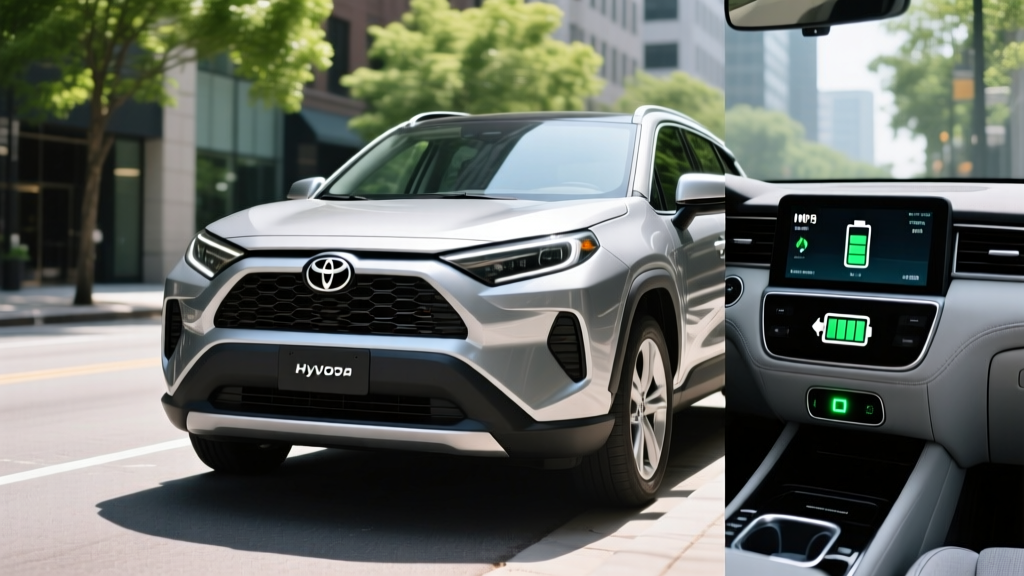
The Toyota RAV4 Hybrid remains one of the most-purchased electrified vehicles in America, and for good reason: it delivers crossover utility with hybrid efficiency without requiring a charging plug. But with multiple trims, a plug-in sibling (the RAV4 Prime), and shifting incentive rules, the cost of a RAV4 Hybrid involves more than just the window sticker. This guide breaks down every dollar — purchase price, fuel savings, maintenance, battery longevity, and tax credit eligibility — so you can decide whether the HEV, the PHEV, or a full EV is the right move for your garage.
RAV4 Hybrid vs. RAV4 Prime: HEV and PHEV Explained
Toyota sells two electrified RAV4 variants, and confusing them is the most common buyer mistake. Here is the critical difference:
Conventional Hybrid (HEV) — RAV4 Hybrid
- No plug required. The 1.6 kWh nickel-metal hydride (NiMH) traction battery charges entirely through regenerative braking and the gasoline engine.
- You fuel it like a normal car. The hybrid system simply makes the engine run less often and more efficiently.
- No electric-only driving range to speak of — the motor assists the engine at low speeds but cannot sustain pure-electric travel beyond brief, low-speed coasting.
Plug-In Hybrid (PHEV) — RAV4 Prime
- Plug-in capable. The 18.1 kWh lithium-ion battery provides a genuine electric-only range before the gas engine kicks in.
- Charges via Level 1 (120V) or Level 2 (240V) AC charging. No DC fast charging support.
- Operates as an EV for daily commutes, then seamlessly transitions to hybrid mode for longer trips.
If you cannot install a home charger or plug in regularly, the conventional RAV4 Hybrid is the correct choice. The Prime's advantage evaporates if its battery is never charged externally — you would be carrying 300+ lbs of battery weight without the benefit.
2026 RAV4 Hybrid Pricing by Trim
Toyota has structured the RAV4 Hybrid lineup across six trims for the 2026 model year. All trims come standard with electronic on-demand all-wheel drive (AWD). Here is the MSRP breakdown before any incentives or dealer adjustments:
| Trim | MSRP (incl. destination) | Key Additions |
|---|---|---|
| LE | $34,825 | Toyota Safety Sense 3.0, 8" touchscreen, wireless CarPlay/Android Auto |
| XLE | $36,325 | Blind Spot Monitor, dual-zone climate, Smart Key, alloy roof rails |
| XLE Premium | $38,725 | SofTex seats, power liftgate, 12.3" digital cluster |
| SE | $38,475 | Sport-tuned suspension, 19" wheels, paddle shifters |
| XSE | $40,075 | Bi-tone exterior, heated front seats, ambient lighting |
| Limited | $42,825 | JBL audio, panoramic moonroof, ventilated seats, 360° camera |
RAV4 Prime (PHEV) pricing starts at $46,125 for the SE and $50,550 for the XSE. The Prime carries a significant premium, but as we'll see, the tax credit and fuel-cost math can close that gap for the right buyer.
Fuel Economy: EPA MPG and Real-World Numbers
The RAV4 Hybrid's fuel economy is its headline selling point. Here are the official EPA figures from fueleconomy.gov:
| Model | City MPG | Highway MPG | Combined MPG | Combined Range |
|---|---|---|---|---|
| RAV4 Hybrid (AWD, all trims) | 41 | 38 | 39 | ~565 miles (14.5-gal tank) |
| RAV4 Prime (PHEV, hybrid mode) | 40 | 36 | 38 | ~550 miles (14.5-gal tank) |
| RAV4 Prime (PHEV, EV mode) | 94 MPGe combined | 42 miles electric-only | ||
| RAV4 Gas (AWD, baseline comparison) | 27 | 34 | 30 | ~435 miles |
Real-World MPG: What to Actually Expect
Hybrids tend to outperform their EPA city estimates in stop-and-go driving because regenerative braking recovers more energy. In real-world mixed driving, RAV4 Hybrid owners commonly report 38–43 MPG combined. Highway-dominant commutes at 75+ mph may drop to 34–36 MPG, since the engine bears more load and regen opportunities decrease.
Cold weather impacts are modest compared to full EVs. Expect a 3–5 MPG reduction in sub-freezing temperatures as the engine runs more frequently to provide cabin heat. This is a fraction of the 20–30% range loss a battery-electric vehicle experiences in the same conditions.
RAV4 Prime Electric-Only Range
The RAV4 Prime delivers 42 miles of EPA-rated electric-only range from its 18.1 kWh lithium-ion battery. In practice, mild-weather city driving can stretch this to 45–48 miles thanks to regen efficiency. Highway driving at 70 mph in cold weather may reduce it to 32–35 miles. Total combined range (electric + gasoline) exceeds 600 miles.
Powertrain Specs: What Moves the RAV4 Hybrid
| Specification | RAV4 Hybrid (HEV) | RAV4 Prime (PHEV) |
|---|---|---|
| Engine | 2.5L inline-4 Atkinson-cycle | 2.5L inline-4 Atkinson-cycle |
| Electric Motors | 2 (front + rear AWD) | 2 (front + rear, higher output) |
| Combined Net Horsepower | 219 hp | 302 hp |
| 0–60 mph | 7.4 seconds | 5.7 seconds |
| Drivetrain | Electronic AWD (eAWD) | Electronic AWD (eAWD) |
| Traction Battery | 1.6 kWh NiMH | 18.1 kWh lithium-ion |
| Towing Capacity | 1,750 lbs | 1,750 lbs |
| Transmission | eCVT | eCVT |
The RAV4 Prime's 302 hp output makes it the quickest RAV4 Toyota sells — quicker than the gas-only V6-era models. The standard Hybrid's 219 hp is more than adequate for merging and passing, and the eCVT delivers seamless, shift-free acceleration.
RAV4 Prime Charging Details
The Prime charges via AC only — there is no DC fast charging capability, which is typical for PHEVs in this class. Charging times:
- Level 1 (120V household outlet): ~12 hours from empty to full using the included portable cordset.
- Level 2 (240V, 32A): ~2.5 hours with the Prime's upgraded 6.6 kW onboard charger (available on XSE and optional on SE for 2026).
- Level 2 (240V, 16A): ~4.5 hours with the base 3.3 kW onboard charger.
For daily use, even Level 1 overnight charging will replenish the 42-mile range if your commute is under 30 miles round-trip.
Federal Tax Credits and Incentives: What You Can Actually Claim
This is where HEV and PHEV diverge dramatically under current IRS §30D rules:
RAV4 Hybrid (HEV): No Federal Tax Credit
Conventional hybrids that cannot be plugged in do not qualify for the §30D Clean Vehicle Credit. There is no federal purchase incentive for the standard RAV4 Hybrid. Some states and utilities offer rebates for high-MPG vehicles — check your local programs — but these vary by jurisdiction and change frequently.
RAV4 Prime (PHEV): Up to $7,500 Federal Credit
The RAV4 Prime qualifies for the full $7,500 federal tax credit under current IRS §30D rules, provided you meet all eligibility requirements. As of 2026, the credit can be transferred to the dealer at point of sale, effectively reducing your purchase price by $7,500 on the spot.
- Buyer income cap: Modified AGI must not exceed $150,000 (single), $225,000 (head of household), or $300,000 (married filing jointly).
- MSRP cap: The vehicle's MSRP must not exceed $80,000 for SUVs (both Prime trims qualify).
- Battery sourcing: The vehicle must meet critical mineral and battery component requirements set by the Treasury Department. The RAV4 Prime has maintained compliance through the 2026 model year, but always verify with your dealer at purchase.
- Point-of-sale transfer: You can elect to transfer the credit to the selling dealer, reducing your out-of-pocket cost immediately rather than waiting to claim it on your tax return.
The math after credit: A RAV4 Prime SE at $46,125 minus $7,500 = $38,625 effective price — essentially the same as a mid-trim RAV4 Hybrid XLE Premium, but with 42 miles of electric range and 302 hp. For eligible buyers, the Prime becomes the value play.
Note: Tax credit rules are subject to legislative change. Consult a tax professional and verify current eligibility on irs.gov before purchasing.
Battery Longevity, Warranty, and Replacement Cost
Battery lifespan is the single most common concern among first-time hybrid buyers. Here is the data:
Toyota Hybrid Battery Warranty
- RAV4 Hybrid (NiMH): 10 years / 150,000 miles (whichever comes first), transferable to subsequent owners.
- RAV4 Prime (Li-ion): 10 years / 150,000 miles for the traction battery.
- Capacity threshold: Toyota warrants the battery against failure and abnormal capacity loss. In practice, Toyota's hybrid battery management is conservative — the system never uses the full top or bottom of the battery's capacity, which dramatically extends cycle life.
Real-World Battery Degradation
Toyota's hybrid synergy drive system is among the most proven in the industry, with over two decades of Prius fleet data. The RAV4 Hybrid's 1.6 kWh NiMH pack is small and lightly stressed — it acts as a buffer, not a primary energy source. Real-world failure before 150,000 miles is uncommon. Independent fleet data suggests Toyota hybrid batteries retain 85–92% of original capacity at the 10-year mark under normal use.
The RAV4 Prime's larger lithium-ion pack is more complex but benefits from active thermal management. Early Prime owners (2021–2022 models) are now at the 4–5 year mark with minimal reported degradation.
Battery Replacement Cost
If a replacement is needed out of warranty:
- RAV4 Hybrid (NiMH): $2,500–$3,800 for a new OEM battery pack, including labor. Refurbished units are available for $1,500–$2,200.
- RAV4 Prime (Li-ion): $8,000–$12,000 for a new OEM pack, reflecting the larger capacity and lithium-ion chemistry.
Given the 10-year/150,000-mile warranty coverage and Toyota's reliability track record, out-of-pocket replacement during typical ownership is statistically unlikely.
Total Cost of Ownership: 5-Year Breakdown
Let's compare the real cost of owning a RAV4 Hybrid LE, a RAV4 Prime SE (with tax credit), and a gas-only RAV4 LE AWD over 5 years and 75,000 miles (15,000 miles/year). Assumptions: $3.40/gallon regular unleaded, $0.14/kWh electricity, standard maintenance schedules.
| Cost Category | RAV4 Gas LE (AWD) | RAV4 Hybrid LE | RAV4 Prime SE (after credit) |
|---|---|---|---|
| Purchase Price (effective) | $32,350 | $34,825 | $38,625 |
| Fuel / Electricity (5 yr) | $8,500 | $6,540 | $3,900* |
| Maintenance (5 yr) | $3,200 | $2,800 | $2,800 |
| Insurance (5 yr est.) | $7,500 | $7,800 | $8,200 |
| Depreciation (est. 5 yr) | $14,500 | $13,200 | $15,500 |
| Total 5-Year Cost | $66,050 | $65,165 | $69,025 |
*Prime fuel cost assumes 70% of driving is within electric-only range and the vehicle is charged nightly at home. Drivers who cannot plug in regularly should expect costs closer to the Hybrid column.
The Hybrid saves roughly $885 over the gas model across five years — modest but meaningful, and the gap widens significantly if gas prices rise. The Prime's higher effective cost reflects its premium purchase price, but for buyers who can charge at home and whose commutes fit within 42 electric miles, the daily driving experience (silent, instant-torque EV mode) is a qualitative advantage the spreadsheet doesn't fully capture.
Who Should Buy the RAV4 Hybrid, the Prime, or a Full EV?
Choose the RAV4 Hybrid (HEV) if:
- You have no access to plug-in charging at home or work.
- You want maximum MPG with zero behavior change — just fuel up and drive.
- Your budget tops out around $35,000–$40,000.
- You take frequent long road trips and don't want to plan around charging stops.
- You value Toyota's long-term reliability and strong resale value.
Choose the RAV4 Prime (PHEV) if:
- You can install a Level 2 charger at home or have reliable workplace charging.
- Your daily round-trip commute is under 40 miles — you'll drive electric almost every day.
- You qualify for the $7,500 federal tax credit, making the effective price competitive with the Hybrid.
- You want the performance bump (302 hp, 5.7s 0–60) alongside efficiency.
- You want EV-like daily driving with the gas-engine safety net for road trips.
Choose a Full EV (e.g., Tesla Model Y, Hyundai Ioniq 5) if:
- You have reliable home Level 2 charging and access to DC fast charging networks for road trips.
- You want to eliminate gasoline entirely and minimize moving parts.
- You qualify for the full $7,500 credit on an eligible EV.
- Your household has a second gas or hybrid car for longer trips, or you're comfortable with DC fast charging on road trips.
RAV4 Hybrid Pros
- 39 MPG combined EPA — excellent for an AWD crossover
- No plug-in charging needed; zero lifestyle change
- Strong resale value and proven Toyota reliability
- Spacious cargo area (37.6 cu ft behind rear seats)
- Standard AWD on all trims
- Competitive starting MSRP at $34,825
RAV4 Hybrid Cons
- No federal tax credit (HEV ineligible for §30D)
- eCVT drone under hard acceleration
- 219 hp is adequate, not quick — 7.4s to 60 mph
- Infotainment is functional but not class-leading
- Road noise noticeable at highway speeds
- No DC fast charging capability (not applicable to HEV)
Frequently Asked Questions
How many MPG does the RAV4 Hybrid get in real-world driving?
The EPA rates the RAV4 Hybrid at 41 city / 38 highway / 39 combined MPG. In real-world mixed driving, most owners report 38–43 MPG. City-heavy routes with frequent stops maximize regenerative braking and can push figures above the EPA estimate. Sustained highway driving at 75+ mph typically yields 34–36 MPG.
How far can the RAV4 Prime go on electric only?
The RAV4 Prime delivers 42 miles of EPA-rated electric-only range. In mild weather with city driving, expect 45–48 miles. In cold weather at highway speeds, plan for 32–35 miles. Once the battery depletes, it seamlessly operates as a conventional hybrid at 38 MPG combined.
Does the RAV4 Hybrid qualify for any tax credit?
No. The conventional RAV4 Hybrid (HEV) does not qualify for the federal §30D Clean Vehicle Credit because it cannot be plugged in. The RAV4 Prime (PHEV) qualifies for up to $7,500, subject to buyer income limits, MSRP caps, and battery sourcing requirements. Always verify current rules at irs.gov.
Is the RAV4 Hybrid reliable, and what does battery replacement cost?
The RAV4 Hybrid has an excellent reliability record, backed by Toyota's 10-year/150,000-mile hybrid battery warranty. Out-of-warranty NiMH battery replacement runs $2,500–$3,800 for the HEV, but failures within the first 150,000 miles are statistically rare. Toyota's hybrid system is among the most proven in the industry.
Do I need to plug in the RAV4 Hybrid?
No. The standard RAV4 Hybrid is a conventional hybrid (HEV) — it charges its small battery through regenerative braking and the gasoline engine. You never plug it in. Only the RAV4 Prime (PHEV) benefits from plug-in charging.
How does the RAV4 Hybrid compare to a full EV for cost savings?
A full EV like the Tesla Model Y or Hyundai Ioniq 5 offers lower per-mile fuel costs (roughly $0.04–$0.06/mile on electricity vs. $0.09–$0.11/mile for the RAV4 Hybrid on gas). However, EVs carry higher purchase prices, potential charging infrastructure costs, and greater range sensitivity in cold weather. The RAV4 Hybrid offers a middle path: meaningful fuel savings with no charging dependency and a lower entry price.