Quick Verdict: The BMW X5 PHEV in 2026
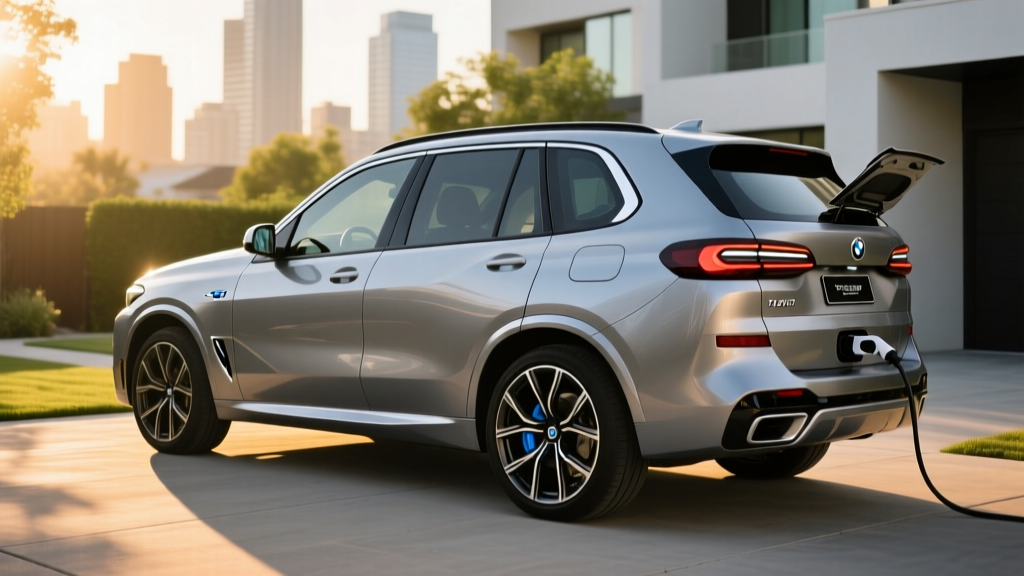
The 2026 BMW X5 xDrive50e is a luxury plug-in hybrid (PHEV) that bridges the gap between a conventional gas SUV and a full battery-electric vehicle. With an EPA-estimated 38 miles of electric-only driving, 483 combined horsepower, and a starting MSRP around $68,900, it targets buyers who want electric commuting without range anxiety on road trips. But whether it qualifies for the federal §30D tax credit — and whether its real-world efficiency matches the sticker — requires a closer look at the numbers.
| Spec | Value |
|---|---|
| Powertrain | 3.0L turbocharged I6 + electric motor (PHEV) |
| Combined Horsepower | 483 HP / 516 lb-ft torque |
| Battery (Usable) | ~25.7 kWh (NMC lithium-ion) |
| EPA Electric-Only Range | 38 miles |
| EPA Combined MPGe | 56 MPGe (EV + gas) |
| EPA MPG (Gas Only, Combined) | 27 MPG |
| Total Combined Range | ~440 miles |
| 0–60 mph | 4.6 seconds |
| AC Charging (Level 2) | 7.4 kW (~3.5 hours 0–100%) |
| DC Fast Charging | Not supported |
| Base MSRP | ~$68,900 (before destination) |
| Battery Warranty | 8 years / 80,000 miles |
HEV vs PHEV: Where the X5 xDrive50e Fits
Before diving into the X5's numbers, it's worth clarifying what kind of hybrid this is — because the difference between a conventional hybrid (HEV) and a plug-in hybrid (PHEV) directly affects how you'll use it daily.
| Feature | Conventional Hybrid (HEV) | Plug-In Hybrid (PHEV) |
|---|---|---|
| Battery Size | Small (~1–2 kWh) | Larger (~15–30 kWh) |
| Electric-Only Range | 0–2 miles at low speed | 20–50+ miles at highway speed |
| Plug In to Charge? | No — charges via regen & engine | Yes — plug in for full EV range |
| Gas Engine | Always available, assists motor | Always available, kicks in after battery depletes |
| Federal Tax Credit | No (expired for most) | Potentially up to $7,500 (§30D, rules apply) |
| Example | Toyota RAV4 Hybrid | BMW X5 xDrive50e |
The X5 xDrive50e is firmly a PHEV. You can drive it without ever plugging in — it will function like a heavy, less-efficient hybrid — but you'd be leaving 38 miles of free electric commuting on the table. If you can't charge at home or work, a conventional HEV may serve you better at lower cost.
Fuel Economy: EPA Numbers vs Real-World MPG
BMW publishes two sets of efficiency figures for the xDrive50e: one for electric+gas combined operation (MPGe) and one for gas-only driving once the battery is depleted.
| Mode | City | Highway | Combined |
|---|---|---|---|
| Charge-Sustaining (Gas Only) | 25 MPG | 29 MPG | 27 MPG |
| Blended EV+Gas (MPGe) | — | — | 56 MPGe |
| Electric-Only Efficiency | ~72 MPGe (kWh/100mi basis) | ||
Real-world expectations: According to fueleconomy.gov, the EPA's 27 MPG combined in charge-sustaining mode is reasonable for mixed driving. In practice, PHEV owners who charge daily and commute within the 38-mile EV envelope may go weeks without burning fuel. However, on long highway trips with a depleted battery, expect closer to 24–26 MPG at sustained 75+ mph speeds — the X5's 5,200+ lb curb weight works against it.
In city driving with a charged battery, the electric motor handles most low-speed acceleration, and the gas engine stays dormant. This is where PHEVs shine: stop-and-go commuting on electricity, then seamless gas power for weekend road trips.
Electric Range, Battery, and Charging Specs
The X5 xDrive50e packs approximately 25.7 kWh of usable battery capacity (from a ~29.5 kWh gross pack) using NMC (nickel-manganese-cobalt) lithium-ion cells. BMW reserves a buffer at the top and bottom of the pack to protect long-term health — a standard practice that means you'll never see the full gross capacity on the dash.
Real-world expectation: ~30–35 miles in mixed driving. In cold weather (below 32°F), expect 20–28 miles due to reduced battery efficiency and cabin heating demands. Highway driving at 70+ mph will also reduce EV range to roughly 28–32 miles.
Charging: The X5 xDrive50e accepts Level 2 AC charging at up to 7.4 kW via a J1772 connector (NACS adapter available through BMW). A full 0–100% charge takes approximately 3.5 hours on a 240V / 32A home charger. There is no DC fast charging capability — this is a deliberate engineering choice by BMW, as the relatively small battery doesn't justify the added weight, cost, and thermal management complexity of DC hardware. For a 25.7 kWh pack, Level 2 overnight charging is practical and sufficient.
If you're charging at home on a standard 120V outlet (Level 1, ~1.4 kW), a full charge takes roughly 18 hours — effectively an overnight-plus affair. Most PHEV owners install a Level 2 wallbox for daily convenience.
Powertrain Performance: 483 HP From Engine + Motor
The xDrive50e pairs BMW's B58 3.0-liter turbocharged inline-six (producing 312 HP on its own) with an electric motor integrated into the 8-speed automatic transmission (contributing up to 184 HP). Combined system output is 483 HP and 516 lb-ft of torque, routed through BMW's xDrive all-wheel-drive system.
The result is a 0–60 mph time of 4.6 seconds — genuinely quick for a 5,200-lb luxury SUV. The electric motor fills in the torque gap before the turbo spools, delivering smooth, immediate acceleration from a stop. In EV-only mode, the X5 can reach up to 84 mph before the gas engine automatically engages — enough for most suburban and highway merging scenarios.
Driving modes include Electric, Hybrid, and Sport. In Hybrid mode, the system intelligently blends power sources based on navigation data, pre-conditioning the battery for upcoming electric-only zones (such as city centers or your home neighborhood).
Pricing, Trims, and Federal Tax Credit Eligibility
The 2026 BMW X5 xDrive50e starts at approximately $68,900 (plus $995 destination). BMW offers it in a single well-equipped trim, with options packages including the Premium Package, Driving Assistance Professional, and Executive Package pushing a fully loaded example past $82,000.
Under current IRS rules (irs.gov), the X5 xDrive50e may qualify for up to $7,500 in federal tax credits, but eligibility depends on several factors that change annually:
- MSRP Cap: SUVs must be under $80,000 MSRP. The base X5 xDrive50e qualifies; heavily optioned examples may exceed the cap.
- Buyer Income Cap: AGI must not exceed $150,000 (single) / $300,000 (joint).
- Battery Sourcing: Critical minerals and battery component requirements phase in annually. The partial credit ($3,750) or full credit ($7,500) depends on whether BMW's supply chain meets current-year thresholds.
- Point-of-Sale Transfer: Eligible buyers can apply the credit as a down-payment reduction at the dealer, rather than waiting for tax filing.
Consult a tax professional and check the IRS Clean Vehicle Credit portal before purchasing. Rules and eligible VIN lists update frequently.
Battery Warranty, Reliability, and Replacement Cost
BMW covers the X5 xDrive50e's high-voltage battery with an 8-year / 80,000-mile warranty — the federal minimum mandated by the EPA for emissions-related components, which PHEV batteries fall under. This warranty guarantees the battery will retain at least 70% of its original capacity. If it degrades below that threshold within the warranty period, BMW will repair or replace it at no cost.
Coverage: 8 years / 80,000 miles
Capacity retention guarantee: ≥70% of original
Out-of-warranty replacement estimate: $12,000–$18,000 (parts + labor at dealer)
Reliability: BMW's B58 inline-six is one of the most well-regarded engines in the industry, with a strong track record for durability. The electric motor and power electronics add complexity, but PHEV drivetrains generally experience fewer wear-related failures than conventional transmissions (the electric motor reduces mechanical stress on the engine and gearbox). BMW's overall brand reliability has improved significantly in recent JD Power and Consumer Reports rankings, though it still trails Toyota/Lexus in long-term cost-of-ownership metrics.
Replacement cost: If the battery fails outside warranty, expect a dealer replacement to cost between $12,000 and $18,000 based on current BMW parts pricing. Third-party hybrid battery repair shops are emerging as a lower-cost alternative ($5,000–$9,000 for module-level repair), but availability varies by region. For most owners who charge daily and avoid repeated 100%→0% deep cycles, the battery should outlast the vehicle's typical ownership period.
Who Should Buy the X5 PHEV vs a Full EV or Gas SUV?
The X5 xDrive50e isn't for everyone. Here's a practical decision framework:
- Your daily commute is under 35 miles round-trip and you can charge at home
- You regularly take road trips over 200 miles and don't want to plan around chargers
- You want luxury SUV refinement with meaningful fuel savings
- You don't have reliable access to public DC fast chargers in your area
- You can charge at home AND your daily driving rarely exceeds 250 miles
- You want zero tailpipe emissions and minimal maintenance
- You have access to DC fast charging for road trips
- You cannot charge at home or work
- Your budget is under $60,000 and you drive less than 10,000 miles/year
- You want a lighter vehicle with simpler long-term maintenance
- 38-mile EV range covers most daily commutes
- 483 HP delivers effortless acceleration
- No range anxiety — gas engine for long trips
- Premium interior, excellent ride quality
- Potential $7,500 federal tax credit (eligibility varies)
- 8-year battery warranty provides peace of mind
- No DC fast charging — Level 2 only
- Heavy curb weight hurts gas-only MPG (~24 MPG highway)
- Base price near $69K; options push past $80K (credit cap risk)
- Cargo space slightly reduced vs gas X5 (battery packaging)
- Real-world EV range drops significantly in cold weather
- Complex drivetrain = potentially higher out-of-warranty repair costs
Frequently Asked Questions
How many MPG does the BMW X5 PHEV get?
The EPA rates the 2026 X5 xDrive50e at 27 MPG combined in gas-only (charge-sustaining) mode — 25 city / 29 highway. When using both battery and gas, it achieves 56 MPGe combined. Real-world gas-only highway driving at 75+ mph typically yields 24–26 MPG. Owners who charge daily and commute within the 38-mile EV range may use very little gasoline for weeks at a time.
How far can the X5 PHEV go on electric only?
The EPA rates the X5 xDrive50e at 38 miles of electric-only range. In real-world mixed driving, expect 30–35 miles. Cold weather (below freezing) can reduce this to 20–28 miles. The vehicle can reach up to 84 mph in EV mode before the gas engine engages.
Hybrid vs PHEV vs EV — which is right for me?
A conventional hybrid (HEV) is best if you can't plug in and want better MPG with zero behavior change. A PHEV like the X5 xDrive50e is ideal if you can charge at home and want electric commuting plus gas flexibility for road trips. A full EV (BEV) is the right choice if you can charge at home, have DC fast-charger access for trips, and want the lowest operating cost and zero tailpipe emissions. The PHEV is the "best of both worlds" compromise — but only if you actually plug it in.
Is the BMW X5 PHEV reliable, and what does battery replacement cost?
BMW's B58 engine has a strong reliability record, and PHEV drivetrains are generally robust. The high-voltage battery is warranted for 8 years / 80,000 miles (≥70% capacity retention). Out-of-warranty battery replacement is estimated at $12,000–$18,000 at a dealer, though third-party module-level repairs may cost $5,000–$9,000. Daily charging and avoiding extreme deep-discharge cycles will maximize battery lifespan.
Does the BMW X5 PHEV qualify for a federal tax credit?
The X5 xDrive50e may qualify for up to $7,500 under the IRS §30D Clean Vehicle Credit, but eligibility depends on the buyer's income (≤$300K joint / ≤$150K single), the vehicle's MSRP (≤$80K for SUVs), and battery sourcing requirements that change annually. The credit can be applied at the point of sale as a price reduction. Always verify current eligibility on irs.gov and consult a tax professional before purchasing.
Can the X5 PHEV DC fast charge?
No. The 2026 X5 xDrive50e supports only Level 1 (120V) and Level 2 (240V, up to 7.4 kW) AC charging. A full Level 2 charge takes approximately 3.5 hours. BMW does not include DC fast-charging hardware on this model, as the ~25.7 kWh battery is small enough to refill practically overnight on Level 2.