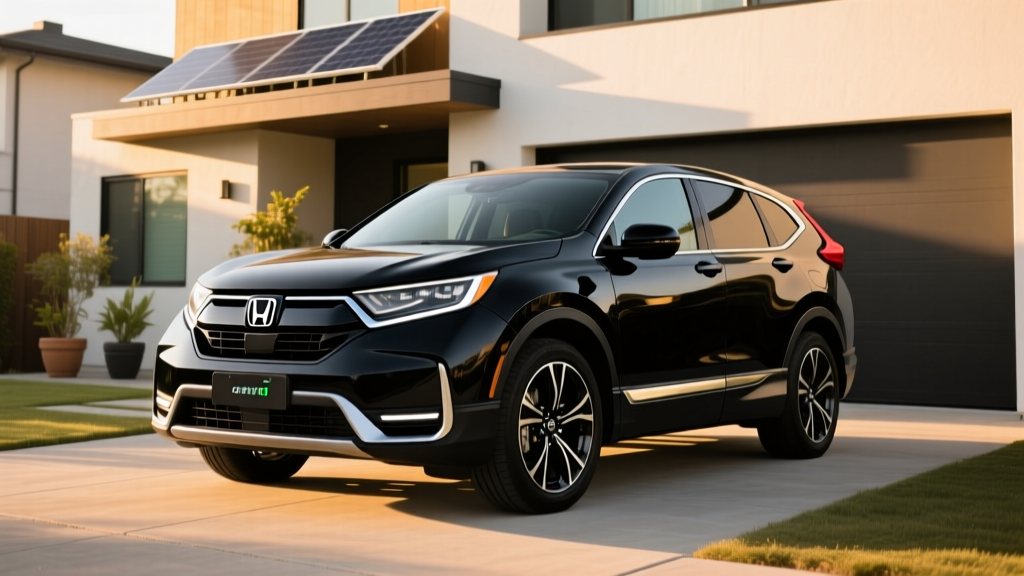
The Honda CR-V Hybrid has become one of the best-selling electrified compact SUVs in America, and its stealthy black-on-black aesthetic remains the most popular color combination among buyers who want efficiency without the visual statement of a full EV. For 2026, Honda carries forward the sixth-generation CR-V Hybrid with its proven two-motor powertrain, refined interior, and an EPA-estimated 40 MPG combined — a figure that routinely improves in real-world city driving thanks to how the hybrid system prioritizes electric propulsion at low speeds.
This guide breaks down everything a buyer needs to know about the 2026 black Honda CR-V Hybrid: exact fuel economy by trim, how the HEV powertrain works, battery longevity and warranty coverage, pricing across all four hybrid trims, and whether this conventional hybrid or a plug-in alternative makes more sense for your commute.
2026 Honda CR-V Hybrid Fuel Economy: EPA Numbers and Real-World Results
The 2026 CR-V Hybrid pairs a 2.0-liter Atkinson-cycle four-cylinder engine with two electric motors through Honda's fourth-generation two-motor hybrid system. Front-wheel-drive models lead the efficiency charts, while the widely chosen Real Time AWD trims sacrifice just 3 MPG combined.
| Drivetrain | City MPG | Highway MPG | Combined MPG | Annual Fuel Cost* |
|---|---|---|---|---|
| FWD (Sport, Sport Touring) | 43 | 36 | 40 | ~$1,450 |
| AWD (Sport, Sport Touring) | 40 | 34 | 37 | ~$1,575 |
*Based on 15,000 miles/year at $3.50/gallon regular unleaded. Source: fueleconomy.gov
HEV vs. PHEV: Why the CR-V Hybrid Doesn't Plug In (and Why That's Fine)
A common point of confusion among first-time hybrid shoppers is whether the CR-V Hybrid needs to be plugged in. It does not. The 2026 CR-V Hybrid is a conventional hybrid electric vehicle (HEV), meaning it generates all its electricity internally through regenerative braking and the gasoline engine. There is no charging port, no electric-only range to manage, and no need for home charging infrastructure.
| Feature | HEV (CR-V Hybrid) | PHEV (e.g., Toyota RAV4 Prime) |
|---|---|---|
| Plug-in charging | No — self-charging | Yes — 120V or 240V |
| Electric-only range | ~1 mile at low speed | 35–42 miles typical |
| Battery capacity | ~1.1 kWh (small buffer) | 18.1 kWh usable |
| Federal tax credit | Not eligible | Up to $7,500 (§30D) |
| Base price premium | ~$1,500 over gas model | ~$6,000+ over gas model |
| Best for | No home charging access | Short commute + home charger |
Honda does not currently offer a plug-in hybrid version of the CR-V in the United States. If electric-only commuting is a priority, you would need to look at competitors like the Toyota RAV4 Prime (42 miles EV range) or consider a full battery-electric vehicle like the Hyundai Ioniq 5 or Tesla Model Y.
Powertrain and Performance Specs
The 2026 CR-V Hybrid uses Honda's fourth-generation two-motor hybrid system, which operates primarily as a series hybrid at low and moderate speeds — the gasoline engine acts as a generator while the electric drive motor propels the wheels. At highway speeds, a lock-up clutch connects the engine directly to the front wheels for optimal efficiency.
| Specification | Value |
|---|---|
| Engine | 2.0L Atkinson-cycle DOHC 4-cylinder |
| Engine horsepower | 145 hp @ 6,100 rpm |
| Drive motor output | 184 hp / 247 lb-ft torque |
| Combined system output | 204 hp / 247 lb-ft torque |
| Transmission | Electronic CVT (e-CVT) |
| 0–60 mph (est.) | 7.6 seconds |
| Drivetrain | FWD or Real Time AWD |
| Towing capacity | 1,000 lbs (not recommended for heavy towing) |
| Fuel tank | 14.0 gallons |
| Total driving range (AWD) | ~518 miles |
The 204 combined horsepower provides confident highway merging and adequate passing power. The e-CVT eliminates shift shock entirely, and the transition between electric and engine drive is nearly imperceptible from the driver's seat. AWD models use a rear-mounted electric motor that engages the rear axle when slip is detected — this is not a full-time AWD system, which helps preserve the strong fuel economy figures.
2026 Black CR-V Hybrid Trims, Pricing, and Tax Credit Eligibility
The CR-V Hybrid is available in four trims for 2026, all offered in Honda's Crystal Black Pearl exterior. The Sport and Sport Touring trims feature black-finished wheels and dark chrome accents that make the black colorway particularly cohesive. Sport Touring adds a black leather interior option.
| Trim | Drivetrain | MSRP | Key Features |
|---|---|---|---|
| Sport | FWD | $36,395 | 19" black wheels, heated seats, 9" touchscreen, wireless CarPlay/Android Auto |
| Sport | AWD | $37,895 | Same as FWD + Real Time AWD, heated steering wheel |
| Sport-L | AWD | $40,395 | Leather seats, power liftgate, wireless phone charger |
| Sport Touring | AWD | $43,395 | Bose 12-speaker audio, navigation, heated rear seats, panoramic roof, hands-free liftgate |
Destination charge: $1,395 (included above). Prices per Honda's 2026 model-year MSRP. Source: Honda.com
Battery Longevity, Warranty Coverage, and Replacement Cost
Hybrid battery anxiety is the number-one concern we hear from prospective CR-V Hybrid buyers. Here's what the data shows: Honda's lithium-ion hybrid battery pack is designed to last the life of the vehicle, and failure rates within the warranty period are exceptionally low based on owner surveys and dealer service data.
- Hybrid battery: 8 years / 100,000 miles (10 years / 150,000 miles in CARB states including CA, NY, MA, and others)
- Hybrid system components (inverter, motor, control unit): 8 years / 100,000 miles
- Powertrain warranty: 5 years / 60,000 miles
- Limited vehicle warranty: 3 years / 36,000 miles
If the hybrid battery fails outside warranty, replacement cost at a Honda dealer typically ranges from $2,500 to $4,000 including labor. Independent hybrid specialists often offer refurbished packs for $1,500–$2,500. Given that most CR-V Hybrids are driven 12,000–15,000 miles per year, the battery should comfortably outlast 150,000+ miles under normal conditions.
The CR-V Hybrid's battery is small (~1.1 kWh) and operates within a narrow state-of-charge window — typically between 20% and 80% — which dramatically reduces degradation stress compared to a full EV battery that cycles through a wider range. This conservative buffer management is why 10-year-old Honda hybrids with 150,000+ miles routinely retain 85–90% of original battery capacity.
Reliability Ratings and Safety Scores
Honda's hybrid powertrain has accumulated over two decades of real-world reliability data, and the sixth-generation CR-V benefits from that institutional knowledge. The 2026 model carries forward the strong ratings of its predecessors.
- IIHS: Top Safety Pick+ (highest rating across all crash-test categories)
- NHTSA: 5-Star Overall Safety Rating — source: nhtsa.gov
- Consumer Reports predicted reliability: Above average for the hybrid powertrain; average for infotainment electronics
The standard Honda Sensing suite includes adaptive cruise control with low-speed follow, lane-keeping assist, road departure mitigation, and traffic sign recognition. These are SAE Level 1 driver-assistance features — the driver remains fully responsible for vehicle control at all times.
Who Should Buy the Black CR-V Hybrid — and Who Shouldn't
- You lack access to home or workplace charging (apartment, street parking)
- Your daily commute is 20–60 miles of mixed driving
- You want 500+ miles of total range with zero refueling anxiety
- You prefer a lower purchase price over maximum electrification
- You drive in extreme cold where EV range loss is a concern
- Cargo space (36.3 cu ft behind rear seats) and family utility are priorities
- Your commute is under 30 miles round-trip and you have home charging (a PHEV or EV eliminates most gas use)
- You want to qualify for the $7,500 federal EV tax credit
- You want one-pedal driving or full electric silence
- You tow more than 1,000 lbs regularly
- You plan to keep the vehicle 12+ years and want minimal fossil fuel dependency
CR-V Hybrid vs. the Competition: Quick Comparison
| Model | Combined MPG | HP | Base MSRP | EV Tax Credit |
|---|---|---|---|---|
| Honda CR-V Hybrid AWD | 37 | 204 | $37,895 | None |
| Toyota RAV4 Hybrid AWD | 39 | 219 | $36,395 | None |
| Toyota RAV4 Prime (PHEV) | 38 / 94 MPGe | 302 | $44,595 | Up to $7,500 |
| Ford Escape Hybrid AWD | 39 | 210 | $37,500 | None |
| Hyundai Tucson Hybrid AWD | 38 | 226 | $37,250 | None |
The CR-V Hybrid trades a slight MPG deficit to the RAV4 Hybrid for a more refined ride, a more spacious rear seat, and higher-quality interior materials. If maximum electrification matters, the RAV4 Prime PHEV's 42-mile EV range is compelling — but its $6,700+ price premium over the CR-V Sport AWD takes years of fuel savings to recoup.
Frequently Asked Questions
How many MPG does the black Honda CR-V Hybrid actually get?
The EPA rates the 2026 CR-V Hybrid AWD at 40 city / 34 highway / 37 combined MPG. FWD models earn 43/36/40. In real-world suburban driving, most owners report 38–42 MPG combined, with city-heavy routes pushing above 43 MPG and sustained highway driving dropping to 31–33 MPG.
Does the CR-V Hybrid need to be plugged in?
No. The CR-V Hybrid is a conventional HEV that charges its small battery through regenerative braking and the gasoline engine. There is no plug, no charging port, and no electric-only commute mode. You simply fill it with gas like any other vehicle.
Does the 2026 CR-V Hybrid qualify for any federal tax credit?
Not the new-vehicle §30D credit, which requires plug-in capability and a minimum 7 kWh battery. The CR-V Hybrid's ~1.1 kWh pack doesn't meet this threshold. However, a used CR-V Hybrid may qualify for the up-to-$4,000 used clean vehicle credit if purchased from a dealer and income/price caps are met. Check current IRS guidelines before purchasing.
How long will the CR-V Hybrid battery last, and what does replacement cost?
Honda warranties the hybrid battery for 8 years/100,000 miles (10/150,000 in CARB states). Real-world data from prior-generation CR-V and Accord Hybrids shows most batteries lasting 150,000–200,000+ miles with minimal degradation. Out-of-warranty replacement runs $2,500–$4,000 at a dealer, or $1,500–$2,500 through independent hybrid shops.
Is the CR-V Hybrid better than a full EV like the Tesla Model Y?
It depends entirely on your charging situation. If you have reliable Level 2 home charging and a commute under 250 miles, a full EV eliminates gas costs entirely and offers lower per-mile energy costs ($0.04–$0.06/mile vs. $0.09–$0.11/mile for the CR-V Hybrid). If you live in an apartment, take frequent 400+ mile road trips, or face extreme cold, the CR-V Hybrid's go-anywhere convenience and 518-mile total range are significant advantages.
Which black CR-V Hybrid trim should I buy?
The Sport AWD at $37,895 offers the best value — you get the full hybrid powertrain, AWD, heated seats, and a 9-inch touchscreen. The Sport-L ($40,395) adds leather and a power liftgate for those who want a more premium feel. The Sport Touring ($43,395) is well-equipped but approaches luxury-SUV pricing without the badge. For the black-on-black look, the Sport and Sport Touring trims with black wheels and dark accents are the most visually cohesive.