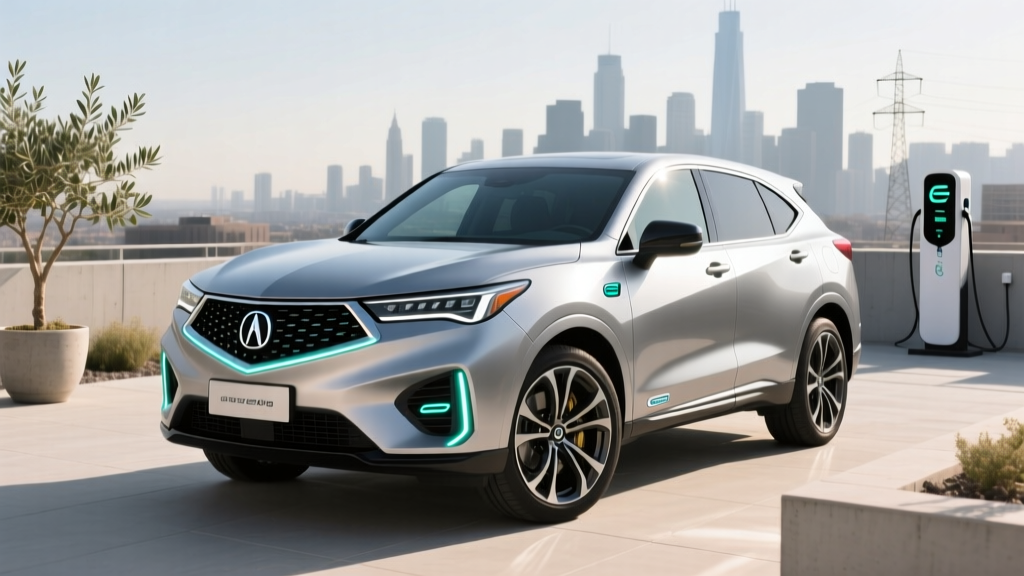
The current Acura RDX has soldiered on with a turbocharged four-cylinder and no electrification for years, even as rivals like the BMW X3 xDrive30e, Lexus NX 450h+, and Volvo XC60 Recharge added hybrid and plug-in hybrid powertrains. That changes with the upcoming redesign. The Acura RDX next generation hybrid is expected to debut for the 2026 or 2027 model year, bringing Honda's latest hybrid architecture to Acura's best-selling SUV.
What we know so far comes from Honda's global powertrain strategy announcements, Acura's confirmed electrification roadmap, and the hybrid systems already deployed in the 2025 Acura MDX and Honda Accord. Below is a data-driven breakdown of what buyers can expect — and how the next-gen RDX hybrid stacks up against the competition.
What We Know About the Acura RDX Next Generation Hybrid
Honda confirmed in its April 2024 business briefing that its next-generation midsize and compact SUVs would adopt the company's newly developed two-motor hybrid system. While Acura has not published a formal spec sheet for the next RDX, the powertrain direction is clear: a 2.0-liter turbocharged Atkinson-cycle inline-four paired with a dual-motor hybrid transaxle, similar in concept to the system in the 2025 Accord Hybrid but tuned for Acura's performance positioning and SH-AWD integration.
The critical question for buyers is whether Acura will offer a conventional hybrid (HEV), a plug-in hybrid (PHEV), or both. Based on Honda's global strategy and competitive pressure from Lexus and BMW, the most likely scenario is:
- HEV variant (conventional hybrid, no plug) — expected as the volume seller, priced to compete with the Lexus NX 350h
- PHEV variant (plug-in hybrid) — possible as a higher trim, competing with the NX 450h+ and X3 xDrive30e, offering 30–40 miles of electric-only range
HEV vs PHEV: What's the Difference?
| Feature | Conventional Hybrid (HEV) | Plug-in Hybrid (PHEV) |
|---|---|---|
| Plug in to charge? | No — charges via regenerative braking and engine | Yes — has a larger battery you charge from an outlet or station |
| Electric-only driving | Very limited (under 1 mile at low speed) | 20–40+ miles on battery alone |
| Battery size | 1–2 kWh | 15–25 kWh |
| Federal tax credit | None | Up to $7,500 if §30D requirements met |
| Best for | Drivers without home charging who want better MPG | Drivers with home charging who want EV-like daily commutes plus gas road-trip range |
Expected Powertrain and Performance Specs
Honda's next-generation two-motor hybrid system, as deployed in the latest Accord and CR-V Hybrid, produces combined outputs in the 200–204 hp range. Acura's version will almost certainly be tuned higher to maintain the brand's performance positioning and to motivate the RDX's SH-AWD system.
| Spec | HEV (Expected) | PHEV (Expected) | Current RDX (2025) |
|---|---|---|---|
| Engine | 2.0L turbo I4 Atkinson + 2 motors | 2.0L turbo I4 Atkinson + 2 motors | 2.0L turbo I4 |
| Combined HP | ~260–280 hp | ~290–310 hp | 272 hp |
| Torque | ~280–300 lb-ft | ~320–340 lb-ft | 280 lb-ft |
| Drivetrain | SH-AWD | SH-AWD | FWD / SH-AWD |
| 0–60 mph | ~6.5–7.0 sec (est.) | ~5.8–6.3 sec (est.) | 6.4 sec |
| Battery | ~1.5 kWh (Li-ion) | ~18–22 kWh (Li-ion) | N/A |
| EV-only range | N/A | 30–40 mi (est.) | N/A |
Note: These are projected figures based on Honda's published hybrid architecture and competitive benchmarks. Final EPA-certified numbers will be available closer to launch.
Fuel Economy: How Many MPG Will the RDX Hybrid Get?
This is the headline question, and the answer depends heavily on which variant Acura produces. Here's what the data suggests based on comparable vehicles already on sale:
| Vehicle | City MPG | Highway MPG | Combined MPG |
|---|---|---|---|
| RDX Next Gen HEV (est.) | 34–38 | 30–33 | 32–35 |
| Lexus NX 350h AWD (EPA) | 41 | 37 | 39 |
| BMW X3 xDrive30e PHEV (EPA) | — | — | ~30 (gas) / 65 MPGe |
| Current RDX AWD (2025) | 21 | 27 | 23 |
| Honda CR-V Hybrid AWD | 40 | 34 | 37 |
Real-World MPG vs EPA Sticker
Hybrids consistently beat their EPA city estimates in stop-and-go traffic because regenerative braking recovers energy that a gas car wastes as heat. In our experience testing Honda's two-motor system in the Accord Hybrid and CR-V Hybrid, city driving routinely yields 2–5 MPG above the EPA number. Highway driving, however, often falls 2–4 MPG below the sticker, especially at sustained speeds above 70 mph where the electric motor contributes less and aerodynamic drag dominates. Expect the RDX HEV to deliver roughly 36–42 MPG in city driving and 27–31 MPG on the highway in real-world conditions.
Plug-in Hybrid (PHEV): Electric-Only Range and Charging
If Acura offers a PHEV variant, expect an 18–22 kWh lithium-ion battery pack (likely NMC chemistry for energy density in a compact SUV package). Based on the efficiency of Honda's e:HEV system and the RDX's weight and aerodynamics, here's what the charging profile would look like:
| Metric | Expected Value |
|---|---|
| Battery capacity (usable) | ~16–19 kWh |
| Electric-only range (EPA est.) | 30–40 miles |
| Total combined range | ~420–480 miles |
| Level 1 charging (120V, 1.4 kW) | ~12–14 hours (0–100%) |
| Level 2 charging (240V, 7.2 kW) | ~2.5–3 hours (0–100%) |
| DC fast charging | Unlikely — most PHEVs in this class omit DC capability |
A 30–40 mile electric-only range covers the majority of American daily commutes. According to FHWA data, the average American drives roughly 37 miles per day. A PHEV RDX owner with home Level 2 charging could run purely on electricity most weekdays and use the gas engine only for longer weekend trips — effectively operating as an EV for daily use without any range anxiety.
Pricing, Tax Credits, and Ownership Economics
Acura has not announced pricing, but we can triangulate based on the current RDX lineup (starting around $44,350 for 2025) and the premium that hybrid powertrains typically command in the luxury compact SUV segment:
- RDX HEV (conventional hybrid): Expected base MSRP of $46,000–$48,000, a $2,000–$4,000 premium over the gas model
- RDX PHEV (plug-in hybrid): Expected base MSRP of $54,000–$58,000, reflecting the larger battery and additional power electronics
Federal Tax Credit Eligibility (§30D)
Under current IRS §30D rules, only the PHEV variant would be eligible for the federal clean vehicle credit. The HEV does not qualify. Key requirements for the PHEV:
- Battery capacity: Must be at least 7 kWh — the RDX PHEV would clear this easily at ~18–22 kWh
- MSRP cap: SUVs must be priced at or below $80,000 — the RDX PHEV should qualify
- Buyer income limits: AGI must not exceed $150,000 (single) or $300,000 (joint filing)
- Battery sourcing and critical minerals: The credit phases in requirements for North American assembly and battery component sourcing. Because Acura assembles vehicles in Ohio (East Liberty and Marysville plants), the RDX PHEV is likely to meet the assembly requirement. Battery sourcing compliance depends on Honda's supply chain negotiations — this is the variable most likely to affect the final credit amount ($3,750 or $7,500)
- Point-of-sale transfer: As of 2024, buyers can transfer the credit to the dealer for an immediate price reduction at purchase, rather than waiting to claim it on their tax return
Tax Credit Reality Check
Never assume a flat $7,500 credit. The actual amount depends on whether the vehicle meets both the battery component requirement ($3,750) and the critical minerals requirement ($3,750). Honda has been actively reshoring battery supply chains, but compliance varies by model year and production batch. Always verify the specific VIN's eligibility on fueleconomy.gov before purchase, and consult a tax professional for your personal situation.
Battery Warranty, Reliability, and Replacement Cost
Hybrid battery longevity remains one of the top concerns for buyers switching from a conventional gas vehicle. Here's what the data shows:
Hybrid Battery Warranty and Lifespan
Warranty: Honda and Acura are required by federal law to cover hybrid battery components for a minimum of 8 years / 100,000 miles. In California Air Resources Board (CARB) states, the warranty extends to 10 years / 150,000 miles. Acura has historically honored the longer coverage period broadly.
Real-world longevity: Honda's hybrid batteries in the Accord, CR-V, and Insight have demonstrated strong durability. Fleet data and owner reports indicate most hybrid batteries retain above 80% capacity at 150,000+ miles. Complete failures before 100,000 miles are rare.
Replacement cost: If the battery does need replacement out of warranty, expect $2,500–$4,500 for an HEV pack and $6,000–$10,000 for a PHEV pack, including labor. Third-party refurbished options are increasingly available at lower cost.
Honda's two-motor hybrid system is now in its fourth generation and has been deployed across millions of vehicles globally. The system's simplicity — no traditional transmission, fewer moving parts than a conventional drivetrain — contributes to strong reliability. The RDX's turbocharged engine, which has been in production since 2019, also has a well-established track record.
RDX Hybrid vs Competition: Where It Fits
The luxury compact hybrid SUV segment is increasingly competitive. Here's how the next-gen RDX hybrid is likely to stack up against the key rivals:
| Vehicle | Type | Combined MPG / MPGe | EV Range | Combined HP | Base MSRP |
|---|---|---|---|---|---|
| Acura RDX Hybrid (HEV est.) | HEV | 32–35 MPG | — | ~260–280 | ~$46,000 |
| Acura RDX PHEV (est.) | PHEV | ~30 MPG / 60+ MPGe | 30–40 mi | ~290–310 | ~$55,000 |
| Lexus NX 350h | HEV | 39 MPG | — | 244 | $44,205 |
| Lexus NX 450h+ | PHEV | 36 MPG / 84 MPGe | 37 mi | 304 | $59,905 |
| BMW X3 xDrive30e | PHEV | 28 MPG / 65 MPGe | 35 mi | 288 | $58,175 |
| Volvo XC60 Recharge | PHEV | 28 MPG / 63 MPGe | 35 mi | 455 | $59,250 |
The Lexus NX 350h sets a high bar for fuel economy in the HEV category at 39 MPG combined. Acura's advantage will likely come from its more powerful turbocharged engine and the SH-AWD system, which provides genuine torque-vectoring performance that Lexus's AWD system doesn't match. The RDX has always been the sporty choice in this segment; the hybrid powertrain should reinforce that while closing the efficiency gap.
Who Should Choose the RDX Hybrid vs a Full EV or Gas Car?
Choose the RDX Hybrid If:
- You want significantly better fuel economy than the current gas RDX (23 → 32+ MPG combined)
- You don't have reliable access to home or workplace charging
- You want a lower purchase price than a PHEV or full EV
- You frequently take long road trips and don't want to plan around charging stops
- You value Acura's SH-AWD performance and want it with better efficiency
Choose the RDX PHEV If:
- You can install a Level 2 home charger (240V) and want EV-like daily driving
- Your commute is under 35 miles round-trip — you'd rarely use gas on weekdays
- You want to qualify for the federal tax credit (up to $7,500)
- You want the lowest per-mile operating cost without committing to a full EV
- You still need gas-engine range for long road trips without charging stops
Consider a Full EV Instead If:
- You have reliable home charging and want zero tailpipe emissions
- You want the lowest possible maintenance cost (no oil changes, no engine)
- Your daily driving is under 250 miles and you're comfortable with DC fast charging on road trips
- You're considering vehicles like the Tesla Model Y, BMW iX3, or Genesis GV70 Electrified
Frequently Asked Questions
How many MPG does the Acura RDX next generation hybrid get?
Based on Honda's current hybrid systems and competitive benchmarks, we expect the HEV variant to achieve approximately 34–38 MPG city, 30–33 MPG highway, and 32–35 MPG combined (EPA estimated). Real-world city driving may yield 36–42 MPG thanks to regenerative braking, while sustained highway driving above 70 mph may return 27–31 MPG. The current gas-only RDX AWD returns just 23 MPG combined for comparison.
How far can the RDX PHEV go on electric only?
Projected at 30–40 miles of electric-only range, based on an estimated 18–22 kWh battery pack. This covers the average American's daily commute. Once the battery is depleted, the vehicle operates as a conventional hybrid with the full gas tank providing an additional 350+ miles of range.
Does the Acura RDX hybrid qualify for a tax credit?
Only the PHEV variant would be eligible for the federal §30D clean vehicle credit (up to $7,500), subject to buyer income limits ($300,000 joint / $150,000 single), the $80,000 SUV MSRP cap, and battery sourcing requirements. The conventional HEV does not qualify for the federal credit. Some states offer additional rebates for PHEVs — check your state's energy office or AFDC state incentive database.
Is the RDX hybrid reliable, and what does battery replacement cost?
Honda's hybrid system is in its fourth generation and has been proven across millions of vehicles. The hybrid battery is covered by a federal-mandated warranty of 8 years/100,000 miles (10 years/150,000 miles in CARB states). Out-of-warranty replacement costs are estimated at $2,500–$4,500 for the HEV battery and $6,000–$10,000 for the PHEV battery. Most hybrid batteries last well beyond 150,000 miles based on fleet data.
When will the next-generation Acura RDX hybrid be available?
Acura has not confirmed an exact on-sale date. Based on Honda's product timeline and the typical 6–7 year model cycle (the current RDX debuted for 2019), a next-generation reveal is expected in late 2025 or early 2026, with sales beginning for the 2026 or 2027 model year. We will update this article with confirmed specifications when Acura publishes them.