Quick Verdict: Is the 2016 Sonata Plug-In Still Worth It in 2026?
The 2016 Hyundai Sonata Plug-In Hybrid was one of the first mainstream midsize sedans to offer meaningful electric-only driving alongside a conventional gasoline engine. With an EPA-rated 27 miles of pure electric range and 99 MPGe when running on battery power, it remains a practical used-car option for commuters who want EV-like daily driving without range anxiety. In 2026, well-maintained examples sell between $9,000 and $14,000 depending on mileage and battery health — making it one of the most affordable entry points into plug-in hybrid ownership.
But a decade-old PHEV comes with real considerations: battery degradation, outdated charging hardware, and the expiration of its original federal tax credit. This guide covers the exact specs, real-world efficiency data, and ownership costs you need before buying one today.
| Spec | Value |
|---|---|
| EPA Electric-Only Range | 27 miles |
| EPA MPGe (EV mode) | 99 MPGe combined |
| EPA MPG (hybrid mode) | 39 city / 43 hwy / 40 combined |
| Total Combined Range | ~590 miles |
| Battery Capacity | 9.8 kWh (lithium-ion polymer, NMC chemistry) |
| Usable Battery Capacity | ~7.6 kWh |
| Onboard Charger | 3.3 kW (Level 2 AC only) |
| DC Fast Charging | Not supported |
| Level 2 Charge Time (0–100%) | ~2.5 hours |
| Level 1 Charge Time (120V) | ~5 hours |
| Combined System Horsepower | 202 hp |
| Engine | 2.0L GDI 4-cylinder (154 hp) |
| Electric Motor | 50 kW (67 hp) |
| Transmission | 6-speed automatic |
| 0–60 mph | ~8.4 seconds |
| Cargo Volume | 13.3 cu ft (reduced by battery) |
| Original MSRP | $34,600 (base) / $38,600 (Limited) |
| 2026 Used Price Range | $9,000–$14,000 |
HEV vs PHEV: What the 2016 Sonata Plug-In Actually Is
Hyundai sold two electrified Sonata variants in this era, and confusing them is a common buyer mistake:
| Feature | Sonata Hybrid (HEV) | Sonata Plug-In Hybrid (PHEV) |
|---|---|---|
| Plugs in to charge? | No — self-charging via regen + engine | Yes — J1772 AC port |
| Electric-only driving | Brief low-speed assist only | 27 miles EPA at highway speeds |
| Battery size | 1.62 kWh | 9.8 kWh |
| EPA combined MPG | 41 MPG | 40 MPG (hybrid) / 99 MPGe (EV) |
| EV mode top speed | N/A | ~75 mph |
| Charging port | None | J1772 (Level 1 and Level 2) |
The PHEV is the variant covered here. It has a larger battery, a more powerful electric motor, and a charge port on the driver-side front fender. If the car you're looking at doesn't have a plug port, it's the conventional HEV — a different vehicle with different economics.
How Many MPG Does the 2016 Sonata Plug-In Get?
| Mode | City | Highway | Combined |
|---|---|---|---|
| Charge-depleting (EV) | — | — | 99 MPGe |
| Charge-sustaining (hybrid) | 39 MPG | 43 MPG | 40 MPG |
Real-world MPG vs EPA: Plug-in hybrids are uniquely sensitive to driving habits. If you charge nightly and your commute is under 27 miles round-trip, you may use almost no gasoline for months — effectively achieving 100+ MPGe on a daily basis. Owners who rarely plug in and drive primarily on the highway report 36–40 MPG in charge-sustaining mode, roughly matching the EPA sticker.
City driving in hybrid mode often exceeds the EPA estimate. Regenerative braking recaptures energy at low speeds, and real-world city figures of 42–45 MPG are common among owners who drive conservatively. Highway efficiency at 75+ mph drops more noticeably — expect 38–41 MPG in warm weather and 35–38 MPG in freezing temperatures when the engine runs more to heat the cabin.
Electric-Only Range and Charging: The Daily Commute Equation
The 2016 Sonata Plug-In's 27-mile EPA electric range is its defining feature. That range was competitive in 2016 (the Chevy Volt offered 53 miles, but cost significantly more) and remains useful for short commutes in 2026.
Real-world electric range: Expect 22–25 miles in moderate temperatures with mixed city/highway driving. In winter conditions below 35°F, cabin heating and battery cold-soak reduce usable electric range to approximately 17–20 miles. Running the HVAC in eco mode and using seat heaters instead of cabin heat can recover 2–3 miles of range.
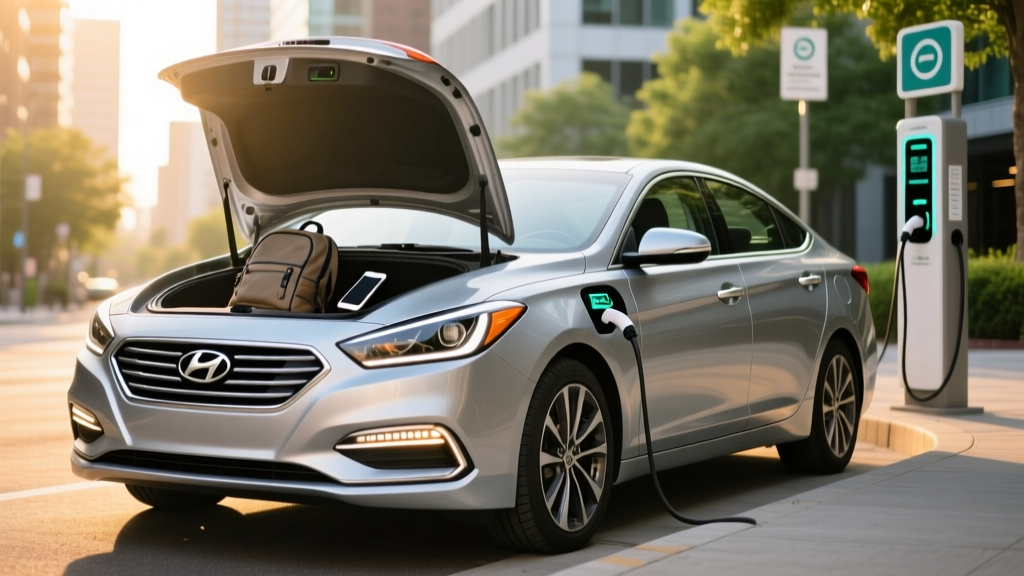
Charging hardware: The 3.3 kW onboard charger is the car's biggest limitation by 2026 standards. On a Level 2 (240V) home charger, a full charge takes about 2.5 hours. On a standard 120V outlet (Level 1), plan for roughly 5 hours. The car uses a J1772 connector — the North American standard before Tesla's NACS adoption — so it's compatible with virtually every public Level 2 station and home charger on the market.
There is no DC fast charging capability. This was normal for PHEVs of this era, and it means the Sonata Plug-In relies entirely on overnight home charging or destination Level 2 stops to replenish its battery. For a 27-mile range vehicle, this is adequate — most owners charge once at home overnight and never need public charging.
Powertrain and Driving Impressions
The Sonata Plug-In pairs a 2.0-liter GDI four-cylinder engine (154 hp, 140 lb-ft) with a 50 kW electric motor (67 hp, 151 lb-ft) integrated into the transmission housing. Combined system output is 202 hp, sent to the front wheels through a 6-speed automatic.
The electric motor's 151 lb-ft of torque is available from zero RPM, giving the car responsive off-the-line acceleration that masks its 8.4-second 0–60 mph time. In EV mode, the Sonata Plug-In pulls away from stops silently and can merge onto highways at full speed without the engine engaging — a meaningful advantage over conventional hybrids that can only creep on electric power.
When the battery depletes below its threshold, the gasoline engine starts seamlessly. The transition between EV and hybrid mode is smooth, though the 6-speed automatic can hunt for gears under hard acceleration. The steering is light and the ride quality is comfortable rather than sporty — this is a commuter sedan, not a performance car.
Reliability, Battery Health, and Warranty
Hyundai Hybrid/PHEV Battery Warranty (original): 10 years / 100,000 miles for the original owner; 8 years / 100,000 miles for subsequent owners (in CARB states). Hyundai defines battery failure as capacity dropping below 70% of original.
The 2016 Sonata Plug-In's 9.8 kWh lithium-ion polymer battery uses NMC (nickel-manganese-cobalt) chemistry. After 10 years on the road, battery degradation is a legitimate concern. PHEV batteries experience more charge cycles than full EV batteries because the usable window is smaller and they cycle deeper relative to total capacity.
Expected degradation in 2026: Based on owner reports and industry data for Hyundai/Kia PHEV packs of this era, expect 15–25% capacity loss at 100,000+ miles. A pack that originally delivered 27 miles of electric range may now provide 20–23 miles. This is noticeable but not debilitating for most commuters.
Battery replacement cost: A new OEM replacement battery pack costs approximately $3,500–$5,500 including labor at a Hyundai dealer. Third-party rebuilt packs are available for $2,000–$3,500. Before purchasing, request a battery state-of-health (SoH) reading from a dealer scan tool — this is the single most important pre-purchase check for a 10-year-old PHEV.
General reliability: The 2.0L GDI engine and 6-speed automatic are proven, conventional components with widely available parts. Common issues reported by owners include carbon buildup on intake valves (a GDI engine trait — an induction service every 50,000 miles helps), occasional 12V auxiliary battery failures (standard for any car this age), and infotainment system sluggishness. The high-voltage powertrain itself has a strong reliability record.
Tax Credits and Used PHEV Economics in 2026
The 2016 Sonata Plug-In originally qualified for a $4,167 federal tax credit under the old §30D rules (the credit was proportional to battery capacity — the 9.8 kWh pack didn't reach the full $7,500 threshold). That credit was available only to the original purchaser and is long expired for used buyers.
Current federal incentive — Used Clean Vehicle Credit (§25E): Under current IRS rules, buyers of qualifying used PHEVs and EVs may claim up to $4,000 or 30% of the sale price (whichever is less). To qualify:
- The vehicle must be at least two model years old (2016 qualifies)
- Sale price must be $25,000 or less (all 2016 Sonata PHEVs meet this)
- Buyer income must not exceed $75,000 (single) / $112,500 (head of household) / $150,000 (joint)
- The vehicle must be purchased from a licensed dealer
- The credit can only be claimed once per vehicle
At typical 2026 used prices of $9,000–$14,000, the 30% calculation yields a credit of $2,700–$4,000. This significantly improves the value proposition. Always verify eligibility on the IRS used clean vehicle credit page and consult a tax professional before filing.
Who Should Choose the 2016 Sonata Plug-In vs a Full EV or Gas Car?
Pros
- Low used price ($9K–$14K) with potential $4,000 tax credit
- 27-mile EV range covers most daily commutes gas-free
- No range anxiety — 590-mile total range for road trips
- Comfortable midsize sedan with good visibility
- J1772 charging compatible with all public Level 2 stations
- Conventional powertrain is inexpensive to service
Cons
- No DC fast charging
- 3.3 kW onboard charger is slow by 2026 standards
- Cargo space reduced to 13.3 cu ft by battery placement
- 10-year-old battery will have noticeable degradation
- Outdated infotainment (no wireless CarPlay, small screen)
- EV range drops significantly in cold weather
Choose the 2016 Sonata Plug-In if: Your daily round-trip commute is under 25 miles, you have access to Level 1 or Level 2 home charging, you want to reduce gasoline use without committing to a full EV, and your budget is under $15,000.
Choose a full EV instead if: You have reliable home charging, your daily driving is under 200 miles, and you want zero tailpipe emissions with lower maintenance costs. Consider a used 2019–2021 Hyundai Kona Electric or Chevy Bolt EV in a similar price range.
Choose a conventional hybrid (HEV) instead if: You cannot charge at home or at work. The standard Sonata Hybrid or a Toyota Camry Hybrid will deliver 40+ MPG without needing a plug.
Stick with a gas car if: You drive primarily long highway routes, live in an apartment without charging access, and prioritize the lowest upfront purchase price over fuel savings.
Frequently Asked Questions
How far can the 2016 Sonata Plug-In go on electric only?
The EPA rates it at 27 miles of electric-only range. In real-world driving, expect 22–25 miles in moderate weather and 17–20 miles in freezing temperatures. The electric motor can propel the car up to approximately 75 mph without the engine engaging.
How many MPG does it get when the battery is depleted?
In charge-sustaining (hybrid) mode, the EPA rates it at 39 city / 43 highway / 40 combined MPG. Real-world owners report 36–45 MPG depending on driving style, with city driving often exceeding the EPA estimate thanks to regenerative braking.
Does the 2016 Sonata Plug-In qualify for any tax credit in 2026?
It no longer qualifies for the new-vehicle §30D credit. However, it may qualify for the federal Used Clean Vehicle Credit (§25E) of up to $4,000 (30% of sale price) if you meet income limits and purchase from a licensed dealer. Check current rules at irs.gov.
Is the 2016 Sonata Plug-In Hybrid reliable?
Overall reliability is good. The 2.0L GDI engine and 6-speed automatic are conventional and well-supported. The high-voltage battery has a strong track record but will show 15–25% degradation at this age. Always get a battery SoH check before purchasing. Refer to IIHS safety ratings for crash-test data.
What does it cost to replace the hybrid battery?
A new OEM battery pack replacement runs $3,500–$5,500 at a Hyundai dealer. Third-party rebuilt packs cost $2,000–$3,500. Given current used car prices of $9,000–$14,000, a battery replacement represents a significant percentage of the vehicle's value — factor this into your purchase decision.
Can I charge it at public charging stations?
Yes, at any Level 2 public station with a J1772 connector — which is virtually all of them in North America. However, the 3.3 kW onboard charger means a full charge takes ~2.5 hours, so public charging is best used at destinations where you'll be parked for a while (workplaces, shopping centers). DC fast chargers are not compatible.
How does the Sonata Plug-In compare to a 2016 Chevy Volt?
The 2016 Volt offers 53 miles of electric range — nearly double the Sonata's 27 miles — and a more powerful electric motor. However, the Volt is a compact liftback with less passenger space, and used prices are typically $2,000–$4,000 higher. If electric-only range is your priority, the Volt wins. If you need a roomy midsize sedan, the Sonata Plug-In is the better fit.