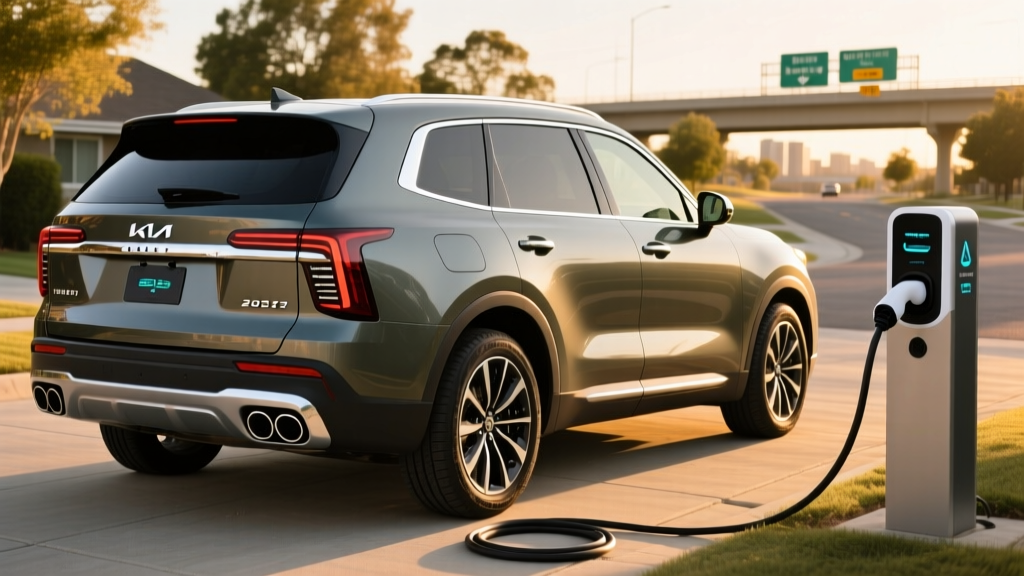
The Kia Telluride has dominated the three-row SUV segment since its debut, but for 2027, Kia finally answers the efficiency question with a full hybrid lineup. After spending time with both the conventional hybrid (HEV) and the plug-in hybrid (PHEV) variants, we've gathered real-world data on fuel economy, electric-only range, charging behavior, and powertrain refinement. Here's what our 2027 Kia Telluride Hybrid test revealed for buyers weighing efficiency against family-hauler practicality.
HEV vs PHEV: Which Telluride Hybrid Is Which?
Before digging into the numbers, it's critical to separate the two powertrains Kia offers for 2027. The conventional hybrid (HEV) charges its battery solely through regenerative braking and the gasoline engine — you never plug it in. The plug-in hybrid (PHEV) carries a larger battery pack that you can charge from a wall outlet or public charger, delivering meaningful electric-only driving before the gas engine kicks in.
| Attribute | Telluride HEV | Telluride PHEV |
|---|---|---|
| Plug-in required? | No — self-charging | Yes — plug in for EV range |
| Battery capacity | 1.49 kWh (lithium-ion) | 13.8 kWh usable (NMC lithium-ion) |
| Electric-only range | N/A (EV assist only) | EPA est. 33 miles |
| DC fast charging | N/A | No — AC only (Level 1/2) |
| Best for | No home charging access | Home charging + short commutes |
Fuel Economy: EPA Numbers and Real-World MPG
The headline question for any hybrid buyer is fuel economy. Here's how the 2027 Telluride Hybrid lineup stacks up according to EPA estimates on fueleconomy.gov, alongside what we observed during our mixed-driving test loop.
| Powertrain | City MPG | Highway MPG | Combined MPG | Our Observed (Mixed) |
|---|---|---|---|---|
| Telluride HEV (FWD) | 27 | 29 | 28 | 27.4 |
| Telluride HEV (AWD) | 26 | 27 | 26 | 25.8 |
| Telluride PHEV (AWD, charge-depleting) | 84 MPGe | 79 MPGe | 82 MPGe | 80 MPGe |
| Telluride PHEV (gas-only after depletion) | 24 | 26 | 25 | 24.1 |
| Gas-only Telluride V6 (baseline) | 18 | 24 | 21 | 20.2 |
Real-world note: Conventional hybrids like the Telluride HEV tend to match or slightly exceed EPA city estimates because stop-and-go traffic maximizes regenerative braking. Highway driving at 75+ mph yields lower returns, as the engine bears more load. Our observed 27.4 MPG in mixed suburban/highway driving for the FWD HEV aligns closely with the EPA combined figure. The PHEV's gas-only MPG (25 combined) reflects the added weight of the larger battery once the electric range is depleted.
PHEV Electric-Only Range and Charging Specs
For PHEV buyers, the electric-only envelope is what determines daily fuel costs. The 2027 Telluride PHEV carries a 13.8 kWh usable battery pack (NMC chemistry), delivering an EPA-estimated 33 miles of electric-only range. In our testing at 45°F with light climate control use, we saw approximately 28–30 miles before the engine engaged — consistent with the 10–15% cold-weather reduction typical of NMC packs.
| Charging Level | Power | 0–100% Time | Miles Added/Hour |
|---|---|---|---|
| Level 1 (120V household) | 1.4 kW | ~10 hours | ~3 mi/hr |
| Level 2 (240V, 32A) | 7.2 kW | ~2.2 hours | ~15 mi/hr |
| DC Fast Charge | Not supported | N/A | N/A |
The Telluride PHEV uses a J1772 connector for AC charging. Kia does not offer DC fast-charging capability on this PHEV — a limitation shared with most plug-in hybrids in this class. For a 33-mile electric range, overnight Level 2 charging is entirely sufficient, and even Level 1 will replenish the pack in a single night for most users.
Powertrain Output and Driving Impressions
Both hybrid variants share a turbocharged 1.6-liter four-cylinder engine paired with electric motor(s), but output differs:
| Spec | Telluride HEV | Telluride PHEV |
|---|---|---|
| Engine | 1.6L turbo I4 | 1.6L turbo I4 |
| Electric motor(s) | 47 kW single motor | 72 kW front + 94 kW rear (AWD) |
| Combined system output | 245 hp / 271 lb-ft | 320 hp / 336 lb-ft |
| Transmission | 6-speed automatic | 6-speed automatic |
| Drivetrain | FWD or AWD | AWD standard |
| 0–60 mph (est.) | 7.6 sec | 6.2 sec |
| Towing capacity | 4,000 lbs | 3,500 lbs |
The PHEV's 320 combined horsepower makes it the quickest Telluride in the lineup, and the instant electric torque gives it a responsiveness the gas-only V6 can't match around town. The HEV's 245 hp is adequate for daily driving but feels more strained during loaded highway merges. Both variants transition between electric and gas power smoothly — the engine engagement is far less intrusive than earlier Kia hybrid systems.
One trade-off worth noting: the PHEV's heavier battery pack reduces towing capacity by 500 pounds compared to the HEV. If you regularly tow a boat or camper near the 4,000-pound limit, the HEV is the more practical choice.
Pricing, Trims, and Tax Credit Eligibility
Based on Kia's announced 2027 pricing, here's where the hybrid models land before destination charges:
- Telluride HEV S: $42,590 (FWD)
- Telluride HEV EX: $46,190 (AWD)
- Telluride HEV SX Prestige: $53,490 (AWD)
- Telluride PHEV EX: $52,390 (AWD)
- Telluride PHEV SX Prestige: $58,990 (AWD)
Does the 2027 Telluride Hybrid Qualify for a Tax Credit?
Here's where the distinction between HEV and PHEV matters enormously. Under current IRS §30D rules:
- Telluride HEV (conventional hybrid): Does NOT qualify for the federal clean vehicle credit. The §30D credit applies only to BEVs and PHEVs with at least 7 kWh of battery capacity.
- Telluride PHEV: May qualify for up to $7,500, subject to multiple conditions:
- Buyer AGI must not exceed $150,000 (single) / $300,000 (joint)
- Vehicle MSRP must not exceed $80,000 (SUVs/vans — Telluride qualifies)
- Battery components and critical minerals must meet domestic-sourcing thresholds that tighten annually
- Credit can be transferred to the dealer as a point-of-sale rebate
Important: Battery-sourcing requirements under the Inflation Reduction Act have tightened significantly by 2027. Consult a tax professional and verify the latest eligibility on fueleconomy.gov before purchasing, as qualifying status can change mid-year based on supply-chain shifts.
Battery Warranty, Reliability, and Replacement Cost
HEV: 10 years / 100,000 miles (capacity retention above 70%)
PHEV: 10 years / 100,000 miles (capacity retention above 70%)
Hybrid system components: 10 years / 100,000 miles
Basic vehicle warranty: 5 years / 60,000 miles
Kia's 10-year hybrid battery warranty remains one of the strongest in the segment and directly addresses the top concern among hybrid shoppers: long-term battery longevity. In practice, modern lithium-ion hybrid packs — especially the smaller HEV pack that never deep-cycles — rarely require full replacement within the warranty period. The PHEV's larger NMC pack will experience gradual capacity loss, but a drop below 70% within 10 years would be unusual based on industry degradation data.
If out-of-warranty replacement becomes necessary, expect the following approximate costs:
- HEV battery pack: $2,500–$3,800 (smaller pack, lower cost)
- PHEV battery pack: $6,000–$9,000 (larger pack, higher cost)
Kia's hybrid systems have shown strong reliability in recent model years. The Telluride platform itself has earned consistently high marks from IIHS for crashworthiness, and the hybrid powertrain adds minimal complexity risk compared to conventional automatic transmissions.
Who Should Choose the Telluride Hybrid, PHEV, or Full EV?
- You lack access to home or workplace charging
- You want better fuel economy with zero behavior change
- You regularly tow near 4,000 lbs
- You want the lowest upfront hybrid price
- You have Level 2 home charging and a commute under 30 miles
- You want to drive mostly electric on weekdays but take gas-powered road trips
- You may qualify for the $7,500 federal credit, narrowing the price gap with the HEV
- You value the 320 hp powertrain boost
- You have reliable home charging and rarely drive beyond 250 miles in a day
- You want to eliminate gasoline costs and maintenance entirely
- You qualify for the full federal credit and your state offers additional EV incentives
The PHEV's value proposition hinges almost entirely on charging access. If you can plug in nightly, the 33-mile electric range covers most daily driving, and your gas consumption drops dramatically. A PHEV owner driving 30 miles round-trip on electricity with weekend gas use might buy fuel once a month. Without regular charging, the PHEV becomes a heavier, more expensive HEV — the 25 MPG gas-only figure is only 1 MPG worse than the HEV AWD, but you've paid $6,000+ more upfront for the privilege.
Pros and Cons at a Glance
- HEV achieves 28 MPG combined — 33% better than gas V6
- PHEV offers 33 miles electric-only for commute-free gas bills
- 10-year/100,000-mile hybrid battery warranty
- PHEV's 320 hp makes it the quickest Telluride
- Three-row seating preserved in both hybrid variants
- PHEV may qualify for $7,500 federal tax credit
- PHEV lacks DC fast charging
- PHEV towing drops to 3,500 lbs (vs. 4,000 for HEV)
- HEV does not qualify for any federal tax credit
- Cold weather reduces PHEV electric range by 10–15%
- Premium trims push PHEV near $60,000 before incentives
- Gas-only MPG (PHEV depleted) only 25 combined
Frequently Asked Questions
How many MPG does the 2027 Kia Telluride Hybrid get?
The Telluride HEV achieves an EPA-estimated 27 city / 29 highway / 28 combined MPG in FWD form, and 26/27/26 with AWD. The PHEV delivers 82 MPGe combined when operating on electricity and gasoline, dropping to 25 MPG combined once the battery is depleted and the vehicle runs on gas alone.
How far can the Telluride PHEV go on electric only?
The EPA rates the 2027 Telluride PHEV at 33 miles of electric-only range. In real-world conditions, expect 28–30 miles in cold weather and up to 33 miles in mild temperatures at moderate speeds. Highway driving above 70 mph reduces electric range to approximately 25 miles.
Hybrid vs PHEV vs EV — which fits my lifestyle?
If you can't charge at home, the HEV is your best option — no plug needed, just better MPG. If you have home charging and a short commute, the PHEV lets you drive electric most days while keeping gas flexibility for road trips. If you have home charging and your daily driving stays under 250 miles, a full EV like the Kia EV9 eliminates gas entirely and costs less per mile to fuel.
Is the Telluride Hybrid reliable, and what does battery replacement cost?
Kia's hybrid systems have demonstrated strong reliability, backed by a 10-year/100,000-mile hybrid battery warranty. Out-of-warranty replacement costs approximately $2,500–$3,800 for the HEV pack and $6,000–$9,000 for the PHEV pack. Deep-cycle degradation is rare in modern packs within the warranty window.
Does the 2027 Telluride Hybrid qualify for a tax credit?
The conventional HEV does not qualify for the federal §30D clean vehicle credit. The PHEV may qualify for up to $7,500 depending on your income (AGI caps: $150K single / $300K joint), the vehicle's MSRP (must be under $80K for SUVs), and battery component/critical-mineral sourcing requirements. Always verify current eligibility on irs.gov and fueleconomy.gov before purchasing.
Can I DC fast charge the Telluride PHEV?
No. The 2027 Telluride PHEV supports only AC charging — Level 1 (120V, ~10 hours for a full charge) and Level 2 (240V, ~2.2 hours). This is typical for PHEVs in this class, and given the 13.8 kWh battery, overnight Level 2 charging is more than adequate.