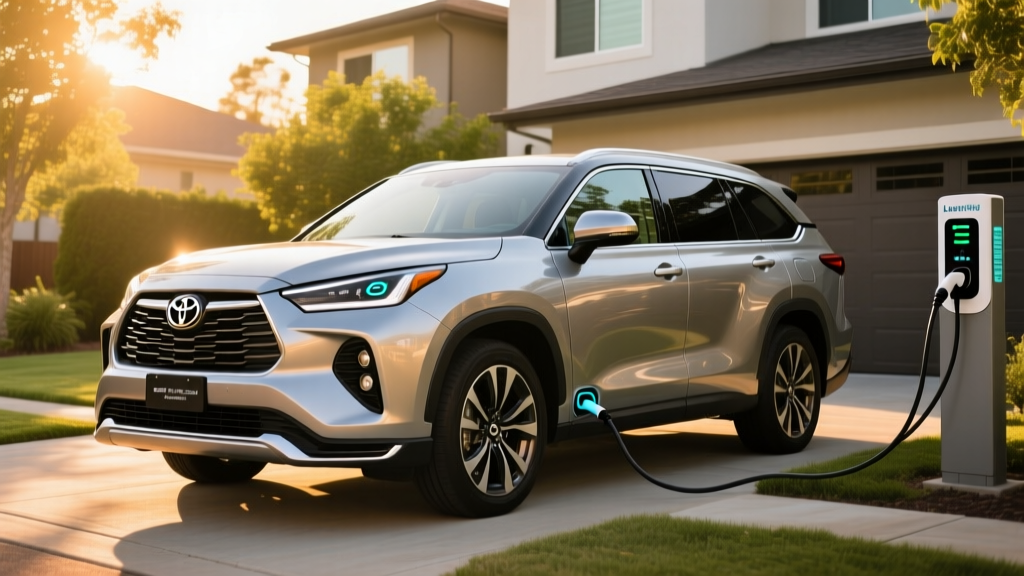
The midsize three-row SUV segment is crowded, but the Toyota Highlander Hybrid continues to occupy a specific niche: a family hauler that delivers genuinely low fuel consumption without requiring a plug, a charging routine, or any change in driving habits. For 2026, Toyota carries forward the proven fourth-generation hybrid powertrain with incremental tech and safety updates. If you're researching 2026 Highlander Hybrid features to decide whether this is the right electrified SUV for your family, this guide covers every number that matters — from EPA MPG to battery warranty to real-world efficiency.
HEV vs PHEV: What the Highlander Hybrid Actually Is
Before diving into specs, it's critical to establish what the Highlander Hybrid is — and what it isn't. The Highlander Hybrid is a conventional hybrid electric vehicle (HEV). It pairs a gasoline engine with electric motors and a small battery that recharges through regenerative braking and engine power. You never plug it in. You simply fill it with gas and drive.
HEV vs PHEV at a Glance
| Feature | Highlander Hybrid (HEV) | Plug-In Hybrid (PHEV) Example |
|---|---|---|
| Plug-in charging required? | No | Yes (for EV range) |
| Electric-only range | None (EV assist only) | 30-45 mi typical |
| Battery size | ~1.6 kWh (NiMH) | 15-25 kWh (Li-ion) |
| Federal tax credit (§30D) | Not eligible | Up to $7,500 if qualified |
| Driving routine change | None | Home charging recommended |
Toyota does not currently offer a Highlander PHEV in the United States. If you need plug-in electric range for a short commute, you'd need to look at competitors like the Jeep Grand Cherokee 4xe or consider stepping up to a fully electric three-row SUV such as the Kia EV9. The Highlander Hybrid's value proposition is simplicity: no charging infrastructure needed, no range anxiety, just consistently low fuel consumption.
2026 Highlander Hybrid Powertrain and Performance Specs
The 2026 Highlander Hybrid uses Toyota's fourth-generation hybrid system, pairing a 2.5-liter inline-four Atkinson-cycle engine with two front electric motors (and an additional rear motor on AWD trims). The result is a combined output of 243 horsepower routed through an electronically controlled continuously variable transmission (eCVT).
| Specification | 2026 Highlander Hybrid |
|---|---|
| Engine | 2.5L 4-cyl Atkinson-cycle |
| Combined Horsepower | 243 hp (net system) |
| Electric Motors | Front: 2 (MG1 + MG2); Rear: 1 (AWD trims) |
| Transmission | eCVT |
| Drivetrain | FWD or Electronic On-Demand AWD |
| Hybrid Battery | ~1.6 kWh, Nickel-Metal Hydride (NiMH) |
| 0-60 mph | ~7.8 seconds (est.) |
| Towing Capacity | 3,500 lbs |
| Seating | 7 or 8 passengers |
The eCVT isn't a traditional belt-driven CVT — it uses a planetary gearset to blend engine and motor power, which eliminates the rubber-band feel some drivers dislike in conventional CVTs. Acceleration is adequate for merging and passing, though the Highlander Hybrid prioritizes efficiency over urgency. The electronic on-demand AWD system engages the rear motor only when slip is detected, meaning there's no mechanical driveshaft to the rear wheels — reducing weight and parasitic loss.
Fuel Economy: EPA Ratings and Real-World MPG
Fuel economy is the headline feature of the Highlander Hybrid, and the numbers hold up across the lineup.
| Drivetrain | City MPG | Highway MPG | Combined MPG |
|---|---|---|---|
| FWD (LE, XLE) | 36 | 35 | 36 |
| AWD (all trims) | 35 | 34 | 35 |
Source: EPA Fuel Economy
Real-World MPG vs. EPA Sticker
In mixed suburban and city driving, the Highlander Hybrid routinely matches or slightly exceeds its EPA city rating. Hybrid systems recapture the most energy in stop-and-go traffic, where regenerative braking and low-speed electric assist do the heavy lifting. Expect 36-38 MPG in urban commuting.
On sustained highway trips at 70-80 mph, expect a slight dip to roughly 31-33 MPG, as aerodynamic drag increases and the gasoline engine carries more of the load. In cold weather (below 30°F), fuel economy may drop 2-4 MPG as the engine runs longer to maintain cabin heat and battery temperature. These are modest penalties compared to the 20-30% range loss seen in full EVs under the same conditions.
For context, the non-hybrid 2026 Highlander with the turbocharged 2.4-liter four-cylinder achieves an EPA combined 24 MPG — a difference of roughly 11 MPG. Over 15,000 miles per year at $3.40/gallon, the hybrid saves approximately $550-$650 annually in fuel costs compared to its gas counterpart.
2026 Highlander Hybrid Trim Levels and Pricing
Toyota offers the 2026 Highlander Hybrid across several trims, with AWD standard on most upper trims and available on the base LE.
| Trim | Drivetrain | MSRP (est.) | Key Features |
|---|---|---|---|
| LE | FWD or AWD | $42,220 - $43,820 | Toyota Safety Sense 3.0, 8" touchscreen, 3rd row |
| XLE | FWD or AWD | $45,820 - $47,420 | SofTex seats, power liftgate, wireless CarPlay/Android Auto |
| XSE | AWD | $48,720 | Sport-tuned suspension, 20" wheels, black exterior accents |
| Limited | AWD | $51,820 | Leather, 12.3" touchscreen, panoramic roof, JBL audio |
| Platinum | AWD | $55,220 | Head-up display, 360° camera, ventilated front seats |
Pricing reflects estimated 2026 MSRP including destination. Final MSRPs subject to Toyota's official release.
Does the Highlander Hybrid Qualify for a Tax Credit?
This is one of the most common questions buyers ask, and the answer requires precision. The Highlander Hybrid is a conventional HEV, not a plug-in vehicle. Under current IRS rules for the §30D Clean Vehicle Credit, conventional hybrids do not qualify for the federal EV tax credit. The credit — up to $7,500 — is reserved for battery electric vehicles (BEVs) and plug-in hybrid electric vehicles (PHEVs) that meet battery sourcing, critical mineral, MSRP, and buyer income requirements.
§30D Federal Tax Credit Eligibility
- ❌ Highlander Hybrid (HEV): Not eligible — no plug, insufficient battery capacity
- ✅ Plug-in hybrids (PHEVs): Eligible if battery ≥ 7 kWh, meets sourcing rules
- ✅ Battery electric vehicles (BEVs): Eligible if MSRP/income/sourcing caps met
- ⚠️ State incentives vary — some states offer rebates for HEVs (check AFDC state laws)
A handful of states and local utilities do offer modest rebates or HOV lane access for conventional hybrids, but these programs are jurisdiction-specific and change frequently. Always verify with your state's energy office or a tax professional before counting on any incentive.
Hybrid Battery Warranty, Lifespan, and Replacement Cost
Battery longevity is the top concern for hybrid buyers considering a vehicle they plan to keep for a decade or more. Toyota addresses this with one of the strongest hybrid battery warranties in the industry.
Toyota Hybrid Battery Warranty
10 years / 150,000 miles (whichever comes first) — covers the hybrid battery pack against defects and excessive capacity loss. This applies to the original owner and is transferable to subsequent owners at no cost.
Additionally, all hybrid-system components (inverter, control module, electric motors) carry the same 10-year/150,000-mile coverage under Toyota's Hybrid System Warranty.
In practice, Toyota's NiMH hybrid batteries have demonstrated exceptional longevity. Data from fleet and owner reports show that Highlander Hybrid batteries routinely last 150,000 to 200,000+ miles before needing replacement. The NiMH chemistry used in the Highlander Hybrid is less energy-dense than lithium-ion but is extremely tolerant of the shallow charge-discharge cycles that hybrids use — the battery never fully charges or fully depletes, which dramatically extends cycle life.
If replacement is eventually needed, a new OEM hybrid battery for the Highlander Hybrid typically costs between $2,500 and $4,000 including labor. Refurbished and aftermarket options are available for $1,500-$2,500. This is a fraction of the $10,000-$20,000+ replacement costs associated with large BEV battery packs.
Safety, Tech, and Driver Assistance
Every 2026 Highlander Hybrid comes standard with Toyota Safety Sense 3.0, Toyota's latest suite of driver-assistance features. This includes:
- Pre-Collision System with Pedestrian Detection
- Full-Speed Range Dynamic Radar Cruise Control
- Lane Departure Alert with Steering Assist
- Lane Tracing Assist
- Road Sign Assist
- Automatic High Beams
- Proactive Driving Assist (subtle braking/acceleration support in certain scenarios)
It's worth noting that Toyota Safety Sense is a SAE Level 1-2 driver-assistance system. The driver must remain fully engaged, hands on the wheel, and eyes on the road at all times. This is not autonomous or self-driving capability — it's a support system designed to reduce fatigue and mitigate collisions.
On the tech side, upper trims feature a 12.3-inch infotainment display with wireless Apple CarPlay and Android Auto, a 12.3-inch digital instrument cluster, and available JBL premium audio. The LE trim includes an 8-inch touchscreen with wired smartphone integration. All trims include six USB-C ports across the three rows.
Who Should Buy the Highlander Hybrid — and Who Shouldn't
Choose the 2026 Highlander Hybrid If:
- You want three-row seating with minimal fuel cost and no charging routine
- You live in an area without reliable public charging and can't install a home charger
- You regularly drive in stop-and-go city traffic where hybrids shine (36+ MPG city)
- You plan to keep the vehicle 10+ years and value the long hybrid battery warranty
- You need 3,500 lbs of towing capacity with efficient fuel consumption while towing
Consider a PHEV or Full EV Instead If:
- You have home charging and a short commute — a PHEV lets you drive 30-45 miles on electricity alone
- You want to qualify for the $7,500 federal tax credit (requires a PHEV or BEV)
- You want zero tailpipe emissions for local air quality or personal values
- You drive fewer than 30 miles daily and can charge nightly — a BEV eliminates gas entirely
Pros
- 35-36 MPG combined — class-leading for a three-row SUV
- No plug-in charging required; zero change to driving habits
- 10-year/150,000-mile hybrid battery warranty
- 3,500-lb towing capacity
- Proven, reliable Toyota hybrid system (4th generation)
- Strong resale value
Cons
- No electric-only driving range
- Not eligible for federal §30D tax credit
- Modest 243 hp — not the quickest in the segment
- Third row is tight for adults on longer trips
- Cargo space reduced vs. non-hybrid (battery packaging)
- eCVT can drone under hard acceleration
Frequently Asked Questions
How many MPG does the 2026 Highlander Hybrid get?
The FWD Highlander Hybrid achieves an EPA-estimated 36 city / 35 highway / 36 combined MPG. AWD trims rate at 35 city / 34 highway / 35 combined. Real-world city driving often exceeds EPA estimates thanks to regenerative braking, while sustained highway driving may return 31-33 MPG.
Does the Highlander Hybrid need to be plugged in?
No. The Highlander Hybrid is a conventional HEV. Its small battery recharges through regenerative braking and the gasoline engine. You simply refuel with gasoline as you would any other car.
Is the Highlander Hybrid available as a plug-in hybrid (PHEV)?
Not in the United States. Toyota does not offer a Highlander PHEV variant for the U.S. market as of the 2026 model year. The RAV4 Prime is Toyota's most popular PHEV, offering 42 miles of electric-only range in a smaller two-row package.
How long will the Highlander Hybrid battery last?
Toyota's NiMH hybrid batteries are designed for longevity. Real-world data shows most last 150,000-200,000+ miles. The battery is covered by a 10-year/150,000-mile warranty that transfers to subsequent owners. Replacement, when eventually needed, costs $2,500-$4,000 for an OEM unit.
Is the 2026 Highlander Hybrid reliable?
Toyota's hybrid system is among the most proven in the industry, with over 25 years of continuous production since the original Prius. The IIHS typically rates the Highlander highly for crashworthiness, and Toyota's hybrid components carry extensive warranty coverage. Long-term reliability is a core reason buyers choose this powertrain.
Does the Highlander Hybrid qualify for any tax credit?
The Highlander Hybrid does not qualify for the federal §30D Clean Vehicle Credit, which is limited to plug-in vehicles (PHEVs and BEVs). Some state or utility programs may offer small incentives for conventional hybrids — check your local jurisdiction. Consult a tax professional for personalized guidance.
How does the Highlander Hybrid compare to the Grand Highlander Hybrid?
Toyota's larger Grand Highlander Hybrid offers more third-row and cargo space, with a similar hybrid powertrain rated at 35-36 MPG combined. If third-row adult comfort and maximum cargo volume are priorities, the Grand Highlander Hybrid is worth cross-shopping, though it starts at a higher MSRP.