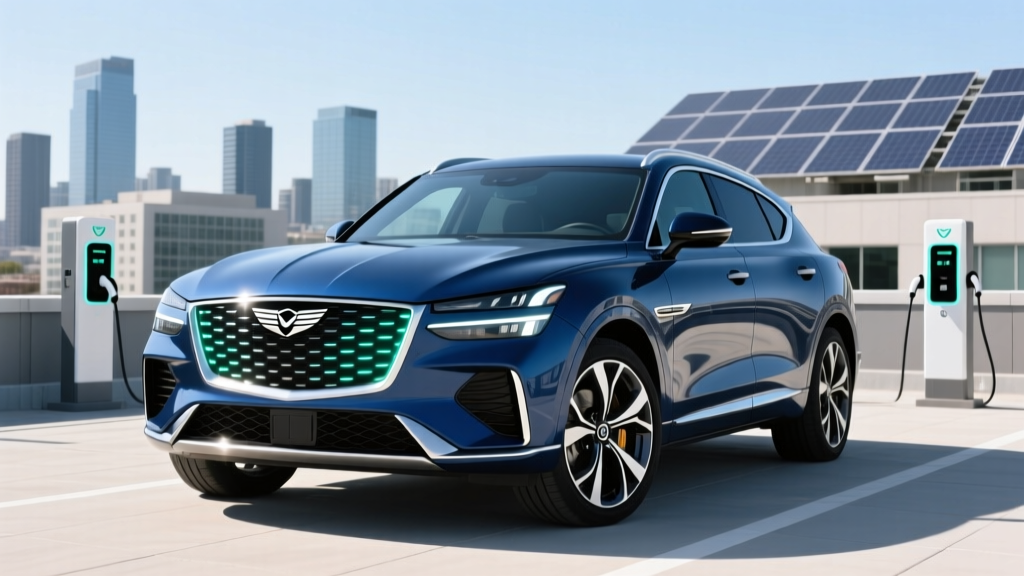
Genesis is reshaping its compact luxury SUV lineup for the 2027 model year. The outgoing gasoline-only GV70 is being replaced by two distinct electrified variants: the fully electric GV70 (riding on Hyundai's next-generation eM platform) and a hybrid variant that retains an internal combustion engine for buyers who aren't ready to commit to a battery-only vehicle. For shoppers searching for the 2027 Genesis GV70 hybrid, the critical question is whether Genesis will offer a conventional hybrid (HEV), a plug-in hybrid (PHEV), or both — and what the real-world efficiency and ownership experience will look like.
This guide breaks down everything confirmed and reasonably projected about the 2027 GV70 hybrid lineup, including powertrain specs, fuel economy, electric-only range, charging capability, pricing, and tax credit eligibility. Because the 2027 GV70 hybrid is still pre-launch, figures marked as estimated are based on Hyundai Motor Group's existing hybrid architectures and official Genesis previews.
HEV vs. PHEV: Which 2027 GV70 Hybrid Are You Looking At?
Hyundai Motor Group currently deploys two hybrid strategies across its luxury and mainstream brands, and the 2027 GV70 is expected to follow suit. Understanding the distinction is essential before evaluating specs.
Conventional Hybrid (HEV)
- No plug required. The battery recharges through regenerative braking and the gasoline engine.
- Small battery (typically 1.5–2.5 kWh) — assists the engine but cannot drive the vehicle on electric power alone for meaningful distances.
- Best for: Drivers without home charging access who want better fuel economy with zero behavior change.
Plug-In Hybrid (PHEV)
- Plugs in to charge. A larger battery provides 25–40+ miles of electric-only driving before the gas engine engages.
- Larger battery (typically 15–25 kWh usable) — supports Level 2 AC charging; some newer architectures add DC fast charging.
- Best for: Drivers with home or workplace charging who want daily electric commuting with gas-engine flexibility for road trips.
Genesis has confirmed that the 2027 GV70 will launch initially as a battery-electric vehicle on the dedicated eM platform. A hybrid variant — widely expected to be a PHEV given Genesis's luxury positioning and the industry's shift away from mild hybrids in premium segments — is anticipated to follow. Hyundai Motor Group's latest PHEV systems, as seen in the Hyundai Tucson PHEV and Kia Sportage PHEV, provide the most reliable template for what the GV70 PHEV will deliver.
Powertrain Specs: What's Under the Hood
Based on Hyundai Motor Group's current-generation PHEV architecture and Genesis's performance-oriented tuning, the 2027 GV70 PHEV is projected to pair a turbocharged gasoline engine with a high-output electric motor integrated into the transmission.
| Specification | Estimated (2027 GV70 PHEV) |
|---|---|
| Engine | 2.5L turbocharged inline-4 |
| Electric Motor | Permanent-magnet synchronous, integrated in 6-speed auto |
| Combined Horsepower | ~290–310 hp (est.) |
| Combined Torque | ~310–350 lb-ft (est.) |
| Transmission | 6-speed automatic with integrated motor |
| Drivetrain | AWD (HTRAC) |
| Battery (Usable) | ~18–22 kWh (est., NMC chemistry) |
| 0–60 mph | ~6.0–6.5 seconds (est.) |
For comparison, the outgoing GV70 with its 2.5T gas engine produced 300 hp and 311 lb-ft. The PHEV variant is expected to deliver similar or slightly higher output while adding the ability to drive silently on electric power for daily commutes. Genesis typically tunes its powertrains for smoothness and linear delivery rather than aggressive off-the-line performance, so expect refined acceleration rather than sports-car urgency.
Fuel Economy and Electric-Only Range
Fuel economy is where the hybrid value proposition lives or dies. Here's what the data suggests for the 2027 GV70 PHEV, benchmarked against comparable Hyundai Motor Group PHEVs and luxury compact SUV competitors.
| Metric | Estimated Figure |
|---|---|
| EPA Electric-Only Range | ~30–37 miles (est.) |
| EPA Combined MPGe (Electric + Gas) | ~70–80 MPGe (est.) |
| EPA City MPG (Gas-Only / Charge-Sustaining) | ~28–32 mpg (est.) |
| EPA Highway MPG (Gas-Only / Charge-Sustaining) | ~26–30 mpg (est.) |
| EPA Combined MPG (Gas-Only) | ~27–31 mpg (est.) |
| Total Combined Range (Full Tank + Full Charge) | ~420–480 miles (est.) |
Real-World MPG vs. EPA Estimates
Hybrids and PHEVs often exceed their EPA city ratings in stop-and-go traffic, where regenerative braking recaptures energy most effectively. Expect the GV70 PHEV to deliver its best real-world numbers in urban driving. Conversely, highway-only trips at 75+ mph will yield lower MPG than the EPA combined figure — plan for roughly 24–28 mpg on sustained highway runs with a depleted battery. Cold weather (below 30°F) can reduce electric-only range by 20–30%, cutting a 35-mile EV range down to 25–28 miles in winter conditions.
Charging: Level 2, DC Fast Charge, and Times
PHEV charging capability varies significantly across the luxury compact SUV segment. Some competitors (like the BMW X3 xDrive30e) offer only Level 2 AC charging, while others are beginning to add DC fast-charge capability. Here's what to expect from the 2027 GV70 PHEV.
| Charging Level | Power (kW) | Estimated Time (0–100%) | Notes |
|---|---|---|---|
| Level 1 (120V household outlet) | ~1.4 kW | ~12–16 hours | Emergency/trickle only; not practical for daily use |
| Level 2 (240V home/public AC) | ~7.2 kW | ~2.5–3.5 hours | Primary charging method; full overnight charge |
| DC Fast Charge | TBD — likely not available | N/A | Most PHEVs in this class lack DC fast charging; Genesis has not confirmed |
The practical implication: Level 2 home charging is the expected primary charging method for the GV70 PHEV. With a ~7.2 kW onboard charger, plugging in when you get home means a full battery by morning — sufficient for most daily commutes within the electric-only range. If Genesis follows the Hyundai Tucson PHEV precedent, DC fast charging will likely not be included, as the smaller battery size makes the cost and weight of a DC fast-charge system harder to justify.
Pricing, Trims, and Tax Credit Eligibility
Genesis positions the GV70 between mainstream luxury competitors like the BMW X3, Mercedes-Benz GLC, and Audi Q5. Pricing for the 2027 GV70 PHEV is expected to reflect a premium over the outgoing gas model, offset partially by fuel savings and potential tax incentives.
| Trim (Projected) | Estimated MSRP |
|---|---|
| GV70 PHEV Advanced | ~$55,000–$58,000 |
| GV70 PHEV Prestige | ~$62,000–$66,000 |
| GV70 PHEV Sport Prestige | ~$67,000–$72,000 |
Pricing is estimated based on outgoing GV70 trim structure and competitor PHEV pricing. Final MSRP will be confirmed at launch.
Federal §30D Tax Credit Eligibility
Under current IRS §30D rules, plug-in hybrids can qualify for up to $7,500 in federal tax credits — but eligibility depends on several requirements that change frequently:
- MSRP cap: SUVs must have an MSRP at or below $80,000. All projected GV70 PHEV trims should clear this threshold.
- Buyer income cap: Modified adjusted gross income must not exceed $150,000 (single), $225,000 (head of household), or $300,000 (joint filers).
- Battery component sourcing: A percentage of battery components must be manufactured or assembled in North America. This threshold increases annually and has disqualified several competitors.
- Critical minerals sourcing: A percentage of critical minerals must be sourced from the U.S. or free-trade-agreement partners. This requirement also tightens yearly.
- Point-of-sale transfer: Eligible buyers can transfer the credit to the dealer at purchase, reducing the out-of-pocket price immediately rather than waiting for a tax refund.
Important Tax Credit Caveat
The §30D credit's battery-sourcing requirements have disqualified many vehicles that previously qualified. Before purchasing, verify the GV70 PHEV's current eligibility on fueleconomy.gov and consult a tax professional. State-level incentives (such as California's CVRP or New York's Drive Clean Rebate) may provide additional savings — check your state's energy or environmental agency for current programs.
Battery Warranty, Reliability, and Replacement Cost
Hybrid and PHEV battery longevity remains one of the top concerns for buyers transitioning from conventional vehicles. Here's what the data shows.
| Category | Coverage / Estimate |
|---|---|
| Hybrid/PHEV Battery Warranty | 10 years / 100,000 miles (Genesis standard) |
| Warranty Capacity Threshold | Typically 70% of original capacity |
| Powertrain Warranty | 10 years / 100,000 miles |
| Battery Replacement Cost (out of warranty) | $5,000–$9,000 (estimated, based on similar HMG PHEVs) |
| Expected Battery Lifespan | 12–15 years with normal use before significant degradation |
Hyundai Motor Group's hybrid batteries have demonstrated strong long-term reliability. NMC (nickel-manganese-cobalt) chemistry is the expected cell type for the GV70 PHEV, offering a good balance of energy density and cycle life. Real-world data from Tucson and Sportage PHEV owners shows minimal degradation within the warranty period — typically 5–10% capacity loss over 5 years of normal use.
The 10-year/100,000-mile warranty provides substantial protection. If the battery degrades below ~70% of its original capacity within that window, Genesis will replace or refurbish it at no cost. Out-of-pocket replacement after the warranty period is estimated at $5,000–$9,000, though prices continue to decline as battery manufacturing scales.
Who Should Choose the 2027 GV70 Hybrid?
Decision Framework: GV70 PHEV vs. Full EV vs. Gas
Choose the GV70 PHEV if:
- You have home Level 2 charging and a daily commute under ~35 miles round-trip.
- You want electric daily driving but need gas-engine flexibility for road trips without charging-infrastructure planning.
- You live in an area with limited public DC fast-charging infrastructure.
- You want luxury features, AWD capability, and lower fuel costs without committing to a full BEV.
Choose the GV70 EV (full electric) if:
- You have reliable home charging and access to DC fast-charging corridors for road trips.
- You want the lowest possible operating cost per mile and zero tailpipe emissions.
- Your daily driving rarely exceeds 200–250 miles without an overnight stop.
Stick with a conventional gas SUV if:
- You have no access to home or workplace charging of any kind.
- Your budget doesn't accommodate the PHEV price premium over a gas equivalent.
- You drive primarily long highway routes where hybrid efficiency gains are smallest.
Pros and Cons at a Glance
Pros
- 30+ miles of electric-only range covers most daily commutes
- No range anxiety — gas engine provides 400+ mile total range
- Luxury interior, quiet ride, strong Genesis warranty coverage
- AWD standard for all-weather capability
- Potential §30D tax credit reduces effective purchase price
- Lower fuel cost vs. gas-only GV70 for chargeable commutes
Cons
- Higher MSRP than outgoing gas GV70
- Electric-only range may fall short in cold weather (20–30% loss)
- Likely no DC fast charging — limits public charging convenience
- Tax credit eligibility uncertain until battery sourcing confirmed
- PHEV adds weight, slightly reducing cargo space vs. gas variant
- Real-world highway MPG with depleted battery is modest (24–28 mpg)
Frequently Asked Questions
How many MPG does the 2027 Genesis GV70 Hybrid get?
The 2027 GV70 PHEV is estimated to deliver approximately 27–31 MPG combined when operating on gasoline alone (charge-sustaining mode), with higher city figures thanks to regenerative braking. When factoring in electric-only driving, the combined MPGe rating is projected at 70–80 MPGe. Final EPA figures will be published closer to launch.
How far can the 2027 GV70 PHEV go on electric power alone?
Estimated electric-only range is 30–37 miles, based on Hyundai Motor Group's current PHEV battery sizing and the GV70's expected weight. Cold weather and highway speeds will reduce this figure. The total combined range (full battery + full gas tank) is projected at 420–480 miles.
Does the 2027 GV70 Hybrid qualify for a tax credit?
As a PHEV, the GV70 may qualify for up to $7,500 under the federal §30D clean vehicle credit, subject to MSRP caps (under $80,000 for SUVs), buyer income limits, and battery component/critical mineral sourcing requirements. Eligibility can change as sourcing rules tighten annually. Verify current status on fueleconomy.gov before purchasing.
Is the 2027 GV70 Hybrid reliable, and what does a battery replacement cost?
Hyundai Motor Group's hybrid systems have demonstrated strong reliability, and the GV70 PHEV is backed by a 10-year/100,000-mile battery and powertrain warranty. Out-of-warranty battery replacement is estimated at $5,000–$9,000, though most owners will not need replacement within the vehicle's typical ownership period.
Does the GV70 Hybrid need to be plugged in?
If Genesis offers a conventional HEV variant, it will not require plugging in — the battery charges through regenerative braking and the engine. The PHEV variant does require plugging in to access its electric-only range and maximum efficiency. Without plugging in, a PHEV operates as a heavier, less efficient conventional hybrid.
When will the 2027 Genesis GV70 Hybrid be available?
The 2027 GV70 EV is expected to launch first, with the hybrid/PHEV variant following. Exact timing has not been confirmed by Genesis. We will update this article with confirmed on-sale dates and final EPA-certified specifications as they become available.
Note: This article reflects information available as of 2026. The 2027 Genesis GV70 hybrid is a pre-launch vehicle. Specifications marked as estimated are based on Hyundai Motor Group's current PHEV platforms and competitive analysis. Final EPA ratings, pricing, and tax credit eligibility will be confirmed at or near the vehicle's launch. Always verify current details with Genesis and official government sources before making a purchase decision.