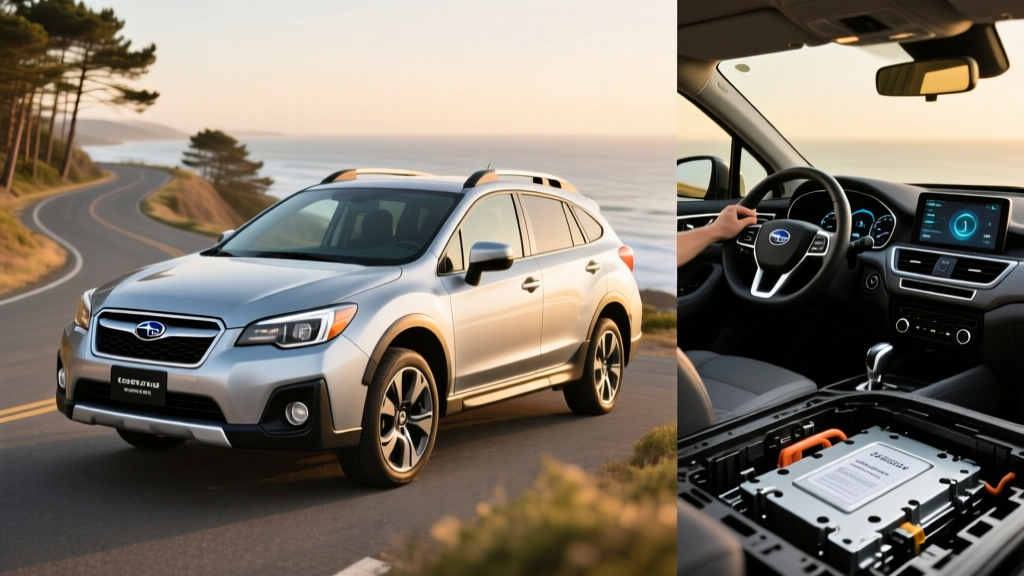
Subaru's first production hybrid was the 2014 XV Crosstrek Hybrid — a compact crossover that paired the brand's signature all-wheel-drive system with a mild parallel-hybrid powertrain. More than a decade later, used examples still circulate in the pre-owned market, and buyers searching for a 2014 Subaru hybrid want straight answers on fuel economy, battery longevity, and ownership costs. This guide delivers the exact numbers you need before signing on the dotted line.
2014 Subaru XV Crosstrek Hybrid — Key Specifications
| Attribute | Specification |
|---|---|
| Powertrain | 2.0L flat-4 + 13 HP electric motor (parallel hybrid) |
| Combined System Output | 160 HP / 163 lb-ft torque |
| Transmission | Lineartronic CVT with manual mode |
| Drivetrain | Symmetrical AWD (standard) |
| Hybrid Battery | ~0.5 kWh (NiMH), trunk-mounted |
| EPA Fuel Economy | 29 city / 33 highway / 31 combined MPG |
| EPA Combined (gas-only Crosstrek CVT) | 27 MPG combined |
| Electric-Only Driving | Very limited, low-speed only (<1 mile) |
| Plug-In Capable | No — conventional HEV only |
| 0–60 MPH | ~10.2 seconds |
| Cargo Volume (rear seats up) | 20.8 cu ft (reduced from 22.3 cu ft) |
| Original MSRP (2014) | $26,780 (Hybrid Touring) |
| Typical Used Price (2026 market) | $8,000–$13,000 depending on mileage |
| Hybrid Battery Warranty (original) | 8 years / 100,000 miles |
Understanding the 2014 Subaru Hybrid: HEV, Not PHEV
The 2014 Subaru XV Crosstrek Hybrid is a conventional hybrid electric vehicle (HEV). It cannot be plugged in, has no meaningful electric-only range, and does not carry a large battery pack. Instead, it uses a small nickel-metal hydride (NiMH) battery and a compact 13-horsepower electric motor sandwiched between the 2.0-liter boxer engine and the CVT. The motor assists during acceleration and enables brief engine-off coasting at very low speeds.
HEV vs. PHEV — What Subaru Offered in 2014
| Feature | 2014 XV Crosstrek Hybrid (HEV) | Plug-In Hybrid (PHEV) — for reference |
|---|---|---|
| Plugs into a charger? | No | Yes (Level 1 or Level 2) |
| Battery capacity | ~0.5 kWh (NiMH) | Typically 8–20 kWh (Li-ion) |
| Electric-only range | <1 mile, low speed only | 20–50 miles typical |
| Regenerative braking | Yes | Yes |
| Federal tax credit (§30D) | Not eligible | Up to $7,500 if criteria met |
| Requires lifestyle change? | No — drives like a gas car | Yes — benefits require regular charging |
Subaru did not offer a plug-in hybrid in the US market until the 2019 Crosstrek PHEV, which used Toyota's hybrid synergy drive system. If you need electric-only commuting capability, the 2014 model will not provide it.
Fuel Economy: Real-World MPG vs. EPA Sticker
The EPA rated the 2014 XV Crosstrek Hybrid at 29 city / 33 highway / 31 combined MPG. That represents a roughly 4 MPG combined improvement over the standard gas-only 2014 Crosstrek with the CVT (rated at 27 combined). On paper, the gain is modest — and in practice, it is even more nuanced.
MPG Breakdown — 2014 Crosstrek Hybrid vs. Gas Model
| Configuration | City | Highway | Combined |
|---|---|---|---|
| XV Crosstrek Hybrid (CVT, AWD) | 29 | 33 | 31 |
| XV Crosstrek Gas (CVT, AWD) | 25 | 30 | 27 |
| XV Crosstrek Gas (5MT, AWD) | 23 | 30 | 26 |
Real-world expectations: Owners on forums and tracking apps like Fuelly commonly report 28–32 MPG combined in mixed driving — essentially on-target with the EPA figure. The hybrid system's benefits concentrate in stop-and-go city traffic where regenerative braking recaptures energy and the electric motor offsets the boxer engine's thirst at low RPM. On sustained highway runs above 70 MPH, the hybrid advantage narrows to 1–2 MPG over the gas model because the small electric motor contributes little at cruising speed and the added ~300 lbs of battery/motor hardware works against efficiency.
In cold weather (below 30°F), expect a 2–4 MPG drop. The NiMH battery is less efficient at low temperatures, the engine runs richer during warm-up, and cabin heating draws additional load. Owners in northern climates commonly report 25–27 MPG combined in winter — still competitive with the gas Crosstrek but far from the EPA sticker.
Powertrain Deep Dive: What 160 HP Feels Like
The hybrid powertrain combines Subaru's FB20 2.0-liter flat-four engine (producing 148 HP on its own) with a 10-kW (13 HP) electric motor integrated into the transmission bell housing. Combined output is rated at 160 HP and 163 lb-ft of torque — a modest bump that you feel primarily in the 15–40 MPH range where the electric motor fills in the torque curve before the CVT spools the engine up.
The 0–60 MPH time of approximately 10.2 seconds is not quick by modern standards. The hybrid system adds roughly 300 pounds compared to the gas-only Crosstrek (curb weight near 3,450 lbs), which offsets much of the power advantage. Merging onto fast-moving highways requires planning, and fully loaded passing maneuvers demand a heavy right foot. This is an efficiency-oriented calibration, not a performance one.
The CVT is Subaru's Lineartronic unit, which includes a "manual mode" with simulated gear ratios. In hybrid trim, the transmission programming prioritizes keeping the engine in its most efficient RPM band, which can produce the characteristic CVT drone under hard acceleration. The electric motor's torque fill helps smooth low-speed takeoffs, making around-town driving feel more refined than the gas-only equivalent.
Hybrid Battery: Longevity, Warranty, and Replacement Cost
The 2014 Crosstrek Hybrid uses a trunk-mounted NiMH (nickel-metal hydride) battery pack with a capacity of approximately 0.5 kWh. NiMH chemistry was well-proven by 2014 — Toyota had used it in the Prius since 1997 — and it tends to degrade more gracefully than early lithium-ion packs, though it is heavier and less energy-dense.
Battery Warranty & Lifespan
Original warranty: 8 years / 100,000 miles (10 years / 150,000 miles in CARB states including California, New York, Massachusetts, and others adopting California emissions standards).
As of 2026: All 2014 models have aged past the 8-year federal warranty threshold. If the vehicle was originally sold in a CARB state and has under 150,000 miles, the 10-year coverage may have just expired or be expiring. Confirm warranty status with a Subaru dealer using the VIN.
Expected lifespan: NiMH hybrid batteries in mild-hybrid applications typically last 120,000–180,000 miles before significant capacity loss, though individual results vary based on climate and usage patterns. Many Prius batteries exceed 200,000 miles.
Battery replacement cost (2026 estimates):
- OEM replacement pack from Subaru: $2,500–$3,500 (part) + $500–$800 (labor) = $3,000–$4,300 total
- Refurbished/remanufactured pack from third-party suppliers: $1,500–$2,200 + labor = $2,000–$3,000 total
- Individual cell replacement (specialist hybrid shops): $800–$1,500 if only a few cells are degraded
Because the 2014 Crosstrek Hybrid's battery is small and the system is a mild parallel hybrid, the vehicle remains drivable even with a degraded battery — it simply reverts to gas-only operation with slightly reduced fuel economy and no electric assist. This is a meaningful advantage over full EVs or PHEVs with large packs where battery failure is a more costly and immobilizing event.
Reliability and Common Issues
The 2014 XV Crosstrek Hybrid inherits most of its mechanical components from the conventional Crosstrek, which carries an average-to-above-average reliability record. Key considerations for a 2026 used purchase:
- Hybrid system: The electric motor and inverter have proven durable. Most reported hybrid-related issues involve the 12V auxiliary battery (not the traction battery), which should be replaced every 4–5 years regardless.
- CVT transmission: Subaru's early Lineartronic CVTs have drawn scrutiny. By 2014, Subaru had extended the CVT warranty to 10 years/100,000 miles on many models due to shudder and solenoid issues. Check service records for CVT fluid changes (recommended every 60,000 miles, though Subaru initially marketed it as "lifetime" fluid).
- Head gaskets: The FB20 engine largely resolved the head-gasket problems that plagued older EJ-series Subaru engines. Oil consumption complaints exist but are less common than on the 2.5L FB25.
- Rust: As with all Subarus of this era, inspect the rear subframe and suspension mounting points for corrosion, especially in salt-belt states.
- Reduced cargo space: The hybrid battery occupies space beneath the cargo floor, reducing volume from 22.3 to 20.8 cu ft and eliminating the spare tire (replaced by a tire-repair kit).
Tax Credits and Incentives: What Applies in 2026
The 2014 Subaru XV Crosstrek Hybrid is a conventional HEV and does not qualify for the federal §30D plug-in vehicle tax credit. That credit — up to $7,500 — applies only to plug-in electric vehicles (BEVs and PHEVs) meeting specific battery sourcing, MSRP, and buyer income requirements under current IRS rules.
When new, the Crosstrek Hybrid also did not qualify for the older §30D credit because its battery capacity (under 5 kWh) fell below the minimum threshold. No federal tax incentive was available for this vehicle at any point.
State-level incentives: A small number of states offered rebates or HOV-lane access for conventional hybrids when this model was new, but most of those programs have since been retired or redirected to plug-in vehicles. Check your state's current energy or transportation department website for any residual programs — but do not count on any incentive for a used 2014 HEV purchase in 2026.
For buyers specifically seeking tax-credit-eligible vehicles, a used PHEV or BEV purchased from a dealer may qualify for the used clean vehicle credit (§25E) — up to $4,000 or 30% of the sale price (whichever is lower) for vehicles priced under $25,000, subject to buyer income caps. A used 2019+ Subaru Crosstrek PHEV could potentially qualify; the 2014 HEV cannot.
Who Should Buy the 2014 Subaru Hybrid — and Who Shouldn't
Pros
- Standard AWD — rare in the hybrid segment at this price point
- Simple hybrid system with proven NiMH chemistry
- Drivable even if hybrid battery fully degrades (reverts to gas-only)
- ~4 MPG improvement over gas Crosstrek in city driving
- 8.7 inches of ground clearance — genuine light-trail capability
- Lower used prices than comparable-age Prius or hybrid SUVs
Cons
- Modest efficiency gain — only ~15% better than the gas model
- No electric-only driving capability
- No federal or state tax credit eligibility
- Added weight hurts acceleration and handling agility
- Reduced cargo space and no spare tire due to battery placement
- Original hybrid battery warranty now expired on most examples
- CVT drone under hard acceleration
Hybrid vs. PHEV vs. EV — Which Fits You?
Choose the 2014 Crosstrek Hybrid (HEV) if: You want AWD, don't have access to home or workplace charging, live in a rural or cold-climate area where charging infrastructure is sparse, and want a simple ownership experience with no plug-in routine. The hybrid system requires zero behavioral change — you fuel up at gas stations and the car handles the rest.
Choose a used PHEV (e.g., 2019+ Crosstrek PHEV, Toyota RAV4 Prime, Ford Escape PHEV) if: You can charge at home (even a standard 120V outlet works for overnight top-ups) and want 20–40 miles of electric-only commuting while retaining gas-engine range for road trips. PHEVs offer the biggest fuel-cost savings if most daily driving falls within electric range.
Choose a full EV (e.g., used Tesla Model Y, Chevrolet Bolt EUV, Hyundai Ioniq 5) if: You have reliable home Level 2 charging, your daily driving is under 200 miles, and you want to eliminate gasoline entirely. EVs offer the lowest per-mile "fuel" cost and minimal powertrain maintenance, but require planning for longer road trips.
Buying Checklist for a Used 2014 Subaru Crosstrek Hybrid
- Verify hybrid battery health: Ask a Subaru dealer to pull the battery State of Health (SoH) reading via the OBD-II port. A healthy pack should show above 75–80% capacity. Below 70%, budget for replacement.
- Check CVT service history: If CVT fluid has never been changed and the odometer reads above 60,000 miles, plan a drain-and-fill ($200–$350 at an independent shop) immediately after purchase.
- Inspect for rust: Focus on rear subframe, control arm mounts, and brake line routing. Surface rust is cosmetic; structural corrosion is a deal-breaker.
- Test the hybrid system: During a cold start, the engine should run briefly then shut off at low-speed coasting. If the engine never shuts off or the "charge" gauge never moves, the hybrid system may have a fault.
- Confirm 12V battery age: The small 12V battery powers the vehicle's computers and engages the hybrid system. A failing 12V battery can prevent the car from starting even if the hybrid traction battery is fully charged. Replace proactively if over 4 years old.
- Run a VIN check: Confirm no open recalls (Subaru issued recalls for CVT solenoids and brake systems on some 2013–2014 models) and verify title status.
Frequently Asked Questions
How many MPG does the 2014 Subaru Crosstrek Hybrid get?
The EPA rates it at 29 city / 33 highway / 31 combined MPG. Real-world owners typically report 28–32 combined in moderate climates, with winter drops to 25–27 MPG in cold regions. That's a 4 MPG combined improvement over the gas-only 2014 Crosstrek CVT (27 combined).
Can the 2014 Subaru hybrid drive on electric power alone?
Only marginally. The electric motor can propel the car at very low speeds (under ~20 MPH) for short distances — typically under one mile — such as creeping through a parking lot. It is not designed for meaningful electric-only commuting. This is a conventional hybrid (HEV), not a plug-in hybrid (PHEV).
Does the 2014 Subaru Crosstrek Hybrid qualify for any tax credit?
No. As a conventional hybrid (HEV), it does not meet the battery capacity threshold for the federal §30D clean vehicle credit. No current federal or most state incentives apply to this model. Only plug-in vehicles (BEVs and PHEVs) are eligible for federal EV tax credits.
Is the hybrid battery reliable and what does replacement cost?
The NiMH battery pack is proven technology with an expected lifespan of 120,000–180,000+ miles. OEM replacement costs $3,000–$4,300; refurbished packs run $2,000–$3,000 installed. The original 8-year/100,000-mile warranty has expired on all 2014 models as of 2026. The car remains drivable on gasoline alone if the hybrid battery fails.
Should I buy the 2014 Crosstrek Hybrid or the gas-only version?
If you find a well-maintained hybrid at a comparable price, the 4 MPG city advantage and smoother low-speed driving are worthwhile. However, if the hybrid commands a significant premium over a gas model, the fuel savings alone won't recoup the cost difference within typical ownership timeframes. Prioritize overall vehicle condition, service history, and battery health over the hybrid badge.
Is the 2014 Subaru hybrid good for towing or off-road use?
The Crosstrek Hybrid is rated to tow only 1,000 lbs — adequate for a small utility trailer but not campers or boats. The 8.7 inches of ground clearance and AWD system handle dirt roads, snow, and mild trails competently. The hybrid system does not enhance off-road capability; the added weight slightly reduces approach/departure performance on steep terrain.