Quick Verdict: A Hybrid Supercar Built for Performance, Not Efficiency
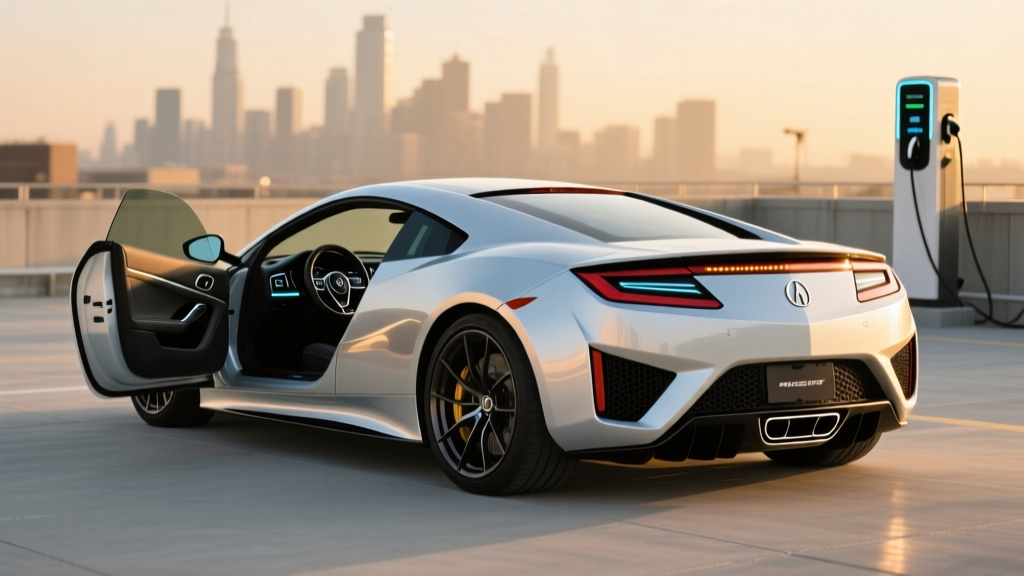
The 2017 Acura NSX is not a hybrid in the Prius sense. It is a mid-engine, twin-turbo V6 supercar that uses three electric motors to fill torque gaps, sharpen all-wheel-drive handling, and enable silent electric-only crawling at low speeds. Acura calls the system Sport Hybrid SH-AWD, and the result is 573 combined horsepower and a 0-60 mph time of approximately 3.0 seconds.
If you're searching for a 2017 Acura NSX hybrid on the used market in 2026, you're likely weighing its exotic performance against ownership costs, reliability, and whether the hybrid system adds complexity or durability. This guide covers every number that matters — EPA fuel economy, powertrain architecture, battery warranty, real-world efficiency, and what it costs to keep one on the road today.
| Spec | Value |
|---|---|
| Powertrain | 3.5L Twin-Turbo V6 + 3 Electric Motors (Sport Hybrid SH-AWD) |
| Combined Horsepower | 573 HP |
| Combined Torque | 476 lb-ft |
| 0-60 mph | ~3.0 seconds |
| Top Speed | 191 mph |
| Transmission | 9-Speed Dual-Clutch Automatic (DCT) |
| EPA MPG (City / Hwy / Combined) | 21 / 22 / 21 |
| Hybrid Battery | 1.3 kWh Lithium-Ion (non-plug-in HEV) |
| Drivetrain | AWD (rear-biased, torque-vectoring front motors) |
| Curb Weight | ~3,878 lbs |
| Original MSRP (2017) | $156,000 (base) |
| 2026 Used Market Range | ~$95,000 – $140,000+ |
HEV vs PHEV: Where the NSX Fits in the Hybrid Landscape
The 2017 Acura NSX is a conventional hybrid (HEV), not a plug-in hybrid (PHEV). This distinction matters for buyers cross-shopping electrified vehicles:
- HEV (like the NSX): The battery charges exclusively through regenerative braking and the gasoline engine. There is no charge port, no plug, and no electric-only highway range. The small battery assists acceleration and enables brief low-speed electric maneuvering.
- PHEV (like a Toyota RAV4 Prime): Has a larger battery (typically 15-20 kWh), a charge port for Level 2 AC charging, and 25-45 miles of electric-only driving before the gas engine engages.
- BEV (like a Tesla Model 3): No gasoline engine at all. Runs entirely on battery energy charged from the grid.
The NSX's 1.3 kWh lithium-ion battery pack is mounted low behind the cabin. It's roughly 1/15th the size of a typical PHEV battery and exists solely to buffer regenerative energy and feed the twin front-axle motors and single rear motor during hard acceleration. You will never plug this car in, and that's by design — the hybrid system is a performance enhancer, not an efficiency play.
Fuel Economy: EPA Numbers vs Real-World MPG
| Driving Condition | EPA Estimate | Real-World Expectation |
|---|---|---|
| City | 21 MPG | 19–22 MPG (hybrid regen helps in stop-and-go) |
| Highway | 22 MPG | 20–24 MPG (depends heavily on speed and throttle discipline) |
| Combined | 21 MPG | 19–22 MPG |
For a 573 HP mid-engine supercar, 21 MPG combined is genuinely impressive context. A contemporary Lamborghini Huracán returns roughly 16 MPG combined; a Porsche 911 Turbo S sits around 19-20 MPG. The NSX's hybrid system delivers measurable efficiency gains over purely mechanical competitors.
According to fueleconomy.gov, the NSX achieves its best efficiency when the Integrated Dynamics System is set to Quiet or Sport mode. In Quiet mode, the car can operate on electric power alone at very low speeds (under ~15 mph, for short distances), which helps city fuel economy. In Sport+ and Track modes, the engine runs continuously and fuel consumption rises sharply.
Real-world caveat: Owners who track the car or drive aggressively should expect 14-17 MPG. Those who commute conservatively in Sport mode report 22-24 MPG on flat highway stretches. The EPA numbers are reasonable for mixed driving with a moderate right foot.
Sport Hybrid SH-AWD Powertrain: How It Works
The NSX powertrain is one of the most sophisticated hybrid architectures ever put into production. Here's how the components distribute work:
Internal Combustion Engine
- 3.5-liter twin-turbocharged V6, longitudinally mounted behind the cabin
- 500 HP and 406 lb-ft of torque on its own
- Redline: 7,500 RPM
- Fed through a 9-speed dual-clutch transmission with an integrated direct-drive electric motor
Three Electric Motors
- Two front-axle motors (Twin Motor Unit): One per front wheel, each producing approximately 36 HP. These enable torque vectoring — the car can push more torque to the outside front wheel in a corner, effectively pulling the nose into the turn. They also handle regenerative braking on the front axle.
- One rear motor (Direct Drive Motor): Approximately 47 HP, sandwiched between the engine and transmission. It fills torque gaps during turbo spool-up and gear shifts, eliminating the lag that plagues traditional twin-turbo setups.
The combined system output is 573 HP and 476 lb-ft. The front motors give the NSX its all-wheel-drive capability without a mechanical driveshaft to the front axle — a setup that reduces weight and enables the torque-vectoring behavior that defines the car's handling character.
Battery Warranty, Reliability, and Replacement Cost
Original Hybrid Battery Warranty: Acura covered the NSX's hybrid battery pack for 8 years / 100,000 miles (10 years / 100,000 miles in California and CARB-adopting states). For a 2017 model, the federal 8-year warranty expired in 2025. California-state cars retain coverage through 2027 or 100,000 miles, whichever comes first.
Is the NSX Hybrid System Reliable?
The first-generation NSX (2017-2022) has been generally well-regarded for build quality, but it is a low-volume, complex machine. The hybrid system itself — the motors, inverter, and battery — has not been a widespread failure point based on owner reports and service bulletins. The 1.3 kWh battery is small, operates within a narrow state-of-charge window (the car never fully charges or fully depletes it), and benefits from liquid thermal management, all of which promote longevity.
However, the NSX is not a Toyota. The twin-turbo V6, the 9-speed DCT, and the three-motor hybrid system represent a high-complexity powertrain. Major service items include:
- Spark plug replacement every ~45,000 miles (requires significant labor due to mid-engine layout)
- DCT fluid service at specified intervals
- Turbo coolant system maintenance
- Hybrid system inverter coolant service
Battery Replacement Cost
If the hybrid battery fails out of warranty, expect a replacement cost in the range of $4,000 to $7,000 for the battery module itself, with additional labor. Because the pack is small (1.3 kWh), it is far less expensive to replace than a full EV traction battery. The front Twin Motor Unit or rear Direct Drive Motor would be significantly more costly to replace — estimates range from $8,000 to $15,000+ per motor assembly at a dealership.
For a 2017 model purchased in 2026, you should budget for out-of-warranty hybrid system repairs. An extended warranty or a pre-purchase inspection by an Acura dealer familiar with the NSX platform is strongly recommended.
Tax Credit Eligibility: What to Expect in 2026
The 2017 Acura NSX does not qualify for the federal §30D new clean vehicle tax credit — that credit applies only to new vehicle purchases, and the NSX's original MSRP of $156,000 far exceeded the credit's MSRP cap ($55,000 for sedans, $80,000 for SUVs/pickups/vans). The NSX was never eligible even when new.
For used buyers in 2026, the §25E Used Clean Vehicle Credit offers up to $4,000 (or 30% of the sale price, whichever is lower). However, this credit has an MSRP cap of $25,000 for the original new vehicle — the NSX's $156,000 original sticker disqualifies it entirely. See the IRS used vehicle credit page for full eligibility rules.
Bottom line: Do not expect any federal tax credit when purchasing a used 2017 NSX. Some states may offer niche incentives for hybrid vehicle ownership, but these are uncommon and vary by jurisdiction. Consult your state's DMV or energy office for specifics.
Who Should Buy the 2017 NSX Hybrid — And Who Shouldn't
Pros
- 573 HP supercar performance with 21 MPG — genuinely rare combination
- Torque-vectoring AWD delivers exceptional cornering grip and stability
- Quiet mode enables silent, electric-only low-speed driving (neighborhood-friendly)
- Mid-engine exotic presence at a fraction of Ferrari/Lamborghini service costs
- Daily-drivable ride quality and visibility for a supercar
- Hybrid battery is small and inexpensive to replace vs. an EV pack
Cons
- Original MSRP of $156K+; used examples still $95K-$140K+
- Complex powertrain means expensive out-of-warranty repairs
- No federal tax credit eligibility (new or used)
- Infotainment and interior materials drew criticism for not matching the price
- Cargo space is minimal (~4.4 cu ft frunk only)
- Depreciation has been steep from original MSRP, though values are stabilizing
- Only 21 MPG combined — efficient for a supercar, but still a premium-fuel guzzler in Track mode
Choose the NSX If:
You want exotic supercar performance with daily-driver usability, you value engineering sophistication over badge prestige, and you accept that a complex hybrid powertrain will require disciplined maintenance. The NSX is for the buyer who wants 3-second 0-60 times and the ability to commute without deafening exhaust noise in Quiet mode.
Look Elsewhere If:
You prioritize fuel economy above performance (any PHEV will triple your MPG), you want electric-only highway range (you need a PHEV or BEV), you're on a tight maintenance budget, or you want a modern infotainment experience with over-the-air updates. A used Porsche 911 or Chevrolet Corvette C8 may offer simpler, more affordable supercar ownership.
Frequently Asked Questions
How many MPG does the 2017 Acura NSX hybrid get?
The EPA rates the 2017 NSX at 21 MPG city, 22 MPG highway, and 21 MPG combined. Real-world results range from 19-22 MPG in mixed driving, with conservative highway driving occasionally reaching 23-24 MPG. Aggressive or track driving drops this to 14-17 MPG.
Can the 2017 NSX drive on electric power only?
Yes, but only at very low speeds (roughly under 15 mph) and for very short distances (under a mile). In Quiet mode, the front electric motors can propel the car silently for neighborhood maneuvering, parking lot navigation, or early-morning departures. This is not a meaningful electric-only range for commuting — it's a convenience feature, not an efficiency mode.
Is the 2017 Acura NSX a plug-in hybrid?
No. The NSX is a conventional hybrid (HEV). It has no charge port and cannot be plugged in. The 1.3 kWh battery charges exclusively through regenerative braking and the gasoline engine. If you want plug-in capability with electric-only range, you need a PHEV like the BMW i8 (now discontinued) or a Porsche Panamera E-Hybrid.
Is the NSX hybrid system reliable?
The hybrid components (battery, motors, inverter) have not been a widespread failure point. However, the overall powertrain is highly complex — a twin-turbo V6, 9-speed DCT, and three electric motors all working in concert. Reliability is generally good for a low-volume exotic, but out-of-warranty repair costs can be substantial. A pre-purchase inspection is essential.
What does it cost to replace the NSX hybrid battery?
The 1.3 kWh hybrid battery replacement is estimated at $4,000-$7,000 including labor — far less than a full EV battery replacement. The electric motors themselves are more expensive, at $8,000-$15,000+ per unit. The original 8-year/100,000-mile hybrid battery warranty has expired for most 2017 models (except in CARB states where it extends to 10 years).
Does the 2017 NSX qualify for any tax credit?
No. The NSX did not qualify for the §30D new vehicle credit when it was sold (MSRP far exceeded caps), and it does not qualify for the §25E used vehicle credit (original MSRP must be under $25,000). Expect no federal tax benefit.
Hybrid vs PHEV vs EV — which is right for me?
If you want maximum performance with modest efficiency gains and no charging infrastructure needs, a performance HEV like the NSX makes sense. If you want 25-45 miles of electric-only commuting with the safety net of a gas engine, a PHEV is ideal. If you want zero tailpipe emissions, the lowest per-mile fuel cost, and have home charging access, a BEV is the best choice. The NSX serves a niche: supercar buyers who appreciate hybrid-assisted performance.
How does the NSX compare to other hybrid supercars?
The NSX's closest contemporaries include the BMW i8 (PHEV, 369 HP, ~27 MPG combined, now discontinued) and the Porsche 918 Spyder (PHEV, 887 HP, limited production, $1M+). The NSX occupies a middle ground: more powerful and practical than the i8, far more attainable than the 918. In 2026, no direct new competitor exists at this price point — the NSX remains a unique proposition in the used market.