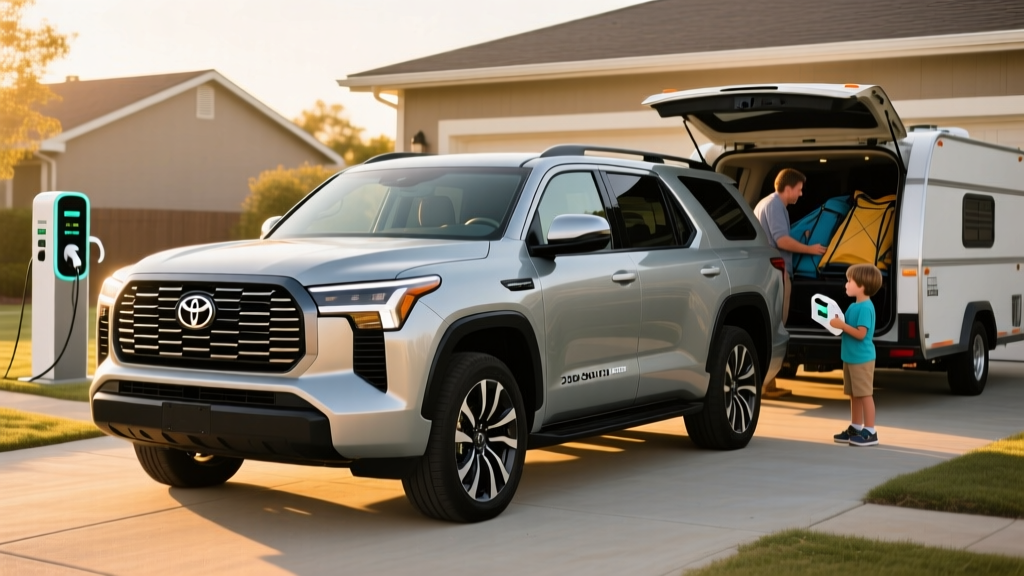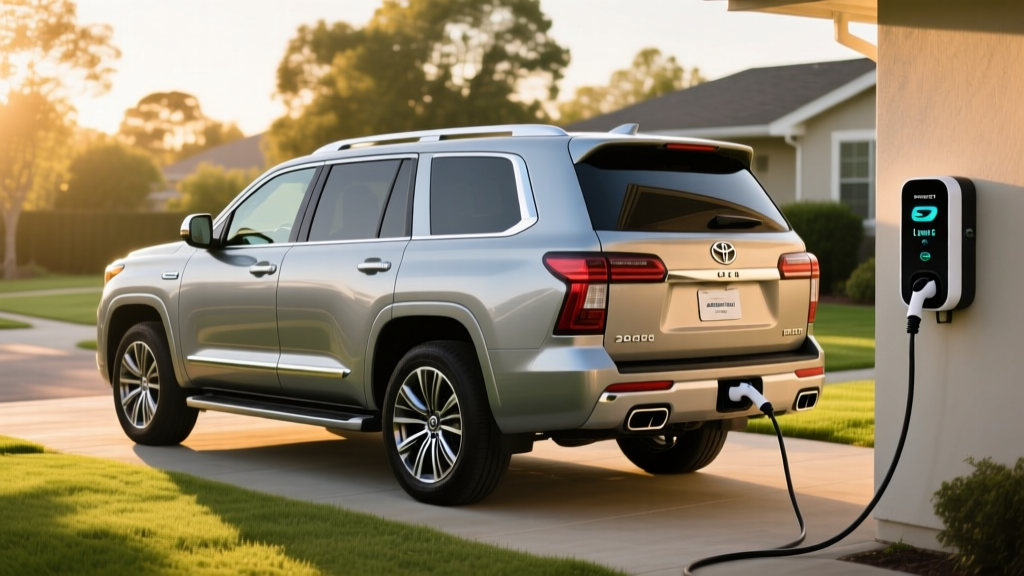
The 2026 Toyota Sequoia Hybrid remains one of the few full-size, three-row SUVs that pairs serious towing capability with hybrid efficiency. Built on the TNGA-F body-on-frame platform shared with the Tundra pickup, the Sequoia uses Toyota's i-FORCE MAX twin-turbo V6 hybrid powertrain to deliver 437 horsepower while returning an EPA-estimated 22 MPG combined. For large families and trailer haulers who aren't ready to commit to a battery-electric vehicle—or who need the range security that EVs still struggle to provide on long towing trips—the Sequoia occupies a practical middle ground.
This guide breaks down the Sequoia's hybrid system architecture, real-world fuel economy expectations, trim pricing, warranty coverage, and how it stacks up against both plug-in hybrid alternatives and full EVs in the full-size SUV segment.
HEV vs. PHEV: Where the Sequoia Fits
Before diving into specs, it's essential to understand what the Sequoia is—and what it isn't. The 2026 Sequoia is a conventional hybrid electric vehicle (HEV), not a plug-in hybrid (PHEV). This distinction matters for ownership expectations:
| Feature | Conventional Hybrid (HEV) — Sequoia | Plug-In Hybrid (PHEV) | Battery Electric (BEV) |
|---|---|---|---|
| Plugs in to charge? | No — charges via engine and regenerative braking | Yes — external charging required for EV mode | Yes — sole energy source |
| Electric-only range | None (motor assists engine only) | 20–50 miles typical | 200–400+ miles |
| Fuel/energy source | Gasoline (primary), regenerative braking | Gasoline + grid electricity | Grid electricity only |
| Battery size | ~1.87 kWh (small, sealed NiMH/Li-ion) | 15–25 kWh typical | 75–130+ kWh |
| Federal tax credit (§30D) | Not eligible | Up to $7,500 (if criteria met) | Up to $7,500 (if criteria met) |
| Home charging install needed | No | Level 2 recommended | Level 2 strongly recommended |
The Sequoia's hybrid battery is small by design. It captures energy during braking and deceleration, then deploys it to assist the gasoline engine during acceleration and low-speed driving. You never plug it in. You simply fuel up at any gas station and drive. This makes the Sequoia ideal for buyers who want better fuel economy without changing their refueling habits or installing home charging infrastructure.
Powertrain Specs: i-FORCE MAX Twin-Turbo V6 Hybrid
The 2026 Sequoia uses a single powertrain across all trims: Toyota's i-FORCE MAX system, which pairs a 3.4-liter twin-turbocharged V6 engine with a motor-generator sandwiched between the engine and a 10-speed automatic transmission. Here's the full breakdown:
| Specification | 2026 Toyota Sequoia Hybrid |
|---|---|
| Engine | 3.4L twin-turbo V6 (V35A-FTS) |
| Electric motor | Motor-generator integrated in bell housing |
| Combined system horsepower | 437 hp |
| Combined system torque | 583 lb-ft |
| Transmission | 10-speed automatic |
| Drivetrain | RWD standard; 4WD available |
| Hybrid battery type | Sealed lithium-ion, ~1.87 kWh |
| 0–60 mph | ~6.5 seconds (est. 4WD) |
| Max towing capacity | 9,520 lbs (RWD SR5 trim) |
| EPA fuel economy (combined) | 22 MPG (4WD); 22 MPG (RWD) |
| Fuel tank capacity | 21.1 gallons |
| Total driving range | ~464 miles (4WD, EPA est.) |
The electric motor's primary role isn't to drive the Sequoia on electricity alone—it's to fill in torque at low RPM where turbocharged engines typically lag. The result is a full-size SUV that pulls away from stoplights with immediate authority while the turbos spool, and that maintains strong highway passing power without excessive downshifting.
Fuel Economy: EPA Numbers vs. Real-World MPG
Toyota's EPA estimates for the 2026 Sequoia Hybrid are consistent across most trims, though wheel size and drivetrain configuration introduce minor variation:
| Configuration | City MPG | Highway MPG | Combined MPG |
|---|---|---|---|
| RWD (SR5 base) | 21 | 24 | 22 |
| 4WD (SR5 and above) | 19 | 22 | 20–22 depending on trim/wheels |
| TRD Pro / Capstone (4WD, larger wheels) | 19 | 22 | 20 |
Real-world expectations: Hybrid SUVs like the Sequoia tend to perform close to or slightly above their EPA city estimates in stop-and-go driving, where regenerative braking captures the most energy. On the highway at sustained 75–80 mph speeds, expect fuel economy to dip to roughly 18–20 MPG, especially with roof cargo boxes, crosswinds, or full passenger loads.
When towing, fuel economy drops significantly—expect 10–13 MPG when pulling a 5,000–7,000 lb trailer. This is the reality of physics: no hybrid system can fully offset the aerodynamic drag and rolling resistance of a heavy trailer at highway speeds. However, the Sequoia's 21.1-gallon tank still provides roughly 210–275 miles of towing range before refueling, which is competitive with or better than non-hybrid rivals like the Ford Expedition (non-hybrid EcoBoost) or Chevrolet Tahoe (5.3L V8).
Cold weather impact is modest compared to EVs. Expect roughly 1–2 MPG reduction in winter conditions due to increased engine warm-up time and thicker fluids, but the gasoline engine's waste heat efficiently warms the cabin without the range penalty that EVs experience when running resistive heaters.
Pricing, Trims, and Tax Credit Eligibility
The 2026 Sequoia Hybrid lineup spans six trims. Pricing below reflects estimated MSRP (destination included) based on the current generation's pricing trajectory:
| Trim | MSRP (est.) | Key Features |
|---|---|---|
| SR5 | ~$62,500 | 8-seat config, 8" touchscreen, Toyota Safety Sense 2.5 |
| Limited | ~$68,500 | Leather, 14" touchscreen, power liftgate, JBL audio |
| Platinum | ~$74,000 | Panoramic roof, 360° camera, adaptive suspension |
| TRD Pro | ~$80,000 | Off-road suspension, skid plates, all-terrain tires |
| Capstone | ~$82,500 | Semi-aniline leather, power running boards, premium trim |
| 1794 Edition | ~$76,000 | Heritage styling, western-themed interior, 4WD standard |
Federal Tax Credit: Not Eligible
Because the 2026 Sequoia is a conventional hybrid (HEV) rather than a plug-in hybrid or battery-electric vehicle, it does not qualify for the federal §30D Clean Vehicle Credit. The IRS restricts the credit to vehicles with a battery capacity of at least 7 kWh that can be recharged from an external source—criteria the Sequoia's ~1.87 kWh self-charging system does not meet.
Some states and localities offer their own incentives for conventional hybrids, though these are increasingly rare as incentive programs shift toward PHEVs and BEVs. Check your state's energy office or department of environmental quality for current programs. A qualified tax professional can advise on any applicable deductions or credits.
Reliability, Battery Warranty, and Replacement Costs
Toyota's hybrid systems have an extensive track record dating back to the 1997 Prius. The i-FORCE MAX system in the Sequoia is newer (introduced with the 2022 Tundra), but it uses proven Toyota hybrid architecture scaled up for truck duty.
Hybrid Battery & Powertrain Warranty Coverage
- Hybrid battery warranty: 10 years / 150,000 miles (whichever comes first)
- Hybrid system components: 8 years / 100,000 miles (motor-generator, inverter, control modules)
- Powertrain warranty: 5 years / 60,000 miles (engine, transmission)
- Basic warranty: 3 years / 36,000 miles
Source: Toyota Warranty Guide
Replacement cost: If the hybrid battery fails outside warranty coverage, replacement cost for the Sequoia's lithium-ion hybrid battery pack is estimated at $3,000–$5,000 including labor, based on current Toyota hybrid battery pricing. This is a fraction of BEV battery replacement costs (which can exceed $15,000) because the pack is small (~1.87 kWh vs. 75–100+ kWh in an EV).
Longevity data: Toyota's earlier NiMH hybrid batteries (Prius, Camry Hybrid, Highlander Hybrid) have demonstrated 150,000–250,000+ mile lifespans with minimal degradation in fleet and owner reports. The lithium-ion pack in the i-FORCE MAX is expected to match or exceed this, given Toyota's conservative state-of-charge management—the system never fully charges or fully depletes the battery, which significantly extends cycle life. The 10-year/150,000-mile warranty reflects Toyota's confidence.
Sequoia vs. Alternatives: Hybrid, PHEV, or Full EV?
The full-size SUV segment offers three electrification paths. Here's how they compare for a buyer cross-shopping the Sequoia:
Choose the Sequoia Hybrid (HEV) If:
- You tow frequently (5,000–9,000 lbs) and can't risk EV range loss under load
- You lack access to home Level 2 charging
- You want improved MPG over a conventional V8 without changing refueling habits
- You plan to keep the vehicle 8–15 years and value Toyota's long-term reliability record
- You take long road trips through areas with sparse charging infrastructure
Consider a PHEV or Full EV Instead If:
- Your daily driving is under 40 miles and you can charge at home (a PHEV like the Jeep Grand Cherokee 4xe offers ~25 miles electric-only)
- You want access to the $7,500 federal tax credit (§30D) to offset a higher purchase price
- You prioritize zero tailpipe emissions for local air quality
- You rarely tow and mostly drive in urban/suburban settings (a BEV like the Rivian R1S excels here)
- You want one-pedal driving and the instant torque of a full EV powertrain
The towing reality: Electric SUVs lose 30–50% of their EPA range when towing heavy trailers. A Rivian R1S (EPA ~350 miles) may deliver only 175–240 miles while towing 7,000 lbs, with limited fast-charging infrastructure along many trailer-friendly routes. The Sequoia's 9,520-lb tow rating and ubiquitous gas stations make it the pragmatic choice for frequent heavy towing until DC fast-charging networks expand and EV tow ratings improve.
Safety and Driver Assistance
Every 2026 Sequoia includes Toyota Safety Sense 2.5 as standard equipment, which bundles:
- Pre-Collision System with Pedestrian Detection
- Full-Speed Range Dynamic Radar Cruise Control
- Lane Departure Alert with Steering Assist
- Lane Tracing Assist
- Automatic High Beams
- Road Sign Assist
These features constitute an SAE Level 2 driver-assistance system. The driver must remain fully engaged—hands on the wheel, eyes on the road—at all times. This is not autonomous or self-driving capability. Higher trims add front and rear parking assist with automatic braking, a 360-degree camera system, and a panoramic view monitor.
For crash-test ratings, refer to NHTSA and IIHS test results for the current-generation Sequoia (testing data for the 2026 model year may lag initial release).
Ownership Costs: 5-Year Estimate
Here's a ballpark five-year ownership cost comparison for the Sequoia Hybrid versus a comparable non-hybrid full-size SUV (using a 5.3L V8 competitor as baseline), assuming 15,000 miles/year and $3.50/gallon regular unleaded:
| Cost Category | Sequoia Hybrid (4WD, Limited) | Non-Hybrid V8 Competitor |
|---|---|---|
| Purchase price (MSRP) | ~$68,500 | ~$63,000 |
| Fuel (5 yrs, 75K mi) | ~$11,900 (20 MPG avg) | ~$14,700 (16 MPG avg) |
| Maintenance (5 yrs) | ~$2,500 | ~$3,200 |
| Insurance (5 yrs, avg) | ~$9,500 | ~$9,000 |
| Federal tax credit | $0 | $0 |
| Estimated 5-yr total | ~$92,400 | ~$89,900 |
The Sequoia's fuel savings (~$2,800 over 5 years) partially offset its higher purchase price. The gap narrows further when factoring in Toyota's historically strong resale values, which typically outperform domestic competitors at the 5-year mark. However, the Sequoia does not receive the federal tax credit that a qualifying PHEV or BEV would, which can be worth up to $7,500 under current IRS §30D rules.
Frequently Asked Questions
How many MPG does the 2026 Toyota Sequoia Hybrid get?
The EPA rates the Sequoia Hybrid at 19 city / 22 highway / 20–22 combined MPG depending on drivetrain and trim. Real-world city driving often matches or slightly exceeds the EPA city estimate thanks to aggressive regenerative braking. Highway driving at 75+ mph typically yields 18–20 MPG. Towing drops fuel economy to 10–13 MPG.
Does the Sequoia Hybrid need to be plugged in?
No. The Sequoia is a conventional hybrid (HEV), not a plug-in hybrid. Its small battery recharges through regenerative braking and the gasoline engine. You simply fill up at a gas station as you would with any conventional vehicle.
How far can the Sequoia Hybrid drive on electricity alone?
It cannot drive on electricity alone for any meaningful distance. The electric motor assists the gasoline engine but does not propel the vehicle independently at highway speeds. If electric-only driving is a priority, look at plug-in hybrid SUVs like the Jeep Grand Cherokee 4xe (~25 miles EV range) or a full BEV.
Is the Sequoia Hybrid reliable? What does battery replacement cost?
Toyota's hybrid powertrains are among the most reliable in the industry, backed by decades of data from the Prius lineage. The hybrid battery carries a 10-year/150,000-mile warranty. Out-of-pocket replacement, should it be needed beyond warranty, is estimated at $3,000–$5,000—far less than EV battery replacement due to the small (~1.87 kWh) pack size.
Does the 2026 Sequoia Hybrid qualify for any tax credit?
No. The federal §30D Clean Vehicle Credit requires a minimum 7 kWh battery and external plug-in charging capability. The Sequoia's ~1.87 kWh self-charging hybrid system does not qualify. Some states may offer separate hybrid incentives—check your state energy office for current programs.
How much can the Sequoia Hybrid tow?
Maximum towing capacity is 9,520 lbs on the RWD SR5 trim. 4WD models and higher trims with additional equipment may have slightly lower ratings (typically 9,000–9,300 lbs). Always confirm the specific tow rating for your trim and configuration in the owner's manual, and use a weight-distributing hitch for trailers above 5,000 lbs.
How does the Sequoia Hybrid compare to the Toyota Grand Highlander Hybrid?
The Grand Highlander Hybrid is a unibody crossover with up to 36 MPG combined (on the standard hybrid powertrain) but a lower tow rating of ~5,000 lbs. The Sequoia is a body-on-frame SUV with 20–22 MPG but nearly double the towing capacity. Choose the Grand Highlander for maximum efficiency and car-like ride; choose the Sequoia for heavy towing and off-road capability.