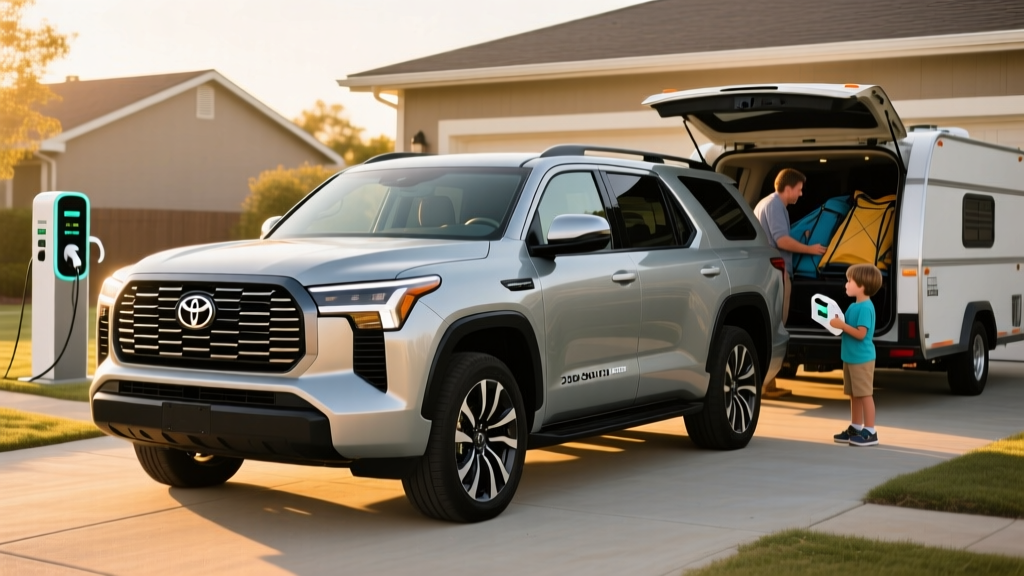
The 2024 Toyota Sequoia is a full-size, body-on-frame SUV that ditched its thirsty V8 for a twin-turbo V6 hybrid powertrain. For buyers who need three rows, serious towing capability, and better fuel economy than a traditional gas truck-based SUV — without plugging in — the Sequoia Hybrid occupies a specific niche. This guide covers everything from EPA fuel economy to the hybrid battery warranty, real-world MPG expectations, and how it compares to a full EV or plug-in hybrid for your use case.
HEV vs PHEV: Where the Sequoia Fits
Before diving into specs, it's critical to understand what the Sequoia is — and isn't.
Conventional Hybrid (HEV) — Sequoia
- No plug required; charges via regenerative braking and the engine
- Small battery (~1.87 kWh); not designed for electric-only driving
- No federal §30D tax credit eligibility
- Lower upfront cost; no charging infrastructure needed
Plug-in Hybrid (PHEV)
- Plugs into Level 1 or Level 2 charger; larger battery (typically 13-20+ kWh)
- 20-40+ miles of electric-only range before engine engages
- May qualify for up to $7,500 federal tax credit (subject to §30D rules)
- Higher upfront cost; benefits most from home charging access
The 2024 Toyota Sequoia is a conventional hybrid (HEV). You never plug it in. The electric motor assists the gasoline engine to improve fuel economy, particularly in city driving, but it cannot drive on electricity alone for meaningful distances. If you need electric-only commuting, you'll want a PHEV like the Toyota RAV4 Prime or a full BEV.
Powertrain: i-FORCE MAX Twin-Turbo V6 Hybrid
Toyota replaced the old 5.7L V8 with the i-FORCE MAX hybrid system — a 3.5-liter twin-turbocharged V6 paired with an electric motor integrated into the transmission bell housing.
| Specification | 2024 Toyota Sequoia Hybrid |
|---|---|
| Engine | 3.5L Twin-Turbo V6 |
| Electric Motor | 36 kW (48 hp) integrated |
| Combined Output | 437 hp / 583 lb-ft torque |
| Transmission | 10-speed automatic |
| Drivetrain | RWD standard; 4WD available |
| Hybrid Battery | 1.87 kWh, sealed NiMH |
| 0-60 mph | ~5.6 seconds (est.) |
| Max Towing Capacity | 9,520 lbs (RWD SR5) |
| Starting MSRP | $60,875 (SR5 RWD) |
The 583 lb-ft of torque arrives low in the rev range thanks to the electric motor's instant contribution, giving the Sequoia strong off-the-line acceleration and confident highway merging — a meaningful upgrade over the outgoing V8's 401 lb-ft. The 10-speed automatic is well-matched, though it can hunt for gears under heavy load when towing near max capacity.
Fuel Economy: EPA MPG vs Real-World
This is where the Sequoia Hybrid justifies its existence. A body-on-frame, three-row SUV with 9,500-lb towing capability that returns over 20 MPG combined is a genuine engineering achievement for this vehicle class.
| Trim / Drivetrain | City MPG | Highway MPG | Combined MPG |
|---|---|---|---|
| SR5 / Limited / Platinum (RWD) | 21 | 24 | 22 |
| SR5 / Limited / Platinum (4WD) | 19 | 22 | 20 |
| TRD Pro / Capstone (4WD) | 19 | 22 | 20 |
Source: EPA / fueleconomy.gov
Real-World MPG Expectations
Hybrids typically exceed their EPA city rating because regenerative braking recaptures energy in stop-and-go traffic. Owners report 22-24 MPG in mixed suburban driving with the 4WD model, and some see 25+ MPG in city-heavy commutes. However, highway-heavy driving at 75-80 mph can drop the 4WD model to 18-19 MPG, and towing near max capacity typically yields 10-13 MPG — physics that no hybrid system can fully overcome. Cold weather and short trips further reduce efficiency by 10-15%.
For context, the previous V8 Sequoia returned just 13 city / 17 highway / 14 combined. The i-FORCE MAX hybrid represents a roughly 40-50% improvement in combined fuel economy — substantial savings over a 200,000-mile ownership cycle.
Pricing, Trims, and Tax Credit Eligibility
The 2024 Sequoia Hybrid is priced at a premium, reflecting its full-size SUV positioning and standard hybrid powertrain.
| Trim | Drivetrain | MSRP |
|---|---|---|
| SR5 | RWD | $60,875 |
| SR5 | 4WD | $62,875 |
| Limited | RWD | $66,125 |
| Limited | 4WD | $68,125 |
| Platinum | 4WD | $74,325 |
| TRD Pro | 4WD | $78,325 |
| Capstone | 4WD | $80,475 |
Prices include destination charge. Source: Toyota.com
Does the Sequoia Hybrid Qualify for a Federal Tax Credit?
No. The Sequoia is a conventional hybrid (HEV), not a plug-in hybrid or battery-electric vehicle. The IRS §30D Clean Vehicle Credit applies only to new plug-in electric vehicles (BEVs and PHEVs) with batteries of at least 7 kWh that meet critical mineral and battery component sourcing requirements, MSRP caps ($80,000 for SUVs), and buyer income limits. The Sequoia's ~1.87 kWh NiMH battery does not qualify.
Some states may offer minor incentives for hybrid vehicles, but these are uncommon and vary by jurisdiction. Check your state's energy office or AFDC state incentive database for current local programs.
Battery Warranty, Lifespan, and Replacement Cost
Hybrid battery longevity is the single most common concern among first-time hybrid buyers. Toyota has refined its hybrid systems over 25+ years (since the 1997 Prius), and the Sequoia's sealed NiMH pack is one of the most proven designs in the industry.
Toyota Hybrid Battery Warranty
- Hybrid Battery: 10 years / 150,000 miles (whichever comes first)
- Hybrid System Components: 8 years / 100,000 miles
- Powertrain (engine, transmission): 5 years / 60,000 miles
- Capacity Threshold: Warranty covers defects and abnormal degradation; Toyota does not publish a specific % capacity retention guarantee for HEVs (unlike BEVs, which often guarantee 70% over the warranty period)
How Long Will the Battery Actually Last?
Toyota's NiMH hybrid batteries in the Camry, Highlander, and RAV4 Hybrid platforms have demonstrated lifespans of 150,000-250,000+ miles before replacement is needed. The Sequoia uses the same fundamental architecture. Because the battery is small (1.87 kWh) and Toyota's battery management system keeps it within a narrow state-of-charge window (roughly 40-80%), the cells experience far less stress than a BEV's large NMC or LFP pack.
Replacement Cost
If the hybrid battery does fail outside warranty, expect a replacement cost of approximately $3,000-$4,500 for a new OEM battery pack, including labor. Refurbished or reconditioned packs are available from third-party suppliers for $1,500-$2,500. Individual cell replacement is sometimes possible for $500-$1,000 if only a few modules have degraded. These costs are significantly lower than BEV battery replacements ($8,000-$20,000+).
Reliability and Safety
The Sequoia shares its TNGA-F platform with the Toyota Tundra and Land Cruiser 300 Series. Toyota's hybrid systems have consistently ranked among the most reliable powertrains in Consumer Reports and J.D. Power surveys. The i-FORCE MAX is newer (introduced 2022 in the Tundra), so long-term data beyond ~60,000 miles is still accumulating, but early reports have been positive.
Safety-wise, the Sequoia comes standard with Toyota Safety Sense 2.5 (TSS 2.5), which includes:
- Pre-Collision System with Pedestrian Detection
- Full-Speed Range Dynamic Radar Cruise Control
- Lane Departure Alert with Steering Assist
- Lane Tracing Assist (SAE Level 2 driver-assist — driver must remain engaged)
- Automatic High Beams
- Road Sign Assist
The NHTSA has not published a full crash-test rating for the 2024 Sequoia as of this writing. The IIHS has not yet evaluated the current-generation model. The TNGA-F platform's structural rigidity and the Sequoia's mass (6,000+ lbs) provide inherent crash protection advantages.
Sequoia Hybrid vs EV vs PHEV: Which Fits You?
Choose the Sequoia Hybrid (HEV) If:
- You need 3 rows and 9,000+ lb towing capacity — very few BEVs or PHEVs match this
- You don't have reliable home or workplace charging access
- You take frequent long road trips and don't want to plan around charging stops
- You want better fuel economy than a gas V8 without changing your refueling habits
Choose a PHEV (e.g., Jeep Wrangler 4xe, Grand Cherokee 4xe) If:
- You have home Level 2 charging and a short commute (20-40 mi electric-only range)
- You want the option of zero-emission daily driving with gas backup for road trips
- You want to potentially qualify for the §30D federal tax credit (check current IRS rules)
Choose a Full BEV (e.g., Rivian R1S, Tesla Model X) If:
- You have reliable home charging and your daily driving is under 250 miles
- You want the lowest per-mile energy cost (~$0.04-$0.06/mi vs $0.18-$0.22/mi for the Sequoia at $4/gal)
- You want instant torque, minimal maintenance, and zero tailpipe emissions
- You can accept current BEV towing limitations (range drops 40-50% when towing heavy loads)
Pros and Cons
Pros
- 22 MPG combined in a 6,000-lb body-on-frame SUV is exceptional
- 583 lb-ft of torque makes towing and highway merging effortless
- No plug-in charging required — zero lifestyle change from a gas vehicle
- 10-year / 150,000-mile hybrid battery warranty
- Proven Toyota hybrid reliability track record
- 9,520-lb max towing capacity (best in hybrid SUV class)
Cons
- $60,875 starting MSRP is steep; Capstone tops $80,000
- No federal tax credit eligibility
- Third-row space is tighter than the Ford Expedition or Chevy Tahoe
- Cargo space behind third row is limited (11.2 cu ft)
- Highway MPG drops noticeably at 75+ mph (18-19 real-world)
- TRD Pro and Capstone trims sacrifice some ride comfort for styling
Frequently Asked Questions
How many MPG does the 2024 Toyota Sequoia Hybrid get?
The EPA rates the RWD Sequoia Hybrid at 21 city / 24 highway / 22 combined MPG. The 4WD model gets 19 city / 22 highway / 20 combined. Real-world city driving often exceeds EPA estimates by 2-3 MPG thanks to regenerative braking, while sustained highway driving above 75 mph may fall 1-2 MPG short.
Does the Sequoia Hybrid need to be plugged in?
No. The Sequoia is a conventional hybrid (HEV). Its small 1.87 kWh battery charges entirely through regenerative braking and the gasoline engine. You fuel it like any other vehicle at a gas station.
Is the Sequoia Hybrid reliable?
Toyota's hybrid systems have a 25+ year track record of strong reliability. The i-FORCE MAX is newer, but early data is positive. The hybrid battery carries a 10-year / 150,000-mile warranty, and Toyota NiMH packs commonly last 150,000-250,000+ miles before replacement.
How much does it cost to replace the Sequoia hybrid battery?
Out-of-warranty replacement runs approximately $3,000-$4,500 for a new OEM pack, or $1,500-$2,500 for a refurbished unit. Individual module repair is sometimes possible for $500-$1,000. This is significantly cheaper than a BEV battery replacement.
Does the 2024 Sequoia Hybrid qualify for any tax credit?
No federal tax credit is available. The IRS §30D Clean Vehicle Credit only applies to plug-in vehicles (BEVs and PHEVs) with battery packs of at least 7 kWh. The Sequoia's ~1.87 kWh pack does not qualify. Check your state's incentive database for any local hybrid programs.
Can the Sequoia Hybrid tow as much as a gas truck?
Yes — the Sequoia Hybrid tows up to 9,520 lbs (RWD SR5), which is competitive with or exceeds many gas-powered full-size SUVs. However, expect fuel economy to drop to 10-13 MPG when towing near maximum capacity, similar to any vehicle in this class.
How does the Sequoia Hybrid compare to the Ford Expedition Hybrid?
Ford discontinued the Expedition's 3.5L PowerBoost hybrid option after the 2022 model year, leaving the Sequoia as the only hybrid in the full-size SUV segment. The Sequoia's 22 MPG combined significantly outperforms the gas-only Expedition's 19 combined.