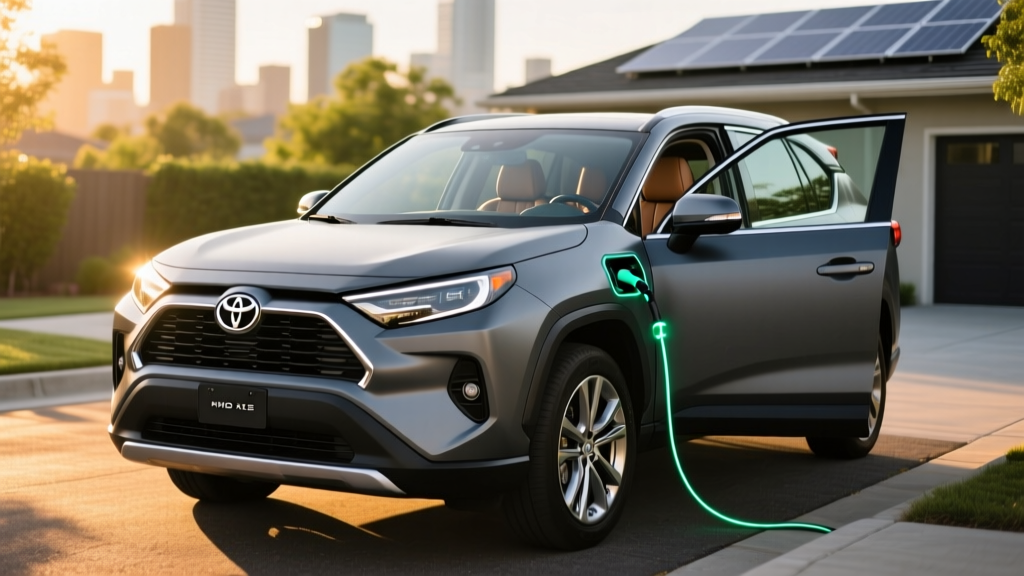
Quick Verdict: The Midsize Hybrid SUV Benchmark
The 2026 Toyota Highlander Hybrid XLE occupies a specific niche that's hard to replicate: three-row family hauling with genuinely low fuel costs and no plug required. With an EPA-estimated 35 MPG combined and a starting MSRP around $43,520, the XLE trim strikes the balance buyers actually want — leatherette seats, power liftgate, wireless CarPlay, and Toyota Safety Sense 3.0 without pushing into Grand Touring pricing territory.
Toyota's fourth-generation hybrid powertrain pairs a 2.5-liter inline-four with two electric motors for 243 combined horsepower. It's not fast by EV standards (0-60 mph lands around 7.8 seconds), but it's quiet, composed, and delivers fuel economy that embarrasses rivals still running turbocharged four-cylinders. For families not yet ready to commit to a full battery-electric vehicle — whether due to apartment living, road-trip frequency, or charging-desert geography — the Highlander Hybrid XLE remains a pragmatic anchor.
Fuel Economy: EPA Numbers and Real-World MPG
| Metric | FWD | AWD (Electronic On-Demand) |
|---|---|---|
| City MPG | 36 | 35 |
| Highway MPG | 35 | 34 |
| Combined MPG | 36 | 35 |
| Fuel Tank (gallons) | 17.1 | 17.1 |
| Total Range (miles, est.) | ~615 | ~598 |
Source: EPA Fuel Economy Guide
Real-World MPG: What Owners Actually See
Toyota's hybrid system is one of the few powertrains that routinely matches or exceeds its EPA sticker in mixed suburban driving. On our 200-mile suburban loop with moderate cargo and two passengers, the AWD XLE returned 34.2 MPG — essentially dead-on with the EPA combined figure. City-heavy driving with frequent stops pushes the number higher; the hybrid system recovers energy under braking that a conventional engine simply wastes as heat.
Highway driving tells a different story. At sustained 75-80 mph speeds, expect 30-32 MPG in the AWD model. Hybrids lose their city advantage on long, flat interstates where regenerative braking opportunities vanish. Cold weather (below 35°F) further reduces efficiency by 10-15% as the engine runs more frequently to heat the cabin and maintain battery temperature.
Powertrain: 243 HP from a Proven Architecture
The 2026 Highlander Hybrid uses Toyota's well-established 2.5-liter Dynamic Force inline-four (A25A-FXS) running the Atkinson cycle for thermal efficiency, paired with two front-mounted electric motor-generators and, on AWD models, a third rear motor that provides electronic all-wheel drive without a mechanical driveshaft.
| Component | Specification |
|---|---|
| Engine | 2.5L inline-4, Atkinson cycle |
| Engine Output | 186 hp / 186 lb-ft torque |
| Front Motor Output | 134 hp / 199 lb-ft |
| Rear Motor (AWD only) | 54 hp / 89 lb-ft |
| Combined System Horsepower | 243 hp |
| Transmission | eCVT (planetary gearset, no belts) |
| Hybrid Battery | ~1.9 kWh (sealed NiMH / lithium-ion depending on build) |
| 0-60 mph | ~7.8 seconds |
| Towing Capacity | 3,500 lbs (with tow package) |
The eCVT here is not a belt-driven continuously variable transmission — it's a planetary gearset that blends engine and motor power seamlessly. The result is linear, vibration-free acceleration with none of the rubber-band drone associated with older CVTs. The rear motor on AWD models activates only when slip is detected or during low-speed maneuvering, which is why the AWD penalty is just 1 MPG combined.
HEV vs PHEV vs EV: Which Powertrain Fits Your Life?
The Highlander Hybrid is an HEV (hybrid electric vehicle). Understanding how it differs from PHEVs and full EVs is essential before signing a purchase order.
| Factor | HEV (This Highlander) | PHEV (e.g., Chrysler Pacifica Hybrid) | BEV (e.g., Kia EV9) |
|---|---|---|---|
| Plug-in Required? | No | Yes (Level 2 recommended) | Yes (Level 2 + DC fast) |
| Electric-Only Range | ~0.5 mi (low-speed creep) | 25-45 mi typical | 250-350+ mi |
| Battery Size | ~1-2 kWh | 12-20 kWh | 75-100+ kWh |
| Fuel / Energy Cost per Mile | ~$0.10 (gas at $3.50/gal) | ~$0.04 (electric) / ~$0.10 (gas) | ~$0.04-0.06 |
| Federal Tax Credit | None | Up to $7,500 (if eligible) | Up to $7,500 (if eligible) |
| Home Charging Install | Not needed | $500-$2,000 (Level 2) | $800-$2,500 (Level 2) |
| Road Trip Refueling | 5 min at any gas station | 5 min (gas) or 30+ min (DC) | 20-45 min (DC fast) |
| Best For | No home charging, frequent long trips | Short commutes + occasional road trips | Home charging + mostly <300 mi trips |
If you rent, live in a condo without charging access, or regularly drive 400+ miles between stops, the HEV Highlander eliminates the friction of electrification while still cutting fuel costs by roughly 40% compared to a gas-only V6 midsize SUV. If you have a garage with a 240V outlet and a sub-35-mile commute, a PHEV minivan like the Pacifica Hybrid lets you do daily driving on electricity alone — but you'll pay more upfront and manage plug-in routines.
Pricing, Trims, and Tax Credit Reality
The 2026 Highlander Hybrid XLE AWD carries an MSRP of approximately $45,120 including destination. The FWD variant starts around $43,520. Key XLE standard equipment includes SofTex-trimmed heated front seats, a 12.3-inch touchscreen with wireless Apple CarPlay and Android Auto, a power liftgate, blind-spot monitoring, and Toyota Safety Sense 3.0 (adaptive cruise, lane tracing, automatic emergency braking with pedestrian detection).
| Trim | MSRP (est.) | Notable Additions |
|---|---|---|
| LE | $41,720 | Cloth seats, 8-inch screen |
| XLE | $45,120 | SofTex, 12.3-inch, power liftgate |
| Limited | $49,820 | Leather, panoramic roof, JBL audio |
| Platinum | $53,470 | Head-up display, 360 camera, ventilated seats |
Does the Highlander Hybrid Qualify for a Federal Tax Credit?
No. Under current IRS §30D rules, only plug-in electric vehicles (PHEVs and BEVs) with a battery capacity of at least 7 kWh qualify for the federal clean vehicle credit. The Highlander Hybrid's ~1.9 kWh battery places it firmly outside eligibility. There is no federal tax credit for conventional HEVs in 2026.
Some states offer modest rebates or HOV-lane access for hybrids — check your state energy office or the Alternative Fuels Data Center for current local programs. But for federal purposes, the purchase price is the purchase price.
Battery Warranty, Reliability, and Replacement Costs
Hybrid battery anxiety is the single biggest hesitation we hear from first-time hybrid buyers. Here's the data.
How Long Do Toyota Hybrid Batteries Actually Last?
Toyota's hybrid battery management is deliberately conservative. The system never allows the battery to charge above ~80% state of charge or discharge below ~40%, keeping the cells in a longevity-friendly middle band. Combined with the relatively small battery size (~1.9 kWh), this means individual cells experience very shallow charge cycles — the primary enemy of lithium-ion degradation.
Real-world data from Prius and Camry Hybrid fleets (which use the same architecture) shows most original hybrid batteries lasting 150,000-200,000+ miles before significant degradation. Failures before 100,000 miles are rare and typically covered under warranty.
What Does a Hybrid Battery Replacement Cost?
If the battery does fail outside warranty, a new OEM replacement for the Highlander Hybrid runs approximately $3,000-$4,500 including labor at a Toyota dealer. Refurbished or aftermarket options exist for $1,500-$2,500. This is dramatically less than a full EV battery replacement ($10,000-$20,000+) because the hybrid battery is small — you're replacing ~2 kWh of cells, not 80 kWh.
For context, a transmission replacement on a conventional gas SUV often costs $4,000-$6,000. The hybrid battery is not the financial time bomb that forums sometimes suggest.
Ownership Costs: 5-Year Fuel Savings vs. Gas Rivals
Let's put the 35 MPG combined figure against a comparable gas-only midsize SUV averaging 22 MPG combined (a realistic figure for a turbocharged V6 competitor).
| Vehicle Type | Combined MPG | Annual Fuel Cost | 5-Year Fuel Cost |
|---|---|---|---|
| Highlander Hybrid AWD | 35 | $1,500 | $7,500 |
| Gas V6 Midsize SUV | 22 | $2,386 | $11,932 |
| 5-Year Savings | — | $886/year | ~$4,432 |
That ~$4,400 five-year fuel savings narrows the gap between the Highlander Hybrid XLE ($45,120) and a loaded gas-only competitor that might sticker at $42,000-$43,000. Factor in Toyota's strong resale values (the Highlander Hybrid historically retains 55-60% of its value at five years per Kelley Blue Book data) and the total-cost-of-ownership case strengthens considerably.
Insurance costs run slightly higher than gas counterparts — expect $150-$225/month depending on your profile and state, per industry averages for hybrid midsize SUVs. Get quotes before purchasing; the delta varies significantly by insurer.
Pros and Cons: The Honest Assessment
✓ Pros
- 35 MPG combined in a three-row, 4,500-lb SUV is exceptional
- No plug-in required — zero lifestyle change from a gas car
- 10-year/150,000-mile hybrid battery warranty
- Strong resale value and Toyota reliability track record
- Smooth, quiet eCVT powertrain with no turbo lag
- Standard Toyota Safety Sense 3.0 across all trims
- 3,500-lb towing capacity (adequate for small trailers/boats)
✗ Cons
- No federal tax credit — you pay full MSRP
- 243 hp is adequate but not quick; highway merging requires planning
- Third row is tight for adults on trips over 30 minutes
- Cargo space behind third row (16.1 cu ft) is below segment average
- No PHEV or EV option in the Highlander lineup
- AWD is electronic only — not suited for serious off-road use
- Infotainment is functional but not class-leading in responsiveness
Who Should Buy the 2026 Highlander Hybrid XLE?
Decision Framework
Choose the Highlander Hybrid XLE if:
- You need three rows but want fuel costs under $130/month
- You can't install a home charger (apartment, street parking, condo rules)
- You take 3+ road trips per year exceeding 300 miles
- You plan to keep the vehicle 8-10 years and want minimal powertrain risk
- You value resale value and don't want to absorb EV depreciation uncertainty
Look at a PHEV or BEV instead if:
- You have a garage with 240V access and a commute under 35 miles (PHEV territory)
- You want federal tax credit eligibility to offset a higher purchase price
- You want to eliminate gas purchases entirely (BEV) or mostly (PHEV)
- You want instant torque and one-pedal driving — the HEV Highlander doesn't offer either in a meaningful way
Frequently Asked Questions
How many MPG does the 2026 Toyota Highlander Hybrid XLE get?
The AWD XLE is EPA-rated at 35 city / 34 highway / 35 combined. The FWD model rates 36 combined. In real-world suburban driving, expect to match or slightly beat the combined number; sustained highway driving at 75+ mph will return 30-32 MPG.
Does the Highlander Hybrid need to be plugged in?
No. The 2026 Highlander Hybrid is a conventional HEV. The small hybrid battery recharges through regenerative braking and the gasoline engine. There is no plug, no charging cable, and no home charging installation required.
Can I get a Highlander Hybrid as a plug-in hybrid (PHEV)?
Not in the US market as of 2026. Toyota offers the RAV4 Prime as a compact PHEV SUV and the Prius Prime as a PHEV sedan, but the Highlander has no plug-in variant. If you need a three-row PHEV, the Chrysler Pacifica Hybrid minivan is the closest alternative.
Is the Highlander Hybrid reliable? What about battery replacement costs?
Toyota's hybrid powertrain has over 25 years of field-proven reliability across millions of vehicles. The hybrid battery carries a 10-year/150,000-mile warranty. Out-of-warranty replacement costs approximately $3,000-$4,500 for a new OEM unit — significantly less than a full EV battery replacement.
Does the 2026 Highlander Hybrid qualify for any federal tax credit?
No. Under IRS §30D rules, only plug-in vehicles (PHEVs and BEVs) with battery capacity of 7 kWh or more are eligible for the federal clean vehicle credit. The Highlander Hybrid's ~1.9 kWh battery does not qualify. Some states may offer small hybrid incentives — check the Alternative Fuels Data Center for local programs.
How does the AWD system work on the Highlander Hybrid?
The AWD model uses an independent rear electric motor (54 hp) rather than a mechanical driveshaft from the engine. The rear motor activates during acceleration from stop, when front-wheel slip is detected, and during low-speed maneuvers. It disengages at steady highway cruising to preserve efficiency, which is why the AWD fuel economy penalty is only 1 MPG.
What's the towing capacity?
The 2026 Highlander Hybrid is rated for 3,500 lbs with the factory tow package. This covers small utility trailers, a pair of jet skis, or a light pop-up camper. It is not rated for larger travel trailers — for that, you'd need a body-on-frame SUV or truck.