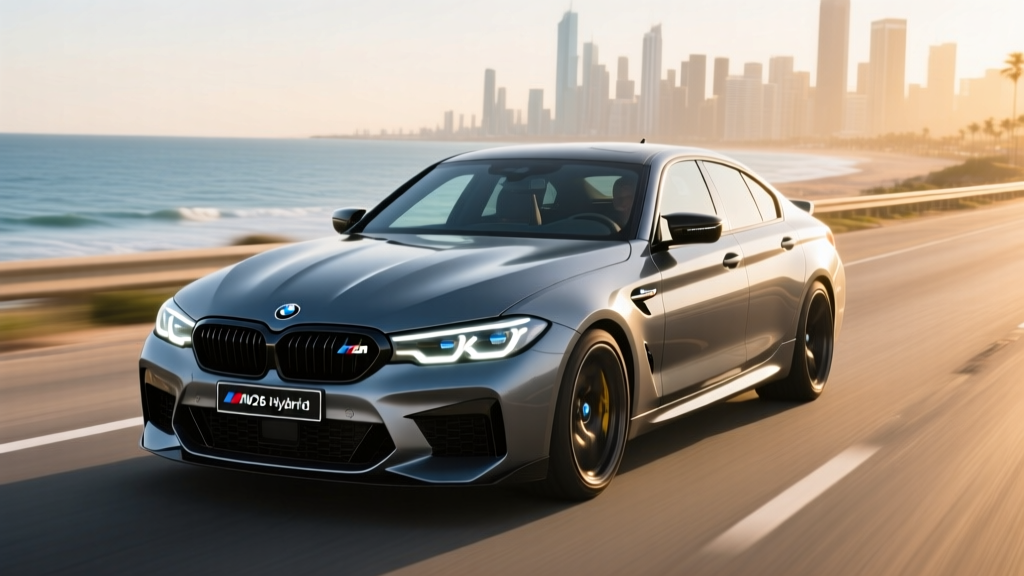
The BMW M5 has always been the benchmark for four-door performance sedans, but the 2026 model year marks a radical departure: it's now a plug-in hybrid. If you're searching for a BMW hybrid sports car, the M5 PHEV is the most electrified performance machine Munich currently offers — pairing a twin-turbo V8 with a high-output electric motor for a combined 717 horsepower. But adding 500+ pounds of battery and power electronics to a sports sedan changes the ownership equation in ways that go far beyond the spec sheet.
This guide breaks down everything a prospective buyer needs to know: real-world MPG versus the EPA sticker, electric-only range, charging logistics, battery warranty, tax credit eligibility, and whether this PHEV makes more sense than a full EV or a traditional gas sports sedan.
HEV vs PHEV: Why the M5 Is a Plug-In, Not a Conventional Hybrid
Before diving into the M5 specifically, it's critical to understand the distinction between the two hybrid architectures BMW uses across its lineup:
Conventional Hybrid (HEV)
A small battery (typically 1-2 kWh) recharged exclusively through regenerative braking and the gas engine. No plug, no electric-only driving beyond very low speeds. Think of the BMW X5 xDrive50e's non-plug siblings or the Toyota Camry Hybrid — you simply fill up with gas and the system optimizes efficiency automatically.
Plug-In Hybrid (PHEV)
A substantially larger battery (the M5 uses an 18.6 kWh usable pack) that can be recharged from a wall outlet or charging station, enabling meaningful electric-only range before the gas engine engages. PHEVs operate as EVs for short commutes and as hybrids on longer trips — giving you the best of both worlds, but adding charging as an ownership responsibility.
The 2026 BMW M5 is exclusively a PHEV. BMW does not offer a conventional HEV version of the M5. If you want a BMW hybrid sports car that never requires plugging in, you'd need to look at the mild-hybrid (48V) systems in models like the M440i — but those offer negligible electric assist and no electric-only range.
2026 BMW M5 PHEV: Powertrain and Performance Specs
The M5's powertrain is a masterpiece of engineering complexity. Here's exactly what's under the hood — and under the floor:
| Specification | 2026 BMW M5 PHEV |
|---|---|
| Engine | 4.4L Twin-Turbo V8 (S68) |
| Engine Output | 577 hp / 553 lb-ft torque |
| Electric Motor | Integrated in 8-speed transmission |
| Motor Output | 194 hp / 207 lb-ft torque |
| Combined System Output | 717 hp / 738 lb-ft torque |
| 0-60 mph | 3.4 seconds |
| Battery (Usable) | 18.6 kWh (NMC lithium-ion) |
| Battery (Gross) | 22.0 kWh |
| Drivetrain | M xDrive AWD (rear-biased) |
| Transmission | 8-speed M Steptronic automatic |
| Curb Weight | ~5,390 lbs |
| Top Speed | 155 mph (electronically limited); 190 mph w/ M Driver's Package |
The 717-hp combined figure places the M5 in supercar territory, but the 5,390-lb curb weight — roughly 1,000 lbs heavier than the previous-generation F90 M5 — is the trade-off for electrification. In real-world driving, you feel the mass during direction changes and heavy braking, even though the straight-line acceleration is devastating.
Fuel Economy: EPA MPG and Real-World Expectations
The M5 PHEV's efficiency story depends entirely on how you use it. The EPA rates it in two modes:
| Mode | City | Highway | Combined |
|---|---|---|---|
| Charge-Depleting (EV+Gas blended) | 14 MPGe combined | ||
| Charge-Sustaining (hybrid mode, battery depleted) | 15 MPG | 20 MPG | 17 MPG |
Source: fueleconomy.gov
Real-World MPG vs EPA
Here's where the M5 PHEV gets complicated. If you charge daily and commute within the ~25-mile electric range, your effective gas consumption drops dramatically — you might burn zero gasoline on a typical weekday. But once the battery is depleted and you're driving on the V8 alone, expect 14-16 MPG in mixed driving and closer to 19-21 MPG on a steady highway cruise. Aggressive driving (this is an M car, after all) can push that below 12 MPG.
For comparison, a non-hybrid BMW M5 Competition from the previous generation averaged roughly 15 MPG combined. The PHEV only delivers meaningful efficiency gains if you actually plug it in regularly.
Electric-Only Range and Charging
EPA Electric-Only Range: 25 miles
Real-World Expectation: 18-22 miles at highway speeds or in cold weather; up to 25 miles in mild conditions with city driving
Total Combined Range (Electric + Gas): ~340 miles
The 25-mile electric range is modest by 2026 PHEV standards — the Toyota RAV4 Prime delivers 42 miles, and the BMW X5 xDrive50e manages 38 miles. The M5's relatively small 18.6 kWh usable battery and heavy, powerful platform limit its EV range. This is enough for a short commute or an emissions-free neighborhood loop, but it won't cover most round-trip commutes without the engine kicking in.
Charging Specifications
| Charging Level | Power | Time (0-100%) | Notes |
|---|---|---|---|
| Level 1 (120V household) | ~1.4 kW | ~14 hours | Emergency only; impractical for daily use |
| Level 2 (240V) | 7.4 kW | ~2 hours 45 min | Standard home/public charging; full overnight recharge |
| DC Fast Charge | Not supported | N/A | No CCS or NACS DC fast-charging capability |
The lack of DC fast charging is a notable omission. BMW limits the M5 PHEV to AC Level 2 charging at a maximum of 7.4 kW. For a car with only 25 miles of range, this is acceptable — a full recharge takes under 3 hours on a home Level 2 charger. But it means you can't meaningfully top up the battery on a road trip via public DC fast chargers.
The M5 uses a J1772 connector for AC charging (the North American standard for non-Tesla PHEVs). An adapter is available for Tesla destination chargers, but the car cannot access Tesla Supercharger stalls for DC charging.
Pricing, Trims, and Tax Credit Eligibility
| Trim | Base MSRP | Destination | Total Starting Price |
|---|---|---|---|
| M5 PHEV Sedan | $119,900 | $1,175 | $121,075 |
| M5 PHEV Touring (Wagon) | $123,900 | $1,175 | $125,075 |
At over $120,000, the M5 PHEV is a serious investment. Options like carbon ceramic brakes ($8,500), the Executive Package ($4,400), and Bowers & Wilkins audio ($4,200) can push a well-equipped example past $145,000.
Federal Tax Credit: Does the M5 PHEV Qualify?
Under the IRS §30D clean vehicle credit rules, the BMW M5 PHEV does not qualify for the federal $7,500 tax credit. Here's why:
- MSRP Cap: PHEV sedans are capped at $55,000 MSRP under §30D. The M5 at $119,900 far exceeds this limit.
- Battery Sourcing: Even if the price qualified, the M5's battery components and critical minerals must meet phased-in domestic sourcing thresholds that most European-built BMWs do not satisfy.
- Buyer Income Cap: AGI limits of $150K (single) / $300K (joint) would further restrict eligibility.
Source: IRS.gov §30D Clean Vehicle Credit
Bottom line: budget the full MSRP. No federal incentive applies. Some states may offer their own PHEV rebates — check your state energy office for current programs, but most state incentives also have price caps well below the M5's sticker.
Battery Warranty, Reliability, and Replacement Costs
BMW PHEV High-Voltage Battery Warranty: 8 years / 80,000 miles (whichever comes first)
Capacity Retention Threshold: BMW warrants the battery against defects and excessive capacity loss below 70% of original capacity during the warranty period.
Estimated Out-of-Warranty Replacement Cost: $12,000 - $18,000 (parts and labor, based on current BMW PHEV battery pricing)
BMW's high-voltage battery technology in its PHEV lineup has proven reasonably reliable. The brand has been building plug-in hybrids since the i8 in 2014 and the 530e since 2018. Industry data suggests PHEV battery degradation is generally slower than full EV battery degradation because the battery operates in a narrower state-of-charge window — BMW typically buffers the pack to avoid full 0% or 100% states, which reduces stress on the NMC cells.
For reliability broadly, the M5's complexity is a double-edged sword. You have a twin-turbo V8, an 8-speed automatic, an integrated electric motor, power electronics, and a liquid-cooled battery pack — all in one vehicle. BMW's B58 and S68 engine families have strong reliability track records, but the combined system has more potential failure points than a conventional M5 or a pure EV.
Source: NHTSA.gov — 2026 BMW M5
Who Should Buy the BMW M5 Hybrid Sports Car?
Choose the M5 PHEV if:
- You want supercar-level acceleration (3.4s to 60) in a four-door sedan with daily usability
- You have home Level 2 charging and a commute under 25 miles — you'll rarely burn gas on weekdays
- You value the ability to drive silently and emission-free in residential areas while retaining V8 range for road trips
- You want the latest BMW M technology and don't mind the weight trade-off
- Budget is flexible above $120K and you don't need a federal tax credit
Look elsewhere if:
- You want maximum efficiency — a Tesla Model S Plaid or Lucid Air delivers similar performance at 3-4x the MPGe
- You can't charge at home — driving the M5 as a gas-only hybrid at 17 MPG defeats the purpose of the PHEV premium
- You want a lightweight, tossable sports car — at 5,390 lbs, the M5 is a muscle sedan, not a corner-carver
- You need DC fast charging for road-trip battery top-ups
- Tax credits or total cost of ownership are primary concerns
M5 PHEV vs Alternatives: Hybrid vs EV vs Gas Sports Sedan
| Attribute | 2026 BMW M5 PHEV | 2026 Tesla Model S Plaid | 2026 BMW M5 CS (prev-gen gas) |
|---|---|---|---|
| Powertrain | V8 PHEV | Tri-Motor BEV | V8 Twin-Turbo |
| Horsepower | 717 hp | 1,020 hp | 627 hp |
| 0-60 mph | 3.4 sec | 1.99 sec | 2.9 sec |
| EPA Range / MPG | 25 mi EV / 17 MPG | 396 mi (124 MPGe) | 16 MPG |
| Starting Price | $121,075 | $89,990 | $142,000 (used/remaining) |
| Federal Tax Credit | None | Up to $7,500* | None |
| Curb Weight | ~5,390 lbs | ~4,766 lbs | ~4,114 lbs |
*Model S Plaid eligibility depends on current-year §30D sourcing rules and buyer income; verify with IRS.
The M5 PHEV occupies a unique niche: it's for the enthusiast who wants V8 character and BMW M driving dynamics but also wants some electric daily-driving capability. If pure performance-per-dollar matters, the Model S Plaid wins on specs. If lightweight handling purity matters, the previous-generation gas M5 (or an M4 CSL) delivers a more visceral experience. The M5 PHEV's value proposition is its duality — silent electric commuting by day, 717-hp V8 fury on demand.
Pros and Cons
Pros
- 717 hp and 738 lb-ft provide effortless, instant torque fill from the electric motor
- 25 miles of silent, zero-emission driving for short commutes
- V8 soundtrack when you want it; electric silence when you don't
- M xDrive AWD with 2WD mode for enthusiast driving
- Practical four-door sedan (and Touring wagon) body style
- Level 2 home charging fully replenishes in under 3 hours
Cons
- 5,390 lbs — significantly heavier than the gas M5; felt in corners and braking
- 25-mile EV range is short for a 2026 PHEV
- No DC fast charging capability
- $121K+ starting price with no federal tax credit
- 17 MPG combined in gas-only mode is thirstier than many expect
- Complex powertrain with more long-term failure points
Frequently Asked Questions
How many MPG does the BMW M5 hybrid get?
The 2026 BMW M5 PHEV is EPA-rated at 14 MPGe combined when using both electric and gas power, and 17 MPG combined (15 city / 20 highway) in charge-sustaining hybrid mode after the battery is depleted. Real-world gas-only driving typically yields 14-16 MPG in mixed use.
How far can the BMW M5 PHEV go on electric only?
The EPA rates the M5 at 25 miles of electric-only range. In real-world conditions — particularly at highway speeds or in cold weather — expect 18-22 miles. This is enough for short commutes but shorter than competitors like the RAV4 Prime (42 mi) or BMW's own X5 xDrive50e (38 mi).
Does the BMW M5 PHEV qualify for a federal tax credit?
No. The M5's $119,900+ MSRP far exceeds the §30D cap of $55,000 for sedans. Battery sourcing requirements and buyer income limits would further restrict eligibility. Budget the full purchase price without expecting a federal incentive.
Is the BMW M5 hybrid reliable? What does a battery replacement cost?
BMW's PHEV systems have proven generally reliable since the brand introduced the 530e in 2018. The high-voltage battery is warranted for 8 years/80,000 miles against defects and excessive degradation (below 70% capacity). Out-of-warranty replacement is estimated at $12,000-$18,000. The added complexity of a combined V8 + electric powertrain means more potential service points than a pure gas or pure electric vehicle.
Can the BMW M5 PHEV use DC fast chargers?
No. The M5 PHEV supports only AC charging — Level 1 (120V) at ~1.4 kW and Level 2 (240V) at up to 7.4 kW. It cannot connect to DC fast chargers (CCS, NACS, or CHAdeMO). A full Level 2 recharge takes approximately 2 hours and 45 minutes.
Hybrid vs PHEV vs full EV — which BMW performance car fits me?
If you can charge at home and want maximum efficiency with sports-sedan performance, a full EV like the Tesla Model S or BMW i5 M60 eliminates gas entirely. If you want V8 character and don't want range limitations, the M5 PHEV gives you both — but only if you commit to daily charging to realize the efficiency benefit. If you simply want a gas sports sedan without plug-in complexity, consider a BMW M440i or look for remaining previous-generation M5 inventory.
Should I charge the M5 PHEV every night?
Yes, if you want to maximize electric driving. BMW recommends charging regularly and suggests keeping the battery between 20-80% for long-term health if you don't need the full range daily. The built-in charge scheduling in iDrive 8.5 lets you set charging windows to take advantage of off-peak electricity rates.