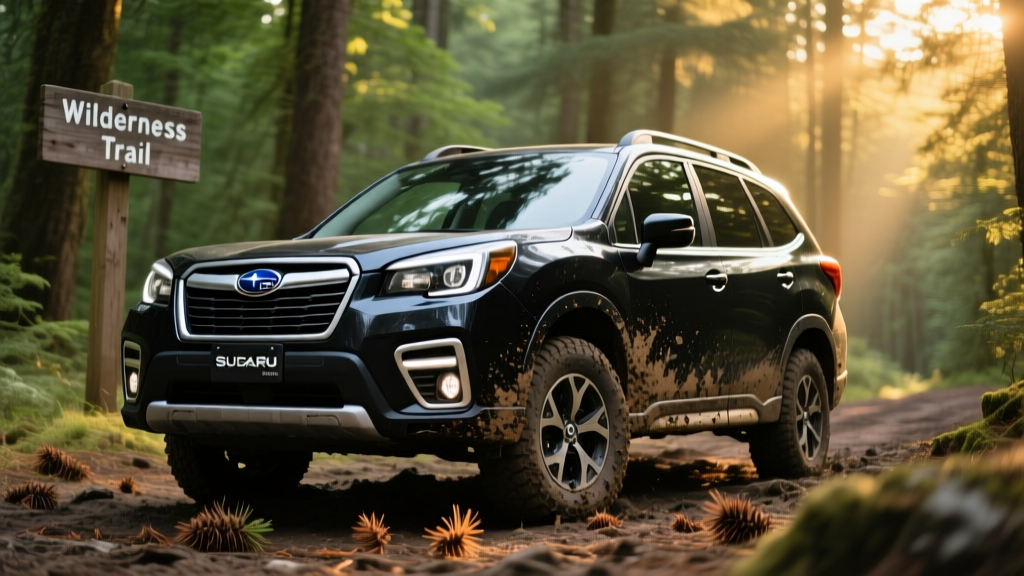
Quick Verdict: The 2026 Subaru Forester Wilderness Hybrid pairs Subaru's trail-ready Wilderness trim with a 2.5-liter hybrid powertrain delivering an EPA-estimated 35 MPG combined. It's a conventional hybrid (HEV) — no plug required — making it a strong pick for buyers who want off-road credibility and better fuel economy without committing to a plug-in or full EV.
Subaru expanded the Forester Wilderness lineup for 2026 by adding a hybrid variant, answering a long-standing request from the outdoor community: a more fuel-efficient trail rig that doesn't sacrifice ground clearance or all-wheel-drive capability. The Wilderness Hybrid slots between the standard gas-powered Wilderness and the fully electric Solterra in Subaru's lineup, targeting buyers who regularly venture off-pavement but also face long highway commutes where the gas-only Wilderness's ~26 MPG combined starts to sting at the pump.
This guide breaks down the Forester Wilderness Hybrid's powertrain, real-world fuel economy expectations, battery longevity, pricing, and how it stacks up against plug-in hybrid and full-electric alternatives for the adventure-oriented buyer.
HEV vs PHEV: What the Forester Wilderness Hybrid Actually Is
| Feature | Conventional Hybrid (HEV) | Plug-In Hybrid (PHEV) |
|---|---|---|
| Plug-in charging required? | No — charges via engine and regenerative braking | Yes — plug in for electric-only range |
| Electric-only range | Minimal (under 1 mile at low speed) | Typically 20–45 miles |
| Battery size | ~1.1 kWh (small buffer) | 13–25 kWh |
| Federal tax credit | Not eligible | Up to $7,500 (with sourcing/income limits) |
| Best for | No home charging access, simplicity seekers | Home chargers, short daily commutes |
The 2026 Forester Wilderness Hybrid is a conventional hybrid (HEV), not a plug-in. Its 1.1 kWh lithium-ion battery pack charges exclusively through the gasoline engine and regenerative braking. You never plug it in. The electric motor assists the gas engine during acceleration and enables brief electric-only creeping at low speeds, but the gasoline engine remains the primary power source at all times.
This is a deliberate choice by Subaru. A PHEV variant would require a larger, heavier battery (typically 15–20 kWh) that would compromise the Wilderness's ground clearance, approach/departure angles, and off-road weight distribution. For a trim defined by its 9.2 inches of ground clearance and dual-function X-MODE, keeping the hybrid system compact preserves the capability buyers are paying for.
Powertrain and Performance Specs
| Specification | 2026 Forester Wilderness Hybrid |
|---|---|
| Engine | 2.5L 4-cylinder BOXER + electric motor |
| Combined System Horsepower | 194 hp |
| Combined System Torque | 182 lb-ft |
| Transmission | Lineartronic CVT |
| Drivetrain | Symmetrical AWD with X-MODE |
| 0–60 mph | ~8.2 seconds (est.) |
| Ground Clearance | 9.2 inches |
| Towing Capacity | 1,500 lbs |
| Battery | 1.1 kWh lithium-ion |
| Hybrid System Type | Series-parallel (conventional HEV) |
The hybrid system pairs Subaru's familiar 2.5-liter horizontally opposed four-cylinder with an electric motor integrated into the transmission housing. Combined output is 194 horsepower — a modest bump over the gas-only Wilderness's 180 hp. The electric motor fills in the torque gap at low RPMs where the BOXER engine is weakest, which translates to noticeably improved response from stops and during low-speed trail crawling.
Subaru's Symmetrical AWD with the Wilderness-specific X-MODE (including Hill Descent Control and the dirt/deep snow setting) carries over unchanged. The hybrid's slightly heavier curb weight — roughly 150 pounds more than the gas version due to the battery and motor — sits low in the chassis thanks to the BOXER engine layout and the battery's placement under the rear cargo floor. Center of gravity remains low, and the weight distribution shift is negligible for off-road use.
Fuel Economy: EPA Estimates vs Real-World MPG
| Driving Cycle | EPA Estimate | Real-World Expectation |
|---|---|---|
| City | 37 MPG | 36–40 MPG (hybrids often beat EPA in city) |
| Highway | 33 MPG | 29–32 MPG (aerodynamic drag, AWD losses) |
| Combined | 35 MPG | 31–35 MPG |
The EPA rates the 2026 Forester Wilderness Hybrid at 35 MPG combined — a substantial improvement over the gas-only Wilderness, which returns roughly 26 MPG combined. The biggest gains come in city and stop-and-go driving, where regenerative braking and electric-motor assist do the most work. According to fueleconomy.gov, the hybrid system's city advantage is significant: 37 MPG city versus the gas model's ~25 MPG city.
Real-world caveat: Highway fuel economy will likely disappoint relative to the EPA sticker. The Wilderness's boxy shape, all-terrain tires, and 9.2 inches of ground clearance create aerodynamic drag that hybrid assist can't fully offset at sustained speeds above 65 mph. Expect 29–32 MPG on highway road trips, particularly with a roof rack or crosswinds. Cold weather will also reduce efficiency — battery performance drops in sub-freezing temperatures, and the engine runs more frequently to provide cabin heat, cutting combined MPG to roughly 28–30 in winter conditions.
For comparison, a Toyota RAV4 Hybrid (the segment benchmark) achieves an EPA-estimated 39 MPG combined, but it lacks the Wilderness's ground clearance, off-road hardware, and standard AWD tuning for rough terrain. The Forester Wilderness Hybrid trades a few MPG for genuine trail capability.
Pricing, Trims, and Tax Credit Eligibility
The 2026 Forester Wilderness Hybrid carries a starting MSRP of approximately $37,500 (including destination), placing it roughly $2,500 above the gas-only Wilderness. Subaru offers the Wilderness Hybrid in a single, well-equipped trim that includes:
- 17-inch alloy wheels with all-terrain tires
- Dual-function X-MODE with Hill Descent Control
- EyeSight Driver Assist Technology (adaptive cruise, lane centering, pre-collision braking)
- 11.6-inch Starlink touchscreen with wireless Apple CarPlay and Android Auto
- Panoramic sunroof
- Heated front seats and steering wheel
- LED fog lights and Wilderness-exclusive exterior cladding
Federal Tax Credit Status
Does the 2026 Forester Wilderness Hybrid qualify for the federal EV tax credit?
No. Under current IRS §30D rules, the federal clean vehicle credit of up to $7,500 applies only to plug-in electric vehicles (BEVs and PHEVs) that meet battery sourcing, critical mineral, MSRP cap, and buyer income requirements. Conventional hybrids (HEVs) like the Forester Wilderness Hybrid do not qualify for any federal purchase incentive.
Some states offer rebates or reduced registration fees for hybrids, but these vary widely. Check your state's energy or DMV website for current programs.
The lack of a federal tax credit means the Wilderness Hybrid's price advantage must come from fuel savings alone. At 35 MPG combined versus 26 MPG for the gas model, and assuming $3.50/gallon fuel and 15,000 miles driven annually, the hybrid saves roughly $550 per year in fuel costs. That means the ~$2,500 price premium pays for itself in approximately 4.5 years — faster if fuel prices rise or if most of your driving is city-based where the MPG gap widens.
Battery Warranty, Lifespan, and Replacement Cost
| Component | Warranty Coverage |
|---|---|
| Hybrid Battery | 8 years / 100,000 miles (10 years / 150,000 miles in CARB states) |
| Hybrid System Components | 8 years / 100,000 miles |
| Powertrain (Engine/Transmission) | 5 years / 60,000 miles |
| Basic Vehicle | 3 years / 36,000 miles |
Subaru warrants the hybrid battery pack for 8 years or 100,000 miles nationwide, with extended coverage of 10 years or 150,000 miles in states that follow California Air Resources Board (CARB) emissions standards — which includes California, New York, Oregon, Washington, and several others.
Realistic battery lifespan: Modern hybrid battery packs from Toyota and Subaru have demonstrated strong longevity in real-world use. The 1.1 kWh pack in the Forester Wilderness Hybrid operates within a narrow state-of-charge window (roughly 40–80%) to minimize degradation stress. Based on data from similar Subaru and Toyota hybrid systems, expect 12–15 years of service life before capacity drops enough to noticeably affect fuel economy — and even then, the vehicle remains drivable with slightly reduced MPG.
Replacement cost: If the hybrid battery does fail outside warranty, expect a replacement cost between $2,500 and $4,000 including labor. Third-party refurbished battery options are increasingly available for $1,500–$2,500. This is substantially cheaper than full EV battery replacements, which can exceed $10,000, because the HEV battery is far smaller.
Who Should Choose This Hybrid vs a PHEV or Full EV?
Choose the Forester Wilderness Hybrid (HEV) if:
- You don't have access to home or workplace charging
- You regularly drive off-pavement and need maximum ground clearance
- You want better fuel economy without changing your refueling habits
- You tow or carry heavy loads where EV range drops sharply
- You want a simpler ownership experience with no charging logistics
Choose a PHEV (like the Toyota RAV4 Prime) if:
- You have Level 2 home charging and a short daily commute (under 40 miles)
- You want electric-only daily driving with gas backup for road trips
- You qualify for the federal tax credit (check IRS §30D requirements for income and sourcing limits)
Choose a full EV (like the Subaru Solterra or Hyundai Ioniq 5) if:
- You have reliable home charging and your daily driving is under 250 miles
- You want zero tailpipe emissions and the lowest per-mile fuel cost
- You prioritize instant torque and a smooth, quiet driving experience
- You live in a region with robust DC fast-charging infrastructure for road trips
The Forester Wilderness Hybrid occupies a specific niche: it's for the buyer who wants to reduce fuel consumption and emissions during daily commuting but whose weekend activities — forest service roads, ski trips, camping in areas without charging — make a full EV impractical. The hybrid powertrain adds efficiency without adding range anxiety or requiring any infrastructure investment.
For buyers who do have home charging and primarily commute on pavement, a PHEV like the RAV4 Prime (42 miles electric-only range, EPA-estimated 38 MPG after battery depletion) offers more daily electrification. But the RAV4 Prime has only 8.1 inches of ground clearance and no dedicated off-road trim, making it a compromise for serious trail use.
Pros
- 35 MPG combined — 35% better than gas Wilderness
- No plug-in charging required — zero infrastructure change
- Full Wilderness off-road capability preserved (9.2" clearance, X-MODE)
- Standard Symmetrical AWD with trail-tuned calibration
- Strong hybrid battery warranty (8yr/100k mi, 10yr/150k in CARB states)
- Improved low-speed torque for trail crawling
- Comprehensive EyeSight safety suite standard
Cons
- No federal tax credit eligibility (HEV)
- Highway MPG closer to 30 in real-world driving
- ~$2,500 price premium over gas Wilderness
- Towing limited to 1,500 lbs (same as gas, lower than some competitors)
- No electric-only driving beyond very low speeds
- Single trim only — no option to delete features for lower price
Reliability and Long-Term Ownership Outlook
Subaru's hybrid system is derived from the Toyota Hybrid System (THS) architecture through the companies' ongoing partnership. Toyota's hybrid powertrains have accumulated over two decades of reliability data, with many Prius and RAV4 Hybrid units exceeding 200,000 miles on original battery packs. The Forester Wilderness Hybrid benefits directly from this proven architecture.
Subaru's BOXER engine has historically had head-gasket concerns in older generations, but the current FB25 engine family (used since 2019) has largely resolved these issues. The hybrid variant reduces engine load during acceleration (the electric motor assists), which may further extend engine life by reducing thermal stress.
According to IIHS, the Forester platform earns top marks in crash testing, and the hybrid variant carries the same structural safety ratings. The EyeSight system — standard on the Wilderness Hybrid — provides adaptive cruise control, lane centering, and pre-collision braking that function identically to the gas model. Note that EyeSight is an SAE Level 2 driver-assistance system, meaning the driver must remain fully engaged and hands on the steering wheel at all times.
Frequently Asked Questions
How many MPG does the 2026 Forester Wilderness Hybrid get?
The EPA estimates 37 MPG city, 33 MPG highway, and 35 MPG combined. Real-world city driving often matches or exceeds the EPA estimate (36–40 MPG), while highway driving typically returns 29–32 MPG due to the Wilderness's aerodynamic profile and all-terrain tires.
Does the Forester Wilderness Hybrid need to be plugged in?
No. It is a conventional hybrid (HEV), not a plug-in hybrid (PHEV). The battery charges through the gasoline engine and regenerative braking. You refuel exclusively at gas stations, just like a conventional car.
Can it drive on electric power alone?
Only at very low speeds (under ~15 mph) for brief distances — such as creeping through a parking lot or in heavy stop-and-go traffic. The electric motor primarily assists the gas engine rather than replacing it. This is normal for all conventional hybrids.
Is the hybrid battery expensive to replace?
Out-of-warranty replacement runs $2,500–$4,000. However, Subaru's hybrid battery warranty covers 8 years/100,000 miles (10 years/150,000 in CARB states), and real-world data from similar hybrid systems suggests 12–15 years of usable life before significant degradation.
Does the hybrid system affect off-road capability?
Subaru engineered the hybrid system to preserve the Wilderness's 9.2 inches of ground clearance, approach/departure angles, and X-MODE functionality. The additional ~150 lbs of hybrid hardware sits low in the chassis. Off-road capability is functionally identical to the gas-only Wilderness.
Does the Forester Wilderness Hybrid qualify for any tax credit?
No federal tax credit is available for conventional hybrids under current IRS §30D rules. Only plug-in hybrids (PHEVs) and battery electric vehicles (BEVs) are eligible. Some states may offer hybrid-specific incentives — check your state energy office for details.
How does it compare to the Toyota RAV4 Hybrid?
The RAV4 Hybrid returns a higher EPA-estimated 39 MPG combined and offers a more car-like on-road experience. However, it has less ground clearance (8.1" vs 9.2"), no dedicated off-road trim with all-terrain tires, and less aggressive approach/departure angles. The Forester Wilderness Hybrid trades a few MPG for genuine trail capability.
Final Assessment: A Niche Done Right
The 2026 Subaru Forester Wilderness Hybrid doesn't try to be everything to everyone. It solves a specific problem: how do you make a capable off-road SUV more livable as a daily driver without compromising what makes it capable? The hybrid powertrain delivers a meaningful 35% fuel economy improvement in combined driving, with the largest gains in the city and stop-and-go conditions that define most commutes.
For buyers who regularly leave the pavement and lack charging infrastructure, this is currently the most efficient way to get 9+ inches of ground clearance and legitimate AWD trail hardware. The ~$2,500 premium over the gas Wilderness pays for itself within five years through fuel savings, and the hybrid battery warranty provides long-term peace of mind. Just don't expect highway MPG to match the EPA sticker, and don't expect any federal tax help — this is an efficiency play, not an electrification play.