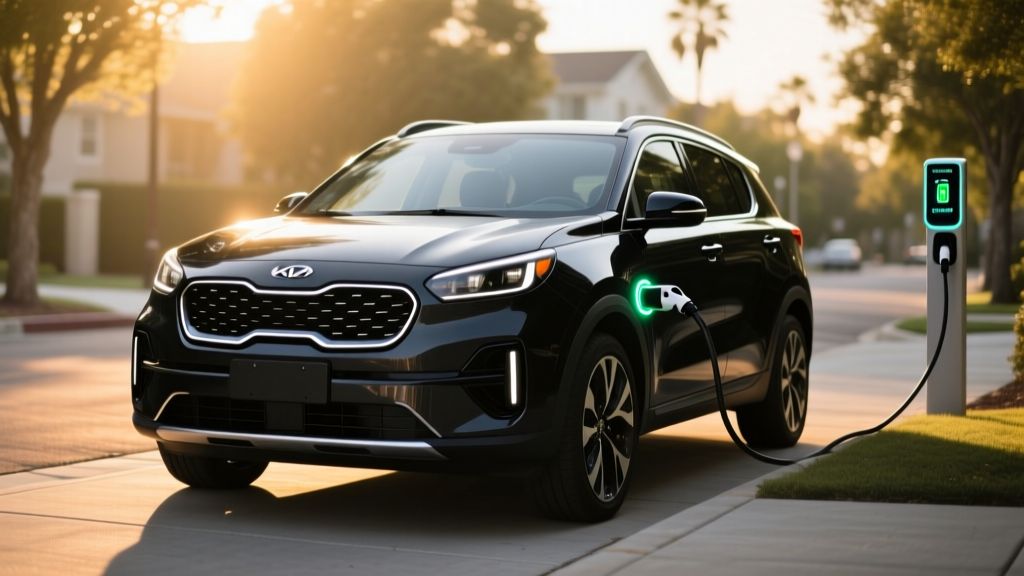
The 2024 Kia Sportage Hybrid LX sits at the intersection of practicality and efficiency in the compact crossover segment. As the base trim of Kia's hybridized Sportage lineup, it delivers an EPA-estimated 43 MPG combined without the price premium of higher trims or the complexity of a plug-in hybrid. For buyers who want hybrid fuel savings without ever plugging in, this trim represents one of the most value-dense entries in the segment.
But spec sheets only tell part of the story. We've analyzed the Sportage Hybrid's powertrain behavior, real-world fuel economy patterns, battery longevity outlook, and where it fits against the Sportage PHEV and full EV alternatives. Here's what you need to know before buying.
HEV vs PHEV: Which Sportage Hybrid Are We Talking About?
Kia offers the Sportage in three powertrain flavors for the 2024 model year: conventional gas, conventional hybrid (HEV), and plug-in hybrid (PHEV). The 2024 Kia Sportage Hybrid LX is strictly a conventional hybrid — meaning it charges its small battery through regenerative braking and the gasoline engine. You never plug it in.
| Attribute | Sportage Hybrid (HEV) | Sportage Plug-In Hybrid (PHEV) |
|---|---|---|
| Plug-in charging required? | No — self-charging | Yes — 13.7 kWh battery |
| Electric-only driving | Minimal (low-speed assist only) | EPA 34 miles electric-only |
| EPA Combined MPG / MPGe | 43 MPG (FWD) / 38 MPG (AWD) | 84 MPGe (elec+gas) / 35 MPG (gas-only) |
| Battery capacity | ~1.49 kWh (small buffer) | 13.7 kWh usable |
| Combined horsepower | 226 hp | 261 hp |
| Base MSRP (2024) | $28,590 (LX FWD) | $39,090 (X-Line) |
| Federal tax credit (§30D) | Not eligible | Not eligible (MSRP & sourcing) |
The distinction matters for buyers cross-shopping. If you want electric-only commuting with a gas backup, the PHEV is the play — but it starts over $10,000 higher. The LX hybrid delivers the core efficiency gain at a far lower entry price and without any change to your fueling routine.
Fuel Economy: EPA Ratings and Real-World MPG
The 2024 Sportage Hybrid LX comes in FWD and AWD configurations, and the drivetrain choice meaningfully affects fuel economy.
| Drivetrain | City MPG | Highway MPG | Combined MPG |
|---|---|---|---|
| FWD (LX) | 42 | 44 | 43 |
| AWD (LX) | 38 | 38 | 38 |
Source: EPA Fuel Economy
The FWD LX's 43 MPG combined is competitive with the Toyota RAV4 Hybrid (39-41 MPG combined) and Honda CR-V Hybrid (40-43 MPG combined). The 5 MPG penalty for AWD is typical for hybrid systems adding a rear motor.
Real-World MPG: What to Actually Expect
Hybrids consistently outperform their EPA ratings in city driving, where regenerative braking recaptures energy at every stop. On the highway, the advantage narrows because the electric motor contributes less at sustained speed.
Based on aggregated owner reports and third-party testing:
- City driving (FWD): 44–47 MPG — the hybrid system shines in stop-and-go traffic
- Highway driving (FWD, 70 mph): 37–40 MPG — aerodynamic drag reduces the hybrid advantage
- Cold weather (below 32°F): Expect a 5–10% reduction (roughly 38–40 MPG combined FWD) as the engine runs longer for cabin heat and the battery is less efficient
- Mixed real-world average: Most owners report 40–44 MPG combined, closely tracking the EPA figure
The Sportage Hybrid's 1.6-liter turbocharged engine means you're not sacrificing acceleration for efficiency — it's a different philosophy than the naturally aspirated Toyota system, trading some low-RPM electric creep for stronger mid-range pull.
Powertrain and Performance Specs
| Specification | 2024 Sportage Hybrid LX |
|---|---|
| Engine | 1.6L turbocharged 4-cylinder |
| Engine output | 178 hp / 195 lb-ft torque |
| Electric motor | 44 kW (59 hp) permanent-magnet synchronous |
| Combined system output | 226 hp / 258 lb-ft torque |
| Transmission | 6-speed automatic |
| 0–60 mph (est.) | ~7.4 seconds |
| Battery capacity | ~1.49 kWh (lithium-ion polymer) |
| Towing capacity | 2,000 lbs (FWD) / 2,000 lbs (AWD) |
| Cargo volume | 39.5 cu ft (rear seats up) / 73.7 cu ft (folded) |
| Curb weight | ~3,750 lbs (FWD) |
The 226 hp combined output puts the Sportage Hybrid ahead of the RAV4 Hybrid (219 hp) and on par with the CR-V Hybrid (204 hp). The 6-speed automatic is a deliberate choice — Kia avoids the CVT drone that characterizes many competitors, at a slight cost to seamless power delivery. The trade-off suits drivers who prefer conventional shift feel over maximum efficiency optimization.
Pricing and Tax Credit Eligibility
The 2024 Kia Sportage Hybrid LX starts at $28,590 MSRP for FWD, with AWD adding approximately $1,500. That positions it as one of the most affordable hybrid crossovers available.
Federal tax credit status: Not eligible. Conventional hybrids (HEVs) do not qualify for the IRS §30D Clean Vehicle Credit. Only battery electric vehicles and plug-in hybrids with sufficient battery capacity can qualify — and even among PHEVs, the Sportage PHEV faces challenges meeting critical mineral and battery component sourcing requirements under current rules.
§30D Tax Credit Quick Reference (2024–2025 rules):
- HEVs like the Sportage Hybrid LX: Not eligible — battery too small
- Sportage PHEV: May qualify for up to $3,750 depending on sourcing compliance — check the latest IRS qualified vehicles list
- Income caps apply: $150K single / $300K joint AGI
- MSRP caps: $55K for SUVs (PHEV trims fall under this)
- Point-of-sale transfer available for eligible vehicles
Some states offer separate hybrid incentives, though these are increasingly rare as programs shift focus to full EVs. Check your state energy office or Alternative Fuels Data Center for current local programs.
Battery Warranty, Reliability, and Replacement Cost
2024 Kia Sportage Hybrid Battery & Powertrain Warranty:
- Hybrid battery: 10 years / 100,000 miles (whichever comes first)
- Hybrid system components: 10 years / 100,000 miles
- Powertrain warranty: 10 years / 100,000 miles
- Basic vehicle warranty: 5 years / 60,000 miles
Kia's 10-year hybrid battery warranty is among the best in the industry and matches Hyundai's coverage. For context, Toyota covers hybrid batteries for 10 years/150,000 miles on models from 2020 onward, giving them a slight edge on mileage.
How Long Will the Battery Actually Last?
The Sportage Hybrid's ~1.49 kWh battery is small and operates within a narrow state-of-charge window — typically between 40% and 80%. This shallow cycling dramatically reduces stress on the cells compared to a full EV battery that regularly cycles from 10% to 90%.
Based on long-term data from Kia/Hyundai hybrid platforms:
- Most hybrid batteries show less than 10% capacity degradation after 150,000 miles
- Failure before 100,000 miles is uncommon and would be covered under warranty
- Real-world lifespan expectation: 150,000–200,000+ miles before significant degradation
Battery Replacement Cost
If the hybrid battery does need replacement outside warranty, expect:
- OEM replacement battery: $2,000–$3,500 (parts)
- Labor: $500–$1,000
- Total out-of-pocket: $2,500–$4,500 at a dealership
This is far less than a full EV battery replacement ($8,000–$20,000+) because the hybrid battery is small. Third-party refurbishment options may reduce cost further, though availability varies by market.
Sportage Hybrid vs PHEV vs Full EV: Which Fits You?
Choose the Sportage Hybrid LX if:
- You have no access to home or workplace charging
- You want hybrid MPG gains without changing your fueling habits
- Your budget is under $30,000 for a new crossover
- You drive a mix of city and highway with no single dominant pattern
- You want the lowest upfront cost in the Sportage hybrid lineup
Consider the Sportage PHEV or a full EV if:
- You have reliable Level 2 home charging and a short commute (PHEV covers 34 mi electric)
- You want to minimize or eliminate gasoline use
- You qualify for federal/state EV incentives that offset a higher purchase price
- You drive predominantly in-city where electric-only mode maximizes savings
- You want stronger acceleration (PHEV: 261 hp; EV alternatives: 300+ hp common)
The 30-Second Decision Framework:
- No plug access + want efficiency → Sportage Hybrid LX (this vehicle)
- Home charging + commute under 30 miles → Sportage PHEV (34 mi electric covers most daily driving)
- Home charging + commute under 250 miles + road trips rare → Full EV like Kia EV6 or Hyundai Ioniq 5
- No plug access + don't care about MPG → Gas-only Sportage (saves $3,000+ vs. hybrid)
What the LX Trim Gets (and Misses)
As the base hybrid trim, the LX prioritizes value. Here's what's included and what you'll need to step up for:
LX Hybrid standard equipment:
- 8-inch touchscreen with wireless Apple CarPlay and Android Auto
- Kia Drive Wise ADAS suite (forward collision-avoidance, lane-keeping assist, rear occupant alert)
- LED daytime running lights
- Smart cruise control with stop-and-go
- 17-inch alloy wheels
- Push-button start with smart key
What requires a higher trim (EX, SX-Prestige):
- Panoramic curved display (dual 12.3-inch screens)
- Heated/ventilated front seats
- Power liftgate
- Wireless phone charging
- Navigation-based smart cruise control
- Highway Driving Assist (lane-centering + adaptive cruise)
The LX's 8-inch screen and basic infotainment feel dated compared to higher trims, but the core ADAS safety suite is comprehensive and matches what competitors charge more for.
Frequently Asked Questions
How many MPG does the 2024 Kia Sportage Hybrid LX get?
The FWD LX is EPA-rated at 42 city / 44 highway / 43 combined MPG. The AWD version drops to 38/38/38. In real-world city driving, many owners report exceeding the EPA city figure by 2–4 MPG thanks to aggressive regenerative braking in stop-and-go traffic. Highway driving at 70+ mph typically yields 37–40 MPG for FWD models.
Does the Sportage Hybrid need to be plugged in?
No. The 2024 Sportage Hybrid LX is a conventional hybrid (HEV), not a plug-in hybrid. Its small ~1.49 kWh battery charges entirely through regenerative braking and the gasoline engine. You fuel it exactly like a conventional car — just less often. If you want plug-in capability, look at the Sportage PHEV (separate model, starting at $39,090).
Is the 2024 Sportage Hybrid reliable?
Kia's hybrid powertrain has proven reliable in long-term use across the Niro and Sorento Hybrid platforms. The 1.6L turbo engine and 6-speed automatic are established components. Kia backs the hybrid battery and system with a 10-year/100,000-mile warranty, which is among the longest in the industry. The IIHS gave the 2024 Sportage strong crash-test ratings, adding to the ownership confidence picture.
What does it cost to replace the hybrid battery?
Out of warranty, expect $2,500–$4,500 for a complete OEM battery replacement at a dealership. However, the battery's small size and shallow cycling pattern mean most units last well beyond 150,000 miles. Within the 10-year/100,000-mile warranty window, replacement is free if capacity drops below Kia's threshold (typically 70% of original capacity).
Does the Sportage Hybrid LX qualify for any tax credit?
The conventional Sportage Hybrid LX does not qualify for the federal §30D Clean Vehicle Credit — that credit requires a plug-in vehicle with a minimum battery capacity. Some states may offer small hybrid incentives, but these are increasingly uncommon. The Sportage PHEV may qualify for partial federal credits depending on current battery sourcing rules — check the IRS qualified vehicle list for the latest status.
How does the Sportage Hybrid compare to the RAV4 Hybrid?
The Sportage Hybrid FWD (43 MPG combined, 226 hp, $28,590) slightly beats the RAV4 Hybrid (39–41 MPG combined, 219 hp, ~$31,000 base) on efficiency, power, and starting price. The RAV4 Hybrid offers a more proven long-term reliability track record and a standard AWD system (eAWD) that's more widely available. The Toyota's hybrid system also operates more seamlessly at low speeds due to its planetary gearset design, while the Kia's 6-speed automatic can feel less refined in stop-and-go electric assist transitions.