Quick Verdict
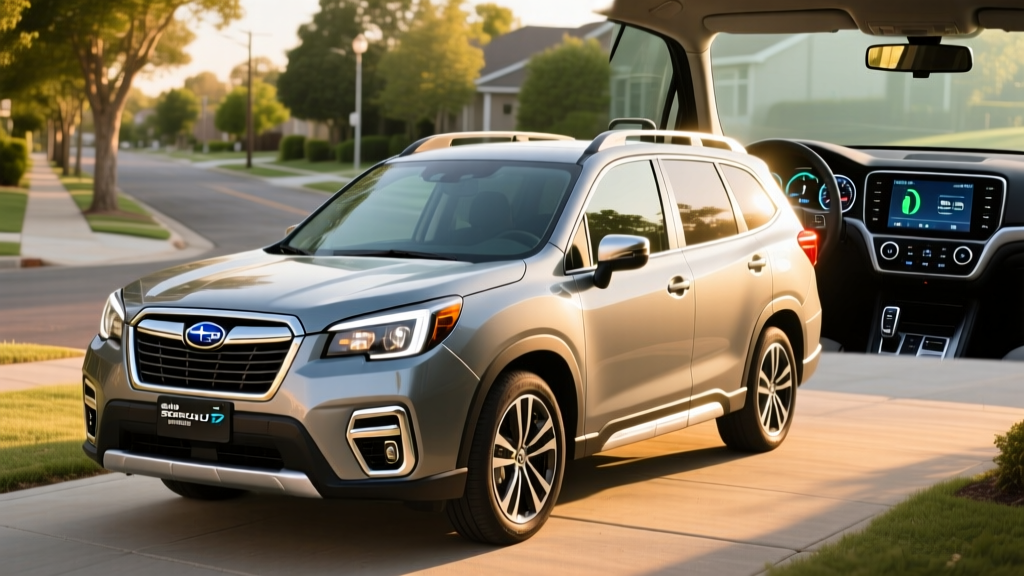
The 2026 Subaru Forester Limited Hybrid pairs Subaru's proven boxer engine with a refined hybrid system to deliver an EPA-estimated 36 MPG combined while retaining the standard symmetrical all-wheel drive that defines the Forester lineup. The Limited trim adds premium interior materials and advanced EyeSight driver-assist technology, making it one of the most practical compact SUV hybrids for buyers who need AWD capability without plugging in.
2026 Subaru Forester Limited Hybrid Powertrain and Performance
The 2026 Forester Hybrid uses a series-parallel hybrid architecture built around a 2.5-liter horizontally-opposed (boxer) four-cylinder engine paired with an electric motor integrated into the Lineartronic CVT transmission. This is a conventional hybrid (HEV), not a plug-in hybrid — it charges its battery through regenerative braking and engine power, requiring no external charging infrastructure.
| Specification | 2026 Forester Limited Hybrid |
|---|---|
| Engine | 2.5L BOXER 4-cylinder + electric motor |
| Combined Horsepower | 194 hp |
| Transmission | Lineartronic CVT |
| Drivetrain | Symmetrical All-Wheel Drive (standard) |
| Hybrid Type | Conventional HEV (no plug-in) |
| 0-60 mph | ~7.8 seconds |
| Towing Capacity | 1,500 lbs |
| Cargo Volume (behind rear seats) | 28.9 cu ft |
| Cargo Volume (rear seats folded) | 74.4 cu ft |
The hybrid system adds approximately 200 pounds compared to the gas-only Forester, but the electric motor's instant torque improves low-speed responsiveness. The boxer engine's low center of gravity, combined with Subaru's symmetrical AWD, provides balanced handling that feels more planted than many crossover competitors.
Fuel Economy: EPA Estimates vs. Real-World MPG
Fuel efficiency is where the Forester Hybrid justifies its premium over the gas-only model. The EPA rates the 2026 Forester Hybrid at:
| Driving Cycle | EPA Estimate | Real-World Expectation |
|---|---|---|
| City | 35 MPG | 36-38 MPG (hybrids excel in stop-and-go) |
| Highway | 34 MPG | 31-33 MPG (sustained speeds reduce regen benefit) |
| Combined | 35 MPG | 33-36 MPG (varies by driving mix) |
Like most conventional hybrids, the Forester Hybrid often exceeds its EPA city rating in real-world urban driving. Regenerative braking recaptures energy during frequent stops, and the electric motor handles low-speed propulsion where gasoline engines are least efficient. Highway driving, where aerodynamic drag dominates and regenerative opportunities are minimal, typically yields slightly lower figures than the EPA highway estimate.
Cold weather impacts hybrid efficiency less severely than full EVs, but expect a 5-10% MPG reduction in freezing temperatures as the engine runs more frequently to maintain cabin heat and battery temperature. The Forester Hybrid's fuel tank holds 13.2 gallons, providing a total driving range of approximately 460-475 miles on a full tank under normal conditions.
HEV vs. PHEV: Understanding What You're Buying
The 2026 Forester Hybrid is a conventional hybrid (HEV), not a plug-in hybrid (PHEV). This distinction matters for ownership experience:
| Feature | HEV (Forester Hybrid) | PHEV (e.g., Toyota RAV4 Prime) |
|---|---|---|
| External Charging Required? | No | Yes (Level 1 or Level 2) |
| Electric-Only Range | None (EV assist only) | 25-42 miles typical |
| Battery Size | ~1.1 kWh (small, self-charging) | 18-20 kWh (larger, plug-in) |
| Federal Tax Credit Eligible? | No | Up to $7,500 (subject to §30D rules) |
| Home Charging Setup Needed? | No | Yes (Level 2 recommended) |
| Best For | Drivers without home charging access | Drivers with home charging + short commutes |
If you have reliable access to Level 2 home charging and a commute under 30 miles, a PHEV like the Toyota RAV4 Prime or Mitsubishi Outlander PHEV may deliver greater fuel savings through electric-only daily driving. However, if you lack home charging, live in an apartment, or frequently drive longer distances where electric range would be depleted quickly, the Forester Hybrid's no-plug-required convenience is a significant advantage.
Pricing and Tax Credit Eligibility
The 2026 Subaru Forester Limited Hybrid carries a starting MSRP of approximately $38,500 (including destination). The Limited trim includes leather-trimmed upholstery, a 10-way power-adjustable driver's seat, heated front seats, a power liftgate, and Subaru's EyeSight Driver Assist Technology suite.
| Trim | MSRP (est.) | Federal Tax Credit |
|---|---|---|
| Forester Hybrid Sport | $36,500 | $0 (HEV ineligible) |
| Forester Hybrid Limited | $38,500 | $0 (HEV ineligible) |
Federal tax credit status: The Forester Hybrid does not qualify for the IRS §30D Clean Vehicle Credit. This credit applies only to plug-in electric vehicles (BEVs and PHEVs) with sufficient battery capacity — conventional hybrids like the Forester are excluded. Some states may offer modest incentives for hybrid purchases, but these vary widely by jurisdiction; check your state's energy or environmental agency for current programs.
While the lack of a federal credit is a disadvantage compared to PHEV competitors, the Forester Hybrid's lower purchase price (PHEVs typically cost $5,000-$8,000 more) and zero charging infrastructure requirements can offset this gap for many buyers.
Reliability and Hybrid Battery Warranty
Hybrid Battery Warranty: Subaru covers the Forester Hybrid's battery pack and hybrid system components for 8 years or 100,000 miles, whichever comes first. In states that follow California Air Resources Board (CARB) emissions standards (including CA, NY, MA, and others), hybrid component coverage extends to 10 years or 150,000 miles.
Subaru's hybrid system has proven reliable since its introduction, with the Forester Hybrid using a smaller, less stressed battery pack than full EVs or PHEVs. The ~1.1 kWh nickel-metal hydride battery operates within a narrow state-of-charge window (typically 40-80%), which significantly reduces degradation compared to the deeper cycling in plug-in vehicles.
Should the hybrid battery require replacement outside warranty coverage, expect costs between $2,000-$4,000 for parts and labor at a Subaru dealer. Independent hybrid specialists may offer refurbished battery packs for $1,500-$2,500. However, hybrid battery failures before 150,000 miles remain uncommon based on long-term data from Subaru's hybrid fleet.
The 2026 Forester carries Subaru's standard new-vehicle warranty: 3 years/36,000 miles bumper-to-bumper and 5 years/60,000 miles powertrain. Subaru's IIHS Top Safety Pick heritage (check current-year ratings for 2026 updates) and standard EyeSight system — which includes pre-collision braking, adaptive cruise control, lane-keep assist, and lane-centering — support strong resale values and long-term ownership satisfaction.
Hybrid vs. PHEV vs. EV: Which Fits Your Needs?
Choose the Forester Hybrid (HEV) if:
- You lack access to home or workplace Level 2 charging
- You want AWD capability with minimal complexity
- Your daily driving varies widely (10 miles some days, 300 miles others)
- You prefer a lower purchase price and don't want to manage charging routines
- You live in an area with limited public charging infrastructure
Consider a PHEV (RAV4 Prime, Outlander PHEV) if:
- You have reliable Level 2 home charging
- Your daily commute is under 35 miles (staying within electric range)
- You want the option of electric-only driving for local trips
- You qualify for the federal §30D tax credit (check IRS eligibility requirements including income caps and battery sourcing rules)
Consider a full EV (Ioniq 5, Model Y, EV6) if:
- You have Level 2 home charging and access to DC fast charging for road trips
- You want the lowest per-mile fuel cost and minimal maintenance
- You're eligible for the full $7,500 federal credit
- Your daily driving is under 250 miles and you're comfortable planning longer trips around charging stops
Real-World Ownership: What to Expect
Owners report the Forester Hybrid delivers its best fuel economy in suburban and city driving with frequent stops. Highway-only road trips at 75+ mph typically yield 30-32 MPG — still strong for an AWD compact SUV, but below the EPA highway estimate. The hybrid system is seamless; most drivers cannot feel the transitions between electric and gasoline power.
The Forester Hybrid's 8.7 inches of ground clearance and X-MODE traction management system retain the off-road capability of the gas model, making it suitable for light trail use, snow, and unpaved roads. However, the 1,500-pound towing capacity is modest — buyers needing to tow heavier loads should consider the gas-only Forester or a larger SUV.
Maintenance costs are comparable to the gas Forester. The hybrid system adds no routine service items; regenerative braking actually extends brake pad life by reducing mechanical brake usage. Oil changes follow the same 6,000-mile/6-month interval as the conventional model.
Pros and Cons
Pros
- Standard AWD with 35 MPG combined — rare combination in the segment
- No plug-in charging required; works with existing gas-station infrastructure
- Strong real-world city MPG (often exceeds EPA estimate)
- 8-10 year hybrid battery warranty provides long-term peace of mind
- EyeSight driver-assist standard on all trims
- Excellent outward visibility and practical cargo space
Cons
- No federal tax credit eligibility (HEV exclusion)
- Highway MPG slightly below EPA estimate at sustained speeds
- Modest 1,500-lb towing capacity
- Limited trim availability (Hybrid offered in Sport and Limited only)
- CVT can drone under hard acceleration
Frequently Asked Questions
How many MPG does the 2026 Forester Hybrid get?
The EPA rates the Forester Hybrid at 35 MPG city / 34 MPG highway / 35 MPG combined. Real-world city driving often yields 36-38 MPG due to regenerative braking, while sustained highway driving typically returns 31-33 MPG.
Is the Forester Hybrid a plug-in hybrid?
No. The Forester Hybrid is a conventional hybrid (HEV) that charges its battery through regenerative braking and the gasoline engine. You never plug it in — you simply refuel at gas stations like any conventional vehicle.
How far can the Forester Hybrid drive on electric power alone?
The Forester Hybrid cannot drive on electric power alone for any meaningful distance. The electric motor assists the gasoline engine during acceleration and low-speed driving, but the vehicle always requires the engine for sustained propulsion. This differs from PHEVs, which offer 25-42 miles of electric-only range.
Does the Forester Hybrid qualify for any tax credits?
The Forester Hybrid does not qualify for the federal §30D Clean Vehicle Credit, which applies only to plug-in vehicles (BEVs and PHEVs). Some states may offer incentives for hybrid purchases — check your state's energy agency for current programs.
How reliable is the Forester Hybrid battery, and what does replacement cost?
Subaru covers the hybrid battery for 8 years/100,000 miles (10 years/150,000 miles in CARB states). Hybrid battery failures before 150,000 miles are uncommon. Out-of-warranty replacement costs $2,000-$4,000 at a dealer, or $1,500-$2,500 through independent hybrid specialists using refurbished packs.
Should I buy the Forester Hybrid or a full EV?
Choose the Forester Hybrid if you lack home charging access, drive highly variable distances, or want AWD without range-planning concerns. Choose a full EV if you have Level 2 home charging, want the lowest per-mile fuel cost, and can accommodate charging stops on longer trips.