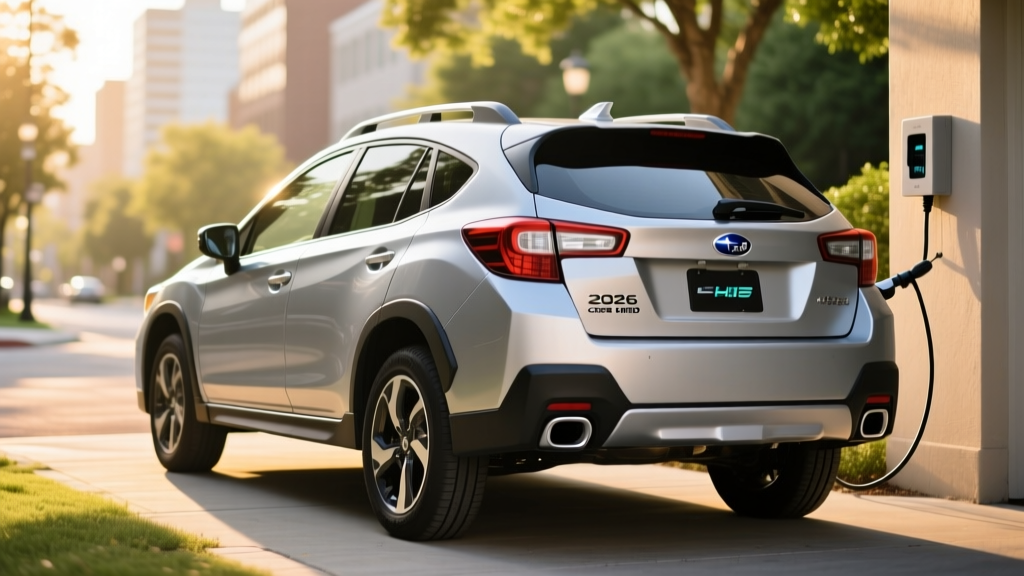
The Subaru Crosstrek has long been the go-to compact crossover for outdoorsy buyers who need standard all-wheel drive without the fuel penalty of a traditional SUV. For 2026, the Crosstrek Hybrid returns as a plug-in hybrid (PHEV), pairing Subaru's boxer engine with a battery and electric motors to deliver short electric-only commutes and excellent all-weather capability. But with a modest EV range and a price premium over the gas model, does the math work? Here is every spec, cost, and ownership detail you need before deciding.
HEV vs PHEV: What the 2026 Crosstrek Hybrid Actually Is
A common point of confusion in the hybrid market is the difference between a conventional hybrid (HEV) and a plug-in hybrid (PHEV). The 2026 Subaru Crosstrek Hybrid is a PHEV. That means it carries a larger battery than a standard hybrid and can be plugged in to recharge, enabling a short window of pure electric driving before the gasoline engine takes over.
| Feature | Conventional Hybrid (HEV) | Plug-In Hybrid (PHEV) |
|---|---|---|
| Plug-in charging | No — charges via regen and engine | Yes — plug in for electric-only miles |
| Battery size | ~1–2 kWh | ~8–20 kWh (Crosstrek: 8.8 kWh usable) |
| Electric-only range | None (assist only) | 17 miles EPA (Crosstrek) |
| Federal tax credit | Not eligible (§30D) | Potentially up to $7,500 (see rules) |
| Example | Toyota RAV4 Hybrid | Subaru Crosstrek Hybrid, RAV4 Prime |
If you never want to think about plugging in, a conventional HEV like the Toyota RAV4 Hybrid may suit you better. But if you have home charging and a commute under 17 miles each way, the Crosstrek PHEV lets you run most weekday errands on electricity alone.
Fuel Economy and Electric Range: The Numbers
The 2026 Crosstrek Hybrid's efficiency story is a tale of two modes. On battery power alone, it returns an EPA-rated 90 MPGe (miles per gallon equivalent — a measure that converts electricity use into a gasoline-equivalent figure). Once the battery is depleted and the hybrid system takes over, the EPA rates it at 35 MPG combined.
| Mode | City | Highway | Combined |
|---|---|---|---|
| Electric-only (MPGe) | — | — | 90 MPGe |
| Hybrid (gasoline, MPG) | 36 | 34 | 35 |
For context, the gas-only 2026 Crosstrek with the 2.5-liter engine achieves roughly 29 MPG combined per fueleconomy.gov. The PHEV's 35 MPG hybrid mode represents a meaningful improvement, especially in stop-and-go city driving where regenerative braking recaptures energy most effectively.
Hybrid-mode fuel economy often exceeds EPA city estimates in real-world driving because regenerative braking is most effective in urban traffic. Owners who do mostly city driving commonly report 37–39 MPG in hybrid mode. Highway-heavy drivers should expect figures closer to 32–34 MPG, as aerodynamic drag and the AWD system's mechanical losses work against efficiency at sustained speed.
Powertrain and Performance Specs
The Crosstrek Hybrid uses a 2.0-liter Subaru boxer four-cylinder engine paired with two electric motor-generators and an 8.8 kWh (usable) lithium-ion battery pack. Combined system output is 148 horsepower, delivered through a continuously variable transmission (CVT) and Subaru's symmetrical all-wheel-drive system.
| Specification | Value |
|---|---|
| Powertrain | 2.0L boxer-4 + dual electric motor-generators |
| Combined horsepower | 148 hp |
| Transmission | CVT (lineartronic) |
| Drivetrain | Symmetrical AWD (standard) |
| Battery (usable) | 8.8 kWh, lithium-ion |
| Electric-only range | 17 miles (EPA) |
| Total range | ~480 miles |
| 0–60 mph | ~8.5 seconds (est.) |
| Towing capacity | 1,000 lbs |
| Cargo volume | 19.9 cu ft (rear seats up) |
Performance is adequate rather than thrilling. The electric motors provide instant low-end torque that makes the Crosstrek feel responsive around town, but the 148 hp combined output means highway passing requires planning. The CVT keeps the engine in its efficient band but drones under hard acceleration — a familiar trade-off in Subaru's lineup.
Charging: Level 1, Level 2, and What to Expect
One important limitation: the 2026 Crosstrek Hybrid does not support DC fast charging. It charges exclusively via AC power — either a standard 120V household outlet (Level 1) or a 240V Level 2 charger.
| Charging Level | Power (kW) | 0–100% Time | Notes |
|---|---|---|---|
| Level 1 (120V outlet) | ~1.2 kW | ~8 hours | Included cord; overnight top-up |
| Level 2 (240V, 16A) | ~3.3 kW | ~3 hours | Home wallbox or public L2 station |
| DC Fast Charge | N/A | N/A | Not supported |
The onboard charger is rated at approximately 3.3 kW, which is modest by PHEV standards. For comparison, the Toyota RAV4 Prime accepts up to 6.6 kW on Level 2. The practical impact: if you plug into a public Level 2 charger during a shopping trip, the Crosstrek will add roughly 10–12 miles of electric range per hour — enough for a partial top-up but not a full recharge during a quick errand.
For most PHEV owners, Level 1 charging from a standard outlet overnight is sufficient. The 8.8 kWh battery is small enough that even 1.2 kW charging replenishes it fully in about 8 hours, which fits neatly into an overnight window. If you want faster turnaround or plan to charge opportunistically during the day, a Level 2 home installation (typically $500–$1,500 for equipment and electrician labor, depending on panel proximity) is worthwhile.
Pricing, Trims, and Federal Tax Credit Eligibility
The 2026 Subaru Crosstrek Hybrid is offered in a single well-equipped trim, starting at an MSRP of approximately $36,995 (including destination). That represents a roughly $7,000 premium over a comparably equipped gas Crosstrek Premium.
Standard equipment includes EyeSight driver-assist technology (Subaru's Level 2 SAE system — the driver must remain engaged at all times), heated front seats, an 11.6-inch infotainment touchscreen, LED headlights, roof rails, and 17-inch alloy wheels. The only factory option is typically a package adding a power moonroof and Harmon Kardon audio.
- Vehicle MSRP cap: SUVs/crossovers must be under $80,000 — Crosstrek Hybrid qualifies.
- Buyer income cap: Modified AGI must not exceed $150,000 (single) / $300,000 (joint). Check IRS guidelines for current-year thresholds.
- Battery sourcing: Critical minerals and battery components must meet escalating domestic-sourcing percentages. PHEV credit amounts vary by battery capacity — the Crosstrek's 8.8 kWh pack may qualify for a partial credit (estimated $3,750–$4,500), not the full $7,500. Confirm on the IRS eligible-vehicle list before purchase.
- Point-of-sale transfer: As of 2024+, buyers can transfer the credit to the dealer for an upfront price reduction, rather than waiting to claim it on their tax return.
Credit rules change frequently. Consult a tax professional and verify eligibility at irs.gov before purchasing.
After a potential partial federal credit, the effective price could drop to roughly $32,500–$33,200, narrowing the gap with the gas model. Several states also offer additional PHEV rebates (California, Colorado, and New York among them), though amounts and eligibility vary by jurisdiction — check your state energy office for current programs.
Battery Longevity, Warranty, and Replacement Cost
Battery degradation is the top concern for hybrid buyers, and Subaru addresses it with a strong warranty. The high-voltage battery pack is covered for 8 years or 100,000 miles (whichever comes first) against defects and excessive capacity loss. In states that follow California Air Resources Board (CARB) standards — including California, New York, Massachusetts, and others — the warranty extends to 10 years or 150,000 miles.
• Federal states: 8 years / 100,000 miles
• CARB states: 10 years / 150,000 miles
• Covers: defects, capacity loss below ~70% of original
• 12V auxiliary battery: separate warranty (typically 3 yr / 36,000 mi)
In practice, PHEV battery packs from Subaru's hybrid system supplier have proven durable. The 8.8 kWh pack is relatively small and operates within a conservative state-of-charge window (the system buffers the top and bottom to prevent deep cycling), which reduces stress on the cells. Most owners report minimal noticeable degradation over 5–7 years of ownership.
If a replacement is needed out of warranty, expect a cost in the range of $3,000–$5,000 for the battery pack itself, plus labor. This is considerably less than a full EV battery replacement because the PHEV pack is much smaller. The hybrid system's motor-generators and power electronics carry their own warranty coverage as part of the emissions-related components.
Who Should Buy the Crosstrek Hybrid vs a Full EV or Gas Car
Choosing between a PHEV, a conventional hybrid, a gas car, and a full battery-electric vehicle (BEV) depends on your driving pattern, charging access, and budget. Here is a practical decision framework:
- Your daily commute is under 20 miles round-trip and you can charge at home
- You need AWD for snow, mud, or mountain roads
- You take occasional long road trips where EV charging infrastructure is sparse
- You want to reduce fuel consumption without range anxiety
- You have reliable home charging and your daily driving is under 200 miles
- You want zero tailpipe emissions and the lowest per-mile energy cost
- You want access to the full $7,500 federal tax credit (on qualifying models)
- You cannot charge at home (apartment, street parking)
- Your budget is tight and the $7,000 PHEV premium is hard to justify
- You drive mostly highway miles where the hybrid advantage is smaller
- You want better MPG without ever plugging in
- You want a lower purchase price than a PHEV
The Crosstrek Hybrid occupies a specific niche: AWD-capable, outdoorsy, plug-in efficient for short commutes. If that describes your life, it is one of the few PHEVs in its class that offers standard AWD alongside genuine electric-only driving.
- Standard symmetrical AWD — rare for PHEVs in this class
- 17-mile EV range covers most short commutes
- 35 MPG combined in hybrid mode is solid for an AWD crossover
- Strong battery warranty (8–10 years)
- EyeSight safety suite standard
- Good ground clearance (8.7 inches) for light off-road use
- No DC fast charging — AC only at 3.3 kW max
- ~$7,000 premium over gas Crosstrek
- 148 hp feels modest for highway merging
- Partial federal tax credit only (not full $7,500)
- Cargo space slightly reduced vs gas model (battery packaging)
- Single trim limits customization
Frequently Asked Questions
How many MPG does the 2026 Crosstrek Hybrid get?
The EPA rates it at 35 MPG combined (36 city / 34 highway) in hybrid mode after the battery is depleted. In electric-only mode, it achieves 90 MPGe. Real-world city driving often yields 37–39 MPG thanks to regenerative braking, while sustained highway driving may drop to 32–34 MPG.
How far can the Crosstrek Hybrid go on electric only?
The EPA rates it at 17 miles of electric-only range. Real-world results vary from about 14 miles in cold weather to 16–17 miles in mild conditions with moderate driving. Total combined range (electric plus a full tank of gasoline) is approximately 480 miles.
Hybrid vs PHEV vs EV — which is right for me?
A conventional hybrid (HEV) improves MPG without any plugging in — ideal if you lack home charging. A PHEV like the Crosstrek Hybrid adds 15–20 miles of electric range for short commutes while retaining a gas engine for road trips. A full EV (BEV) offers the lowest running costs and zero tailpipe emissions but requires reliable charging access and acceptance of range limitations on long trips. For a detailed breakdown of total cost of ownership across all three, see our EPA comparison tool.
Is the Crosstrek Hybrid reliable, and what does battery replacement cost?
Subaru's hybrid system has a solid reliability track record, and the battery is warranted for 8 years/100,000 miles (10 years/150,000 miles in CARB states). The conservative charge-discharge window and relatively small battery pack reduce degradation risk. Out-of-warranty battery replacement is estimated at $3,000–$5,000 including labor — significantly less than a full EV battery swap.
Does the 2026 Crosstrek Hybrid qualify for a federal tax credit?
It may qualify for a partial federal §30D clean vehicle credit, estimated at $3,750–$4,500 depending on battery-sourcing compliance. The full $7,500 credit is unlikely due to the pack's smaller capacity and critical-mineral sourcing requirements. Eligibility also depends on your income (under $150K single / $300K joint) and the vehicle's MSRP (under $80K for SUVs). Verify current eligibility on the IRS clean vehicle credit page before purchasing, as rules and eligible-vehicle lists update periodically.
Can I charge the Crosstrek Hybrid at a DC fast charger?
No. The 2026 Crosstrek Hybrid does not have a DC fast-charge port. It charges via AC only — either Level 1 (120V, ~8 hours for a full charge) or Level 2 (240V, ~3 hours). For most PHEV owners with home charging, this is not a practical limitation, since the small battery tops up overnight on a standard outlet.
How does the Crosstrek Hybrid compare to the Toyota RAV4 Prime?
The RAV4 Prime offers significantly more electric range (42 miles EPA), more power (302 hp combined), and DC-adjacent Level 2 charging at 6.6 kW. However, it also carries a higher starting price (roughly $44,000) and has faced persistent availability constraints. The Crosstrek Hybrid is smaller, more affordable, and offers comparable ground clearance for off-pavement use, making it a strong choice if your commute is short and your budget is tighter.