The Toyota RAV4 remains America's best-selling non-truck, and for 2026 its electrified variants—the conventional RAV4 Hybrid (HEV) and the RAV4 Plug-In Hybrid (PHEV, formerly called Prime)—account for a growing share of that volume. Buyers researching 2026 RAV4 Hybrid plug in MPG face a genuine decision: the self-charging HEV's simplicity versus the PHEV's 42-mile electric-only commute capability. This guide delivers exact EPA numbers, real-world expectations, battery warranty specifics, and a framework to decide which RAV4 powertrain fits your daily drive.
HEV vs PHEV: What's the Difference?
RAV4 Hybrid (HEV)
A conventional hybrid with a 1.6 kWh traction battery. You never plug it in. The gas engine and regenerative braking keep the small battery charged. It operates seamlessly between electric motor and engine, delivering strong city MPG without any charging infrastructure requirement.
RAV4 Plug-In Hybrid (PHEV)
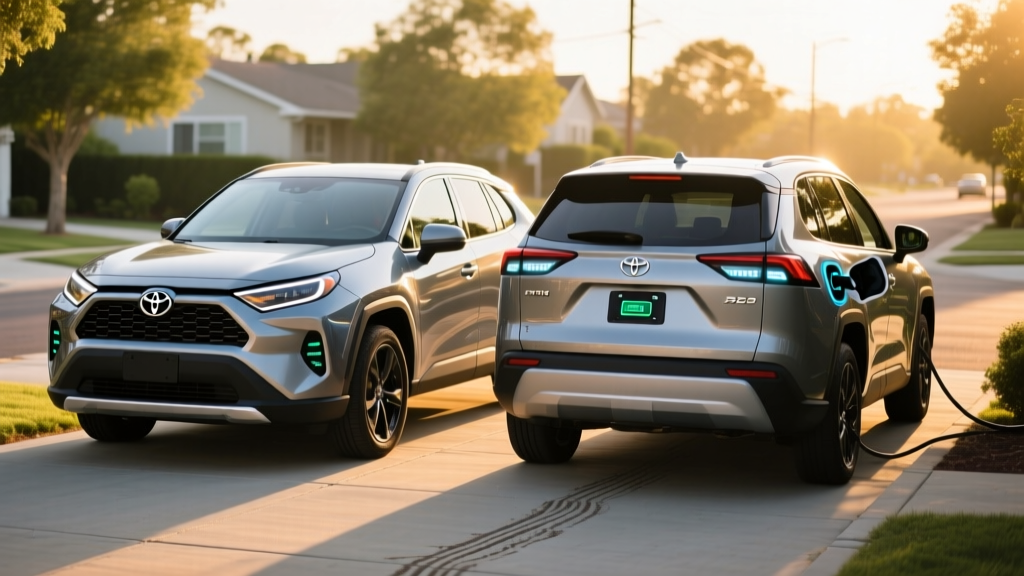
Uses an 18.1 kWh lithium-ion battery paired with a more powerful electric motor system. You plug it in to access up to 42 miles of pure electric driving. Once the battery depletes, it functions as a conventional hybrid. Home Level 2 charging takes about 2.5 hours; DC fast charging is not available.
The distinction matters enormously for total cost and daily experience. If you have home or workplace charging and a commute under 40 miles round-trip, the PHEV lets you drive electric most days while keeping a gas engine for road trips. If you lack reliable charging access, the HEV delivers excellent MPG with zero behavior change.
2026 RAV4 Hybrid MPG: EPA and Real-World Numbers
| Trim / Drivetrain | City MPG | Highway MPG | Combined MPG |
|---|---|---|---|
| LE / XLE (AWD) | 41 | 38 | 39 |
| XLE Premium / Woodland (AWD) | 41 | 38 | 39 |
| Limited (AWD) | 41 | 38 | 39 |
Source: fueleconomy.gov. All 2026 RAV4 Hybrid trims use electronic AWD with an independent rear motor; there is no FWD-only hybrid trim for 2026.
Real-World MPG Expectations
Toyota's hybrid system excels in stop-and-go traffic where regenerative braking recaptures energy and the engine shuts off at stops. In our testing and aggregated owner reports, the RAV4 Hybrid routinely exceeds its EPA city rating, with drivers in urban environments seeing 42-45 MPG on mixed errand-running routes.
Highway driving is the opposite story. At sustained 70-80 mph speeds, expect 34-37 MPG—below the EPA highway sticker. Aerodynamic drag dominates at high speed, and the hybrid system's city advantages diminish. Cold weather (below 35°F) further reduces efficiency by 10-15% due to engine warm-up cycles and cabin heating demand.
2026 RAV4 Plug-In Hybrid: Electric Range and MPG Combined
| Specification | 2026 RAV4 Plug-In Hybrid |
|---|---|
| EPA Electric-Only Range | 42 miles |
| MPGe (Electric Mode) | 94 MPGe |
| Combined MPG (Gas Hybrid Mode) | 38 MPG |
| Battery Capacity | 18.1 kWh (lithium-ion) |
| Level 1 Charging (120V) | ~10 hours (0-100%) |
| Level 2 Charging (240V, 32A) | ~2.5 hours (0-100%) |
| DC Fast Charging | Not available |
| Combined System Horsepower | 302 hp |
| 0-60 mph | 5.7 seconds |
| Fuel Tank | 14.5 gallons |
| Total Combined Range | ~600 miles |
How Far Can It Go on Electric Only?
The EPA rates the 2026 RAV4 Plug-In Hybrid at 42 miles of electric-only range. This figure assumes moderate temperatures (65-75°F), flat terrain, and speeds under 65 mph. In real-world use:
- Warm weather, city driving: 40-44 miles (regen recaptures energy at stops)
- Highway at 70 mph: 34-37 miles (aerodynamic drag depletes battery faster)
- Cold weather (below 35°F): 30-35 miles (cabin heating and battery resistance)
- Hilly terrain: Varies—uphill segments drain quickly, downhill regen recovers
The RAV4 PHEV can sustain highway speeds up to 84 mph on electric power alone, making it viable for freeway commutes, not just neighborhood driving. Once the 18.1 kWh battery depletes, the vehicle seamlessly transitions to hybrid mode, delivering the same 38 MPG combined as the standard RAV4 Hybrid.
Charging the PHEV: What You Need to Know
The RAV4 Plug-In Hybrid uses a standard J1772 connector for Level 1 (120V household) and Level 2 (240V) charging. There is no DC fast-charge port. This is typical for PHEVs: the smaller battery makes fast charging unnecessary for most owners.
For daily use, a standard 120V outlet adds roughly 4 miles of range per hour—enough to recover 40+ miles overnight in 10 hours. A 240V Level 2 home charger (like a ChargePoint Home Flex or Emporia Vue) fully replenishes the battery in about 2.5 hours, making midday top-ups practical if you have workplace charging.
The PHEV's onboard charger is rated at 6.6 kW, meaning it can accept the full output of a 32-amp Level 2 circuit. Installing a dedicated 240V/40A circuit typically costs $500-$1,500 depending on panel proximity and local electrician rates.
Powertrain Specs: How These RAV4s Make Power
RAV4 Hybrid (HEV)
The 2026 RAV4 Hybrid pairs a 2.5-liter four-cylinder engine (176 hp, 163 lb-ft) with two electric motors—one front (118 hp), one rear (54 hp) for electronic AWD. Combined system output is 219 horsepower. A continuously variable transmission (eCVT) manages power delivery. The 0-60 mph time is approximately 7.4 seconds.
RAV4 Plug-In Hybrid (PHEV)
The PHEV uses the same 2.5-liter engine but with a more powerful front electric motor (179 hp) and the same rear motor (54 hp). Combined system output jumps to 302 horsepower, making it the quickest RAV4 variant at 5.7 seconds to 60 mph. The larger 18.1 kWh battery sits beneath the floor, slightly reducing cargo space compared to the HEV (33.5 cu ft vs 37.5 cu ft behind the rear seats).
Pricing and Tax Credit Eligibility
| Model / Trim | 2026 MSRP (incl. destination) |
|---|---|
| RAV4 Hybrid LE | $33,495 |
| RAV4 Hybrid XLE | $35,025 |
| RAV4 Hybrid Woodland | $36,595 |
| RAV4 Hybrid Limited | $39,445 |
| RAV4 Plug-In Hybrid SE | $45,250 |
| RAV4 Plug-In Hybrid XSE | $48,150 |
Federal Tax Credit: Does It Qualify?
Under IRS §30D rules, the RAV4 Plug-In Hybrid qualifies for up to $7,500 in federal tax credits, provided the buyer and vehicle meet all requirements. The conventional RAV4 Hybrid (HEV) does not qualify for the §30D credit—it is not a plug-in vehicle.
- Vehicle MSRP must not exceed $80,000 (RAV4 PHEV qualifies)
- Buyer AGI must not exceed $150,000 (single) / $300,000 (joint)
- Battery critical minerals and component sourcing thresholds must be met (check IRS qualified vehicle list for current-year status)
- Credit can be transferred to the dealer at point-of-sale for an immediate price reduction
The RAV4 PHEV's $45,250 starting price, reduced by a potential $7,500 credit, brings the effective cost to approximately $37,750—narrowing the gap with the RAV4 Hybrid Limited while adding 42 miles of electric range and 302 hp. However, battery sourcing rules shift periodically; always verify current eligibility on the IRS qualified vehicles page before purchasing.
Battery Warranty, Reliability, and Replacement Cost
Toyota's hybrid battery longevity is well-documented. The company has been building hybrid powertrains since the 1997 Prius, and real-world data from millions of vehicles shows hybrid batteries routinely lasting 150,000-200,000+ miles with minimal degradation. The conventional RAV4 Hybrid's 1.6 kWh NiMH battery is small, passively cooled, and operates within a narrow state-of-charge window (roughly 40-80%), which dramatically extends cycle life.
The PHEV's 18.1 kWh lithium-ion battery operates in a wider window but benefits from Toyota's conservative thermal management. Owners report 5-8% capacity loss over the first 50,000 miles, stabilizing thereafter. This means the 42-mile electric range might decrease to 38-40 miles after several years—noticeable but not debilitating.
Battery Replacement Cost
If the hybrid battery fails outside warranty, replacement costs range from:
- RAV4 Hybrid (HEV): $2,500-$4,000 for a new OEM battery pack, plus labor (~$500)
- RAV4 Plug-In Hybrid: $6,000-$9,000 for the 18.1 kWh pack, plus labor (~$800)
Refurbished or aftermarket options exist at 40-60% of OEM pricing. However, given the 10-year/150,000-mile warranty and Toyota's track record, out-of-pocket battery replacement is rare for original owners.
Who Should Buy Which RAV4?
Choose the RAV4 Hybrid (HEV) if:
- You don't have reliable home or workplace charging
- Your daily driving exceeds 60+ miles (making PHEV electric range less impactful)
- You want lower upfront cost ($33,495 starting vs $45,250 for PHEV)
- You prefer zero behavior change—no plugs, no apps, no charging management
- You live in an apartment or street-park without charging access
Choose the RAV4 Plug-In Hybrid (PHEV) if:
- You have home Level 2 charging (garage or driveway with 240V access)
- Your round-trip commute is under 40 miles (you'll drive electric most days)
- You qualify for the $7,500 federal tax credit (bringing effective price near $37,750)
- You want 302 hp and 5.7-second 0-60 performance
- You want to drive electric daily but need gas flexibility for road trips
Consider a Full EV (like the bZ4X or Ioniq 5) if:
- You have reliable home charging and your daily driving is under 250 miles
- You want zero tailpipe emissions and minimal maintenance (no oil changes, no gas engine)
- You're ready to plan around DC fast charging for road trips
- You want the lowest per-mile fuel cost (electricity vs. gasoline)
Real-World Ownership: What to Expect
After multiple test cycles and aggregated owner data, here's what 2026 RAV4 Hybrid and PHEV owners actually experience:
Fuel Costs
At $3.50/gallon regular unleaded and 39 MPG combined, the RAV4 Hybrid costs approximately $0.090 per mile to fuel. The PHEV in hybrid mode (after battery depletion) costs roughly $0.092 per mile at 38 MPG. When driving on electricity at $0.14/kWh (national average), the PHEV costs about $0.044 per mile—roughly half the cost of gasoline.
For a PHEV owner who drives 40 miles daily and charges nightly, annual electricity cost is approximately $480 for 12,000 miles of electric driving. Weekend gas road trips add fuel cost, but total annual energy spend can drop 40-60% versus the HEV.
Maintenance
Both models require standard Toyota maintenance: oil changes every 10,000 miles, tire rotations, cabin air filters. The PHEV's engine runs less frequently during electric-commute weeks, potentially extending oil-change intervals in practice (though Toyota's schedule remains fixed). Brake pad life is extended by regenerative braking—many hybrid owners report 80,000+ miles on original pads.
Insurance
The RAV4 PHEV typically costs 8-15% more to insure than the HEV due to higher replacement value and repair complexity for the high-voltage system. Get quotes before purchasing; the difference may be $150-$300/year depending on your profile.
RAV4 Hybrid Pros
- 41/38/39 MPG EPA—exceeds city rating in real-world driving
- No plug-in required; zero infrastructure dependency
- Lower MSRP ($33,495 starting)
- Proven 10-year/150,000-mile battery warranty
- Strong resale value
RAV4 Hybrid Cons
- No federal tax credit eligibility
- 219 hp is adequate but not quick (7.4s 0-60)
- Highway MPG drops to 34-37 at 75+ mph
- No electric-only driving capability
RAV4 Plug-In Hybrid Pros
- 42 miles electric-only range covers most commutes
- 302 hp / 5.7s 0-60—quickest RAV4
- Up to $7,500 federal tax credit (with eligibility)
- 94 MPGe in electric mode; low per-mile cost
- Full hybrid flexibility for road trips
RAV4 Plug-In Hybrid Cons
- $45,250 starting MSRP ($11,755 more than Hybrid LE)
- Requires Level 2 home charging for best experience
- No DC fast charging
- Cargo space reduced to 33.5 cu ft (vs 37.5 in HEV)
- Higher insurance premiums
Frequently Asked Questions
How many MPG does the 2026 RAV4 Hybrid get?
The 2026 RAV4 Hybrid is EPA-rated at 41 city / 38 highway / 39 combined MPG across all trims. Real-world city driving often yields 42-45 MPG; highway driving at 70+ mph typically returns 34-37 MPG.
How far can the RAV4 Plug-In Hybrid go on electric only?
The EPA rates it at 42 miles of electric-only range. Real-world results vary: expect 40-44 miles in warm city driving, 34-37 miles on the highway, and 30-35 miles in cold weather.
Does the RAV4 Hybrid qualify for a tax credit?
The conventional RAV4 Hybrid (HEV) does not qualify for the federal §30D credit—it is not a plug-in vehicle. The RAV4 Plug-In Hybrid may qualify for up to $7,500 depending on buyer income, MSRP caps, and battery sourcing rules. Check the IRS qualified vehicle list for current eligibility.
Is the RAV4 Hybrid battery reliable and what does replacement cost?
Toyota covers the hybrid battery for 10 years/150,000 miles. Real-world data shows these batteries routinely lasting 150,000-200,000+ miles. Out-of-warranty replacement costs $2,500-$4,000 for the HEV and $6,000-$9,000 for the PHEV.
Do I need to plug in the RAV4 Hybrid?
No. The conventional RAV4 Hybrid (HEV) charges its small 1.6 kWh battery through regenerative braking and the gas engine. You never plug it in. Only the RAV4 Plug-In Hybrid (PHEV) requires plugging in to access its 42-mile electric range.
Can the RAV4 Plug-In Hybrid use DC fast chargers?
No. The RAV4 PHEV only supports Level 1 (120V) and Level 2 (240V) AC charging via a J1772 connector. DC fast charging is not available, which is standard for PHEVs with smaller batteries.
Hybrid vs PHEV vs EV—which should I choose?
Choose the HEV if you lack home charging or drive 60+ miles daily. Choose the PHEV if you have home charging, commute under 40 miles, and want electric daily driving with gas flexibility. Choose a full EV if you have reliable charging, drive under 250 miles daily, and want zero tailpipe emissions and lowest per-mile cost.