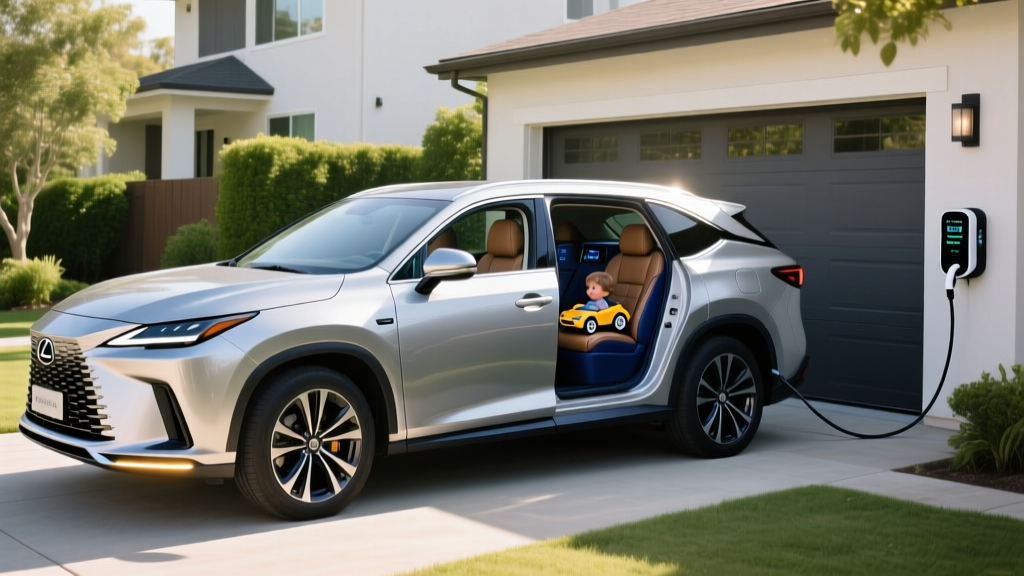
The three-row luxury SUV segment has no shortage of gas-guzzling options, but the 2026 Lexus TX 550h+ occupies a rare middle ground: a plug-in hybrid luxury car that can handle the school run on electricity alone, then swallow six passengers and their luggage for a cross-country weekend without a single range-anxiety thought. As Lexus's largest plug-in hybrid, the TX 550h+ pairs a turbocharged V6 with a 22.7 kWh battery to deliver 367 combined horsepower and an EPA-estimated 33 miles of electric-only driving. But does the math work for luxury buyers weighing a full EV, a conventional hybrid, or a traditional gas SUV?
HEV vs PHEV: Where the TX 550h+ Fits
Before evaluating the TX 550h+, it's essential to distinguish the two hybrid architectures Lexus offers in this platform:
TX 350h (Conventional Hybrid / HEV)
- No plug — regenerates its own battery through braking and engine power
- Smaller ~1.8 kWh battery buffer
- EPA 34 MPG combined; zero electric-only miles
- Lower starting price; no federal tax credit eligibility
- Best for: buyers who want set-it-and-forget-it efficiency
TX 550h+ (Plug-In Hybrid / PHEV)
- Plugs in to charge a 22.7 kWh lithium-ion battery
- 33 miles EPA electric-only range before the engine engages
- EPA 30 MPG combined (hybrid mode) / 76 MPGe (electric + gas)
- May qualify for partial federal tax credit depending on sourcing rules
- Best for: buyers with home charging and a short daily commute
The TX 550h+ is the only plug-in hybrid in the TX lineup and one of very few three-row PHEV luxury SUVs on the market. Its closest competitors include the BMW X5 xDrive50e and the Volvo XC90 Recharge — both two-row-friendly in their standard configurations, making the Lexus unique for larger families.
EPA Fuel Economy and Electric-Only Range
Fuel economy is the headline metric for any hybrid luxury car buyer. Here's how the TX 550h+ breaks down according to fueleconomy.gov:
| Metric | TX 550h+ (PHEV) | TX 350h (HEV) | TX 500h F Sport (HEV) |
|---|---|---|---|
| Electric-Only Range | 33 miles | N/A | N/A |
| MPGe (EV + Gas Combined) | 76 MPGe | N/A | N/A |
| City MPG (Hybrid Mode) | 30 | 37 | 27 |
| Highway MPG (Hybrid Mode) | 30 | 33 | 28 |
| Combined MPG (Hybrid Mode) | 30 | 34 | 27 |
| Total Range (EV + Gas) | ~440 miles | ~580 miles | ~500 miles |
If your daily round-trip commute falls within 30 miles and you charge at home nightly, you may go weeks without visiting a gas station. On a 300-mile highway road trip with no charging stops, the TX 550h+ operates as a conventional hybrid and delivers roughly 30 MPG — respectable for a 5,100-pound luxury SUV, but notably less than the lighter TX 350h HEV's 34 MPG combined.
Powertrain, Battery, and Charging Specs
| Specification | 2026 Lexus TX 550h+ |
|---|---|
| Engine | 2.4L turbocharged 4-cylinder + 2 electric motors |
| Combined Horsepower | 367 hp |
| Combined Torque | 406 lb-ft |
| 0–60 mph | 5.9 seconds |
| Battery Capacity | 22.7 kWh (lithium-ion, NMC chemistry) |
| Usable Battery Capacity | ~18.5 kWh |
| Electric-Only Range (EPA) | 33 miles |
| Level 1 Charging (120V) | ~1.4 kW; full charge in ~14 hours |
| Level 2 Charging (240V) | 6.6 kW; full charge in ~3 hours |
| DC Fast Charging | Not available |
| Charge Port | J1772 (Level 2) |
| Drivetrain | DIRECT4 AWD (standard) |
| Towing Capacity | 5,000 lbs |
A critical detail for PHEV shoppers: the TX 550h+ does not support DC fast charging. This is typical for plug-in hybrids — the smaller battery means Level 2 at 6.6 kW fills it in roughly three hours, which covers overnight home charging and opportunistic top-ups at destination chargers. If you rely exclusively on public DC fast-charging networks like Electrify America or Tesla Superchargers, this PHEV won't benefit from those stations.
The 6.6 kW onboard charger means a full 0–100% charge at home takes about three hours on a 240V Level 2 circuit. For most owners, plugging in when they get home yields a full battery by morning — or even by dinner if you arrive at 5 PM. A standard 120V household outlet (Level 1) works but takes roughly 14 hours, making it viable only for very low daily mileage or trickle-charging.
Pricing, Trims, and Tax Credit Eligibility
| Trim | 2026 MSRP (est.) |
|---|---|
| TX 550h+ Premium | $79,150 |
| TX 550h+ Luxury | $84,500 |
The TX 550h+ sits near the top of the TX range, commanding a significant premium over the TX 350h HEV (starting around $65,000). That premium buys the plug-in powertrain, standard DIRECT4 AWD, and additional sound insulation.
Federal Tax Credit (§30D) Eligibility
- MSRP Cap: SUVs must be under $80,000 — the TX 550h+ Premium qualifies, but the Luxury trim may exceed the cap depending on options.
- Buyer Income Cap: Modified AGI must not exceed $150,000 (single), $225,000 (head of household), or $300,000 (joint).
- Battery Sourcing: Critical minerals and battery components must meet phased-in percentages per IRS rules. As of 2026, sourcing requirements are stringent and may reduce the credit from $7,500 to $3,750 or eliminate it depending on supply chain compliance.
- Point-of-Sale Transfer: Eligible buyers can transfer the credit to the dealer at purchase for an immediate price reduction.
Because battery sourcing requirements tighten annually under IRS §30D rules, eligibility can change mid-year. Always verify current credit status on the IRS qualified vehicles list before purchasing. A tax professional can confirm your personal income eligibility.
At the state level, several states offer additional PHEV rebates (Colorado, California, and others), though amounts and eligibility vary by jurisdiction — check your state's energy office for current programs.
Battery Warranty, Reliability, and Replacement Costs
Lexus (and parent company Toyota) has the deepest track record in hybrid reliability of any automaker, having sold millions of hybrids since the original Prius in 1997. The TX 550h+'s 22.7 kWh NMC battery is liquid-cooled and managed with conservative charge buffers — it never fully charges to 100% or discharges to 0% at the cell level, which dramatically slows degradation.
In real-world data from Toyota/Lexus hybrid platforms, battery packs routinely exceed 150,000 miles with less than 10% capacity loss. Should a replacement be needed out of warranty, expect a cost in the $5,000–$8,000 range for the pack plus labor — significant, but far less catastrophic than early-generation EV battery replacements that could exceed $15,000.
Lexus as a brand consistently ranks at or near the top of J.D. Power and Consumer Reports reliability surveys. The TX is built on the same TNGA-K platform as the Grand Highlander, and early reliability indicators are strong. The main watch items for PHEV buyers are the onboard charger (occasional failure in any brand) and the charge port door mechanism — neither is common, but both are worth noting during the warranty period.
Driving Impressions and Interior Quality
The TX 550h+ leverages its electric motors for smooth, silent acceleration from a stop — the 0–60 mph time of 5.9 seconds feels quicker than the number suggests because torque delivery is instant. In EV mode, the cabin is remarkably quiet, befitting a luxury SUV in this price bracket.
The three-row interior seats six (captain's chairs) or seven (bench second row), with genuine adult usability in the third row for passengers up to about 5'8". Cargo space behind the third row is 20.2 cubic feet — enough for several carry-ons or a week of groceries — expanding to 97 cu ft with both rear rows folded.
The 14-inch infotainment touchscreen runs Lexus's latest interface with wireless Apple CarPlay and Android Auto, and the available Mark Levinson 21-speaker audio system is among the best in the segment. Standard Lexus Safety System+ 3.0 includes adaptive cruise control, lane-keeping assist, and pre-collision braking — note that this is a Level 1 driver-assist system, requiring full driver attention at all times.
Who Should Choose the TX 550h+ vs a Full EV or Gas SUV?
Choose the TX 550h+ PHEV if:
- You have home Level 2 charging and a daily commute under 30 miles
- You need three rows but want to minimize fuel use on weekdays
- You take regular road trips where charging infrastructure is uncertain
- You want luxury refinement without committing to a full BEV
Choose a full EV (Rivian R1S, Tesla Model X) if:
- You have reliable home and workplace charging
- Your road trips follow well-mapped Supercharger or NACS corridors
- You want zero tailpipe emissions and lower per-mile fuel costs
- You're willing to plan charging stops on long drives
Choose the TX 350h (conventional HEV) if:
- You can't install a home charger (apartment, no garage, street parking)
- You want simpler ownership with no plug-in routine
- You drive mostly highway miles where the PHEV advantage narrows
- You want to save $10,000+ on purchase price
Pros
- 33 miles EV-only covers most daily commutes gas-free
- Three-row seating rare among PHEV luxury SUVs
- Lexus reliability and 10-year hybrid battery warranty
- Smooth, quiet EV-mode driving in the city
- 5,000-lb towing capacity
Cons
- No DC fast charging — public charging limited to Level 2
- Highway MPG (30) trails the lighter TX 350h HEV (33)
- Premium pricing; Luxury trim may exceed $80K tax-credit cap
- Electric-only range drops to ~23 miles in cold weather
- Third row tight for taller adults on long trips
Frequently Asked Questions
How many MPG does the Lexus TX 550h+ get?
The EPA rates the TX 550h+ at 30 MPG combined (30 city / 30 highway) once the battery is depleted and it operates as a conventional hybrid. In electric mode, it achieves 76 MPGe. Real-world city driving in hybrid mode often yields 32–35 MPG thanks to regenerative braking, while sustained highway speeds above 75 mph may drop to 27–28 MPG.
How far can the TX 550h+ go on electric power alone?
The EPA estimates 33 miles of electric-only range. In warm weather with moderate speeds, expect 30–35 miles. In cold weather (below 30°F) or at highway speeds, expect 23–26 miles before the gas engine engages. After the battery depletes, the vehicle seamlessly transitions to hybrid mode with no driver input required.
Does the TX 550h+ qualify for a federal tax credit?
Possibly. Under IRS §30D rules, the TX 550h+ Premium (under $80,000 MSRP) may qualify for up to $7,500, but the amount depends on battery component and critical mineral sourcing requirements that tighten each year. The Luxury trim may exceed the $80,000 SUV cap when equipped with options. Buyer income must fall under $300,000 (joint) / $150,000 (single). Check the IRS qualified vehicles list before purchasing.
Is the Lexus TX 550h+ reliable? What does a battery replacement cost?
Lexus has the strongest hybrid reliability track record in the industry. The hybrid battery is warranted for 10 years / 150,000 miles and typically lasts well beyond that with less than 10% degradation. Out-of-warranty replacement, if needed, runs $5,000–$8,000 including labor — a fraction of full EV battery replacement costs.
Can I charge the TX 550h+ at a DC fast charger?
No. Like nearly all plug-in hybrids, the TX 550h+ only accepts Level 2 (240V AC) charging via its J1772 port, at a maximum rate of 6.6 kW. A full charge takes about three hours on Level 2. DC fast chargers (CCS, NACS, CHAdeMO) are not compatible.
Hybrid vs PHEV vs EV — which is right for me?
A conventional hybrid (HEV) like the TX 350h is best if you lack home charging and want effortless efficiency. A PHEV like the TX 550h+ is ideal if you have home charging and a short commute but still need gas-engine range for road trips. A full EV (BEV) offers the lowest running costs and zero tailpipe emissions, but requires reliable charging access and trip planning for long drives.