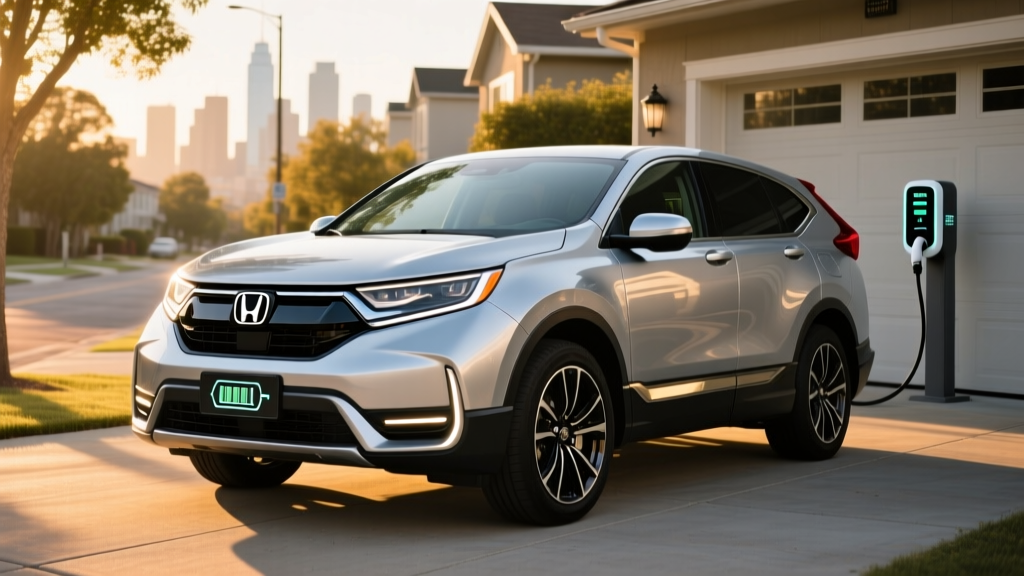
The 2026 Honda CR-V Hybrid Sport-L sits in the sweet spot of Honda's best-selling crossover lineup: leather-trimmed seats, a power liftgate, and the two-motor hybrid powertrain that delivers 40 MPG combined without ever needing a plug. It's the trim buyers choose when they want hybrid efficiency without sacrificing interior comfort — and at roughly $38,950 MSRP, it undercuts many rival hybrid SUVs while offering more cargo room than most.
This guide covers everything a research-heavy buyer needs: exact EPA fuel economy, real-world MPG expectations, the hybrid powertrain breakdown, battery longevity and warranty terms, and whether the CR-V Hybrid Sport-L is the right call versus a plug-in hybrid or a full battery-electric vehicle.
2026 Honda CR-V Hybrid Sport-L: Key Specs at a Glance
| Specification | 2026 CR-V Hybrid Sport-L (AWD) |
|---|---|
| Powertrain | 2.0L 4-cyl Atkinson + 2-motor hybrid |
| Combined Horsepower | 204 hp |
| Combined Torque | 247 lb-ft (electric motor) |
| Drivetrain | AWD (standard on Sport-L) |
| EPA MPG (City / Hwy / Combined) | 40 / 34 / 37 |
| Fuel Tank | 15.3 gallons |
| Total Range | ~566 miles |
| 0–60 mph | ~7.6 seconds |
| Cargo Volume (behind 2nd row) | 36.3 cu ft |
| Cargo Volume (max) | 76.5 cu ft |
| Towing Capacity | 1,000 lbs |
| Base MSRP (AWD) | $38,950 |
| Hybrid Battery Warranty | 8 years / 100,000 miles |
Source: EPA Fuel Economy, Honda specifications. Sport-L AWD figures shown; FWD trims may differ by 1–2 MPG.
Fuel Economy: EPA Ratings vs. Real-World MPG
The 2026 CR-V Hybrid Sport-L with AWD carries EPA ratings of 40 MPG city, 34 MPG highway, and 37 MPG combined. These numbers are consistent with the broader CR-V Hybrid lineup, though FWD-equipped trims eke out slightly higher figures (up to 43 city / 36 highway).
| Driving Scenario | EPA Rating | Real-World Expectation |
|---|---|---|
| City / Stop-and-Go | 40 MPG | 38–44 MPG (hybrids often exceed EPA in city) |
| Highway (70+ mph) | 34 MPG | 30–33 MPG (aero drag hurts hybrids at speed) |
| Combined | 37 MPG | 34–39 MPG (depends on mix) |
| Cold Weather (below 32°F) | — | 30–34 MPG (engine runs more for cabin heat) |
Hybrids shine in city driving because regenerative braking recaptures energy at every stop, and the electric motor handles low-speed propulsion where gas engines are least efficient. On the highway, the CR-V Hybrid operates more like a conventional gas car — the 2.0L Atkinson-cycle engine does the heavy lifting, and aerodynamic drag erodes efficiency above 70 mph.
In cold weather, expect a 10–15% MPG drop. The engine must run more frequently to provide cabin heat (this hybrid lacks a heat pump, which is typical for non-plug-in hybrids), and the battery's charge-discharge efficiency decreases in freezing temperatures. Owners in northern climates commonly report 30–34 MPG combined during January and February.
HEV vs. PHEV: Understanding What the CR-V Hybrid Is — and Isn't
The 2026 CR-V Hybrid Sport-L is a conventional hybrid (HEV), not a plug-in hybrid (PHEV). This distinction matters because it shapes your entire ownership experience.
- HEV (this CR-V): Small battery (~1.1 kWh), charges via regenerative braking and the engine. Never plugs in. No electric-only range to speak of. Delivers consistent MPG gains across all driving.
- PHEV (e.g., Toyota RAV4 Prime, Honda CR-V e:PHEV in other markets): Larger battery (15–20 kWh), plugs into a wall outlet or charger. Offers 30–42 miles of electric-only driving before the gas engine engages. Qualifies for some tax incentives.
- BEV (e.g., Tesla Model Y, Hyundai Ioniq 5): No gas engine. 250–320+ miles of all-electric range. Requires home or public charging infrastructure.
Honda does not currently sell a plug-in hybrid CR-V in the United States for the 2026 model year. The CR-V e:PHEV is available in China and Europe, but American buyers choosing Honda's hybrid SUV get the HEV powertrain only. If you need electric-only commuting capability in a Honda, you'd need to look at a different model or brand.
Powertrain Deep Dive: How the Two-Motor Hybrid Works
The CR-V Hybrid's powertrain pairs a 2.0-liter Atkinson-cycle four-cylinder engine (146 hp on its own) with Honda's two-motor hybrid system. The combined system output is 204 horsepower and 247 lb-ft of torque — the torque figure coming primarily from the propulsion motor, which gives the CR-V Hybrid strong off-the-line acceleration.
Here's how the system operates across different conditions:
- Low-speed / city driving: The electric propulsion motor handles most acceleration. The gas engine acts as a generator, charging the small lithium-ion battery or powering the motor directly (series-hybrid mode).
- Cruising / highway: A lock-up clutch connects the engine directly to the wheels for maximum efficiency at steady speeds (parallel-hybrid mode).
- Hard acceleration: Both the engine and electric motor work together, delivering the full 204 hp.
- Deceleration / braking: Regenerative braking captures kinetic energy, feeding it back into the battery. Paddle shifters on the steering wheel let you select from four levels of regen intensity.
The result is seamless operation — most drivers won't notice when the engine starts or stops. The transition between electric and gas power is well-managed, though the engine note under hard acceleration (typical of Atkinson-cycle engines paired with an e-CVT) can sound drone-y compared to a turbocharged gas powertrain.
Battery Longevity, Warranty, and Replacement Cost
Honda covers the CR-V Hybrid's lithium-ion battery pack for 8 years or 100,000 miles (whichever comes first) in most states. In California Air Resources Board (CARB) states — including California, New York, Massachusetts, and several others — the warranty extends to 10 years or 150,000 miles under emissions-related hybrid component coverage. Check your state's specific rules at purchase.
The CR-V Hybrid's battery pack is relatively small — approximately 1.1 kWh — and operates within a conservative state-of-charge window managed by Honda's battery management system. Unlike a full EV battery that cycles through large energy swings, the hybrid battery undergoes shallow charge-discharge cycles, which significantly extends its lifespan.
Degradation reality: Honda's hybrid batteries are designed to last the life of the vehicle under normal use. Real-world data from Honda's earlier hybrid systems (Insight, Accord Hybrid) shows most packs retaining 90%+ capacity at 150,000 miles. Complete failures before 100,000 miles are uncommon and would be covered under warranty.
Replacement cost if out of warranty: A replacement hybrid battery pack for the CR-V Hybrid typically runs $2,500–$4,000 including labor at a Honda dealer. Third-party remanufactured packs are available for $1,500–$2,500. This is substantially cheaper than an EV traction battery replacement ($8,000–$20,000+) because the hybrid pack is much smaller.
For context, the 12V auxiliary battery (which powers lights, infotainment, and accessories) is a separate maintenance item and typically needs replacement every 4–6 years at a cost of $150–$300, same as any conventional vehicle.
Pricing, Trims, and Tax Credit Eligibility
The 2026 Honda CR-V Hybrid Sport-L AWD carries a base MSRP of approximately $38,950, including destination. Key standard equipment on the Sport-L includes:
- Leather-trimmed seats with heated front seats
- Power-adjustable driver's seat
- Power liftgate with walk-away close
- Wireless Apple CarPlay and Android Auto
- 9-inch touchscreen infotainment
- Honda Sensing suite (adaptive cruise, lane-keeping, collision mitigation)
- Wireless phone charger
- AWD (standard on all CR-V Hybrid trims)
For buyers wanting more features, the Sport Touring Hybrid (approximately $42,350 MSRP) adds navigation, a Bose premium audio system, heated rear seats, a heated steering wheel, and low-speed braking assist.
The 2026 Honda CR-V Hybrid (HEV) does not qualify for the federal §30D clean vehicle tax credit of up to $7,500. That credit is reserved for plug-in electric vehicles (BEVs and PHEVs) meeting battery sourcing and MSRP/income requirements under current IRS rules.
Conventional hybrids like the CR-V HEV are excluded. Some states or local utilities may offer minor rebates for hybrid purchases — check your state's energy office or utility provider for current programs.
Who Should Choose the CR-V Hybrid Sport-L — And Who Shouldn't
✓ Choose This Hybrid If:
- You drive 12,000–20,000 miles/year in mixed city/highway conditions
- You want better fuel economy without changing your refueling habits (no plugs, no charging apps)
- You need AWD for snow or rain but want to minimize fuel cost
- You plan to keep the vehicle 8–12 years and want proven Honda reliability
- You want a mainstream SUV with strong resale value and widespread dealer support
✗ Look Elsewhere If:
- You have a short commute and home charging access — a PHEV (RAV4 Prime) or BEV could eliminate gas entirely on daily drives
- You want federal tax credits — those require a plug-in vehicle
- You tow more than 1,000 lbs — consider a gas CR-V or a larger SUV
- You prioritize highway-only driving — the hybrid's advantage shrinks at sustained 75+ mph speeds
- You want the quietest, smoothest powertrain — a full EV is still more refined than any hybrid
CR-V Hybrid vs. the Competition
| Vehicle | Combined MPG | HP | Cargo (cu ft) | Base MSRP (AWD) |
|---|---|---|---|---|
| 2026 Honda CR-V Hybrid Sport-L | 37 | 204 | 36.3 / 76.5 | $38,950 |
| 2026 Toyota RAV4 Hybrid XLE Premium | 39 | 219 | 37.5 / 69.8 | $38,075 |
| 2026 Hyundai Tucson Hybrid SEL Premium | 38 | 232 | 38.7 / 80.3 | $39,650 |
| 2026 Ford Escape Hybrid (ST-Line Select) | 39 | 163 | 34.4 / 60.8 | $37,500 |
The CR-V Hybrid Sport-L's advantage isn't class-leading MPG — the RAV4 Hybrid and Escape Hybrid edge it out by 2 MPG combined. Instead, the Honda wins on cargo versatility (best-in-class behind the second row among most rivals), interior build quality, and Honda Sensing standard safety tech. The Sport-L trim specifically delivers leather and premium features at a price point where rivals often require stepping up to a top trim.
Ownership Costs: What to Budget Over 5 Years
At 37 MPG combined and 15,000 miles driven annually, the CR-V Hybrid Sport-L consumes roughly 405 gallons of fuel per year. At a national average of $3.40/gallon (2026 estimate), that's approximately $1,377/year in fuel — compared to roughly $1,950/year for a gas-only compact SUV getting 26 MPG combined.
Annual fuel savings versus a gas equivalent: ~$570/year, or about $2,850 over five years. The hybrid premium over a comparably equipped gas CR-V is typically $1,500–$2,000 at purchase, meaning you recoup the upcharge in roughly 3–4 years of average driving.
Insurance costs for the CR-V Hybrid are generally comparable to the gas version — some insurers offer minor discounts for hybrid vehicles. Maintenance is also similar: same oil change intervals (every 7,500–10,000 miles with synthetic), same brake intervals (regen braking actually extends pad life, often to 60,000+ miles).
Frequently Asked Questions
How many MPG does the 2026 Honda CR-V Hybrid Sport-L actually get?
The EPA rates the AWD Sport-L at 40 city / 34 highway / 37 combined. In real-world mixed driving, most owners see 34–39 MPG combined. City-heavy commutes can push above 40 MPG thanks to regenerative braking, while sustained highway driving at 75+ mph typically yields 30–33 MPG. Cold weather drops combined figures to roughly 30–34 MPG.
Does the CR-V Hybrid need to be plugged in?
No. The CR-V Hybrid is a conventional hybrid (HEV). Its small battery charges entirely through regenerative braking and the gas engine. You refuel it exactly like a standard gasoline vehicle — just at the pump, less often.
How far can the CR-V Hybrid drive on electric power alone?
Essentially zero miles in any practical sense. The hybrid system uses the electric motor for low-speed assist and brief EV-mode coasting, but the battery is too small (~1.1 kWh) to sustain electric-only driving beyond a few hundred yards at parking-lot speeds. If you need 30+ miles of electric-only range, you need a PHEV like the Toyota RAV4 Prime (42 miles electric) — but Honda doesn't offer a PHEV CR-V in the U.S. market.
Is the CR-V Hybrid reliable, and what does battery replacement cost?
Honda's hybrid system has a strong reliability track record across the Accord Hybrid and previous CR-V Hybrid model years. The hybrid battery is warranted for 8 years/100,000 miles (10 years/150,000 miles in CARB states). Out-of-warranty replacement runs $2,500–$4,000 at a dealer, though most packs last well beyond 150,000 miles with minimal degradation. IIHS and NHTSA safety ratings for the CR-V remain strong across the lineup.
Does the 2026 CR-V Hybrid qualify for any federal tax credit?
No. The federal §30D clean vehicle credit (up to $7,500) applies only to plug-in electric vehicles — battery-electric (BEV) and plug-in hybrid (PHEV) models that meet battery sourcing, MSRP, and buyer income requirements. The CR-V Hybrid is a conventional HEV and does not qualify. Some state or utility-level rebates may apply; check your local programs.
Is the CR-V Hybrid Sport-L worth the premium over the gas CR-V?
If you plan to keep the vehicle 4+ years and drive more than 10,000 miles annually, yes. The ~$1,500–$2,000 hybrid premium pays for itself in fuel savings within 3–4 years, and you get smoother acceleration (247 lb-ft of electric torque from a stop) plus reduced brake wear. If you drive very few miles or plan to trade in within 2 years, the gas model may make more financial sense.