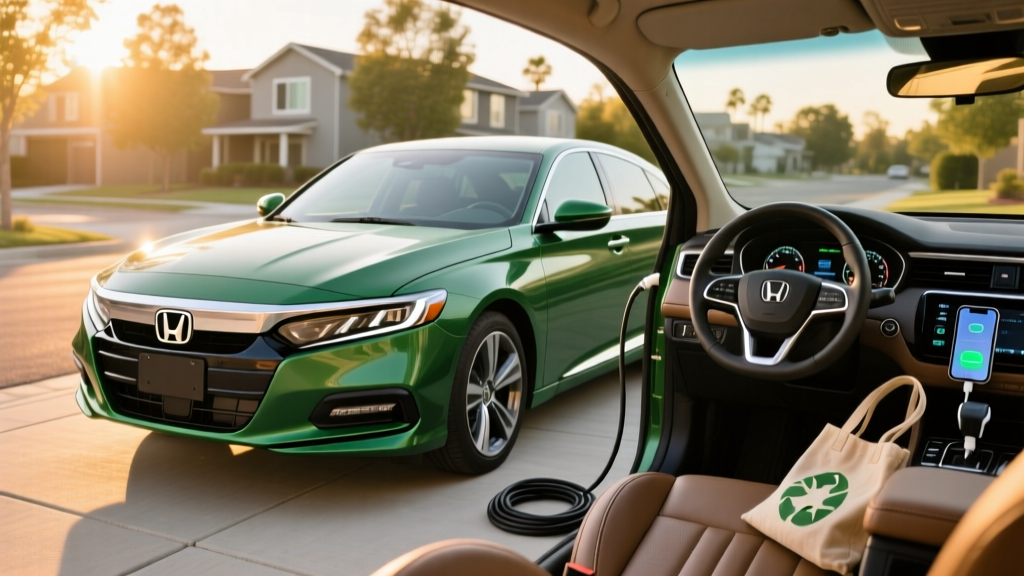
The 2026 Honda Accord EX-L Hybrid occupies a precise niche: a midsize sedan that slashes fuel consumption without demanding any change in daily habits. No plugs, no range math, no charging-app troubleshooting. You fill it with gasoline and drive. For buyers weighing electrification but lacking reliable home or workplace charging access, the Accord Hybrid's two-motor system remains one of the most efficient and refined solutions on the market.
This review focuses on the EX-L trim — the volume seller that adds leather, a larger touchscreen, and wireless phone charging over the base Sport Hybrid — while contextualizing its powertrain against plug-in hybrid and full-electric alternatives.
HEV vs. PHEV: What the Accord Hybrid Actually Is
Before examining specs, it is critical to distinguish what the 2026 Accord EX-L Hybrid is not: it is not a plug-in hybrid (PHEV). It is a conventional hybrid electric vehicle (HEV). Here is what that means in practice:
| Feature | Conventional Hybrid (HEV) | Plug-In Hybrid (PHEV) |
|---|---|---|
| Plug-in charging required? | No — self-charges via engine and regen | Yes — requires Level 1 or Level 2 outlet |
| Electric-only driving | Limited (low-speed, short distances under ~1 mile) | Typically 20–50 miles of full EV range |
| Battery size | ~1.0–1.3 kWh (small buffer) | ~13–25 kWh (usable) |
| Federal tax credit (§30D) | Not eligible | Up to $7,500 if battery sourcing and income rules met |
| Best for | No home charging, high-mileage commuters, simplicity | Home charging available, short daily commutes under EV range |
The 2026 Accord EX-L Hybrid uses a compact ~1.1 kWh lithium-ion battery pack. This battery never plugs in. It charges through regenerative braking and the gasoline engine, acting as a buffer that allows the electric motors to handle low-speed acceleration and assist during hard throttle demands. Honda's system is closer to a series-hybrid architecture at city speeds — the engine primarily generates electricity rather than turning the wheels directly — which is precisely why its city MPG exceeds its highway number.
Fuel Economy: EPA Ratings and Real-World MPG
The Accord Hybrid's efficiency is its headline act. The EPA rates the 2026 Accord Hybrid at the following:
| Driving Cycle | EPA MPG |
|---|---|
| City | 51 MPG |
| Highway | 44 MPG |
| Combined | 48 MPG |
The city-highway split is the opposite of a conventional gasoline car, where highway driving is more efficient. Hybrid systems thrive in stop-and-go traffic: every deceleration event sends energy back into the battery via regenerative braking, and the engine shuts off at stops. On a 12-mile urban commute with multiple traffic lights, owners consistently report exceeding the EPA city figure — 52 to 55 MPG is achievable in warm weather with moderate acceleration.
City commuter (warm climate): 50–55 MPG
Mixed driving (suburban/highway blend): 46–50 MPG
Sustained highway (70–80 mph): 40–44 MPG
Cold weather (below 30°F): 38–43 MPG combined — engine runs more frequently for cabin heat and battery warmup
At the combined 48 MPG figure and a 12.8-gallon fuel tank, total range reaches approximately 614 miles per tank. For a driver covering 15,000 miles annually, that translates to roughly 312 gallons per year — versus approximately 500 gallons in a comparably sized non-hybrid sedan rated at 30 MPG combined. At $3.40/gallon, the annual fuel savings versus a 30 MPG gas car approaches $640.
Powertrain and Performance Specs
Honda's fourth-generation two-motor hybrid system pairs a 2.0-liter Atkinson-cycle four-cylinder engine with two electric motors — one functioning primarily as a generator, the other as the drive motor. The system prioritizes electric propulsion at low and moderate speeds, engaging a lock-up clutch to connect the engine directly to the wheels only during steady highway cruising where internal combustion is most efficient.
| Specification | 2026 Accord EX-L Hybrid |
|---|---|
| Combined System Horsepower | 204 hp |
| Combined System Torque | 247 lb-ft (drive motor) |
| Engine | 2.0L Atkinson-cycle I-4, 146 hp / 134 lb-ft |
| Drive Motor Output | 181 hp / 247 lb-ft |
| Hybrid Battery | ~1.1 kWh lithium-ion (self-charging) |
| Transmission | Direct-drive (no traditional gearbox) |
| Drivetrain | Front-wheel drive |
| 0–60 mph (est.) | ~7.0 seconds |
| EPA Combined MPG | 48 |
| Fuel Tank Capacity | 12.8 gallons |
| Total Range (est.) | ~614 miles |
The 247 lb-ft of electric motor torque delivers from zero RPM, giving the Accord Hybrid surprisingly responsive off-the-line acceleration. The direct-drive transmission eliminates shift shock entirely. The tradeoff is that at sustained speeds above 80 mph, the system lacks the mechanical gearing advantage of a traditional powertrain, so passing power tapers. For the overwhelming majority of driving scenarios — merging, city acceleration, suburban cruising — the powertrain feels smooth and adequately quick.
Pricing, Trims, and Tax Credit Eligibility
The 2026 Honda Accord Hybrid is offered in Sport, EX-L, and Sport-L trims. The EX-L sits in the middle and is the most popular configuration for buyers prioritizing comfort and technology over the Sport's appearance package.
| Trim | MSRP (incl. destination) | Key Additions Over Prior Trim |
|---|---|---|
| Sport Hybrid | $33,990 | 19-inch wheels, sport appearance, heated front seats |
| EX-L Hybrid | $35,790 | Leather seats, 12.3-inch touchscreen, wireless CarPlay/Android Auto, power passenger seat |
| Sport-L Hybrid | $36,290 | Sport appearance + EX-L interior features |
Federal tax credit: The 2026 Accord Hybrid does not qualify for the IRS §30D Clean Vehicle Credit. That credit applies only to plug-in electric vehicles (BEVs and PHEVs) meeting battery capacity, critical-mineral sourcing, and buyer income requirements. Conventional hybrids like the Accord HEV are excluded by statute.
State and local incentives: A small number of states and utilities offer modest rebates for conventional hybrids, but these are uncommon and vary by jurisdiction. Check your state energy office or local utility for current programs. Do not rely on hybrid-specific incentives in your purchase budget.
Battery Longevity, Warranty, and Replacement Cost
Hybrid battery anxiety is understandable but largely misplaced for modern Honda systems. The Accord Hybrid's ~1.1 kWh battery pack is small, operates within a narrow state-of-charge window (the system never fully charges or fully depletes it), and benefits from Honda's extensive thermal management calibration. These factors dramatically reduce degradation compared to a full EV battery that cycles through deeper charge states.
- Hybrid battery: 8 years / 100,000 miles (10 years / 150,000 miles in CARB states including CA, NY, MA, and others)
- Hybrid system components: 8 years / 100,000 miles
- Powertrain warranty: 5 years / 60,000 miles
- Bumper-to-bumper: 3 years / 36,000 miles
Warranty covers battery capacity loss below a functional threshold and any hybrid-system component failure under normal use.
In real-world ownership, Honda's hybrid batteries in the Accord and Insight lineages have demonstrated lifespans well exceeding 150,000 miles with minimal capacity loss. The system's shallow cycling — typically using only 40–60% of the battery's total capacity — is the primary reason. If a replacement is needed out of warranty, expect approximately $2,000–$3,500 for a refurbished or new hybrid battery pack at a dealership, though third-party refurbished options can reduce this to $1,200–$2,000 installed. For context, this is a fraction of a full EV battery replacement and an event most owners will never experience.
Accord Hybrid vs. PHEV vs. Full EV: Which Fits You?
The Accord EX-L Hybrid competes not only against other midsize sedans but against the buyer's own question: should I go plug-in instead? Here is a practical decision framework:
- You lack access to home Level 2 charging (apartment, street parking, no garage outlet)
- Your daily driving is unpredictable — some days 15 miles, other days 300+
- You want maximum simplicity: no charging cables, no apps, no planning
- Your priority is reducing fuel cost without behavioral change
- You can install a Level 2 charger at home or have reliable workplace charging
- Your daily commute is under 30–40 miles round-trip (within electric-only range)
- You want to drive on electricity most days but keep gas for road trips
- You may qualify for the §30D federal tax credit (up to $7,500)
- You have reliable home Level 2 charging
- Your daily driving is under 200 miles and you can plan road-trip charging stops
- You want zero tailpipe emissions and the lowest per-mile energy cost
- You qualify for the §30D credit and your total cost of ownership favors EV
The Accord Hybrid's advantage is zero infrastructure dependency. It works identically whether you park in a suburban garage or a downtown street spot. The tradeoff is that you will always burn gasoline — there is no electric-only commute mode. For a driver covering 15,000 miles/year at 48 MPG, that is still only ~312 gallons annually, a meaningful reduction from the ~500 gallons a comparable gas-only sedan would require.
Reliability and Safety
Honda's hybrid powertrain has accumulated over two decades of field data since the original Insight. The two-motor system used in the current Accord is mechanically simpler than a traditional automatic transmission — there are no gear sets, torque converters, or friction bands to wear. The IIHS has historically rated the Accord as a Top Safety Pick+, and the 2026 model continues this trajectory with standard Honda Sensing (adaptive cruise, lane-keeping, collision mitigation, and traffic-sign recognition).
Long-term reliability for the Accord Hybrid is strong. The primary maintenance items remain conventional: oil changes (the engine still requires them, typically every 7,500–10,000 miles), brake fluid, cabin air filter, and tire rotation. Notably, brake pad life is often extended well beyond 80,000 miles because regenerative braking handles the majority of deceleration, reducing friction-brake usage.
Pros and Cons
- 51 MPG city — class-leading for a midsize sedan
- No charging infrastructure required
- Smooth, responsive electric-motor torque at low speeds
- Spacious cabin with 16.7 cu-ft trunk (hybrid battery under rear seats, no cargo compromise)
- Honda Sensing ADAS suite standard on all trims
- Strong resale value and proven hybrid reliability
- No federal tax credit eligibility (HEV, not PHEV/BEV)
- Highway MPG drops to ~40–44 at sustained 75+ mph speeds
- Cold-weather MPG penalty of 10–15% due to engine running for cabin heat
- No all-wheel-drive option (FWD only)
- Engine drone under hard acceleration (CVT-like character at high load)
- EX-L pricing at $35,790 approaches some PHEV competitors after their tax credits
Frequently Asked Questions
How many MPG does the 2026 Honda Accord EX-L Hybrid get?
The EPA rates it at 51 MPG city, 44 MPG highway, and 48 MPG combined. Real-world city driving in warm weather often yields 50–55 MPG. Sustained highway driving at 75+ mph typically returns 40–44 MPG.
Does the Accord Hybrid need to be plugged in?
No. The Accord Hybrid is a conventional hybrid (HEV), not a plug-in hybrid. It charges its small battery through regenerative braking and the gasoline engine. You never plug it in — you simply refuel with gasoline as you would any other car.
How far can the Accord Hybrid drive on electric power alone?
Only very short distances at low speeds — typically under one mile and below 30 mph, such as creeping through a parking lot or stop-and-go traffic. The engine engages automatically for any meaningful acceleration or sustained speed. This is normal for a conventional hybrid; it is not designed for electric-only commuting like a PHEV.
Is the hybrid battery reliable, and what does replacement cost?
Honda's hybrid batteries are engineered for shallow cycling and have demonstrated lifespans exceeding 150,000 miles routinely. The battery is warrantied for 8 years/100,000 miles (10 years/150,000 miles in CARB states). Out-of-warranty replacement costs approximately $2,000–$3,500 at a dealer, or $1,200–$2,000 with a refurbished unit. Most owners will never need a replacement.
Does the 2026 Accord Hybrid qualify for any tax credit?
No. The IRS §30D Clean Vehicle Credit applies only to plug-in electric vehicles (BEVs and PHEVs) meeting battery sourcing and buyer income thresholds. Conventional hybrids like the Accord HEV are not eligible. Some state or utility programs may offer small rebates — check your local jurisdiction.
How does the Accord Hybrid compare to a PHEV like the Toyota Prius Prime?
The Prius Prime offers approximately 40 miles of electric-only range when plugged in, making it ideal for short commutes with home charging. However, it requires charging infrastructure to realize its efficiency advantage. The Accord Hybrid requires no plug, offers more interior and cargo space, and delivers strong MPG without behavioral change. If you cannot charge at home, the Accord Hybrid is the more practical choice.
Is the Accord Hybrid slower than the gas-only Accord?
The 2026 Accord lineup is exclusively hybrid — Honda discontinued the turbocharged gasoline-only Accord after the 2024 model year. The hybrid's 204 hp and 247 lb-ft of torque deliver a 0–60 mph time of approximately 7.0 seconds, which is competitive for the midsize sedan segment and feels responsive in daily driving thanks to instant electric torque.