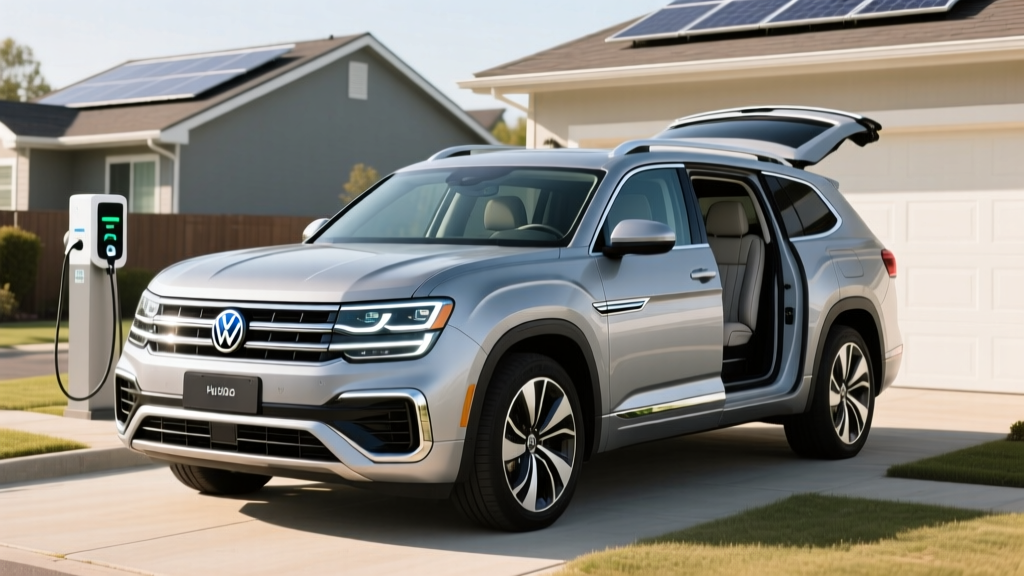
If you're shopping for a three-row family hauler with some form of electrification, the Volkswagen Atlas hybrid search can lead to confusion. Volkswagen's current U.S. strategy for its largest SUV centers on a turbocharged four-cylinder engine paired with a 48-volt mild-hybrid system—not a full conventional hybrid (HEV) or plug-in hybrid (PHEV) in the way Toyota or Chrysler offer them. That distinction matters enormously for fuel economy expectations, tax-credit eligibility, and daily driving experience.
This guide cuts through the noise: we'll explain exactly what electrification the 2026 Atlas uses, how its real-world MPG compares to true HEV and PHEV competitors, whether any federal incentives apply, and whether you should wait for a full PHEV Atlas or pivot to a rival.
HEV vs. PHEV vs. Mild Hybrid: Where the 2026 Atlas Fits
Before we look at the Atlas specifically, it's essential to understand the three types of hybrid systems on the market—because Volkswagen's approach differs from what many buyers expect when they search for a "Volkswagen Atlas hybrid."
Hybrid Powertrain Types Explained
| Type | Plug In? | Electric-Only Driving | Typical MPG Gain | Tax Credit? |
|---|---|---|---|---|
| Mild Hybrid (MHEV) | No | None (motor assists only) | 1–3 MPG | No |
| Full Hybrid (HEV) | No | Very short, low-speed only | 5–15 MPG | No |
| Plug-In Hybrid (PHEV) | Yes | 20–50 miles at full speed | MPGe 50–80+ (electric mode) | Up to $7,500 (§30D) |
The 2026 Volkswagen Atlas uses a 48V mild-hybrid system. It is not an HEV or PHEV.
VW introduced the 48-volt mild-hybrid system to the Atlas with its 2024 refresh, pairing it with the 2.0-liter turbocharged EA888 Evo4 four-cylinder engine. The small electric motor integrated into the transmission assists during acceleration and enables smoother stop-start operation, but it cannot propel the vehicle on electric power alone. You'll never plug it in, and you won't see the dramatic MPG gains of a true hybrid.
2026 Volkswagen Atlas: Powertrain and EPA Fuel Economy
For the 2026 model year, Volkswagen continues to offer the Atlas with a single powertrain across all trims: a 2.0-liter turbocharged inline-four with 48V mild-hybrid assist.
| Specification | Value |
|---|---|
| Engine | 2.0L turbocharged I4 (EA888 Evo4) + 48V MHEV |
| Combined Horsepower | 269 hp @ 5,500 rpm |
| Combined Torque | 273 lb-ft @ 1,600–4,750 rpm |
| Transmission | 8-speed automatic |
| Drivetrain | FWD standard; 4Motion AWD available |
| 0–60 mph | ~7.5 seconds (FWD) |
| Towing Capacity | 5,000 lbs (when equipped) |
| EPA MPG (FWD) | 21 city / 27 highway / 23 combined |
| EPA MPG (AWD) | 20 city / 26 highway / 22 combined |
| Fuel Tank | 18.5 gallons |
| Total Range | ~407–425 miles |
Source: EPA Fuel Economy and Volkswagen USA.
How Many MPG Does the Atlas Mild-Hybrid Actually Get?
The EPA rates the 2026 Atlas at 23 MPG combined (FWD) and 22 MPG combined (AWD). In real-world driving, the mild-hybrid system's benefits are modest but measurable:
- City driving: The 48V system smooths out stop-start events and provides a small torque fill during acceleration. Expect EPA-matching or slightly better results—22–24 MPG in mixed urban traffic.
- Highway driving: At sustained speeds, the mild-hybrid assist is negligible. Expect 25–27 MPG on flat terrain, dropping to 22–24 MPG at 80+ mph or in mountainous terrain.
- Cold weather: Like all turbocharged engines, efficiency drops 5–10% in sub-freezing temperatures due to richer fuel mixtures and increased accessory loads.
The honest takeaway: the Atlas's mild-hybrid system is a refinement upgrade, not a fuel-economy revolution. You'll save perhaps 1–2 MPG over the pre-2024 non-hybrid turbo four, but you won't approach the 30+ MPG combined of a true HEV like the Toyota Grand Highlander Hybrid.
Does the Volkswagen Atlas Have a Plug-In Hybrid (PHEV) Version?
No. As of the 2026 model year, Volkswagen does not offer a PHEV variant of the Atlas in the United States. VW has sold PHEV versions of smaller vehicles globally (the Tiguan eHybrid in Europe, for example), but the company's U.S. electrification strategy for large SUVs has focused on mild-hybrid optimization of the existing powertrain rather than adding a larger battery pack and electric motor capable of plug-in operation.
This means:
- No electric-only driving range
- No plug or charging port
- No eligibility for the federal §30D plug-in vehicle tax credit
- No MPGe rating (because there's no grid-charged electricity involved)
If a PHEV three-row SUV is a priority, you'll need to look at competitors like the Kia Sorento PHEV (32 miles electric-only, ~79 MPGe) or the Toyota Grand Highlander Hybrid MAX (conventional HEV, ~27 MPG combined)—or wait to see if VW announces a future Atlas PHEV.
Pricing, Trims, and Tax-Credit Eligibility
The 2026 Volkswagen Atlas is available in five trims, all sharing the same mild-hybrid powertrain:
| Trim | Drivetrain | MSRP (incl. destination) |
|---|---|---|
| SE | FWD | ~$39,995 |
| SE w/ Technology | FWD / AWD | ~$43,495 / $45,495 |
| SE R-Line Black | AWD | ~$47,195 |
| SEL | AWD | ~$49,995 |
| SEL Premium R-Line | AWD | ~$54,995 |
Federal Tax Credit: Does the Atlas Qualify?
No. The IRS §30D New Clean Vehicle Credit applies only to plug-in electric vehicles—battery-electric vehicles (BEVs) and plug-in hybrids (PHEVs) with a minimum battery capacity of 7 kWh. Because the Atlas uses a 48-volt mild-hybrid system with a battery under 1 kWh that cannot be plugged in, it does not qualify for any federal EV or PHEV tax credit.
Reliability, Battery Warranty, and Long-Term Costs
The 48-volt mild-hybrid system in the Atlas is far simpler and less costly to maintain than a full HEV or PHEV battery pack. Here's what buyers should know:
48V Mild-Hybrid Battery: What You Need to Know
- Battery type: Small lithium-ion 48V pack (under 1 kWh)
- Warranty: Covered under VW's standard powertrain warranty — 4 years / 50,000 miles limited warranty, with emissions-related components covered for 8 years / 80,000 miles per federal requirements
- Replacement cost: Estimated $800–$1,500 if out of warranty — far less than a full HEV battery ($2,000–$5,000) or PHEV battery ($5,000–$12,000+)
- Degradation: Minimal impact on vehicle operation; the 48V system assists but doesn't drive the wheels, so even significant degradation won't strand you
- Expected lifespan: 10–15 years under normal use, consistent with modern lithium-ion 48V systems
Volkswagen's EA888 Gen 4 (Evo4) engine has proven reliable in global markets where it's been in service since 2020. The 8-speed automatic transmission is a conventional torque-converter unit (not a DSG), which tends to be smoother and more durable for heavy SUV duty. The 48V system adds complexity compared to a purely mechanical drivetrain, but the components are relatively low-stress.
For comparison, the IIHS has given the Atlas strong safety ratings, and the platform has been in production since 2018, meaning most early-production issues have been addressed.
Atlas Mild-Hybrid vs. True Hybrid and PHEV Competitors
If fuel economy and electrification are top priorities, the Atlas's mild-hybrid system puts it at a measurable disadvantage against true HEV and PHEV three-row competitors:
| Vehicle | Type | EPA Combined | Electric Range | HP | Base MSRP |
|---|---|---|---|---|---|
| VW Atlas (2026) | MHEV | 22–23 MPG | None | 269 | ~$39,995 |
| Toyota Grand Highlander Hybrid | HEV | 34–36 MPG | None | 245–362 | ~$45,120 |
| Kia Sorento PHEV | PHEV | 79 MPGe / 34 MPG | 32 miles | 261 | ~$51,090 |
| Mazda CX-90 PHEV | PHEV | 56 MPGe / 25 MPG | 26 miles | 323 | ~$50,695 |
| Hyundai Santa Fe Hybrid | HEV | 34–36 MPG | None | 232 | ~$39,995 |
✓ Atlas MHEV Advantages
- Lower starting price than most PHEV rivals
- Spacious third row and cargo area (96.8 cu ft max)
- No charging required or expected
- Smooth, refined turbo-four with adequate power
- Strong VW dealer network for service
✗ Atlas MHEV Limitations
- Significantly lower MPG than HEV competitors (10–13 MPG gap)
- No electric-only driving capability
- No federal or state tax incentives
- Four-cylinder feels strained under full load vs. V6 rivals
- Not a "true hybrid" despite marketing proximity to the term
Who Should Buy the Atlas Mild-Hybrid — and Who Shouldn't?
Decision Framework
Choose the Volkswagen Atlas if:
- You prioritize interior space, ride comfort, and tech over maximum fuel efficiency
- You don't have access to home charging and don't want to change your fueling habits
- You want a European-flavored SUV with VW's IQ.DRIVE safety suite at a competitive price
- Fuel economy of 22–23 MPG combined is acceptable for your budget
- You value a conventional powertrain with minimal electrification complexity
Choose a true HEV (Toyota Grand Highlander Hybrid, Hyundai Santa Fe Hybrid) if:
- You drive 15,000+ miles per year and want to save $500–$800 annually on fuel
- 35+ MPG combined is a top-three purchase priority
- You want proven hybrid reliability with 10-year/150,000-mile battery warranties
Choose a PHEV (Kia Sorento PHEV, Mazda CX-90 PHEV) if:
- You can charge at home and your daily commute is under 30 miles
- You want to drive mostly on electricity during the week with gas-engine flexibility for road trips
- You qualify for the up-to-$7,500 federal §30D tax credit (subject to income, MSRP caps, and battery sourcing rules per IRS guidelines)
Choose a full BEV (Kia EV9, Tesla Model X) if:
- You want zero tailpipe emissions and have reliable home charging
- You're ready to commit to 250–300+ miles of EPA range and DC fast charging for road trips
- You want the lowest per-mile fuel cost and minimal drivetrain maintenance
The Bottom Line on the "Volkswagen Atlas Hybrid"
The 2026 Volkswagen Atlas is a capable, comfortable three-row SUV with a mild-hybrid system that improves refinement but doesn't fundamentally change its fuel-economy profile. If your search for a "Volkswagen Atlas hybrid" was motivated by a desire for 35+ MPG, electric-only commuting, or federal tax credits, the Atlas won't meet those expectations—it's a mild-hybrid, not an HEV or PHEV.
What the Atlas does deliver is a spacious cabin, competitive pricing, a smooth turbocharged powertrain, and the simplicity of a vehicle you fuel exclusively at gas stations with no plugs, no charging apps, and no range calculations. For many families, that's exactly the right trade-off. For efficiency-focused buyers, the HEV and PHEV competition offers measurably more electrification—and the savings that come with it.
Frequently Asked Questions
Is the Volkswagen Atlas a full hybrid or plug-in hybrid?
No. The 2026 Volkswagen Atlas uses a 48-volt mild-hybrid (MHEV) system paired with a 2.0L turbocharged four-cylinder engine. It cannot drive on electric power alone, does not plug in, and is not classified as a full hybrid (HEV) or plug-in hybrid (PHEV) by the EPA or IRS.
How many MPG does the Volkswagen Atlas get?
The EPA rates the 2026 Atlas at 21 city / 27 highway / 23 combined MPG with front-wheel drive, and 20/26/22 with 4Motion all-wheel drive. Real-world results typically match these figures in mixed driving, with highway-only trips potentially reaching 26–28 MPG under ideal conditions.
Does the Volkswagen Atlas qualify for any federal tax credit?
No. The IRS §30D New Clean Vehicle Credit requires a plug-in vehicle with at least 7 kWh of battery capacity. The Atlas's 48V mild-hybrid battery is under 1 kWh and cannot be charged from an external source, making it ineligible for any federal EV or PHEV tax credit.
Will Volkswagen make a plug-in hybrid Atlas?
As of early 2026, Volkswagen has not announced a PHEV variant of the Atlas for the U.S. market. VW sells PHEV versions of smaller SUVs in Europe (Tiguan eHybrid), but there is no confirmed timeline for an Atlas PHEV. If plug-in capability is essential, consider the Kia Sorento PHEV or Mazda CX-90 PHEV as alternatives.
How long will the Atlas 48-volt battery last, and what does replacement cost?
The 48V lithium-ion battery is designed to last the life of the vehicle (10–15 years). It's covered under VW's powertrain warranty (4 years/50,000 miles) and potentially under the federal emissions warranty (8 years/80,000 miles). Out-of-warranty replacement is estimated at $800–$1,500, significantly less than full HEV or PHEV battery replacements.
Is the Atlas mild-hybrid reliable compared to Toyota or Honda hybrids?
The 48V MHEV system is simpler than a full hybrid system, with fewer high-voltage components to fail. However, Toyota and Honda have decades of full-hybrid production experience and back their hybrid batteries with 10-year/150,000-mile warranties. VW's hybrid track record is shorter, though the EA888 engine family is well-established globally.
How does the Atlas compare to the Toyota Grand Highlander Hybrid?
The Grand Highlander Hybrid delivers 34–36 MPG combined (vs. the Atlas's 22–23 MPG), a standard hybrid battery warranty of 10 years/150,000 miles, and up to 362 hp in Hybrid MAX trims. The Atlas counters with a lower starting price (~$40K vs. ~$45K), a roomier third row, and a more car-like ride. The fuel-cost gap is roughly $500–$800 per year at 15,000 miles driven.