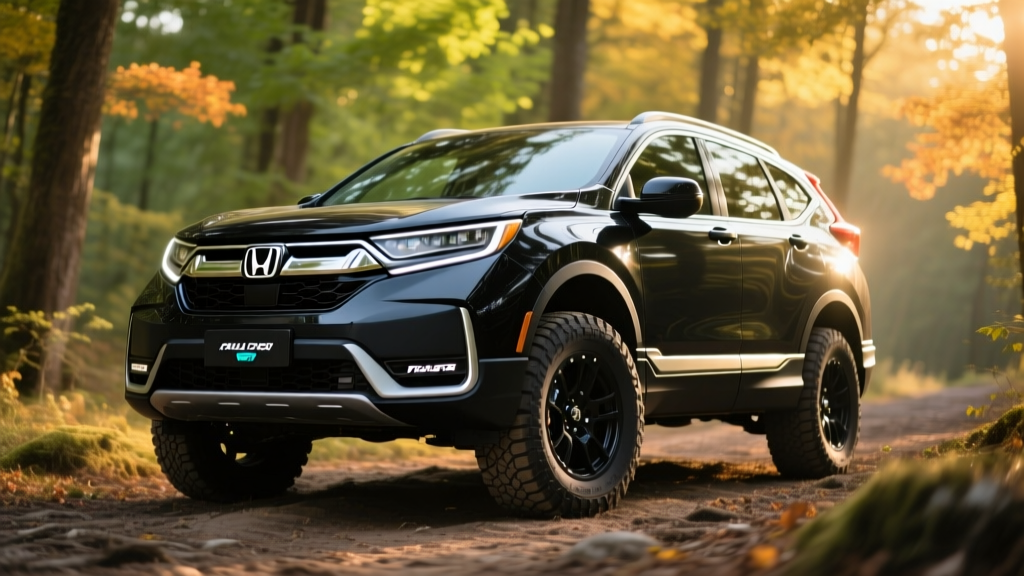
The 2026 Honda CR-V Hybrid TrailSport sits at a crossroads that many SUV buyers recognize: you want better fuel economy than a gas-only compact crossover, but you aren't ready to commit to plugging in every night or hunting for public chargers on road trips. Honda's answer is a conventional hybrid (HEV) wrapped in the TrailSport's off-road-oriented styling and hardware — no plug required, no range anxiety, just meaningful MPG gains with genuine all-weather capability.
As Honda's most rugged CR-V Hybrid variant, the TrailSport trim layers on all-terrain tires, increased ground clearance, and retuned suspension alongside the proven two-motor hybrid powertrain. For 2026, it continues to compete directly with the Toyota RAV4 Hybrid Woodland Edition and Subaru Forester Hybrid Wilderness, but Honda's hybrid system refinement gives it a distinct edge in city efficiency and drivetrain smoothness.
2026 Honda CR-V Hybrid TrailSport: Key Specs at a Glance
| Specification | Value |
|---|---|
| Powertrain | 2.0L 4-cylinder + two-motor hybrid system (HEV) |
| Combined Horsepower | 204 hp |
| Combined Torque | 247 lb-ft (electric motor peak) |
| Drivetrain | Real Time AWD with torque vectoring |
| EPA MPG (City / Highway / Combined) | 40 / 34 / 37 MPG |
| Fuel Tank Capacity | 14.0 gallons |
| Total Driving Range | ~518 miles |
| Ground Clearance | 8.3 inches |
| Towing Capacity | 1,000 lbs |
| Cargo Volume (behind rear seats) | 36.3 cu ft |
| Base MSRP (TrailSport Hybrid) | $39,845 |
| Hybrid Battery Warranty | 8 years / 100,000 miles |
The 204-hp combined output comes from Honda's fourth-generation two-motor hybrid system. The 2.0-liter Atkinson-cycle inline-four produces 145 hp on its own, but the electric drive motor contributes up to 181 hp. The system manages power blending seamlessly — you won't feel a handoff between gas and electric. This is the same architecture that powers the Accord Hybrid, retuned for the CR-V's higher ride height and weight.
Fuel Economy: EPA Ratings vs. Real-World MPG
| Driving Cycle | EPA Rating | Real-World Expectation |
|---|---|---|
| City | 40 MPG | 38–43 MPG (hybrids often exceed EPA in stop-and-go) |
| Highway | 34 MPG | 31–34 MPG (aerodynamic drag limits hybrid advantage) |
| Combined | 37 MPG | 35–38 MPG (mixed driving) |
The CR-V Hybrid's city advantage is where the two-motor system shines. At low speeds, the gasoline engine acts primarily as a generator, while the electric drive motor handles propulsion. This means extended electric-only operation in traffic, during parking-lot maneuvers, and on short neighborhood trips. Owners who do a lot of city and suburban driving routinely report 40+ MPG in warm weather — sometimes beating the EPA city estimate.
Highway efficiency tells a different story. Above 65 mph, the engine engages directly via a lock-up clutch, and the CR-V's boxy SUV aerodynamics work against it. Expect 31–33 MPG on sustained 75-mph interstate runs. In cold weather (below 30°F), plan for a 5–10% reduction across the board as the engine runs more frequently for cabin heat and battery conditioning. Per fueleconomy.gov, the combined 37 MPG rating translates to roughly $1,550 in annual fuel costs at 15,000 miles/year and $3.50/gallon — about $550 less than the gas-only CR-V AWD.
Hybrid (HEV) vs. Plug-In Hybrid (PHEV): What the CR-V TrailSport Is — and Isn't
A common point of confusion: the CR-V Hybrid TrailSport is a conventional hybrid (HEV), not a plug-in hybrid (PHEV). This distinction matters for your daily routine and your wallet.
Conventional Hybrid (HEV) — CR-V Hybrid TrailSport
- No plug-in charging required
- Self-charges via regenerative braking and the gas engine
- Small battery (~1.1 kWh usable) buffers energy for electric assist
- No electric-only driving range to speak of (under 1 mile at very low speeds)
- Lower purchase price, simpler ownership
- No federal tax credit for new HEV purchases
Plug-In Hybrid (PHEV) — e.g., Toyota RAV4 Prime
- Plugs into a wall outlet or Level 2 charger
- Larger battery (18+ kWh) enables 30–42 miles of electric-only driving
- Gas engine kicks in after battery depletes, operating as a hybrid
- Higher purchase price, but may qualify for federal tax credit (§30D)
- Requires charging access to capture full value
Honda does not currently offer a CR-V PHEV in the United States. If you want 30+ miles of electric-only commuting with a gas backup, you'll need to look at competitors like the RAV4 Prime (42 miles electric, $44,900) or the Hyundai Tucson PHEV (33 miles electric, $38,775). The CR-V Hybrid TrailSport instead prioritizes simplicity: fill up at any gas station, never think about charging, and still cut fuel consumption by roughly 30% compared to the gas-only CR-V AWD.
TrailSport Off-Road Hardware: What You Actually Get
The TrailSport badge isn't just an appearance package. For 2026, Honda equips the CR-V Hybrid TrailSport with functional off-road upgrades that separate it from the Sport Touring Hybrid:
- All-terrain tires: 18-inch wheels wrapped in Continental CrossContact A/T rubber, providing better traction on loose surfaces and light trails
- Increased ground clearance: 8.3 inches (up from 8.2 inches on other trims), with revised front and rear bumper fascias for improved approach and departure angles
- Retuned suspension: Specific damper tuning for rough-road compliance
- Steel skid plate: Protects the undercarriage on rocky terrain
- Orange recovery hooks: Front tow points for extraction situations
- TrailSport-specific drive mode: Adjusts throttle response, AWD torque distribution, and traction control for off-pavement use
Is this a Jeep Wrangler competitor? No. The CR-V Hybrid TrailSport is engineered for fire roads, gravel forest-service roads, sandy beach access, and snowy unplowed driveways — not rock crawling or deep mud. The AWD system can send up to 50% of torque to the rear axle and uses brake-based torque vectoring to manage wheel slip. For the vast majority of "adventure-lite" SUV buyers, this hardware is more than adequate.
Pricing, Trims, and Tax Credit Eligibility
| Trim | MSRP | Key Additions |
|---|---|---|
| Sport Hybrid (base hybrid) | $35,545 | Hybrid powertrain, 18" wheels, sport styling |
| Sport Touring Hybrid | $39,845 | Leather, Bose audio, wireless CarPlay, hands-free liftgate |
| TrailSport Hybrid | $39,845 | A/T tires, skid plate, recovery hooks, TrailSport drive mode |
The TrailSport Hybrid shares its MSRP with the Sport Touring Hybrid but trades luxury features (leather seats, Bose premium audio) for off-road hardware. Both include Honda Sensing (adaptive cruise, lane-keeping, automatic emergency braking), a 9-inch touchscreen, wireless Apple CarPlay and Android Auto, and heated front seats.
Hybrid Battery Warranty, Longevity, and Replacement Cost
Hybrid battery anxiety is one of the most common concerns among first-time hybrid buyers, but the data is reassuring. Honda's two-motor hybrid system uses a relatively small lithium-ion battery pack (approximately 1.1 kWh usable capacity) that operates in a narrow state-of-charge window — typically between 20% and 80%. This shallow cycling dramatically reduces degradation stress compared to a full EV battery that regularly cycles from 10% to 90%.
Based on long-term ownership data from Honda's hybrid lineup (Insight, Accord Hybrid, CR-V Hybrid since 2020), most hybrid battery packs last well beyond the warranty period. Reports of CR-V Hybrid battery failures before 150,000 miles are rare. When replacement is eventually needed, Honda hybrid battery packs typically cost between $2,000 and $3,500 installed — a fraction of the $10,000–$20,000+ costs associated with full EV battery replacements.
Beyond the traction battery, the CR-V Hybrid's conventional components (gasoline engine, brakes, suspension) follow standard Honda maintenance schedules. In fact, regenerative braking reduces wear on the friction brakes, meaning brake pad replacement intervals are often longer than on gas-only models.
Who Should Choose the CR-V Hybrid TrailSport — and Who Shouldn't
✓ Choose the CR-V Hybrid TrailSport If:
- You want 35–40 MPG without changing your fueling habits
- You regularly drive on unpaved roads, snow, or sand but don't need hardcore off-roading
- You want AWD capability without the fuel penalty of a body-on-frame SUV
- You don't have reliable access to home or workplace charging
- You plan to keep the vehicle 8+ years (hybrid system longevity is proven)
✗ Look Elsewhere If:
- You want electric-only commuting (you need a PHEV or BEV)
- You tow more than 1,000 lbs (consider a gas CR-V or midsize SUV)
- You want the latest ADAS features beyond Honda Sensing (no hands-free driving system)
- You prioritize cargo space over efficiency (hybrid battery slightly reduces under-floor storage)
- You want a federal tax credit (only PHEVs and BEVs qualify under §30D)
Hybrid vs. PHEV vs. Full EV: Quick Decision Framework
Hybrid (HEV) — CR-V Hybrid TrailSport: Best for drivers who want better MPG with zero lifestyle change. No plug, no range planning, no charging infrastructure dependency. Ideal if you live in an apartment, lack home charging, or take frequent long road trips through areas with sparse charging networks.
Plug-In Hybrid (PHEV) — e.g., RAV4 Prime: Best for drivers with home charging who commute under 40 miles round-trip. You get EV-like daily driving with gas-engine backup for long trips. Higher upfront cost, but potential tax credit and lower daily fuel cost offset it over time.
Full EV (BEV) — e.g., Tesla Model Y, Hyundai Ioniq 5: Best for drivers with reliable home Level 2 charging who want the lowest operating cost, strongest acceleration, and zero tailpipe emissions. Requires planning for road trips and acceptance of public charging variability.
Pros, Cons, and the Bottom Line
Pros
- 37 MPG combined (40 city) with no plug-in required
- Genuine off-road hardware, not just an appearance package
- Smooth, responsive two-motor hybrid system with 204 hp
- Proven Honda reliability and strong resale value
- 8-year/100,000-mile hybrid battery warranty (10/150k in CARB states)
- Spacious interior with 36.3 cu ft cargo volume
Cons
- 1,000-lb towing capacity is limiting for an "adventure" SUV
- Highway MPG (34) trails some expectations for a hybrid
- No PHEV option for electric-only commuting
- TrailSport trades premium features (leather, Bose) for off-road gear at the same price as Sport Touring
- No federal tax credit eligibility
- CVT-like driving feel under hard acceleration
The 2026 Honda CR-V Hybrid TrailSport occupies a narrow but well-defined niche: it's the compact SUV for drivers who want hybrid efficiency and light off-road capability without the complexity, cost, or charging dependency of a PHEV or full EV. At $39,845, it's not cheap, but the fuel savings over a gas-only CR-V AWD (roughly $550/year) combined with Honda's reputation for hybrid durability make it a sound long-term purchase. If your adventures stay on fire roads and forest-service trails rather than Moab-grade rock gardens, the TrailSport Hybrid delivers exactly what it promises.
Frequently Asked Questions
How many MPG does the 2026 Honda CR-V Hybrid TrailSport get?
The EPA rates the CR-V Hybrid TrailSport at 40 MPG city, 34 MPG highway, and 37 MPG combined. In real-world city and suburban driving, many owners report 38–43 MPG thanks to the hybrid system's electric-motor dominance at low speeds. Highway-heavy drivers should expect 31–34 MPG.
Does the CR-V Hybrid TrailSport need to be plugged in?
No. The CR-V Hybrid is a conventional hybrid (HEV), not a plug-in hybrid (PHEV). The battery charges itself through regenerative braking and the gasoline engine. You fuel it like any other car — at a gas station.
Is the CR-V Hybrid battery expensive to replace?
Honda hybrid battery replacement typically costs $2,000–$3,500 installed. However, failures before 150,000 miles are uncommon based on long-term data from Honda's hybrid fleet. The battery is warranted for 8 years/100,000 miles (10 years/150,000 miles in CARB states).
Does the 2026 CR-V Hybrid TrailSport qualify for any tax credit?
No. The federal §30D Clean Vehicle Credit applies only to plug-in electric vehicles (BEVs and PHEVs) that meet battery sourcing, MSRP caps, and buyer income requirements. Conventional hybrids like the CR-V Hybrid do not qualify. Check your state for any local hybrid incentives.
How does the TrailSport Hybrid compare to the RAV4 Hybrid Woodland Edition?
The Toyota RAV4 Hybrid Woodland Edition offers similar off-road positioning with 39 MPG combined and a slightly lower starting price (~$37,500). The Honda's advantage is a more refined hybrid powertrain with smoother gas-electric transitions and a more spacious cargo area. The Toyota edges ahead on highway MPG (35 vs. 34) and has a longer track record in the hybrid SUV segment. Per IIHS ratings, both vehicles earn top safety marks.
Can the CR-V Hybrid TrailSport tow a trailer?
The maximum towing capacity is 1,000 lbs — enough for a small utility trailer, a pair of dirt bikes, or a light camping setup, but not a boat or larger camper. If you need 3,500+ lbs of towing, you'll need to look at a midsize SUV or truck.