Quick Verdict: A Luxury PHEV That Actually Makes Sense for Commuters
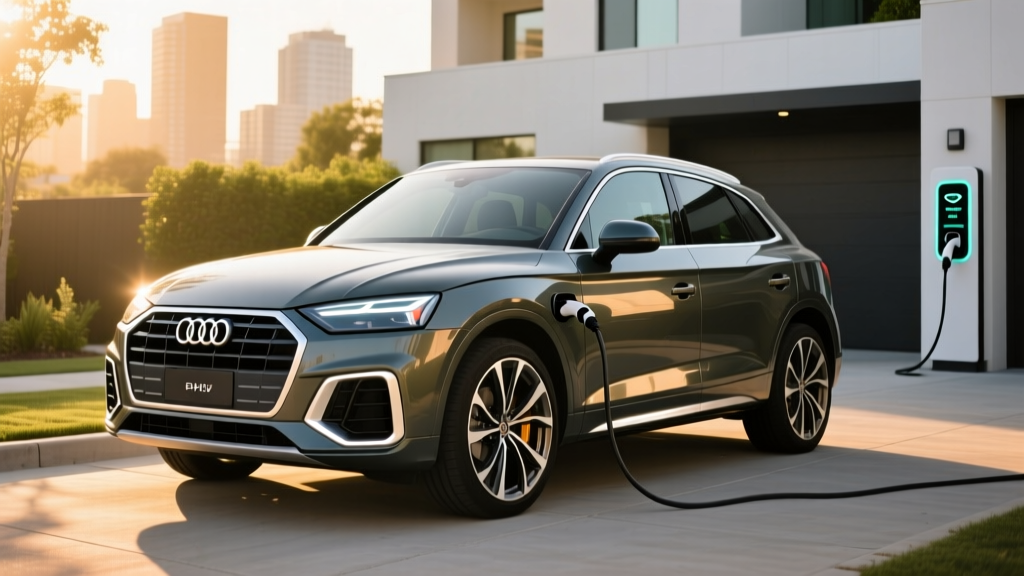
The 2026 Audi Q5 PHEV (officially the Q5 55 TFSI e) occupies a narrow but compelling lane: a premium compact SUV that covers most daily commutes on electricity alone while eliminating range anxiety for weekend road trips. With an EPA-estimated 23 miles of electric-only range, a combined 367 horsepower, and a starting MSRP near $59,400, it targets buyers who want electrified driving without committing to a full battery-electric vehicle.
But the real question for 2026 is whether the Q5 PHEV's relatively small battery and modest EV range justify its price premium over the conventional Q5 hybrid — or whether buyers should look at the fully electric Audi Q4 e-tron or Q8 e-tron instead. Let's break down the exact numbers.
HEV vs. PHEV: What's the Difference on the Q5 Lineup?
| Feature | Q5 45 TFSI (Mild Hybrid) | Q5 55 TFSI e (PHEV) |
|---|---|---|
| Powertrain Type | Conventional HEV (mild-hybrid assist) | Plug-in Hybrid (PHEV) |
| Plug-In Capable? | No — charges via regen only | Yes — external AC charging |
| Electric-Only Range | None (electric assist only) | 23 miles (EPA est.) |
| Combined Horsepower | 261 hp | 367 hp / 369 lb-ft torque |
| Battery (Usable) | ~0.5 kWh (mild-hybrid buffer) | 17.9 kWh (lithium-ion) |
| Fuel Economy (Combined) | 25 MPG | 26 MPG (hybrid mode) / 78 MPGe (EV) |
| Starting MSRP (2026) | ~$46,200 | ~$59,400 |
The distinction matters. The conventional Q5 45 TFSI uses a 12-volt mild-hybrid system that can't propel the car on electricity alone — it simply smooths stop-start events and provides minor torque assist. The Q5 55 TFSI e is a true plug-in hybrid with a high-voltage battery and electric motor capable of driving at highway speeds without the gasoline engine firing.
Powertrain, Performance, and Battery Specs
| Specification | 2026 Audi Q5 55 TFSI e |
|---|---|
| Engine | 2.0L turbocharged inline-4 |
| Engine Output | 261 hp / 273 lb-ft |
| Electric Motor Output | ~141 hp (integrated into transmission) |
| Combined System Output | 367 hp / 369 lb-ft torque |
| Transmission | 7-speed S tronic dual-clutch automatic |
| Drivetrain | quattro AWD |
| Battery Capacity (Gross / Usable) | 17.9 kWh / ~14.3 kWh usable |
| Battery Chemistry | NMC (nickel manganese cobalt) |
| 0–60 mph | 5.0 seconds |
| Top Speed (EV Mode) | 84 mph |
| Towing Capacity | 4,400 lbs |
The 2.0L turbo four paired with the electric motor delivers brisk acceleration that outpaces the gas-only Q5 by over a second to 60 mph. The electric motor is sandwiched between the engine and the S tronic gearbox, enabling seamless transitions between EV, hybrid, and engine-only driving modes. Audi's drive-mode selector lets you force EV mode, hold battery charge for later use, or let the system manage the blend automatically.
Electric-Only Range and Total Range
EPA Electric-Only Range: 23 miles
Real-World Expectation: Expect 18–21 miles in mixed driving, dropping to 15–17 miles in cold weather (below 32°F) or sustained highway speeds above 70 mph. Cabin heating and battery conditioning draw from the same pack.
Total Combined Range (EV + Gas): ~430 miles with a full tank and full battery.
Twenty-three miles of EV range is adequate for short commutes and errands but trails competitors like the BMW X5 xDrive50e (38 miles) and the Volvo XC60 Recharge (35 miles). If your round-trip commute is under 20 miles and you can charge at home overnight, you'll run almost entirely on electricity during the workweek. If your commute exceeds 30 miles, the gasoline engine will activate regularly, and the PHEV advantage narrows.
The 14.7-gallon fuel tank ensures that long road trips are no different from driving a conventional Q5 — fill up in five minutes and keep going.
Fuel Economy: EPA Ratings and Real-World MPG
| Driving Mode | City | Highway | Combined |
|---|---|---|---|
| Charge-Sustaining (Hybrid Mode) | 25 MPG | 27 MPG | 26 MPG |
| EV Mode (MPGe) | 80 MPGe | 76 MPGe | 78 MPGe |
When the battery is depleted and the Q5 PHEV operates as a conventional hybrid, it returns an EPA-estimated 26 MPG combined. That's only marginally better than the mild-hybrid Q5 45 TFSI at 25 MPG combined — a reflection of the PHEV's added weight (roughly 500 lbs more than the gas model).
Real-world note: In city driving with frequent regenerative braking, owners report 28–30 MPG in hybrid mode — hybrids typically exceed EPA city estimates in stop-and-go traffic. On the highway at 75+ mph, expect 24–25 MPG. Source: fueleconomy.gov.
The efficiency math changes dramatically if you charge regularly. A driver who commutes 18 miles round-trip and charges nightly may use zero gasoline for weeks at a time. A driver who never plugs in is essentially hauling 500 extra pounds of battery for a 1 MPG gain.
Charging: Level 2 Speeds, Times, and the DC Fast-Charge Limitation
| Charging Level | Power (kW) | 0–100% Time | Connector |
|---|---|---|---|
| Level 1 (120V household) | ~1.4 kW | ~12–14 hours | Standard J1772 adapter |
| Level 2 (240V home/public) | 7.4 kW | ~2.5 hours | J1772 |
| DC Fast Charging | Not supported | N/A | N/A |
The 2026 Q5 PHEV accepts up to 7.4 kW on Level 2 AC charging, which replenishes the pack in roughly 2.5 hours. That's practical for overnight home charging or topping up during a workday at an office charger.
Critical limitation: The Q5 PHEV does not support DC fast charging. You cannot use Electrify America, Tesla Supercharger, or any CCS/NACS fast-charging station. For a 17.9 kWh battery, this is a manageable compromise — a 2.5-hour Level 2 session is a full charge — but it means road trips rely entirely on the gasoline engine once the battery is depleted.
Home Level 2 installation typically costs $800–$2,000 for equipment and electrician labor, depending on panel capacity and run length. A licensed electrician should verify your panel has a spare 40-amp breaker slot before purchasing a charger.
Pricing, Tax Credits, and Ownership Economics
The 2026 Audi Q5 55 TFSI e starts at an MSRP of approximately $59,400 (including destination), with Premium Plus and Prestige trims pushing the price to $64,000–$69,000 when equipped with options.
Federal §30D Tax Credit Eligibility (2026 Rules):
- Credit Amount: Up to $3,750 for PHEVs meeting critical-mineral requirements (full $7,500 requires both critical-mineral AND battery-component sourcing thresholds — the Q5 PHEV's battery sourcing may only qualify for the partial credit; verify with your tax professional and the IRS eligible vehicle list).
- MSRP Cap: SUVs must be under $80,000 MSRP — the Q5 PHEV qualifies.
- Income Cap: Modified AGI must not exceed $150,000 (single), $225,000 (head of household), or $300,000 (joint).
- Point-of-Sale Transfer: Eligible buyers can transfer the credit to the dealer at purchase for an immediate price reduction rather than waiting for a tax refund.
- Assembly Requirement: Final assembly must occur in North America — the 2026 Q5 for the U.S. market is assembled in Mexico, which meets the USMCA requirement.
Five-Year Cost Snapshot: Assuming 15,000 miles/year, 60% of driving on electricity at $0.14/kWh, and 40% on gasoline at $3.60/gallon, annual fuel costs land around $1,400–$1,700 — compared to $2,100–$2,400 for the gas-only Q5 and $700–$900 for a fully electric Q4 e-tron. Insurance premiums for the PHEV typically run 8–12% higher than the gas model due to the higher replacement value of the battery and powertrain.
Battery Warranty, Reliability, and Replacement Costs
High-Voltage Battery Warranty: 8 years / 100,000 miles (whichever comes first), covering defects and capacity loss below 70% of original capacity.
Powertrain Warranty: 4 years / 50,000 miles (Audi's standard new-vehicle coverage).
Battery Replacement Cost (Out of Warranty): $8,000–$12,000 for the high-voltage pack, plus $1,500–$2,500 in labor. This figure is based on current dealer parts pricing for the 17.9 kWh module.
Audi's hybrid battery warranty meets the federal minimum mandated by the EPA and is consistent with BMW, Volvo, and Mercedes-Benz PHEV coverage. PHEV batteries experience less degradation than full EV packs because the system maintains a larger state-of-charge buffer — you're rarely cycling from 0% to 100%. Most PHEV owners report minimal capacity loss within the warranty period.
Reliability data specific to the 2026 model year is limited given its recent release, but the Q5 platform has scored well in IIHS crash testing (Top Safety Pick+ when equipped with specific headlights). Audi's turbocharged 2.0L engine has a proven track record in the VW Group family. The primary reliability concern with PHEVs is the added complexity of two powertrains — if the electric motor, inverter, or high-voltage contactors fail out of warranty, repairs are costly.
Who Should Choose the Q5 PHEV vs. a Full EV or Gas Q5?
Choose the 2026 Audi Q5 PHEV if:
- Your daily commute is under 25 miles round-trip and you can charge at home
- You regularly take road trips exceeding 250 miles and don't want to plan around charging stops
- You want luxury-brand refinement, quattro AWD, and 4,400-lb towing in an electrified package
- You're not ready to commit to a full EV but want to reduce fuel consumption and emissions
Choose a full EV (e.g., Audi Q4 e-tron or Tesla Model Y) if:
- Your commute is longer than 30 miles and you want to maximize electric driving
- You have reliable home charging and access to DC fast chargers for road trips
- You want to eliminate gasoline costs and oil changes entirely
- Lower long-term maintenance matters more than towing capacity
Choose the gas-only Q5 45 TFSI if:
- You cannot install a home charger (apartment, street parking)
- Your budget is under $50,000
- You drive primarily highway miles where the PHEV's EV range is irrelevant
Pros
- 367 hp delivers genuinely quick acceleration (5.0 sec to 60)
- 23-mile EV range covers most short commutes gas-free
- quattro AWD and 4,400-lb towing — real utility
- No range anxiety on road trips
- Premium interior with Audi's latest MMI infotainment
- May qualify for up to $3,750 federal tax credit at point of sale
Cons
- 23-mile EV range trails BMW X5 PHEV (38 mi) and Volvo XC60 Recharge (35 mi)
- No DC fast charging — road trips run on gasoline only
- $59,400 starting price is ~$13,000 more than the gas Q5
- Only 1 MPG improvement over gas Q5 when battery is depleted
- Added weight and complexity of dual powertrains
- Tax credit eligibility depends on sourcing rules and income caps
Frequently Asked Questions
How many MPG does the 2026 Audi Q5 PHEV get?
The EPA rates it at 25 city / 27 highway / 26 combined MPG when operating in hybrid mode with a depleted battery. In EV mode, it achieves 78 MPGe combined. Real-world city driving with regen braking can push hybrid-mode MPG to 28–30.
How far can the 2026 Audi Q5 PHEV go on electric only?
The EPA estimates 23 miles of electric-only range. In real-world conditions, expect 18–21 miles in moderate weather and 15–17 miles in cold weather or at sustained highway speeds. The gasoline engine kicks in seamlessly when the battery is depleted.
Hybrid vs. PHEV vs. EV — which is right for me?
A conventional hybrid (like the Q5 45 TFSI mild-hybrid) requires no plugging in and improves MPG slightly. A PHEV (like the Q5 55 TFSI e) gives you 15–35 miles of electric driving if you charge regularly, plus a gas engine for long trips. A full EV (like the Q4 e-tron) eliminates gasoline entirely but requires reliable charging access and road-trip planning. If you can charge at home and your commute is under 25 miles, the PHEV is a strong middle ground.
Is the 2026 Audi Q5 PHEV reliable, and what does a battery replacement cost?
The Q5 platform has a solid reliability record, and the VW Group 2.0L turbo engine is well-proven. The high-voltage battery is warrantied for 8 years / 100,000 miles against defects and capacity loss below 70%. Out-of-warranty battery replacement runs $8,000–$12,000 plus labor. PHEV batteries typically degrade slower than full EV batteries due to larger charge buffers.
Does the 2026 Audi Q5 PHEV qualify for a federal tax credit?
It may qualify for up to $3,750 under IRS §30D rules, depending on battery-component and critical-mineral sourcing compliance. The vehicle's MSRP is under the $80,000 SUV cap, and North American final assembly meets requirements. However, buyer income caps ($150K single / $300K joint) apply, and sourcing rules are subject to change. Consult a tax professional and check the IRS eligible vehicle list before purchasing.
Can the Q5 PHEV charge at Tesla Superchargers or DC fast-charging stations?
No. The Q5 PHEV does not support DC fast charging of any kind — no CCS, no CHAdeMO, no NACS. It charges exclusively via Level 1 (120V) or Level 2 (240V) AC charging using a J1772 connector. A full Level 2 charge takes approximately 2.5 hours.
How does the Q5 PHEV compare to the BMW X5 xDrive50e?
The BMW X5 xDrive50e offers significantly more electric range (38 miles EPA), a larger battery (~25.7 kWh usable), DC fast charging capability, and a six-cylinder engine — but starts around $10,000 higher at ~$69,000 MSRP. The Q5 PHEV is the more affordable entry point in the luxury PHEV segment, trading EV range and charging speed for a lower price and a more compact footprint.