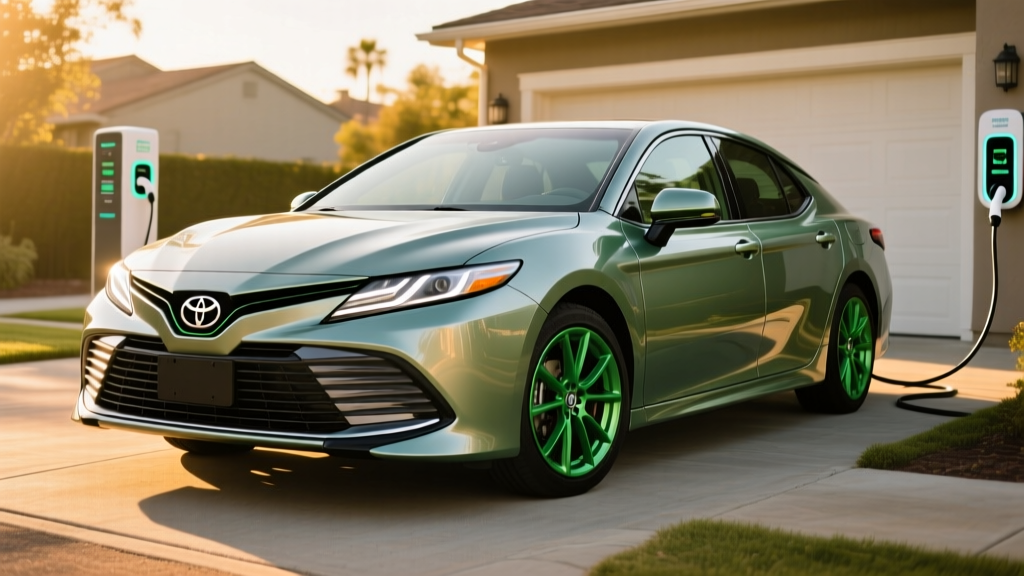
The 2025 Toyota Camry Hybrid All Wheel Drive represents a pivotal shift for Toyota's best-selling sedan: it is now exclusively a hybrid. Gone are the four-cylinder and V6 gas-only options. Every 2025 Camry ships with Toyota's fifth-generation hybrid system, and the electronic all-wheel-drive (AWD) variant adds a rear-mounted electric motor for enhanced traction without a mechanical driveshaft. This guide covers everything a buyer needs — EPA fuel economy, real-world MPG expectations, powertrain details, pricing, and how the Camry Hybrid AWD stacks up against plug-in hybrids and full EVs.
HEV vs PHEV: What the 2025 Camry Hybrid Actually Is
Before diving into specs, it's critical to understand what you're buying. The 2025 Camry Hybrid is a conventional hybrid electric vehicle (HEV), not a plug-in hybrid (PHEV). You never plug it in. The battery charges itself through regenerative braking and the gasoline engine.
| Feature | HEV (2025 Camry Hybrid) | PHEV (e.g., Toyota RAV4 Prime) | BEV (e.g., Tesla Model 3) |
|---|---|---|---|
| Plug-in charging required? | No | Yes | Yes |
| Electric-only range | ~1 mile at low speed | 25–42 miles typical | 250–350+ miles |
| Battery size | ~1.0 kWh (small buffer) | 13–18 kWh usable | 60–100 kWh |
| Federal tax credit (§30D) | Not eligible | Up to $7,500 (if qualified) | Up to $7,500 (if qualified) |
| Gas engine | Yes (primary power) | Yes (backup + highway) | No |
| Best for | No home charging access | Short commutes + road trips | Home charging + low fuel cost |
The Camry Hybrid AWD is engineered for drivers who want dramatically better fuel economy than a gas car but don't have access to home or workplace charging. It's the simplest electrified ownership experience available.
Fuel Economy: EPA Ratings and Real-World MPG
The headline number for the 2025 Toyota Camry Hybrid AWD is impressive across the board. Here's the EPA-rated breakdown by trim, sourced from fueleconomy.gov:
| Trim (AWD) | City MPG | Highway MPG | Combined MPG |
|---|---|---|---|
| LE AWD | 51 | 49 | 50 |
| SE AWD | 51 | 49 | 50 |
| XLE AWD | 51 | 49 | 50 |
| XSE AWD | 51 | 49 | 50 |
All AWD trims share the same powertrain calibration, so fuel economy is identical. The front-wheel-drive (FWD) versions bump combined to 51 MPG due to slightly lower weight and drivetrain losses.
Real-World MPG vs EPA Sticker
Toyota's fifth-generation hybrid system excels in city driving, where the electric motor handles low-speed propulsion and regenerative braking recaptures energy at every stop. In real-world testing:
- City driving: Many owners report 52–55 MPG in stop-and-go traffic — the hybrid system actually exceeds its EPA city rating in dense urban conditions.
- Highway cruising (70+ mph): Expect 43–47 MPG. At sustained high speeds, the gasoline engine does most of the work, and aerodynamic drag dominates.
- Cold weather (below 30°F): Plan for a 10–15% reduction (roughly 43–45 MPG combined). The engine runs more frequently to heat the cabin and bring the catalytic converter to operating temperature.
- Mixed driving: A realistic year-round average for most drivers falls between 47–51 MPG combined.
With a 13.2-gallon fuel tank, real-world total range sits between 580 and 660 miles per tank depending on conditions — enough for most drivers to visit a gas station once every two to three weeks.
Powertrain: Fifth-Generation Hybrid System with Electronic AWD
The 2025 Camry uses Toyota's latest hybrid architecture, pairing a 2.5-liter inline-4 Atkinson-cycle engine with electric motors front and rear.
| Specification | 2025 Camry Hybrid AWD |
|---|---|
| Engine | 2.5L 4-cyl Atkinson cycle |
| Front electric motor | Permanent magnet synchronous |
| Rear electric motor (AWD) | 40 kW independent rear unit |
| Combined net horsepower | 232 hp (AWD) |
| Hybrid battery | Lithium-ion, ~1.0 kWh |
| Transmission | eCVT (planetary gearset) |
| 0–60 mph | ~7.1 seconds (est.) |
| Drivetrain | Electronic AWD (no mechanical driveshaft) |
The AWD system deserves specific attention. Unlike traditional AWD with a driveshaft and rear differential connected to the engine, the Camry Hybrid AWD uses a standalone rear electric motor that engages automatically when the system detects front-wheel slip — during acceleration on wet pavement, light snow, or loose gravel. At steady highway cruising, the rear motor disengages entirely to preserve fuel economy. This system can send up to 50% of available torque to the rear wheels when needed, but it is not designed for serious off-road use or deep snow. Think of it as a traction-enhancement system, not a Subaru-style full-time AWD.
The 232 hp combined output (AWD) is a meaningful upgrade from the prior generation's 219 hp, and the Camry Hybrid AWD now accelerates with genuine confidence for highway merging and passing. The eCVT operates without the rubber-band feeling of older Toyota hybrids — the fifth-generation system is notably more responsive.
Pricing and Tax Credit Eligibility
The 2025 Camry Hybrid AWD is positioned as a mainstream midsize sedan with premium hybrid efficiency. Here's the MSRP breakdown by AWD trim (destination charge included):
| Trim | MSRP (AWD) |
|---|---|
| LE AWD | $30,495 |
| SE AWD | $31,795 |
| XLE AWD | $34,295 |
| XSE AWD | $35,495 |
Federal Tax Credit Status
The 2025 Camry Hybrid does not qualify for the federal §30D Clean Vehicle Credit. Under current IRS rules, only plug-in electric vehicles (PHEVs and BEVs) with sufficient battery capacity are eligible. Conventional hybrids like the Camry HEV are excluded regardless of price or efficiency.
However, some states and municipalities offer their own incentives for hybrid vehicles, and the Camry Hybrid's strong fuel economy may qualify for certain employer commuter benefits or fleet-purchase programs. Check your state's energy office or AFDC incentive database for local programs.
Battery Warranty, Reliability, and Replacement Cost
Hybrid battery longevity remains one of the top concerns for buyers considering their first hybrid. Toyota addresses this with robust warranty coverage and a long track record.
2025 Camry Hybrid Battery Warranty
- Hybrid battery: 10 years / 150,000 miles (whichever comes first)
- Hybrid system components: 8 years / 100,000 miles
- Basic vehicle warranty: 3 years / 36,000 miles
- Powertrain warranty: 5 years / 60,000 miles
The hybrid battery warranty applies to all 50 states — not just CARB states as in prior model years.
Real-World Battery Longevity
Toyota's hybrid batteries have proven exceptionally durable in practice. Data from fleet operators and long-term owners shows that Toyota hybrid batteries routinely last 150,000–200,000+ miles before significant capacity loss. The Camry's small ~1.0 kWh battery operates in a narrow state-of-charge window (roughly 40–80% SoC), which dramatically reduces stress on the cells compared to a full EV battery that cycles through wider ranges.
If replacement is eventually needed outside of warranty, current pricing for a Toyota Camry Hybrid battery pack ranges from $2,000 to $3,500 including labor at a dealership. Independent hybrid specialists often offer refurbished packs for $1,200–$2,000. Given the 10-year/150,000-mile warranty and the battery's proven track record, this is a manageable long-term cost — and one that most owners will never face during their ownership.
Overall Reliability
Toyota consistently ranks at or near the top of reliability surveys from J.D. Power and Consumer Reports. The Camry Hybrid's powertrain is mechanically simpler than a conventional automatic transmission — the eCVT uses a planetary gearset with no clutches, belts, or bands to wear out. There are no spark plugs to change at 30,000-mile intervals (Toyota's hybrid engines use iridium plugs rated for 120,000 miles), and regenerative braking significantly extends brake pad life, with many owners reporting 80,000+ miles on original brake pads.
Camry Hybrid AWD vs PHEV vs EV: Which Should You Choose?
Choose the Camry Hybrid AWD (HEV) if:
- You don't have access to home or workplace charging
- You want a simple ownership experience with no plug-in routine
- You drive 15,000+ miles per year and want low fuel cost without range planning
- You live in an apartment or rent and can't install a charger
- You want AWD traction for rain and light snow
- Budget is $30,000–$36,000
Choose a PHEV (e.g., Toyota Prius Prime) if:
- You have home charging (Level 1 or 2) and a commute under 40 miles
- You want electric-only daily driving with gas-engine road-trip flexibility
- You want to qualify for the $7,500 federal tax credit (if eligible)
- You want to minimize gasoline use without committing to a full EV
Choose a full EV (e.g., Tesla Model 3, Hyundai Ioniq 6) if:
- You have reliable home Level 2 charging
- You want the lowest per-mile fuel cost ($0.03–$0.05/mile on home electricity)
- You want instant torque, one-pedal driving, and zero tailpipe emissions
- You qualify for federal/state EV incentives
- You're comfortable planning DC fast-charging stops on road trips
Camry Hybrid AWD Pros & Cons
- Pro: 50 MPG combined with zero behavior change required
- Pro: AWD traction without fuel-economy penalty
- Pro: 600+ mile range per tank
- Pro: 10-year/150,000-mile hybrid battery warranty
- Pro: Strong resale value and Toyota reliability
- Con: No federal tax credit eligibility
- Con: No electric-only driving mode for daily commuting
- Con: AWD system is traction-assist only, not off-road capable
Ownership Costs: Fuel Savings vs Gas-Only Midsize Sedans
At 50 MPG combined, the Camry Hybrid AWD delivers substantial fuel savings compared to gas-only midsize competitors. Here's a practical calculation:
| Vehicle | Combined MPG | Annual Fuel Cost (15,000 mi @ $3.40/gal) |
|---|---|---|
| 2025 Camry Hybrid AWD | 50 | $1,020 |
| Honda Accord 1.5T (gas) | 33 | $1,545 |
| Hyundai Sonata 2.5T (gas) | 28 | $1,821 |
| Nissan Altima 2.5 AWD (gas) | 30 | $1,700 |
The Camry Hybrid AWD saves roughly $500–$800 per year in fuel compared to gas-only midsize sedans. Over a 5-year ownership period, that translates to $2,500–$4,000 in fuel savings — effectively covering the hybrid premium over the base price of a gas competitor.
Frequently Asked Questions
How many MPG does the 2025 Toyota Camry Hybrid AWD get?
The EPA rates the 2025 Camry Hybrid AWD at 51 city / 49 highway / 50 combined MPG across all trims. Real-world results vary: expect 52–55 MPG in city driving, 43–47 MPG on the highway, and approximately 47–51 MPG combined year-round.
Does the Camry Hybrid AWD need to be plugged in?
No. The Camry Hybrid is a conventional HEV. The battery charges through regenerative braking and the gasoline engine. You simply fill up at a gas station like any other car.
Is the Camry Hybrid AWD good in snow?
The electronic AWD system provides meaningful traction improvement over FWD in rain and light snow by automatically engaging the rear electric motor when front wheels slip. However, it is not a substitute for winter tires in heavy snow or ice, and it's not designed for off-road use. For serious winter conditions, pair the AWD system with dedicated winter tires.
Does the 2025 Camry Hybrid qualify for a federal tax credit?
No. The federal §30D Clean Vehicle Credit applies only to plug-in vehicles (PHEVs and BEVs). Conventional hybrids are not eligible. Check your state's incentive programs for any local hybrid rebates.
How long will the hybrid battery last?
Toyota's hybrid batteries are warrantied for 10 years / 150,000 miles. In real-world use, they routinely last 150,000–200,000+ miles. The battery operates in a narrow charge window that minimizes degradation, and replacement cost (if needed outside warranty) ranges from $1,200 to $3,500.
How does the Camry Hybrid AWD compare to the Prius AWD?
The Prius AWD achieves 53 MPG combined (slightly better) and starts at a lower price, but it's a smaller liftback with less rear-seat room and cargo space. The Camry offers a more refined ride, more interior volume, and a more traditional sedan profile. If maximum fuel economy and lowest price are priorities, the Prius wins. If comfort, space, and driving refinement matter more, the Camry is the better choice.
What's the difference between Camry Hybrid FWD and AWD?
The AWD adds an independent 40 kW rear electric motor for traction assistance and increases combined horsepower from 225 hp (FWD) to 232 hp (AWD). The trade-off is a 1 MPG combined reduction (50 vs 51) and approximately $1,500 in additional MSRP. For most buyers in moderate climates, FWD is sufficient. AWD is worth the premium if you regularly drive in rain, light snow, or on gravel roads.