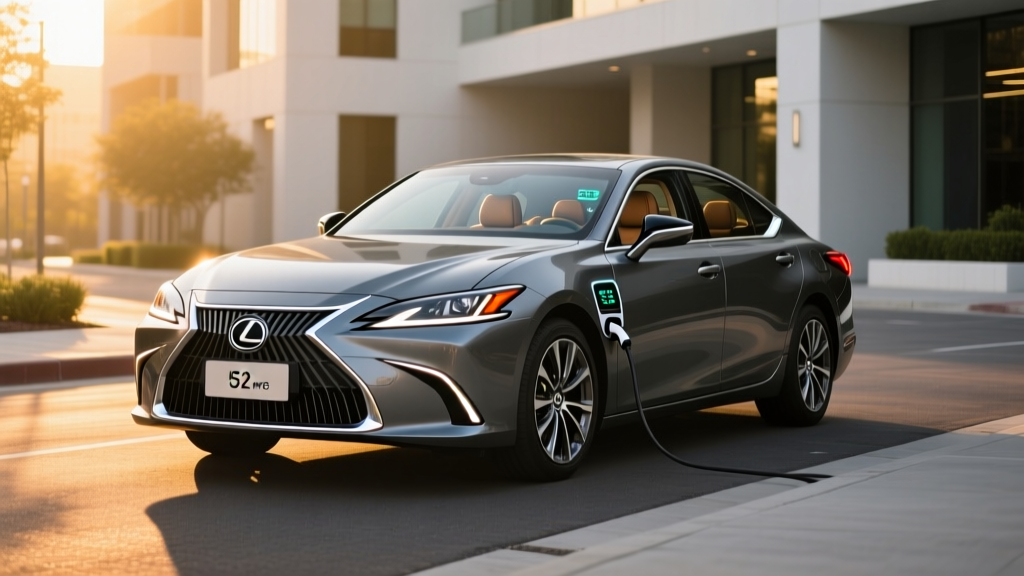
The midsize luxury sedan segment has thinned considerably, but the Lexus ES 300h remains a staple for buyers who want premium comfort without a charging cable. As a conventional hybrid (HEV), the ES 300h requires no plug-in infrastructure, no range calculations, and no behavioral change from a gas car — it simply sips fuel and delivers the quiet, composed ride Lexus is known for. For 2026, the ES 300h continues with the fourth-generation Lexus Hybrid Drive system, pairing a 2.5-liter four-cylinder with an electric motor for a combined 215 horsepower and an EPA-estimated 44 MPG combined.
This guide covers everything a prospective buyer needs: exact fuel economy figures, real-world MPG expectations, powertrain details, pricing across trims, battery longevity and warranty coverage, and how the ES 300h stacks up against plug-in hybrids and full battery-electric vehicles.
HEV vs PHEV: Where the Lexus ES 300h Fits
Before diving into specs, it is essential to understand what the ES 300h is — and what it is not. The ES 300h is a conventional hybrid (HEV). It charges its small traction battery through regenerative braking and the gasoline engine. You never plug it in. There is no electric-only driving mode of meaningful distance; the electric motor assists the gas engine and enables brief low-speed EV operation, but the car is fundamentally fueled by gasoline.
This differs from a plug-in hybrid (PHEV), which carries a larger battery (typically 10–20 kWh), can be plugged into a wall or public charger, and offers 20–40+ miles of electric-only range before the gas engine engages. Lexus does not currently offer the ES as a PHEV in the US market.
| Feature | HEV (ES 300h) | PHEV (e.g., BMW 550e) | BEV (e.g., Tesla Model S) |
|---|---|---|---|
| Plug-in required? | No | Yes (optional but recommended) | Yes (mandatory) |
| Electric-only range | ~1 mi at low speed | 20–40+ miles | 250–400+ miles |
| Battery size | ~1.6 kWh (NiMH) | 10–25 kWh (lithium-ion) | 75–100+ kWh (lithium-ion) |
| Fuel source | Gasoline only | Gasoline + electricity | Electricity only |
| DC fast charge? | No | Some models, yes | Yes |
| Federal tax credit (§30D) | Not eligible | Up to $7,500 if qualified | Up to $7,500 if qualified |
If you have access to home or workplace charging and a commute under 35 miles, a PHEV can eliminate most gasoline use on weekdays. If you lack charging access or prefer zero lifestyle adjustment, the ES 300h's HEV approach is the lower-friction path to better fuel economy.
Fuel Economy: EPA Ratings and Real-World MPG
The 2026 Lexus ES 300h carries the following EPA fuel-economy estimates, consistent with the model's ratings since the current generation's refresh:
| Cycle | MPG |
|---|---|
| City | 43 MPG |
| Highway | 44 MPG |
| Combined | 44 MPG |
Source: fueleconomy.gov (US EPA).
Real-World MPG: What Owners Actually See
Toyota and Lexus hybrids have a well-documented tendency to exceed their EPA city estimates in stop-and-go traffic, where regenerative braking and electric-motor assist do the most work. Many ES 300h owners report 46–50 MPG in urban driving, particularly in warm climates where the engine doesn't need to run continuously for cabin heat.
Highway driving is a different story. At sustained 75–80 mph speeds, the aerodynamic drag of a midsize sedan works against the hybrid system's advantages. Expect 38–42 MPG on the highway in real-world conditions — slightly below the EPA sticker. Cold weather (below 40°F) will knock 3–5 MPG off combined figures because the engine runs more frequently to maintain cabin temperature and battery warmth.
With a 13.2-gallon fuel tank, total range sits between 525 and 600 miles per tank in typical conditions — enough to make fuel stops a roughly biweekly affair for most drivers.
Powertrain and Performance Specs
The ES 300h uses Lexus's fourth-generation hybrid synergy drive. Here is the full powertrain breakdown:
| Specification | Detail |
|---|---|
| Engine | 2.5L inline-4 (A25A-FXS, Atkinson cycle) |
| Engine output | 176 hp / 163 lb-ft torque |
| Electric motor | Permanent-magnet synchronous (front axle) |
| Motor output | 88 kW (118 hp) / 149 lb-ft torque |
| Combined system output | 215 hp |
| Transmission | eCVT (planetary gearset, not a belt CVT) |
| Drivetrain | Front-wheel drive |
| Hybrid battery | Nickel-metal hydride (NiMH), ~1.6 kWh |
| 0–60 mph | ~8.1 seconds (manufacturer estimate) |
| Top speed | 112 mph (electronically limited) |
The eCVT deserves a note: unlike the rubber-band-feel belt-driven CVTs found in some competitors, Lexus uses a planetary gearset that seamlessly blends engine and motor power. There are no simulated "shifts" or droning — just linear, quiet acceleration. The trade-off is that 215 hp in a 3,680-pound sedan yields adequate but not quick acceleration. This is a car optimized for efficiency and refinement, not sportiness. Buyers seeking more urgency should look at the ES 350 (non-hybrid V6, 302 hp) or a sport sedan alternative.
Pricing, Trims, and Tax Credit Eligibility
The 2026 Lexus ES 300h is offered in several trims. Pricing below reflects manufacturer MSRP before destination charges:
| Trim | MSRP (approx.) |
|---|---|
| Base | $44,590 |
| Premium | $46,090 |
| Luxury | $49,590 |
| F SPORT Design | $47,090 |
| F SPORT Handling | $48,590 |
Destination and delivery adds approximately $1,150. Options packages (navigation, Mark Levinson audio, panoramic roof, head-up display) can push a fully loaded ES 300h Luxury past $55,000.
Federal Tax Credit: Does the ES 300h Qualify?
No. The Lexus ES 300h is a conventional hybrid (HEV), not a plug-in vehicle. Under IRS §30D, the federal clean vehicle credit of up to $7,500 applies only to battery-electric vehicles (BEVs) and plug-in hybrids (PHEVs) that meet battery-sourcing, critical-mineral, MSRP cap, and buyer income requirements. The ES 300h does not qualify for §30D.
The previously available "Alternative Motor Vehicle Credit" for conventional hybrids expired years ago. No current federal tax credit applies to HEV purchases. Some states or local utilities may offer modest rebates for hybrid vehicles, but these vary widely by jurisdiction — check your state energy office or utility provider for current programs. For authoritative federal credit rules, consult IRS.gov §30D guidance.
Battery Longevity, Warranty, and Replacement Cost
Hybrid battery longevity is the single most common concern among first-time hybrid buyers. Here is what the data shows for the ES 300h:
How Long Does the ES 300h Hybrid Battery Last?
The ES 300h uses a nickel-metal hydride (NiMH) battery pack — a mature, well-proven chemistry that Toyota/Lexus has deployed across millions of hybrids since the late 1990s. NiMH packs in Lexus sedans routinely last 150,000–200,000+ miles before capacity loss becomes noticeable. Unlike the lithium-ion packs in EVs, the ES 300h's small 1.6 kWh battery operates within a narrow state-of-charge window (roughly 40–80%), which dramatically reduces degradation stress.
Real-world failure before 150,000 miles is uncommon. When it does occur, the warranty covers replacement. Lexus dealerships also offer refurbished/reconditioned battery packs as a lower-cost out-of-warranty option.
Battery Replacement Cost
If the hybrid battery fails outside the warranty window, expect the following:
- New OEM battery (dealer): $3,000–$4,500 installed
- Refurbished/reconditioned battery: $1,500–$2,500 installed
- Individual cell module replacement (if only one or two modules degrade): $500–$1,200 at a hybrid specialist shop
For context, the ES 300h's NiMH pack is far less expensive to replace than a full EV traction battery (which can run $10,000–$20,000+). The hybrid system's simplicity is a cost advantage over the vehicle's full lifespan.
Reliability and Ownership Costs
Lexus consistently ranks at or near the top of J.D. Power Vehicle Dependability Studies and Consumer Reports reliability surveys. The ES nameplate specifically has been one of the brand's most trouble-free models over multiple generations.
The hybrid system adds components (electric motor, inverter, battery) but removes others — there is no traditional alternator, no starter motor, no accessory drive belt, and the eCVT has no clutch packs or torque converter to wear out. Brake pad life is extended significantly by regenerative braking; many ES 300h owners report 60,000–80,000 miles on original brake pads.
Estimated 5-Year Ownership Costs
| Category | Estimated Cost |
|---|---|
| Fuel (44 MPG avg, $3.40/gal) | ~$5,800 |
| Maintenance (scheduled services) | ~$2,200 |
| Insurance (national avg, luxury sedan) | ~$9,500 |
| Depreciation (estimated 5-yr) | ~$18,000 |
| Tires, misc. repairs | ~$2,000 |
| Total (approx.) | ~$37,500 |
Fuel savings versus a comparable non-hybrid luxury sedan (say, 26 MPG combined on premium) amount to roughly $3,500–$4,000 over five years at current fuel prices. The hybrid premium over the ES 250 (4-cylinder turbo) is typically recouped within 3–4 years for drivers covering 12,000+ miles annually.
ES 300h vs PHEV vs EV: Which Powertrain Fits You?
Choosing between the ES 300h, a plug-in hybrid, and a full EV comes down to three questions: your charging access, your daily mileage, and your willingness to adapt.
- You have no access to home or workplace charging
- You want a luxury sedan with zero behavioral change from a gas car
- Your priority is low fuel cost with maximum simplicity
- You drive 10,000–18,000 miles per year in mixed conditions
- You plan to keep the car 8+ years (hybrid reliability is proven long-term)
- You can install a Level 2 home charger (240V, ~$500–$1,500 install)
- Your daily commute is under 35 miles round-trip (enabling electric-only weekday driving)
- You want to reduce gasoline use by 60–80% without range limitations on road trips
- You want eligibility for up to $7,500 in federal tax credits (subject to §30D sourcing and income rules)
- You have reliable home charging (Level 2) and access to DC fast-charging networks
- You want the lowest per-mile "fuel" cost (~$0.04–$0.06/mile on home electricity vs ~$0.10/mile in the ES 300h)
- You want instant torque, zero tailpipe emissions, and minimal maintenance
- You are comfortable planning charging stops on long road trips
Pros and Cons: The Honest Assessment
- 44 MPG combined EPA — best-in-class for midsize luxury sedans
- No plug-in required; zero lifestyle change
- Exceptionally quiet, comfortable ride quality
- 10-year/150,000-mile hybrid battery warranty
- Strong Lexus reliability and resale value
- 525+ mile total range per tank
- Regenerative braking extends brake pad life significantly
- 215 hp — adequate, not quick (8.1 sec 0–60)
- No federal tax credit eligibility (HEV, not PHEV/BEV)
- FWD only — no AWD option (ES 250 offers AWD)
- Infotainment system improved but still trails German competitors
- No plug-in hybrid variant available in US
- Highway MPG drops to ~38–42 in real-world driving
- NiMH battery is older chemistry (proven, but less energy-dense)
Frequently Asked Questions
How many MPG does the Lexus ES 300h get?
The EPA rates the 2026 Lexus ES 300h at 43 MPG city, 44 MPG highway, and 44 MPG combined. In real-world driving, city-heavy commuters often see 46–50 MPG, while highway-dominant driving at 75+ mph yields 38–42 MPG. Cold weather reduces combined economy by roughly 3–5 MPG.
Does the Lexus ES 300h need to be plugged in?
No. The ES 300h is a conventional hybrid (HEV). It charges its battery entirely through regenerative braking and the gasoline engine. There is no plug, no charging cable, and no electric-only range of practical significance. You fuel it with gasoline exactly as you would any other car.
Is the Lexus ES 300h hybrid reliable?
Yes. Lexus (and parent company Toyota) has the longest track record in hybrid production of any automaker, with over 25 years of hybrid system refinement. The ES 300h's NiMH battery and planetary eCVT are among the most proven powertrain components in the industry. Major hybrid-system failures within the 10-year/150,000-mile warranty period are uncommon, and the system eliminates several wear items found in conventional powertrains (starter, alternator, accessory belt, traditional transmission clutches).
What does it cost to replace the ES 300h hybrid battery?
A new OEM hybrid battery replacement at a Lexus dealer runs approximately $3,000–$4,500 installed. Refurbished or reconditioned packs cost $1,500–$2,500. Individual cell module replacement (if only partial degradation occurs) can cost $500–$1,200 at a hybrid specialist. Most ES 300h batteries last 150,000–200,000+ miles before replacement is needed.
Does the Lexus ES 300h qualify for any tax credit?
No federal tax credit applies to the ES 300h. The IRS §30D Clean Vehicle Credit is available only for plug-in vehicles (BEVs and PHEVs) meeting specific battery-sourcing, critical-mineral, MSRP, and buyer-income requirements. Conventional hybrids like the ES 300h are not eligible. Some state or utility programs may offer small rebates — check local resources. Consult a tax professional for personalized guidance.
How does the ES 300h compare to the ES 350 in fuel economy?
The non-hybrid ES 350 (3.5L V6, 302 hp) is rated at approximately 22 city / 32 highway / 26 combined MPG. The ES 300h's 44 MPG combined represents a 69% improvement in combined fuel economy, with the trade-off being less power (215 hp vs 302 hp) and front-wheel drive only. For most luxury sedan buyers prioritizing comfort over acceleration, the fuel savings strongly favor the 300h.
Is the ES 300h a good choice for high-mileage drivers?
Excellent. At 15,000–20,000 miles per year, the fuel savings alone can total $1,500–$2,000 annually versus a non-hybrid competitor. The 10-year/150,000-mile hybrid warranty provides peace of mind, and Lexus's reliability record means fewer unexpected repair costs. High-mileage drivers also benefit from extended brake pad life thanks to regenerative braking, reducing one of the larger routine maintenance costs.