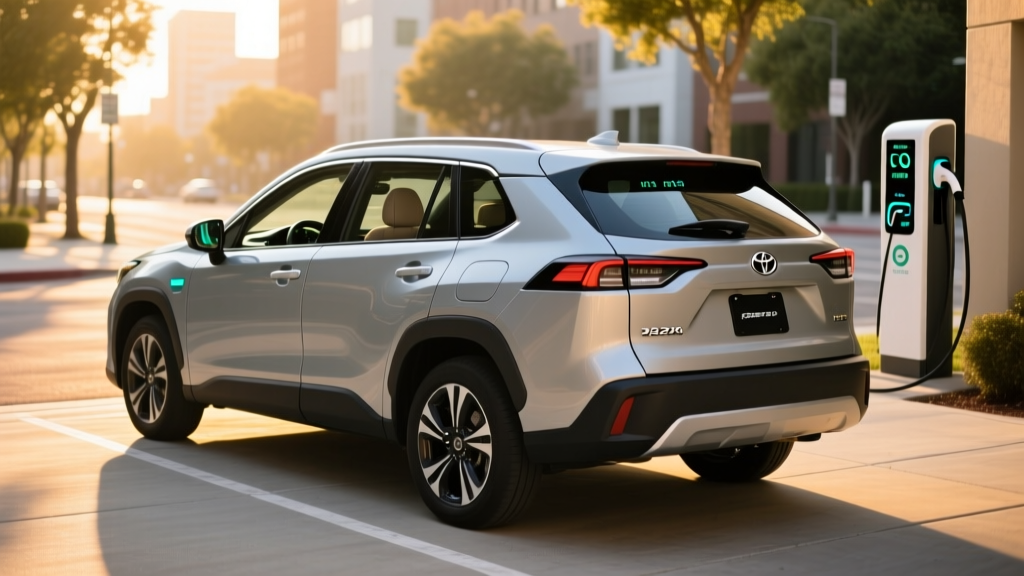
The 2024 Toyota Corolla Cross Hybrid occupies a narrow but valuable lane: a compact crossover that achieves mid-40s city fuel economy without requiring a charging cable, a plug, or any change in driving habits. For buyers weighing the jump to a full EV against the practicality of a gas-electric hybrid, this model offers a compelling middle ground — especially with standard all-wheel drive and a starting price under $30,000.
After reviewing EPA data, owner reports, and Toyota's powertrain specs, here's what you need to know about real-world efficiency, long-term reliability, and whether this hybrid makes financial sense compared to a PHEV or full EV.
What Is the 2024 Corolla Cross Hybrid?
The Corolla Cross Hybrid is a conventional hybrid electric vehicle (HEV) — meaning it pairs a gasoline engine with electric motors and a small battery that charges through regenerative braking and engine power. You never plug it in. This is fundamentally different from a plug-in hybrid (PHEV) like the Toyota RAV4 Prime, which offers 40+ miles of electric-only driving before the gas engine kicks in.
HEV vs PHEV: Key Differences
| Feature | HEV (Corolla Cross Hybrid) | PHEV (e.g., RAV4 Prime) |
|---|---|---|
| Plug-in charging | No — self-charging | Yes — 120V or 240V |
| Electric-only range | Less than 1 mile at low speeds | 35–42 miles typical |
| Battery size | ~1.3 kWh (buffer-limited) | 18.1 kWh usable |
| Federal tax credit | No | Up to $7,500 (if eligible) |
| Best for | No home charging access | Home charger + short commute |
If you have access to home or workplace charging and a commute under 40 miles, a PHEV may save more fuel. If you park on the street, live in an apartment, or simply don't want to think about plugging in, the Corolla Cross Hybrid's self-charging system is the more practical choice.
Fuel Economy: EPA Ratings vs Real-World MPG
The EPA rates the 2024 Corolla Cross Hybrid at 46 MPG city / 38 MPG highway / 42 MPG combined across all trims, thanks to standard electronic all-wheel drive (AWD) that uses a rear-mounted electric motor rather than a mechanical driveshaft. This is among the highest-rated compact crossovers on the market.
| Driving Condition | EPA Estimate | Real-World Expectation |
|---|---|---|
| City | 46 MPG | 44–50 MPG (hybrids excel in stop-and-go) |
| Highway | 38 MPG | 35–40 MPG (aero drag hurts at 75+ mph) |
| Combined | 42 MPG | 40–44 MPG depending on driving mix |
| Cold weather (below 30°F) | — | 36–40 MPG (engine runs more for heat) |
Toyota's hybrid system recovers braking energy and shuts off the engine at stops, which is why city MPG actually exceeds highway MPG — the opposite of a conventional gas car. Owners who do mostly city and suburban driving frequently report 44–48 MPG on forums and fuel-tracking apps. Highway-heavy commuters should expect numbers closer to the low-to-mid 30s, particularly at speeds above 70 mph or in mountainous terrain.
For context, the gas-only 2024 Corolla Cross AWD is rated at 29 MPG combined. The hybrid's 42 MPG combined represents roughly a 45% improvement in fuel consumption, translating to approximately $400–$600 in annual fuel savings for a driver covering 12,000 miles per year at $3.50/gallon (per fueleconomy.gov estimates).
Powertrain Specs: How Toyota's Hybrid System Works
The 2024 Corolla Cross Hybrid uses Toyota's fifth-generation hybrid system, pairing a 2.0-liter four-cylinder engine with two front-mounted motor-generators and a separate rear-axle electric motor for AWD.
| Specification | Detail |
|---|---|
| Engine | 2.0L 4-cylinder Atkinson-cycle |
| Combined net horsepower | 196 hp |
| Front electric motors | Two motor-generators (MG1 for starting/charging, MG2 for drive) |
| Rear electric motor | 40 hp (AWD engagement) |
| Transmission | Electronic continuously variable (eCVT) |
| Drivetrain | Electronic AWD (standard on all trims) |
| 0–60 mph | ~7.5 seconds (est.) |
| Battery type | Lithium-ion, ~1.3 kWh gross |
| Towing capacity | Not rated for towing |
The 196 combined horsepower is a meaningful upgrade over the 169 hp gas-only Corolla Cross, and the electric motors deliver immediate low-end torque that makes the hybrid feel noticeably quicker in city driving. The eCVT avoids the rubber-band feel of older Toyota hybrids, though it still drones under hard acceleration — a common trait of planetary-gear hybrid transmissions.
The rear AWD motor engages automatically when the system detects front-wheel slip or during hard cornering. Unlike mechanical AWD systems, there's no parasitic driveline loss when AWD isn't needed, which is a key reason the hybrid achieves better fuel economy than the gas AWD model despite having more power.
Pricing, Trims, and Tax Credit Eligibility
The 2024 Corolla Cross Hybrid is available in three trims, all with standard AWD:
| Trim | MSRP (incl. destination) | Key Features |
|---|---|---|
| S | $29,435 | 8-inch touchscreen, wireless CarPlay/Android Auto, TSS 3.0 safety suite |
| SE | $30,835 | Sport-tuned suspension, 18-inch alloy wheels, heated front seats |
| XSE | $32,725 | SofTex seats, power liftgate, JBL 9-speaker audio, ambient lighting |
Does the Corolla Cross Hybrid Qualify for a Federal Tax Credit?
No. The 2024 Corolla Cross Hybrid is a conventional HEV and does not qualify for the IRS §30D Clean Vehicle Credit. That credit — up to $7,500 — applies only to battery electric vehicles (BEVs) and plug-in hybrids (PHEVs) that meet battery-sourcing, critical-mineral, MSRP, and buyer income requirements.
Some states offer their own incentives for conventional hybrids, though these are increasingly rare as incentive programs shift toward zero-emission vehicles. Check your state's energy or environmental agency website for current programs. There is no federal incentive for HEV purchases in 2024 or 2025.
Battery Warranty, Lifespan, and Replacement Cost
Hybrid battery longevity is consistently the top concern among first-time hybrid buyers. Toyota addresses this with one of the strongest warranties in the industry.
Toyota Hybrid Battery Warranty
- Coverage: 10 years / 150,000 miles (whichever comes first)
- Applies to: Hybrid battery pack, hybrid control module, inverter
- Transferable: Yes — automatically transfers to subsequent owners
- Capacity threshold: Toyota does not publish a specific degradation percentage, but covers defects and abnormal capacity loss
In practice, Toyota's hybrid batteries have proven exceptionally durable. The Prius, which uses a similar system, routinely reaches 200,000+ miles on its original battery pack. The Corolla Cross Hybrid's lithium-ion pack is smaller and less stressed than a full EV battery — it operates in a narrow state-of-charge window (roughly 40–80%) managed by the hybrid control system, which minimizes degradation.
If a replacement is needed out of warranty, expect to pay $2,000–$4,000 for a new or remanufactured hybrid battery pack, plus labor. This is dramatically less than EV battery replacement ($10,000–$20,000+), reflecting the Corolla Cross Hybrid's much smaller battery size.
Who Should Buy This Hybrid — and Who Shouldn't?
Pros
- 42 MPG combined with no plug-in required
- Standard AWD on every trim
- 196 hp — peppy city acceleration
- Strong 10-year/150,000-mile hybrid warranty
- Sub-$30K starting price for the S trim
- Toyota Safety Sense 3.0 standard (adaptive cruise, lane centering, auto emergency braking)
Cons
- Modest cargo space (25.5 cu ft behind rear seats)
- No electric-only driving mode for zero-emission zones
- CVT drone under hard acceleration
- No federal tax credit
- Rear-seat legroom is tight for taller passengers
- Not rated for towing
Choose the Corolla Cross Hybrid if:
- You don't have access to home or workplace charging
- Your daily driving is a mix of city and highway with no single long commute
- You want AWD for snow/rain without the fuel penalty of a gas AWD crossover
- You plan to keep the vehicle 8–10+ years (warranty coverage and Toyota reliability pay off)
Choose a PHEV (e.g., RAV4 Prime, Tucson PHEV) if:
- You can charge at home and your commute is under 35 miles round-trip
- You want to drive mostly on electricity during the week and use gas for road trips
- You want to qualify for the $7,500 federal tax credit (subject to eligibility)
Choose a full EV (e.g., Hyundai Kona Electric, Tesla Model Y) if:
- You have reliable home Level 2 charging
- You want zero tailpipe emissions and minimal maintenance (no oil changes, fewer brake replacements)
- Your typical trips are under 250 miles or you're comfortable with DC fast charging on road trips
Ownership Costs: 5-Year Comparison
Let's compare the Corolla Cross Hybrid against the gas-only Corolla Cross AWD and a comparable EV over five years and 60,000 miles:
| Cost Factor | Corolla Cross Hybrid ($29,435) | Corolla Cross Gas AWD ($26,435) | Hyundai Kona Electric ($32,975) |
|---|---|---|---|
| Fuel / electricity (60K mi) | ~$5,000 | ~$7,200 | ~$2,700 |
| Maintenance (est.) | ~$2,200 | ~$2,800 | ~$1,200 |
| Federal tax credit | $0 | $0 | Up to $7,500* |
| Estimated depreciation | ~$12,000 | ~$13,000 | ~$16,000 |
| Estimated 5-yr total | ~$34,635 | ~$36,435 | ~$30,375* |
*Kona Electric figures assume full $7,500 credit eligibility. Actual credit depends on battery sourcing, buyer income, and MSRP caps per IRS §30D rules. Consult a tax professional.
The Corolla Cross Hybrid saves roughly $1,800 over the gas model across five years, primarily through fuel savings. The EV saves more if you qualify for the tax credit and have cheap home electricity, but carries higher depreciation risk and requires charging infrastructure.
Reliability and Safety Ratings
Toyota's hybrid powertrains have decades of proven reliability, and the Corolla Cross Hybrid benefits from the same system architecture used across the Toyota lineup. The NHTSA has awarded the Corolla Cross (including the hybrid) a 5-Star Overall Safety Rating.
Standard Toyota Safety Sense 3.0 includes:
- Pre-Collision System with Pedestrian Detection
- Full-Speed Range Dynamic Radar Cruise Control
- Lane Departure Alert with Steering Assist
- Lane Tracing Assist
- Automatic High Beams
- Road Sign Assist
This is an SAE Level 2 driver-assistance system — meaning the driver must remain fully engaged, with hands on the wheel and eyes on the road at all times. It is not self-driving.
Frequently Asked Questions
How many MPG does the 2024 Corolla Cross Hybrid get?
The EPA rates it at 46 MPG city, 38 MPG highway, and 42 MPG combined. Real-world results vary: city-heavy drivers often see 44–48 MPG, while highway-heavy drivers may see 35–40 MPG. Cold weather reduces efficiency by roughly 5–10%.
Do I need to plug in the Corolla Cross Hybrid?
No. This is a conventional hybrid (HEV), not a plug-in hybrid. The battery charges through regenerative braking and the gasoline engine. You fuel it like any other car — just less often.
How far can the Corolla Cross Hybrid drive on electric power alone?
Less than one mile, at very low speeds (typically under 25 mph in parking lots or stop-and-go traffic). The system is designed for electric assist, not electric-only driving. If you want meaningful electric-only range, look at a PHEV like the Toyota RAV4 Prime (42 miles EV range).
Is the hybrid battery reliable, and what does replacement cost?
Toyota's hybrid batteries are among the most proven in the industry, with many lasting 200,000+ miles. The warranty covers 10 years / 150,000 miles. Out-of-warranty replacement runs $2,000–$4,000 — far less than an EV battery.
Does the Corolla Cross Hybrid qualify for any tax credit?
No federal tax credit applies to conventional hybrids. The IRS §30D Clean Vehicle Credit is limited to plug-in hybrids and battery electric vehicles. Some states may offer small hybrid incentives — check your state's energy office for details.
How does the Corolla Cross Hybrid compare to a RAV4 Hybrid?
The RAV4 Hybrid is larger (more cargo room, more rear-seat space) and rated at 39–41 MPG combined depending on trim, slightly less than the Corolla Cross Hybrid's 42 MPG. The RAV4 Hybrid starts around $33,000. If you need the space, the RAV4 is the better choice; if you prioritize fuel economy and a lower price, the Corolla Cross Hybrid wins.
Can the Corolla Cross Hybrid tow?
Toyota does not rate the Corolla Cross Hybrid for towing. If you need towing capability, look at the RAV4 Hybrid (up to 1,750 lbs) or a PHEV/EV crossover rated for towing.
The 2024 Toyota Corolla Cross Hybrid isn't trying to be revolutionary — it's trying to be the most efficient, practical, and affordable compact crossover you can buy without changing how you refuel. At 42 MPG combined with standard AWD, a sub-$30K entry price, and Toyota's proven hybrid reliability, it delivers exactly that. For buyers who can't charge at home or aren't ready for a full EV, it's one of the smartest purchases in the segment.