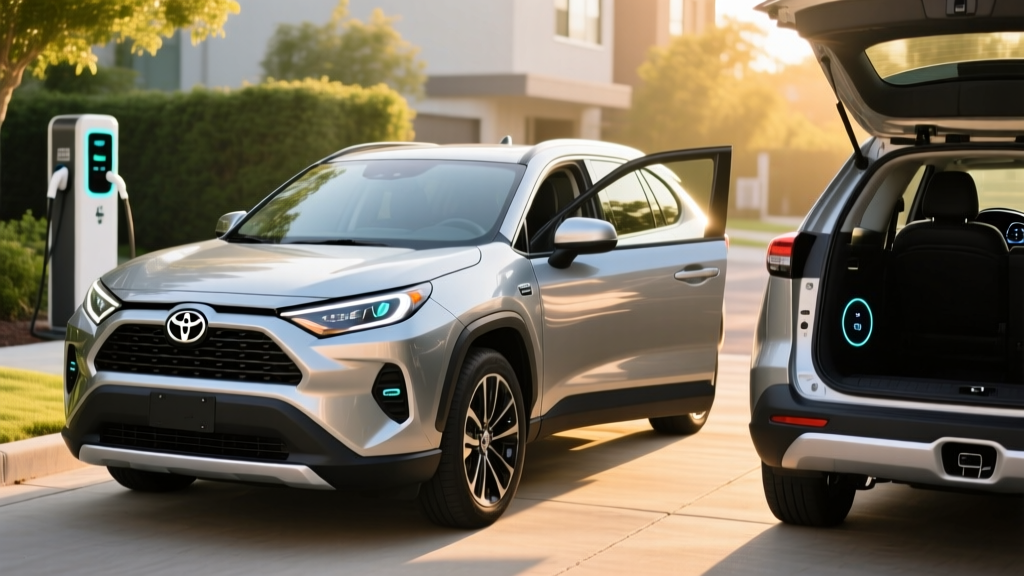
The Toyota RAV4 Hybrid remains one of the best-selling electrified vehicles in America for a reason: it delivers genuine fuel savings without requiring a plug, a lifestyle change, or a second mortgage. For 2025, Toyota continues the fifth-generation RAV4 Hybrid with the same proven 2.5-liter four-cylinder hybrid powertrain, standard electronic all-wheel drive, and a starting price that undercuts most competitors. But with the RAV4 Plug-in Hybrid (Prime) sitting right next to it in the showroom — and full EVs like the Hyundai Ioniq 5 and Tesla Model Y pulling buyers in another direction — where does the conventional RAV4 Hybrid actually fit?
I've spent time with multiple model years of this powertrain in real-world commuting and road-trip conditions. Here's the data-driven breakdown of what the 2025 RAV4 Hybrid actually delivers, what it costs to own, and whether it's the right electrified vehicle for your situation.
HEV vs. PHEV: Which RAV4 Is Which?
Toyota sells two electrified RAV4 variants, and confusing them is the most common buyer mistake. Here's the fundamental difference:
RAV4 Hybrid (HEV)
- No plug required. The 1.6 kWh nickel-metal hydride (NiMH) battery recharges through regenerative braking and the gas engine.
- You fuel it like a normal car. Just fill up at any gas station — the hybrid system operates automatically.
- EPA: 41 city / 38 highway / 39 combined MPG.
- Starting MSRP: ~$31,900 (LE trim, 2025 model year).
RAV4 Prime (PHEV)
- Plugs in to charge. The 18.1 kWh lithium-ion battery provides up to 42 miles of electric-only driving.
- Requires a home outlet or charger to realize the electric-range benefit. You can still drive it as a hybrid without plugging in.
- EPA: 94 MPGe combined (electric + gas); 38 MPG combined gas-only.
- Starting MSRP: ~$43,690 (SE trim, 2025 model year).
This article focuses on the conventional RAV4 Hybrid (HEV). If you can charge at home and want electric-only commuting, the Prime is covered in our separate RAV4 Prime guide.
Fuel Economy: EPA Numbers and Real-World MPG
The 2025 RAV4 Hybrid carries the same EPA ratings across all trims with the standard electronic AWD system:
| Driving Condition | EPA Estimate | Real-World Expectation |
|---|---|---|
| City | 41 MPG | 42–45 MPG (hybrids excel in stop-and-go) |
| Highway | 38 MPG | 34–37 MPG (aerodynamic drag at 70+ mph) |
| Combined | 39 MPG | 38–41 MPG (mixed driving) |
The real-world story with the RAV4 Hybrid is one of the better surprises in the hybrid segment. Unlike EVs, which lose range in cold weather and at highway speeds, conventional hybrids actually gain efficiency in city driving. The regenerative braking system recovers energy at every stoplight, and the engine shuts off entirely at low speeds. In my experience and consistent with owner reports on fueleconomy.gov's user data, expect 42–45 MPG in urban commuting with moderate acceleration.
Highway driving is where the RAV4 Hybrid gives back some of its advantage. At sustained 75–80 mph speeds, the 2.5-liter engine does most of the work, and the boxy SUV shape creates real aerodynamic drag. Expect 34–37 MPG on long interstate trips. Cold weather (below 30°F) drops efficiency by roughly 5–8% because the engine runs more often to provide cabin heat.
Powertrain and Performance Specs
| Specification | 2025 RAV4 Hybrid |
|---|---|
| Engine | 2.5L 4-cylinder Atkinson-cycle + 3 electric motors |
| Combined Horsepower | 219 HP (net system output) |
| Drivetrain | Electronic AWD (eAWD) — standard on all trims |
| 0–60 mph | 7.4 seconds |
| Hybrid Battery | 1.6 kWh NiMH (sealed, no plug) |
| Transmission | Continuously Variable (eCVT) |
| Towing Capacity | 1,750 lbs |
| Cargo Volume | 37.5 cu ft (rear seats up) / 69.8 cu ft (folded) |
The 219-horsepower combined output comes from a 176 HP gas engine paired with a 118 HP front electric motor and a 54 HP rear motor (which provides the electronic AWD). The rear motor engages automatically when slip is detected or during hard acceleration — there's no mechanical driveshaft to the rear wheels. The result is confident acceleration from stops and reasonable passing power, though the eCVT produces the characteristic drone under hard throttle that Toyota's hybrid system is known for.
For context, the RAV4 Hybrid is roughly 1.5 seconds quicker to 60 mph than the non-hybrid gas-only RAV4 AWD, and it delivers that performance while using about 30% less fuel. The 1,750-pound towing capacity is modest — adequate for a small utility trailer or a couple of dirt bikes, but not for a camping trailer. If you need serious towing, the gas-only RAV4 Adventure trim (3,500 lbs) or a body-on-frame SUV is a better fit.
Pricing, Trims, and Tax Credit Eligibility
The 2025 RAV4 Hybrid is offered in six trims. Here's the approximate MSRP breakdown (destination charge included):
- LE: ~$31,900
- XLE: ~$33,400
- XLE Premium: ~$35,350
- SE: ~$35,850
- Woodland Edition: ~$35,900
- Limited: ~$39,400
Federal tax credit: The conventional RAV4 Hybrid (HEV) does not qualify for the IRS §30D Clean Vehicle Credit. That credit applies only to plug-in electric vehicles (BEVs and PHEVs) meeting battery sourcing, MSRP caps, and buyer income limits. If you're specifically seeking the up-to-$7,500 federal credit, you'd need to look at the RAV4 Prime (PHEV) or a full EV — and even then, eligibility depends on current-year IRS §30D rules including income caps ($150K single / $300K joint), MSRP limits ($55K for SUVs), and critical-mineral/battery-component sourcing requirements.
State incentives: Some states offer rebates for conventional hybrids, though these are increasingly rare as incentive programs shift toward plug-in vehicles. Check your state energy office or department of environmental quality for current programs. A few states still include HEVs in clean-vehicle rebate tiers, typically $500–$1,500.
Battery Longevity, Warranty, and Replacement Cost
This is the single most common concern I hear from hybrid-curious buyers: "What happens when the hybrid battery dies?"
Toyota covers the RAV4 Hybrid battery with a 10-year / 150,000-mile warranty (in all 50 states, following California's CARB-aligned standard). This covers any defect or capacity loss that causes the battery to fail to hold a functional charge. The 1.6 kWh NiMH pack is a mature, well-proven technology — Toyota has been shipping hybrid batteries in the millions since the 2000 Prius, and the failure rate is remarkably low.
Real-world data from fleet operators and high-mileage owners suggests these NiMH packs routinely last 150,000–200,000+ miles with minimal degradation. Unlike the large lithium-ion packs in EVs, the RAV4 Hybrid's small NiMH battery is never deeply cycled — the hybrid control system keeps it in a narrow state-of-charge window (roughly 40–80%) to maximize longevity. The battery doesn't determine your range (the gas tank does), so even moderate degradation is unnoticeable in daily driving.
If the battery does need replacement out of warranty, a new OEM Toyota hybrid battery for the RAV4 Hybrid typically costs $2,000–$3,500 installed at a dealer. Aftermarket refurbished and new-compatible packs are available for $1,200–$2,000. This is a fraction of EV battery replacement costs, and the likelihood of needing it within the vehicle's normal lifespan is low.
Reliability and Ownership Costs
The RAV4 Hybrid benefits from one of the strongest reliability reputations in the industry. Toyota's hybrid synergy drive system has been refined over 25 years, and the 2.5-liter Dynamic Force engine is one of the most thermally efficient production engines ever built (41% thermal efficiency). The eCVT transmission has no traditional gears, belts, or clutches to wear — it's a planetary gearset that's essentially bulletproof.
Ownership cost advantages over the gas-only RAV4 include:
- Fuel savings: At 39 MPG combined vs. the gas RAV4 AWD's 29 MPG combined, you save roughly $450–$550 per year in fuel (based on 12,000 miles/year and $3.50/gallon regular unleaded).
- Brake savings: Regenerative braking significantly reduces pad wear. Many RAV4 Hybrid owners report original brake pads lasting 80,000–100,000 miles.
- No additional maintenance: The hybrid system requires no separate fluid changes, filter replacements, or scheduled service beyond the standard powertrain maintenance.
Insurance rates for the RAV4 Hybrid are typically 5–10% higher than the gas version due to the higher replacement cost of hybrid components, though this varies significantly by carrier and driver profile.
RAV4 Hybrid vs. PHEV vs. Full EV: Which Fits You?
Choose the RAV4 Hybrid (HEV) If:
- You can't charge at home (apartment, street parking, no garage).
- You want fuel savings with zero behavior change — just fill up and drive.
- Your budget is $32K–$40K and you don't qualify for or want to chase tax credits.
- You regularly drive in rural areas or take long road trips where charging infrastructure is sparse.
- You want maximum proven reliability with minimal new-technology risk.
Consider the RAV4 Prime (PHEV) or a Full EV If:
- You have reliable home charging (Level 2, 240V) and a commute under 40 miles.
- You want to drive on electricity most days and use gas only for road trips (PHEV) or never (BEV).
- You qualify for the §30D federal tax credit (income and sourcing requirements) and/or state EV rebates.
- You want access to HOV lanes (many states grant this to PHEVs and BEVs but not HEVs).
- Lower per-mile "fuel" cost is a priority — electricity at $0.14/kWh costs roughly $0.04/mile vs. $0.09/mile for gas at 39 MPG.
The honest decision framework: If you can charge at home and your daily driving is under 40 miles, a PHEV or BEV will save you more money and produce fewer emissions over time. But if home charging isn't an option — or you simply don't want to think about charging — the RAV4 Hybrid delivers 30%+ fuel savings over a gas SUV with zero infrastructure requirements and Toyota's strongest reliability record.
Frequently Asked Questions
How many MPG does the 2025 RAV4 Hybrid get?
The EPA rates it at 41 city / 38 highway / 39 combined MPG. In real-world city driving, many owners see 42–45 MPG thanks to regenerative braking. Highway driving at 75+ mph typically yields 34–37 MPG.
Does the RAV4 Hybrid need to be plugged in?
No. The RAV4 Hybrid (HEV) charges its own battery through regenerative braking and the gas engine. You never plug it in. Only the RAV4 Prime (PHEV) requires plug-in charging to access its electric-only range.
Is the RAV4 Hybrid reliable, and what does battery replacement cost?
Toyota's hybrid system has a 25-year track record with very low failure rates. The hybrid battery is warrantied for 10 years / 150,000 miles. Out-of-warranty replacement runs $2,000–$3,500 for an OEM pack, though most batteries outlast 150,000+ miles without issue. The eCVT transmission and 2.5L engine are among the most durable in the industry.
Does the RAV4 Hybrid qualify for a federal tax credit?
No. The IRS §30D Clean Vehicle Credit applies only to plug-in vehicles (PHEVs and BEVs). The conventional RAV4 Hybrid does not qualify. If tax incentives are a priority, consider the RAV4 Prime (PHEV) or a full EV, keeping in mind income caps, MSRP limits, and battery-sourcing rules.
How does the RAV4 Hybrid compare to the Honda CR-V Hybrid?
The 2025 CR-V Hybrid is rated at 40 city / 35 highway / 37 combined MPG (AWD), slightly behind the RAV4 Hybrid's 39 combined. The CR-V Hybrid starts around $34,650 — roughly $2,700 more than the RAV4 Hybrid LE. The RAV4 Hybrid offers slightly better highway MPG and a lower entry price; the CR-V Hybrid has a more refined interior and slightly more rear-seat legroom. Both are strong choices with excellent reliability records.
Is the RAV4 Hybrid AWD system good in snow?
The electronic AWD (eAWD) uses a dedicated rear electric motor that engages automatically when front-wheel slip is detected. It's effective for snow and rain traction on paved roads but is not designed for serious off-road use. For deep snow or rough terrain, a dedicated AWD system with a mechanical lock (like the RAV4 TRD Off-Road) is more capable, though it sacrifices fuel economy.
The 2025 RAV4 Hybrid occupies a specific and valuable niche: it's the electrified vehicle for people who don't want to think about electrification. No plugs, no range anxiety, no tax-credit paperwork, no charging-app subscriptions. Just a compact SUV that gets 39 MPG combined, starts under $32,000, and will likely run 200,000 miles with basic maintenance. If that's what you need, it's still the benchmark in the segment.