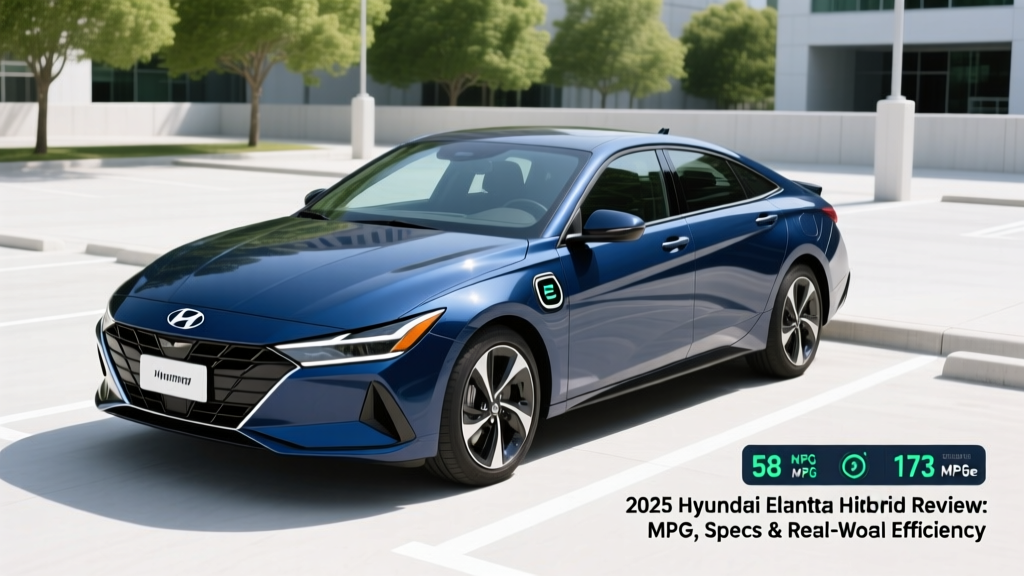
Quick Verdict: The Efficiency Champion in a Compact Sedan
The 2025 Hyundai Elantra Hybrid occupies a narrow but important lane: a conventional hybrid (HEV) that squeezes every last mile from a gallon without asking you to plug in, change your habits, or pay a steep electrification premium. With an EPA-estimated 56 MPG combined in Blue trim, it undercuts the Toyota Corolla Hybrid on price while matching it on efficiency — and it does so with a powertrain that prioritizes smoothness over raw acceleration.
This is not a plug-in hybrid. There is no electric-only driving mode and no charging port. The Elantra Hybrid captures energy through regenerative braking and its gasoline engine, storing it in a small lithium-ion battery that assists acceleration and enables brief electric-only creeping at low speeds. If you want plug-in capability, Hyundai offers the Tucson PHEV and Ioniq PHEV (discontinued after 2022), but the Elantra lineup keeps things simple: gas, hybrid, or the high-performance Elantra N.
| Spec | Blue Trim | SEL Sport / Limited |
|---|---|---|
| Powertrain | 1.6L GDI 4-cyl + electric motor | 1.6L GDI 4-cyl + electric motor |
| Combined Horsepower | 139 hp | 139 hp |
| Engine Output | 104 hp / 109 lb-ft | 104 hp / 109 lb-ft |
| Electric Motor Output | 43 hp / 125 lb-ft | 43 hp / 125 lb-ft |
| Transmission | 6-speed DCT (dual-clutch) | 6-speed DCT |
| EPA City / Hwy / Combined | 56 / 53 / 56 MPG | 49 / 52 / 50 MPG |
| Fuel Tank | 11.1 gal | 11.1 gal |
| Total Range (est.) | ~620 miles | ~555 miles |
| 0–60 mph (est.) | ~8.5 sec | ~8.5 sec |
| Hybrid Battery | ~1.6 kWh lithium-ion | ~1.6 kWh lithium-ion |
| Base MSRP | $26,250 | $29,100 / $31,400 |
| Battery Warranty | 10 yr / 100,000 mi | 10 yr / 100,000 mi |
How Many MPG Does the 2025 Elantra Hybrid Actually Get?
The EPA rates the Elantra Hybrid Blue at 56 MPG city, 53 MPG highway, and 56 MPG combined. Higher trims (SEL Sport and Limited) drop to 49/52/50 MPG due to larger 17-inch alloy wheels, additional sound insulation, and more standard equipment adding curb weight. For context, the EPA's fueleconomy.gov listing confirms these figures across model-year testing.
| Trim | City | Highway | Combined | Est. Annual Fuel Cost* |
|---|---|---|---|---|
| Blue | 56 MPG | 53 MPG | 56 MPG | ~$850 |
| SEL Sport | 49 MPG | 52 MPG | 50 MPG | ~$950 |
| Limited | 49 MPG | 52 MPG | 50 MPG | ~$950 |
*Based on 15,000 miles/year at $3.20/gal regular unleaded. Actual costs vary by region and driving pattern.
Real-World MPG vs. EPA Sticker
Hybrids consistently outperform their EPA estimates in city driving, where regenerative braking recaptures the most energy. Owner reports and third-party fuel tracking data show the Elantra Hybrid Blue regularly achieving 58–62 MPG in stop-and-go urban commutes. Highway driving tells a different story: at sustained 75–80 mph speeds, expect 46–50 MPG as aerodynamic drag dominates and the electric motor provides less benefit. In cold weather (below 35°F), fuel economy drops 5–10% due to longer engine warm-up cycles and increased battery internal resistance.
For a mixed suburban-and-highway commute of roughly 50/50, a realistic year-round average for the Blue trim is 52–55 MPG combined. That's close enough to the sticker to trust, and meaningfully better than most competitors.
HEV vs. PHEV vs. EV: Where Does the Elantra Hybrid Fit?
The Elantra Hybrid is a conventional hybrid (HEV). It has no plug, no charging port, and no meaningful electric-only range beyond low-speed parking-lot crawling. This is a deliberate engineering choice — the ~1.6 kWh battery is small enough to keep cost and weight down while still smoothing out acceleration and enabling engine-off coasting.
| Feature | HEV (Elantra Hybrid) | PHEV (e.g., Prius Prime) | BEV (e.g., Ioniq 6) |
|---|---|---|---|
| Plug Required? | No | Yes | Yes |
| Electric-Only Range | ~1 mi at low speed | 25–44 mi | 250–360 mi |
| Home Charging Needed? | No | Recommended (Level 2) | Essential |
| Federal Tax Credit (§30D) | Not eligible | Up to $7,500 (if eligible) | Up to $7,500 (if eligible) |
| Best For | No home charging access; budget-focused | Short commute + home charging | Full electric lifestyle |
| Upfront Cost Premium | +$1,500–$2,500 vs gas | +$4,000–$7,000 vs gas | +$8,000–$15,000 vs gas |
Choose the Elantra Hybrid if you don't have access to home or workplace charging, you want maximum fuel economy with zero lifestyle change, and your budget doesn't stretch to a plug-in or full EV. Choose a PHEV if you have a garage with a 120V or 240V outlet and a commute under 30 miles — you'll drive mostly on electricity and barely use gas. Choose a BEV if you have reliable home Level 2 charging, want zero tailpipe emissions, and your typical trips fall within 250 miles.
Powertrain Deep Dive: 139 HP of Smooth Efficiency
The Elantra Hybrid pairs a 1.6-liter gasoline direct-injection (GDI) four-cylinder engine with a 43-horsepower electric motor integrated into the transmission housing. Combined output is 139 horsepower, routed through a 6-speed dual-clutch automatic transmission (DCT). Unlike the Toyota Corolla Hybrid's planetary-gear eCVT, Hyundai's DCT provides distinct gear shifts — a deliberate choice that makes the Elantra feel more like a conventional car and less like a rubber-band accelerator.
The trade-off: 139 hp in a 3,000-lb sedan means 0–60 mph takes roughly 8.5 seconds. That's adequate for merging and passing but won't win any stoplight races. The electric motor's 125 lb-ft of torque fills in the low-end gap where the small-displacement engine would otherwise feel sluggish, and the transition between electric and gas power is nearly imperceptible under normal driving.
Hyundai's hybrid system operates in several modes automatically:
- EV Mode: Brief electric-only driving at low speeds (under ~25 mph, light throttle)
- Hybrid Mode: Engine and motor blend seamlessly for acceleration
- Regen Braking: Motor acts as generator during deceleration, recharging the battery
- Engine Charging: Engine generates excess power to charge the battery at steady highway speeds
Pricing, Trims, and Tax Credit Eligibility
The 2025 Elantra Hybrid starts at $26,250 MSRP for the Blue trim (including destination), making it one of the most affordable hybrid sedans on the market. The SEL Sport adds features like a 10.25-inch digital cluster, wireless charging pad, and SmartSense safety suite upgrades at $29,100. The Limited tops the range at $31,400 with leather seats, Bose premium audio, and highway driving assist.
Does the Elantra Hybrid Qualify for a Federal Tax Credit?
No. The Elantra Hybrid is a conventional HEV and does not qualify for the federal §30D Clean Vehicle Credit. That credit — up to $7,500 — is reserved for plug-in vehicles (PHEVs and BEVs) that meet battery sourcing, critical mineral content, MSRP caps, and buyer income limits as defined by the IRS guidelines. The Elantra Hybrid's efficiency gains come at the pump, not through tax incentives.
Some states and municipalities offer rebates or HOV lane access for hybrids, but these programs vary widely and change frequently. Check your state's energy office or the Alternative Fuels Data Center for current local incentives.
Hybrid Battery Warranty, Lifespan, and Replacement Cost
Hyundai Hybrid Battery Coverage
- Warranty: 10 years / 100,000 miles (whichever comes first)
- Coverage: Battery capacity loss below a manufacturer-defined threshold, plus all hybrid system components (motor, inverter, DCT)
- Transferability: Warranty transfers to second owners in most states
The Elantra Hybrid's ~1.6 kWh lithium-ion battery pack operates in a narrow state-of-charge window (roughly 40–80%) managed by the battery management system. This shallow cycling dramatically extends cell life compared to full EVs that routinely cycle from 10–90%. Hyundai has been building hybrid powertrains since the Sonata Hybrid in 2011, and real-world failure data from that generation shows hybrid batteries lasting 150,000–200,000+ miles with minimal degradation.
If a replacement is needed out of warranty, expect $2,000–$3,500 for a new OEM battery pack including labor. Refurbished or aftermarket packs may reduce that to $1,200–$2,000. For context, the hybrid battery is a fraction of the cost of a full EV battery replacement ($8,000–$18,000) because it contains far fewer cells and less total energy.
Is the 2025 Elantra Hybrid Reliable?
Hyundai's hybrid system has proven durable across two generations of Sonata, Ioniq, and Elantra Hybrid models. The 6-speed DCT is the main maintenance item — it uses a wet-clutch design that's more robust than dry-clutch DCTs but may require fluid service at higher mileages. The IIHS and NHTSA have not yet published full 2025 model-year crash ratings for the Elantra Hybrid specifically, but the Elantra platform earned top marks in prior testing. Long-term reliability surveys from Consumer Reports and J.D. Power place Hyundai's hybrid powertrains in the average-to-above-average range, with no systemic battery failure patterns.
Who Should Buy the 2025 Elantra Hybrid?
Pros
- 56 MPG combined (Blue) — among the highest of any non-plug-in sedan
- No plug-in required; zero lifestyle change from a gas car
- $26,250 starting price undercuts most hybrid competitors
- 10-year / 100,000-mile hybrid battery warranty
- 6-speed DCT feels natural vs. CVT drone
- Comprehensive Hyundai SmartSense safety suite standard
Cons
- 139 hp means leisurely acceleration (8.5 sec 0–60)
- Higher trims lose 6 MPG combined vs. Blue
- No federal tax credit (HEV, not PHEV/BEV)
- Rear headroom is tight for passengers over 6'1"
- No DC fast charging or plug-in capability (by design)
- Hyundai's infotainment can lag behind competitors' responsiveness
The Decision Framework
Buy the Elantra Hybrid Blue if: You want maximum MPG at minimum cost, you lack home charging access, your commute involves significant city driving, and you plan to keep the car 5+ years to realize fuel savings.
Buy the Elantra Hybrid SEL/Limited if: You value premium features over peak efficiency, you mostly drive highway miles where the MPG gap narrows, and you want advanced ADAS like Highway Driving Assist.
Look at a PHEV instead if: You have a garage with a 240V outlet, your daily commute is under 30 miles round-trip, and you want to drive mostly on electricity while keeping gas as a backup.
Look at a full BEV instead if: You have reliable home Level 2 charging, you want zero tailpipe emissions, you're eligible for the $7,500 federal credit, and your road trips are infrequent or under 250 miles.
2025 Elantra Hybrid vs. the Competition
| Vehicle | EPA Combined | Horsepower | Starting MSRP | 0–60 mph |
|---|---|---|---|---|
| Hyundai Elantra Hybrid Blue | 56 MPG | 139 hp | $26,250 | ~8.5 sec |
| Toyota Corolla Hybrid LE | 50 MPG | 138 hp | $24,350 | ~9.0 sec |
| Toyota Prius LE | 57 MPG | 194 hp | $28,550 | ~7.2 sec |
| Honda Civic Hybrid Sport | 49 MPG | 200 hp | $29,845 | ~7.5 sec |
The Prius offers more power and a slightly better combined MPG, but starts $2,300 higher. The Corolla Hybrid is cheaper but less efficient and less refined. The Civic Hybrid is the most powerful but sacrifices 7 MPG combined. The Elantra Hybrid Blue sits in the efficiency sweet spot: near-Prius MPG at a Corolla-adjacent price.
Frequently Asked Questions
How many MPG does the 2025 Elantra Hybrid get in real-world driving?
The EPA rates the Blue trim at 56 MPG combined (56 city / 53 highway). In real-world city driving, owners consistently report 58–62 MPG thanks to regenerative braking. Highway-only driving at 75+ mph drops to 46–50 MPG. A realistic year-round mixed-driving average is 52–55 MPG.
Does the Elantra Hybrid need to be plugged in?
No. The Elantra Hybrid is a conventional hybrid (HEV) with no plug or charging port. It recharges its small battery through regenerative braking and the gasoline engine. You fuel it exactly like any other gas car.
How far can the Elantra Hybrid go on a full tank?
With an 11.1-gallon fuel tank and 56 MPG combined, the Blue trim can travel approximately 620 miles between fill-ups. That's among the longest ranges of any compact sedan and means fewer stops on road trips.
Is the Elantra Hybrid battery expensive to replace?
A new OEM hybrid battery replacement runs $2,000–$3,500 including labor. However, Hyundai's 10-year / 100,000-mile hybrid warranty covers battery defects and excessive capacity loss. Real-world data suggests these batteries last 150,000–200,000+ miles with proper maintenance.
Does the 2025 Elantra Hybrid qualify for any tax credits?
The Elantra Hybrid does not qualify for the federal §30D Clean Vehicle Credit because it is a conventional hybrid, not a plug-in vehicle. Some states may offer hybrid-specific rebates or incentives — check the Alternative Fuels Data Center for current programs in your area.
How does the Elantra Hybrid compare to a full EV like the Ioniq 6?
The Ioniq 6 offers 305+ miles of EPA range, zero tailpipe emissions, and potential $7,500 federal tax credit eligibility — but starts around $38,000, requires home Level 2 charging for convenience, and costs more to insure. The Elantra Hybrid costs $12,000+ less upfront, needs no charging infrastructure, and still delivers 56 MPG. The right choice depends on your charging access, budget, and how long you plan to keep the vehicle.
Is the Elantra Hybrid good for highway road trips?
Yes, with caveats. Highway fuel economy drops to around 50 MPG at 75 mph (Blue trim), still excellent, and the 620-mile total range means you can drive from Los Angeles to San Francisco on a single tank. The DCT provides quiet, efficient cruising. However, 139 hp means passing maneuvers at highway speed require planning — it's adequate, not quick.