Quick Verdict: The Performance PHEV That Still Sips Fuel
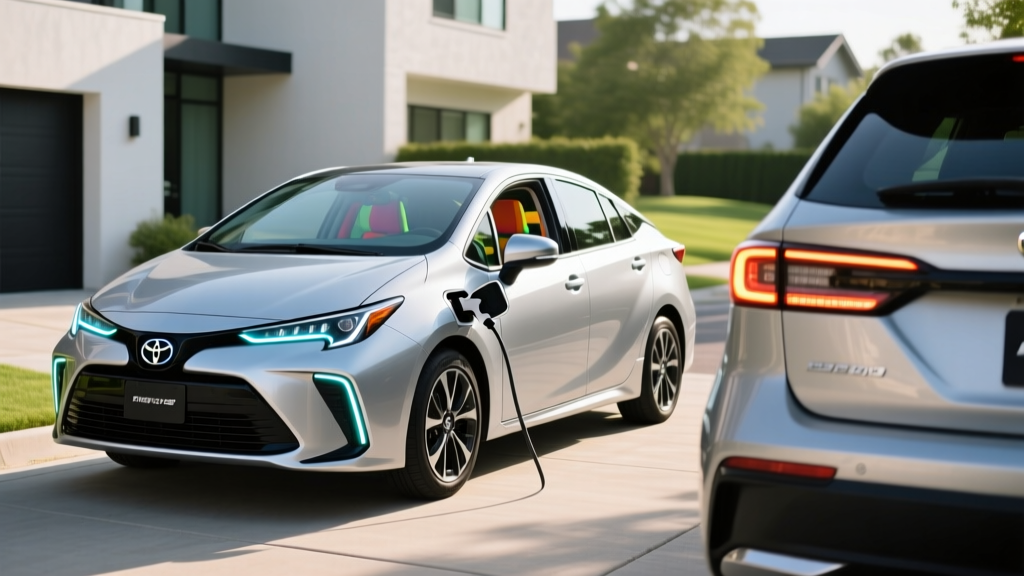
The 2025 Prius Plug-In Hybrid XSE sits at the top of Toyota's PHEV lineup, combining a 2.0-liter four-cylinder engine with dual electric motors for a combined 220 horsepower — a number that would have seemed absurd attached to a Prius badge just a few generations ago. But the real story is efficiency: an EPA-estimated 40 miles of electric-only range and 50 MPG combined once the battery depletes. For buyers who want to commute on electricity without committing to a full BEV, the XSE trim adds sport-tuned suspension, larger 19-inch wheels, and a more aggressive design that finally sheds the Prius's econobox reputation.
Starting at approximately $37,915 (including destination), the XSE commands a premium over the SE trim but delivers meaningful upgrades in both performance and technology. The question is whether those upgrades justify the cost — and whether a PHEV still makes sense in a market increasingly crowded with long-range EVs and conventional hybrids.
| Specification | 2025 Prius Plug-In Hybrid XSE |
|---|---|
| Powertrain | 2.0L 4-cyl + 2 electric motors (PHEV) |
| Combined Horsepower | 220 hp |
| Battery Capacity | 13.6 kWh (lithium-ion) |
| Electric-Only Range (EPA) | 40 miles |
| Total Combined Range | ~440 miles |
| Fuel Economy (charge-depleted) | 50 city / 47 hwy / 50 combined MPG |
| MPGe (electric + gas) | 127 MPGe combined |
| 0–60 mph | 6.6 seconds |
| Level 2 Charge Time (0–100%) | ~4 hours at 3.3 kW |
| DC Fast Charging | Not available |
| Base MSRP (XSE trim) | $37,915 |
| Battery Warranty | 10 years / 150,000 miles |
HEV vs. PHEV: What's the Difference and Why It Matters
Toyota sells two flavors of Prius, and confusing them is the single most common buyer mistake:
| Feature | Prius Hybrid (HEV) | Prius Plug-In Hybrid (PHEV) |
|---|---|---|
| Needs to be plugged in? | No — charges via regenerative braking and engine | Yes — plug in to access electric-only range |
| Battery size | ~1.0 kWh (small buffer) | 13.6 kWh usable |
| Electric-only driving | Very short distances at low speed | 40 miles EPA at full highway speed |
| Combined MPG (gas mode) | 57 MPG (LE trim) | 50 MPG (XSE trim) |
| Starting MSRP | ~$28,350 | ~$33,445 (SE) / $37,915 (XSE) |
| Federal tax credit eligible? | No | Potentially — see details below |
The conventional Prius HEV is a self-charging hybrid. It recovers energy during braking and deceleration, stores it in a small battery, and uses the electric motor to assist the gas engine. You never plug it in. It gets outstanding fuel economy — up to 57 MPG combined on the LE trim — but it cannot drive meaningful distances on electricity alone.
The Prius Plug-In Hybrid (officially called the Prius Prime in prior model years) has a much larger 13.6 kWh battery pack. Plug it in at home or at a public Level 2 charger, and you can drive up to 40 miles without the gasoline engine turning on. Once that battery depletes, it operates exactly like a conventional hybrid — the engine kicks in, and you get 50 MPG combined. The PHEV is the best of both worlds if you have access to charging.
Electric-Only Range and Charging: What to Expect
The EPA rates the 2025 Prius Plug-In Hybrid XSE at 40 miles of electric-only range. That figure is achievable in mixed driving at moderate temperatures. In real-world testing, expect the following variations:
- City driving, mild weather (60–75°F): 38–44 miles — regenerative braking in stop-and-go traffic extends range
- Highway driving at 70 mph: 32–36 miles — higher speeds increase aerodynamic drag and energy consumption
- Cold weather (below 32°F): 28–34 miles — battery chemistry is less efficient, and cabin heating draws significant energy (the XSE includes a heat pump, which mitigates some loss)
For a commuter with a round-trip distance under 35 miles and access to home charging, the PHEV can operate as a de facto EV on most days, with the gasoline engine reserved for longer weekend trips.
Charging Speeds and Connector
The 2025 Prius PHEV uses a J1772 connector for Level 1 and Level 2 AC charging. It does not support DC fast charging — a deliberate engineering choice that keeps cost and weight down but means you cannot top up quickly on a road trip.
| Charging Level | Power (kW) | 0–100% Time | Where You'll Use It |
|---|---|---|---|
| Level 1 (120V household outlet) | ~1.4 kW | ~10 hours | Overnight at home (emergency/trickle) |
| Level 2 (240V home or public) | 3.3 kW (onboard charger max) | ~4 hours | Home wallbox, workplace, public stations |
| DC Fast Charging | N/A | N/A | Not supported |
The onboard charger is limited to 3.3 kW, which means even if you plug into a 7.2 kW or 11.5 kW Level 2 station, the car will only accept 3.3 kW. For most owners, this is perfectly adequate — plug in when you get home, and the battery is full by morning. But it's a consideration if you were hoping to charge at a fast public Level 2 station during a midday break.
Pro tip: Install a 240V Level 2 home charger (even a basic 16-amp unit delivering 3.8 kW) to ensure you get a full charge well within the 4-hour window. A standard 120V outlet works, but 10 hours means you need to plug in immediately upon arriving home to be ready for the next morning's commute.
Fuel Economy: EPA Numbers and Real-World MPG
Once the 13.6 kWh battery is depleted, the 2025 Prius PHEV XSE operates as a conventional hybrid. Here's what the EPA rates:
| Driving Condition | EPA MPG | Real-World Expectation |
|---|---|---|
| City | 50 MPG | 50–55 MPG (hybrids excel in city driving) |
| Highway | 47 MPG | 44–48 MPG (aerodynamic drag at 70+ mph reduces efficiency) |
| Combined | 50 MPG | 47–52 MPG depending on driving mix |
One of the defining characteristics of Toyota's hybrid system is that it often exceeds EPA city estimates in real-world driving. The planetary gearset seamlessly blends regenerative braking with friction braking, capturing energy that a conventional car wastes as heat. If your commute involves heavy stop-and-go traffic, you may consistently see 52–55 MPG on the city portion.
Highway driving is the PHEV's relative weak point. The XSE's 19-inch wheels and sport-tuned suspension add a small efficiency penalty compared to the SE trim (which wears 17-inch wheels and achieves slightly better MPG figures). At sustained 75–80 mph speeds, expect 44–46 MPG — still excellent, but a few ticks below the EPA sticker.
When operating in EV mode, the car achieves 127 MPGe combined, translating to roughly 27 kWh per 100 miles of electric driving. At a national average electricity rate of $0.16/kWh, that works out to about $0.043 per mile on electricity — compared to roughly $0.12 per mile for a 30 MPG gas car at $3.50/gallon.
Powertrain and Performance: 220 HP in a Prius
The 2025 Prius PHEV pairs a 2.0-liter Atkinson-cycle four-cylinder engine (150 hp, 139 lb-ft of torque) with a front-mounted electric motor (161 hp, 153 lb-ft). Combined system output is 220 horsepower, routed through Toyota's eCVT (a planetary gearset, not a belt-driven CVT) to the front wheels.
The result is a 0–60 mph time of 6.6 seconds — nearly three seconds quicker than the previous-generation Prius Prime and competitive with many turbocharged compact sedans. The XSE's sport-tuned suspension and lower-profile 19-inch tires provide noticeably sharper handling than the SE, though ride quality is firmer over broken pavement.
Three driving modes are available:
- EV Mode: Pure electric driving up to ~84 mph, engine stays off unless you floor the accelerator
- EV/HV Mode: The car intelligently switches between electric and hybrid to maximize efficiency over the entire trip
- HV Mode: Operates as a conventional hybrid, preserving battery charge for later use (useful if your destination is in a zero-emissions zone or you want electric driving for the final leg)
A fourth mode, Auto EV/HV, uses navigation data to optimize battery usage across your route — for example, saving electric range for city driving at your destination while using the engine on the highway.
Pricing, Trims, and Federal Tax Credit Eligibility
The 2025 Prius Plug-In Hybrid is offered in three trims:
| Trim | Base MSRP | Key Features |
|---|---|---|
| SE | $33,445 | 17" alloy wheels, heated front seats, 8" touchscreen, wireless CarPlay/Android Auto |
| XSE | $37,915 | 19" alloy wheels, sport-tuned suspension, SofTex seats, 12.3" touchscreen, ambient lighting |
| XSE Premium | $41,165 | Panoramic fixed glass roof, heated/ventilated front seats, digital rearview mirror, JBL audio |
Federal Tax Credit: Does the 2025 Prius PHEV Qualify?
Under the current IRS §30D Clean Vehicle Credit rules, the Prius Plug-In Hybrid may qualify for a partial or full credit, but eligibility depends on several factors that change regularly:
- MSRP cap: The vehicle must have an MSRP at or below $55,000 for sedans (all Prius PHEV trims qualify)
- Buyer income cap: Modified adjusted gross income must not exceed $150,000 (single), $225,000 (head of household), or $300,000 (joint filing)
- Battery sourcing: A percentage of critical minerals and battery components must be sourced from the U.S. or free-trade-agreement countries — these thresholds increase annually and affect the credit amount ($3,750 for minerals, $3,750 for components, up to $7,500 total)
- Point-of-sale transfer: As of 2024, the credit can be transferred to the dealer at purchase, reducing your out-of-pocket cost immediately rather than waiting for a tax refund
- Final assembly: Must occur in North America (the Prius PHEV is assembled in Japan — this is a potential disqualifier; verify current status with your dealer)
Critical note: The Prius PHEV is assembled in Toyota's Tsutsumi plant in Japan. Under current §30D rules, vehicles must undergo final assembly in North America to qualify for the federal credit. This has historically disqualified the Prius Prime/PHEV from the credit. Always verify current eligibility on the fueleconomy.gov tax credit page before purchasing, as trade policy and sourcing agreements can shift eligibility.
Some states offer their own PHEV incentives that are independent of federal rules — check your state's energy office or DMV for current programs.
Reliability, Battery Warranty, and Long-Term Costs
Toyota's hybrid systems have an exceptional reliability track record spanning over two decades. The Prius line has consistently ranked at or near the top of long-term dependability studies, and the PHEV powertrain shares the same fundamental architecture — a planetary gearset with no belts, no clutches, and no traditional transmission components to wear out.
Hybrid Battery Warranty
Toyota covers the 13.6 kWh traction battery for 10 years or 150,000 miles (whichever comes first) in all 50 states. This warranty guarantees that the battery will retain sufficient capacity to deliver rated performance. If the battery drops below a defined capacity threshold during the warranty period, Toyota will repair or replace it at no cost.
Battery Replacement Cost
If you need a replacement battery after the warranty expires, expect to pay between $4,000 and $6,500 for a new OEM battery pack including labor. Third-party refurbished batteries are available for approximately $2,000–$3,500. However, data from the broader Toyota hybrid fleet suggests that most hybrid batteries last 15–20 years under normal use. Unlike full EV batteries, which undergo deep charge-discharge cycles, the Prius PHEV's battery management system maintains a buffer that prevents extreme states of charge, extending cell life.
Other maintenance costs are minimal. The Prius PHEV has no traditional starter motor, no alternator, and regenerative braking significantly extends brake pad life (many owners report 80,000+ miles on original brake pads). Toyota recommends standard maintenance: oil changes every 10,000 miles, cabin air filter replacement, and tire rotations.
Who Should Choose the Prius PHEV XSE vs. a Full EV or Gas Car?
Choose the Prius PHEV XSE if:
- Your daily commute is under 40 miles round-trip and you can charge at home
- You take regular road trips (300+ miles) and don't want to plan around charging stations
- You live in an area with limited public DC fast-charging infrastructure
- You want EV-like commuting costs without range anxiety
- You value the sportier styling and performance of the XSE trim over the base SE
Choose a full BEV (like the Tesla Model 3 or Hyundai Ioniq 6) if:
- You have reliable home charging and your daily driving rarely exceeds 200 miles
- You want zero tailpipe emissions and minimal maintenance (no oil changes, no engine)
- You want to access DC fast charging for road trips
- You qualify for the full $7,500 federal tax credit (many BEVs do; the Prius PHEV likely doesn't)
Choose the conventional Prius HEV if:
- You cannot install a Level 2 charger at home and have no workplace charging
- Your budget is tighter (the HEV starts ~$5,000 less than the PHEV)
- You want maximum MPG (57 combined vs. 50 combined) and don't need electric-only driving
Ownership Economics: 5-Year Cost Estimate
Here's a realistic 5-year / 75,000-mile ownership comparison for the XSE, assuming 60% of miles are driven on electricity (plugged in nightly) and 40% on gasoline:
| Cost Category | Prius PHEV XSE | Gas-Only Compact Sedan (30 MPG) |
|---|---|---|
| Purchase price (MSRP) | $37,915 | $28,000 |
| Fuel/electricity (75k miles) | ~$3,200 | ~$8,750 |
| Maintenance (5 years) | ~$1,800 | ~$3,200 |
| Insurance (avg. national) | ~$7,500 | ~$6,800 |
| Estimated 5-yr depreciation | ~$14,000 | ~$11,500 |
| Total 5-Year Cost | ~$64,415 | ~$58,250 |
The PHEV's fuel savings (~$5,550 over 5 years) partially offset its higher purchase price, but the upfront premium is significant. If the federal tax credit were available (currently unlikely due to Japan assembly), the math would shift substantially in the PHEV's favor. Factor in state incentives, HOV lane access, and environmental priorities, and the value proposition becomes personal.
Pros and Cons
Pros
- 40 miles of real-world electric range covers most commutes
- 220 hp makes it the quickest Prius ever — genuinely engaging to drive
- 50 MPG combined in hybrid mode eliminates range anxiety on road trips
- 10-year / 150,000-mile hybrid battery warranty provides long-term peace of mind
- No DC charging dependency — Level 2 at home is all you need
- XSE trim's 12.3" touchscreen and sport-tuned suspension add genuine refinement
Cons
- No DC fast charging — road-trip top-ups require gas, not electricity
- 3.3 kW onboard charger is slow for public Level 2 stations
- Likely ineligible for the $7,500 federal tax credit (Japan assembly)
- 19-inch wheels on XSE reduce ride comfort and slightly hurt efficiency vs. SE
- Rear seat and cargo space are tighter than competing PHEV crossovers
- Premium over the conventional Prius HEV takes years of fuel savings to recoup
Frequently Asked Questions
How many MPG does the 2025 Prius Plug-In Hybrid XSE get?
The EPA rates it at 50 city / 47 highway / 50 combined MPG in hybrid (charge-depleted) mode. In real-world driving, many owners report 50–55 MPG in city conditions and 44–48 MPG on the highway. When operating on electricity, it achieves 127 MPGe combined.
How far can the 2025 Prius PHEV go on electric only?
The EPA estimates 40 miles of electric-only range. In practice, expect 38–44 miles in mild city driving, 32–36 miles at highway speeds, and 28–34 miles in freezing temperatures. The total combined range (electric + gasoline) is approximately 440 miles.
Does the 2025 Prius PHEV qualify for the federal tax credit?
Under current IRS §30D rules, the Prius PHEV is likely ineligible because it is assembled in Japan, and the credit requires North American final assembly. Always verify on fueleconomy.gov before purchasing, as sourcing and trade agreements can change. State-level incentives may still apply.
How long does the Prius PHEV battery last, and what does replacement cost?
Toyota's hybrid batteries are engineered for 15–20 years of service. The battery is warrantied for 10 years / 150,000 miles. Out-of-warranty replacement costs approximately $4,000–$6,500 for a new OEM pack, or $2,000–$3,500 for a refurbished unit.
Can I charge the Prius PHEV at a DC fast charger?
No. The 2025 Prius PHEV only accepts AC charging via a J1772 connector at up to 3.3 kW (Level 2). DC fast charging is not supported. This is by design — the smaller PHEV battery doesn't require rapid charging, and omitting DC hardware reduces cost and weight.
Is the XSE trim worth the premium over the SE?
The XSE adds 19-inch wheels, sport-tuned suspension, a 12.3-inch touchscreen, SofTex upholstery, and ambient lighting. If you value handling dynamics and technology, the $4,470 premium is justified. If maximum efficiency and value are your priorities, the SE delivers nearly identical powertrain performance with slightly better MPG and a lower price.
Hybrid vs. PHEV vs. EV — which should I choose?
Choose the HEV if you can't charge at home and want maximum MPG with zero behavior change. Choose the PHEV if you can charge at home, commute under 40 miles, and want EV-like daily driving with gas-engine flexibility for road trips. Choose a full BEV if you have home charging, rarely drive more than 250 miles in a day, want zero tailpipe emissions, and want access to DC fast charging and the full federal tax credit.