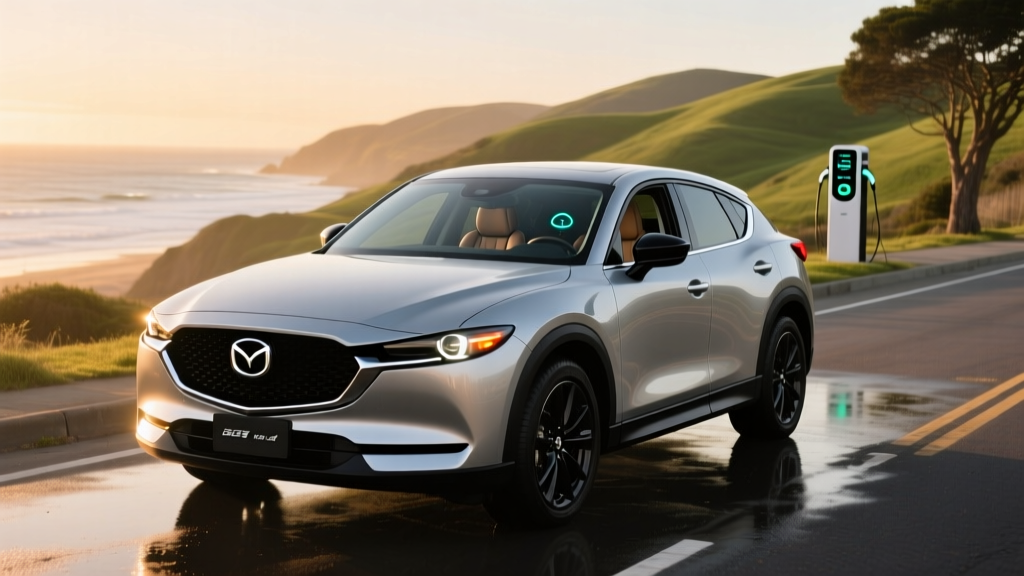
The 2025 Mazda CX-50 Hybrid marks a significant pivot for Mazda's rugged-adjacent compact crossover. Borrowing Toyota's proven hybrid synergy system and pairing it with Mazda's own 2.5-liter engine tuning, the CX-50 Hybrid delivers a substantial efficiency gain over its turbocharged and naturally aspirated siblings without sacrificing the brand's trademark driving dynamics. For buyers who want better fuel economy but aren't ready to plug in, this conventional hybrid (HEV) makes a compelling case.
Hybrid vs. Plug-In: What the CX-50 Hybrid Actually Is
Before diving into the numbers, it's critical to understand what the CX-50 Hybrid is — and what it isn't. This is a conventional hybrid (HEV), not a plug-in hybrid (PHEV). That means:
- No plug, no charging cable required. The small battery recharges through regenerative braking and the gasoline engine.
- No electric-only driving range to speak of — the electric motor assists the engine but cannot propel the car alone for meaningful distances.
- No federal §30D tax credit eligibility (that credit applies only to plug-in EVs and PHEVs meeting specific battery-sourcing and MSRP requirements per IRS rules).
HEV vs. PHEV vs. BEV — Quick Distinction
| Feature | HEV (CX-50 Hybrid) | PHEV | BEV (Full EV) |
|---|---|---|---|
| Plugs in? | No | Yes | Yes |
| Electric-only range | ~0 mi | 20-50 mi typical | 200-400+ mi |
| Federal tax credit | None | Up to $7,500* | Up to $7,500* |
| Gas engine? | Yes (primary) | Yes (backup) | No |
| Home charger needed? | No | Recommended | Essential |
*§30D credit subject to MSRP caps, income limits, and battery-sourcing rules. Consult a tax professional.
Fuel Economy: EPA Ratings and Real-World MPG
The headline number for the 2025 CX-50 Hybrid is its EPA-estimated fuel economy, a dramatic improvement over the gas-only CX-50 models. Here's how it breaks down, per fueleconomy.gov:
| Metric | CX-50 Hybrid (AWD) | CX-50 2.5 S (AWD) | CX-50 Turbo (AWD) |
|---|---|---|---|
| City MPG | 39 | 24 | 23 |
| Highway MPG | 37 | 30 | 29 |
| Combined MPG | 38 | 27 | 25 |
| Annual fuel cost* | ~$1,750 | ~$2,450 | ~$2,650 |
*Based on 15,000 miles/year at $3.50/gallon regular unleaded. Actual costs vary by region and driving habits.
Real-World MPG: What to Actually Expect
Toyota-derived hybrid systems tend to meet or exceed their EPA city estimates in stop-and-go traffic, where regenerative braking shines. Highway driving is where hybrids lose their edge somewhat — at sustained 75+ mph speeds, the gasoline engine does most of the work.
Based on owner reports and independent testing of the Toyota RAV4 Hybrid (which shares this powertrain architecture), expect:
- City driving: 37-42 MPG (often beating the 39 EPA estimate in moderate traffic)
- Highway cruising (70-75 mph): 33-36 MPG
- Cold weather (below 30°F): 32-35 MPG combined (engine runs more to heat the cabin and warm the battery)
- Overall mixed driving: 36-39 MPG combined
The CX-50's boxier, less aerodynamic profile compared to the RAV4 Hybrid may cost it 1-2 MPG on the highway. If your commute is predominantly urban, this hybrid will reward you. If it's 90% interstate, the advantage over the gas model narrows but remains significant.
Powertrain: Toyota Hybrid Meets Mazda Engineering
| Specification | 2025 Mazda CX-50 Hybrid |
|---|---|
| Engine | 2.5L inline-4 (naturally aspirated, Atkinson cycle) |
| Electric motor | Permanent-magnet synchronous (front + rear) |
| Combined system output | 219 hp |
| Drivetrain | AWD (electronic on-demand rear motor) |
| Transmission | eCVT (electronically controlled) |
| Hybrid battery | ~1.6 kWh nickel-metal hydride (NiMH), sealed |
| 0-60 mph (est.) | ~7.3 seconds |
| Towing capacity | 1,500 lbs (reduced from 3,500 lbs on turbo) |
| Fuel type | Regular unleaded (87 octane) |
The 219-horsepower combined output sits between the base CX-50 2.5 S (187 hp) and the turbo model (up to 256 hp on premium). Acceleration is brisk enough for highway merging and passing, though the eCVT drone under hard acceleration is a familiar Toyota hybrid trait that Mazda hasn't fully masked.
The AWD system uses a separate rear electric motor that engages on demand — there's no mechanical driveshaft connecting front and rear axles. This is the same setup Toyota uses in the RAV4 Hybrid and has proven reliable across millions of vehicles.
Pricing, Trims, and Tax Credit Status
The 2025 CX-50 Hybrid is offered across multiple trims. Here's the MSRP breakdown (destination included):
- Preferred Hybrid: $35,395
- Premium Hybrid: $38,595
- Premium Plus Hybrid: $41,595
For comparison, the gas-only CX-50 2.5 S Preferred AWD starts around $33,300. The hybrid premium of roughly $2,000 pays for itself in fuel savings within 2-3 years for most drivers (assuming 15,000 miles/year and a 12 MPG combined improvement).
Federal Tax Credit: Not Eligible
Because the CX-50 Hybrid is a conventional HEV — not a plug-in — it does not qualify for the federal §30D clean vehicle credit (up to $7,500 for qualifying PHEVs and BEVs). There is currently no federal tax incentive for conventional hybrids.
Some states offer their own rebates for hybrids, but these are increasingly rare as incentive programs shift toward plug-in vehicles. Check your state's energy or environmental agency website for current programs. The hybrid's value proposition rests on fuel savings, not tax breaks.
Battery Warranty, Reliability, and Replacement Cost
Hybrid Battery Warranty & Longevity
Mazda hybrid battery warranty: 8 years / 100,000 miles (10 years / 150,000 miles in California-emissions states including CA, NY, MA, NJ, CT, RI, VT, ME, WA, OR, CO, MD, DE, NM, NV, IL)
Battery chemistry: Nickel-metal hydride (NiMH) — a mature, well-understood technology
Expected lifespan: Based on Toyota's track record with the same architecture, 150,000-200,000+ miles before significant degradation is common
Replacement cost (out of warranty): Estimated $2,500-$4,000 for the hybrid battery pack, based on current RAV4 Hybrid battery pricing
The NiMH battery in the CX-50 Hybrid is small (~1.6 kWh) compared to PHEV or BEV packs, which means lower replacement cost if it ever fails outside warranty. More importantly, this Toyota-sourced hybrid system has been in production since 1997 (Prius) and is arguably the most proven electrified powertrain on the road. The hybrid battery rarely fails catastrophically — individual cells can sometimes be replaced for far less than a full pack swap.
The conventional 12V auxiliary battery, which powers accessories and starts the computer systems, will still need replacement every 4-6 years like any other vehicle. Mazda's hybrid system does not eliminate this maintenance item.
Who Should Buy the CX-50 Hybrid — And Who Shouldn't
Pros
- 38 MPG combined — 11 MPG better than the gas CX-50
- AWD standard with no fuel-economy penalty vs. FWD
- No lifestyle change required (no plug, no range planning)
- Toyota-derived hybrid reliability track record
- Strong city MPG that often beats EPA estimate
- Regular 87-octane fuel
Cons
- No federal tax credit (unlike PHEVs/BEVs)
- Towing drops to 1,500 lbs (from 3,500 on turbo)
- eCVT drone under hard acceleration
- No electric-only driving mode
- ~$2,000 premium over equivalent gas trim
- Boxier shape limits highway efficiency gains
The Decision Framework
Choose the CX-50 Hybrid if: You want significantly better fuel economy without changing your fueling habits, you do a mix of city and highway driving, you don't have reliable home charging access for a PHEV/BEV, and you want proven long-term reliability.
Choose a PHEV (like the Toyota RAV4 Prime) if: You have home Level 2 charging, your daily commute is under 40 miles round-trip, and you want to drive mostly on electricity while keeping a gas engine for road trips. PHEVs may also qualify for the $7,500 federal credit.
Choose a full BEV (like the Tesla Model Y or Hyundai Ioniq 5) if: You have reliable home charging, you want zero tailpipe emissions, you want the lowest per-mile fuel cost, and you're comfortable with 250-320 miles of range and DC fast charging for road trips.
Stick with the gas CX-50 Turbo if: You need the 3,500-lb towing capacity, you prioritize acceleration over efficiency, or you drive very few miles per year and the hybrid premium won't pay back.
Real-World Ownership Costs: 5-Year Outlook
| 5-Year Cost Factor | CX-50 Hybrid | CX-50 2.5 S AWD | CX-50 Turbo AWD |
|---|---|---|---|
| Fuel (75,000 mi total) | $8,750 | $12,250 | $13,250 |
| Maintenance (est.) | $3,200 | $3,500 | $3,800 |
| Insurance (est. avg) | $7,800 | $7,500 | $8,100 |
| Total (excl. purchase price) | $19,750 | $23,250 | $25,150 |
Over five years and 75,000 miles, the CX-50 Hybrid saves roughly $3,500-$5,400 in fuel and maintenance compared to its gas-only siblings. Factor in the ~$2,000 hybrid purchase premium, and net savings land around $1,500-$3,400 over the ownership period — with the gap widening the longer you keep the vehicle.
Frequently Asked Questions
How many MPG does the 2025 Mazda CX-50 Hybrid get?
The EPA rates the CX-50 Hybrid at 39 city / 37 highway / 38 combined MPG. In real-world mixed driving, expect 36-39 MPG combined, with city driving often hitting 40+ and sustained highway cruising dropping to 33-36 MPG.
Can the CX-50 Hybrid drive on electric power alone?
Not meaningfully. As a conventional HEV, the CX-50 Hybrid can creep at very low speeds on electric power for brief moments, but the gasoline engine is always the primary propulsion source. There is no EV mode button and no plug. If you want electric-only commuting, you need a PHEV or BEV.
Is the CX-50 Hybrid reliable?
The hybrid powertrain is sourced from Toyota's Hybrid Synergy Drive architecture — the same system that has powered millions of Prius, Camry Hybrid, and RAV4 Hybrid vehicles since 1997. It is widely considered one of the most reliable powertrains in the automotive industry. Mazda's own build quality and interior materials add to the ownership experience. Long-term reliability data specific to the CX-50 Hybrid is still accumulating, but the underlying hardware is proven.
How much does it cost to replace the hybrid battery?
Based on comparable Toyota hybrid battery pricing, expect $2,500-$4,000 for a full hybrid battery replacement if needed outside the 8-year/100,000-mile warranty (10 years/150,000 miles in CARB states). In practice, Toyota-derived NiMH hybrid batteries commonly last 150,000-200,000+ miles. Individual cell replacement may be possible for less.
Does the CX-50 Hybrid qualify for any tax credit?
No. The federal §30D clean vehicle credit applies only to plug-in electric vehicles (BEVs and PHEVs) that meet battery-sourcing, MSRP, and buyer-income requirements. Conventional hybrids like the CX-50 Hybrid do not qualify for any current federal tax incentive. Some states may offer small rebates — check your local programs.
How does towing capacity compare to the gas CX-50?
The CX-50 Hybrid is rated for 1,500 lbs of towing — significantly less than the 3,500-lb rating on the CX-50 Turbo. If you regularly tow a small trailer, jet ski, or camper, the turbo model is the better choice. The hybrid's reduced towing capacity is a trade-off for its efficiency gains.
Is the CX-50 Hybrid the same as the Toyota RAV4 Hybrid?
They share the same fundamental hybrid powertrain architecture (2.5L Atkinson-cycle engine, eCVT, electric AWD with rear motor), but Mazda tunes the engine, suspension, steering, and interior differently. The CX-50 Hybrid has a unique body, chassis tuning, and Mazda's infotainment system. Think of it as the same mechanical foundation with a different personality.