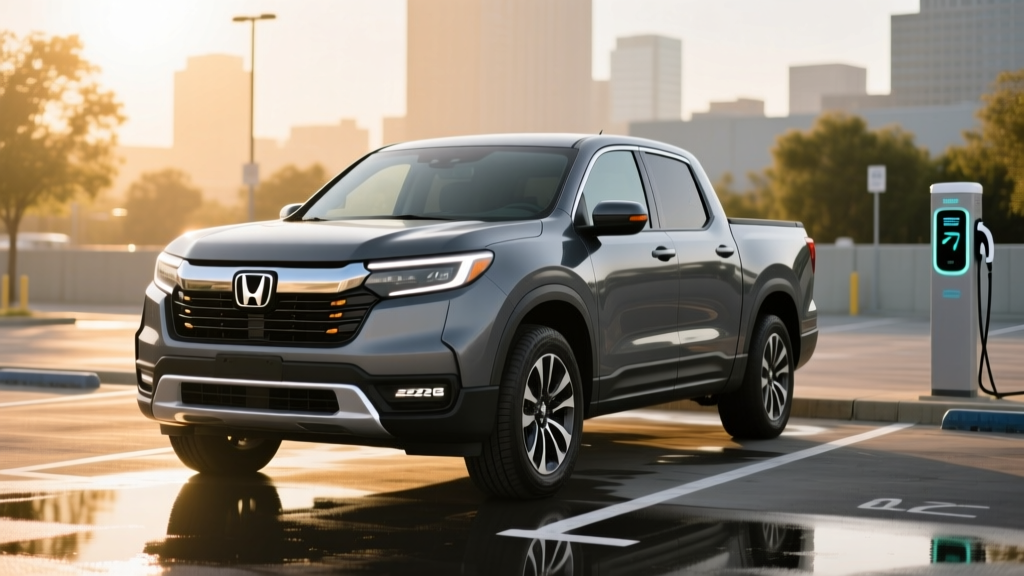
Honda's midsize pickup has long been the sensible alternative in a segment dominated by body-on-frame brutes. The Ridgeline trades maximum towing for car-like ride quality, a clever in-bed trunk, and standard all-wheel drive. Now, with a hybrid powertrain entering the lineup, Honda is addressing the Ridgeline's most common criticism: mediocre fuel economy for a truck that isn't particularly truck-like in capability.
The Ridgeline hybrid pairs Honda's well-proven two-motor hybrid system with its 3.5-liter V6, delivering meaningful MPG gains without sacrificing the unibody truck's ride, utility, or cabin space. But is the hybrid worth the price premium over the gas model, and how does it stack up against the hybridized Toyota Tacoma or a full-electric alternative like the Ford Maverick Hybrid or Chevrolet Silverado EV? This guide breaks down every number that matters.
Honda Ridgeline Hybrid MPG: EPA Estimates and Real-World Economy
Fuel economy is the primary reason to choose the hybrid over the conventional gas Ridgeline, and the numbers make a compelling case. Here is the EPA-rated breakdown for the 2026 Ridgeline Hybrid compared to the standard gas model:
| Powertrain | City MPG | Highway MPG | Combined MPG |
|---|---|---|---|
| Ridgeline Hybrid (AWD) | 24 | 27 | 25 |
| Ridgeline Gas (AWD, 3.5L V6) | 18 | 24 | 21 |
Source: fueleconomy.gov — EPA estimates. Your mileage will vary.
The 4 MPG combined improvement is significant — roughly a 19% gain in overall efficiency. But the real-world story is more nuanced:
- City driving favors the hybrid heavily. Regenerative braking and electric-only low-speed operation mean you'll likely see 25-27 MPG in stop-and-go commuting, sometimes exceeding the EPA city estimate by 1-2 MPG.
- Highway cruising narrows the gap. At sustained 70-80 mph speeds, the gas engine does most of the work. Expect 25-26 MPG highway, close to the sticker.
- Cold weather penalty is moderate. Below 40°F, the hybrid system must run the engine more frequently for cabin heat and battery conditioning. Expect a 2-3 MPG drop in winter, bringing combined to roughly 22-23 MPG.
- Towing erases the advantage. If you're pulling the Ridgeline's 5,000-lb max trailer, expect 14-16 MPG regardless of powertrain — the hybrid system cannot compensate for heavy aerodynamic and rolling loads.
Conventional Hybrid vs. Plug-In: What the Ridgeline Offers
The Ridgeline uses a conventional hybrid (HEV) architecture — not a plug-in hybrid (PHEV). This is a critical distinction that affects how you use the truck every day.
HEV vs. PHEV: The Key Difference
Conventional Hybrid (HEV): Charges its small battery through regenerative braking and the gas engine. You never plug it in. The electric motor assists the engine and enables brief electric-only driving at low speeds. Battery: typically 1.0-1.5 kWh.
Plug-In Hybrid (PHEV): Has a larger battery (typically 12-20 kWh) that you charge from a wall outlet or charger. Offers 20-40 miles of pure electric driving before the gas engine kicks in. Requires access to charging to realize full efficiency benefits.
Honda chose the HEV route for the Ridgeline, which makes practical sense. Midsize pickup buyers are less likely to have reliable home charging access than sedan or crossover buyers, and a PHEV system would add cost, weight, and complexity while eating into the Ridgeline's packaging — particularly the in-bed trunk and rear under-floor storage.
| Factor | Ridgeline Hybrid (HEV) | Hypothetical PHEV Pickup |
|---|---|---|
| Plug in required? | No — fuel and go | Yes, for full benefit |
| Electric-only range | ~1 mile at low speed | 20-40 miles (typical) |
| Battery size | ~1.3 kWh | 15-20 kWh |
| Price premium over gas | ~$2,500-$3,500 | ~$5,000-$8,000 |
| Home charging needed | No | Yes (Level 2 ideal) |
| Federal tax credit | Not eligible | Up to $7,500 (if eligible) |
Ridgeline Hybrid Powertrain: Engine, Motor, and Horsepower
Honda's hybrid system in the Ridgeline uses a series-parallel architecture — the same two-motor design found in the Accord Hybrid and CR-V Hybrid, but scaled for truck duty.
| Specification | Detail |
|---|---|
| Engine | 3.5L V6, Atkinson-cycle |
| Engine horsepower | 280 hp @ 6,000 rpm |
| Engine torque | 262 lb-ft @ 4,700 rpm |
| Electric motor (front) | 181 hp / 232 lb-ft |
| Combined system output | ~300 hp |
| Hybrid battery | ~1.3 kWh lithium-ion |
| Transmission | e-CVT (direct-drive, no traditional gears) |
| Drivetrain | AWD with torque-vectoring rear axle assist |
| Max towing capacity | 5,000 lbs |
| Max payload | ~1,500 lbs |
The combined ~300 hp represents a meaningful bump over the gas model's 280 hp, and more importantly, the electric motor delivers instant torque from 0 rpm. This translates to noticeably quicker off-the-line acceleration in city driving and smoother highway merging. Honda quotes a 0-60 mph time of approximately 6.5 seconds for the hybrid — roughly 0.5 seconds quicker than the gas-only Ridgeline.
The e-CVT operates differently from a belt-driven CVT. Honda's system uses clutch packs to manage power flow between the engine, motor, and wheels, avoiding the "rubber-band" drone common in other CVTs. Under heavy acceleration, the engine revs freely while the motor provides supplemental thrust. At steady cruise, the engine connects directly to the wheels through a lock-up clutch for maximum efficiency.
Pricing, Trims, and Tax Credit Eligibility
The Ridgeline Hybrid is available across multiple trim levels, with the hybrid powertrain offered as a package or standard depending on trim.
| Trim | Base MSRP | Hybrid Premium | Hybrid MSRP |
|---|---|---|---|
| Sport Hybrid | $42,250 | +$2,500 | $44,750 |
| RTL Hybrid | $44,550 | +$2,500 | $47,050 |
| RTL-E Hybrid | $47,300 | +$2,500 | $49,800 |
| Black Edition Hybrid | $49,150 | Included | $49,150 |
Pricing reflects manufacturer suggested retail price before destination charges (~$1,395). Actual dealer pricing may vary.
Federal Tax Credit: Not Eligible
Because the Ridgeline Hybrid is a conventional HEV (not a PHEV or BEV), it does not qualify for the federal §30D Clean Vehicle Credit of up to $7,500. That credit is reserved for plug-in electric vehicles that meet battery-sourcing, MSRP cap ($80,000 for trucks), and buyer income limits.
However, some states offer rebates or tax incentives for conventional hybrids. Check your state's energy office or the Alternative Fuels Data Center for current state-level programs. These vary widely and change frequently.
The ~$2,500 hybrid premium pays for itself in fuel savings over roughly 3-4 years for a driver covering 15,000 miles annually at $3.50/gallon. The math:
- Gas Ridgeline: 15,000 mi ÷ 21 MPG = 714 gallons × $3.50 = $2,499/year
- Hybrid Ridgeline: 15,000 mi ÷ 25 MPG = 600 gallons × $3.50 = $2,100/year
- Annual savings: ~$399 — breakeven at roughly 6.3 years at current fuel prices, or faster if gas prices rise
Battery Warranty, Reliability, and Replacement Cost
Hybrid battery longevity is the top concern for first-time hybrid buyers. Honda's track record with its two-motor system is strong — the same architecture has been in the Accord Hybrid since 2014 and the CR-V Hybrid since 2020 with relatively few widespread battery failures.
Battery and Powertrain Warranty Coverage
- Hybrid battery: 8 years / 100,000 miles (10 years / 150,000 miles in CARB states including CA, CT, ME, MA, NJ, NY, OR, RI, VT, WA)
- Hybrid system components: 8 years / 100,000 miles
- Powertrain (engine + transmission): 5 years / 60,000 miles
- Limited vehicle warranty: 3 years / 36,000 miles
If the hybrid battery does require replacement outside of warranty, expect a cost between $3,000 and $5,000 including labor for a new OEM unit. Third-party remanufactured batteries may be available for $2,000-$3,500 once the Ridgeline Hybrid ages into the aftermarket parts cycle.
For context, the ~1.3 kWh hybrid battery in the Ridgeline is far smaller and less expensive to replace than a full EV battery pack (typically 60-100 kWh at $10,000-$20,000+). The small capacity also means less thermal stress and longer cycle life. Based on data from Honda's existing hybrid fleet, most hybrid batteries retain over 90% capacity at the 100,000-mile mark.
Ridgeline Hybrid vs. the Competition
The midsize truck segment now has several hybrid and electrified options. Here is how the Ridgeline Hybrid compares on the numbers that matter:
| Model | Type | Combined MPG | Max Tow | Starting MSRP |
|---|---|---|---|---|
| Honda Ridgeline Hybrid | HEV | 25 | 5,000 lbs | ~$44,750 |
| Toyota Tacoma i-FORCE MAX Hybrid | HEV | 24 | 6,000 lbs | ~$46,000 |
| Ford Maverick Hybrid | HEV | 42 | 2,000 lbs | ~$29,000 |
| Hyundai Santa Cruz (gas) | Gas only | 23 | 5,000 lbs | ~$29,500 |
| Chevrolet Colorado (gas) | Gas only | 22 | 7,700 lbs | ~$32,000 |
Sources: fueleconomy.gov, manufacturer press sites. All figures EPA estimates for AWD configurations where available.
The Maverick Hybrid dominates on fuel economy and price but is a smaller truck with significantly less towing capacity and cargo space. The Tacoma i-FORCE MAX matches the Ridgeline's hybrid efficiency while offering more towing and off-road capability, but rides more harshly and costs more at comparable trims. The Ridgeline Hybrid occupies a specific niche: the most comfortable-riding midsize truck with reasonable efficiency, best-in-class interior space, and unique bed features like the lockable in-bed trunk and dual-action tailgate.
Who Should Choose the Ridgeline Hybrid?
Decision Framework
Choose the Ridgeline Hybrid if:
- You want a midsize truck primarily for daily driving, light hauling, and weekend gear transport
- Ride comfort and cabin refinement matter more than maximum towing or off-road prowess
- You commute in stop-and-go traffic where hybrid efficiency shines
- You don't have access to home charging (making a PHEV or EV impractical)
- You value the Ridgeline's unique bed features (in-bed trunk, dual-action tailgate)
Look elsewhere if:
- You tow over 5,000 lbs regularly (consider Colorado, Tacoma, or a full-size truck)
- You need serious off-road capability (Tacoma TRD Pro, Colorado ZR2)
- You want maximum fuel savings and don't need truck capability (Maverick Hybrid gets 42 MPG combined)
- You have home charging and want electric-only commuting (consider a PHEV SUV or full EV truck like the Rivian R1T or Silverado EV)
The Ridgeline Hybrid is not trying to be the most capable truck in its class. It is trying to be the most livable one — and for the majority of midsize truck buyers who use their trucks as daily drivers first and haulers second, the hybrid powertrain makes an already practical vehicle meaningfully cheaper to fuel without asking anything of the owner. No plugs, no behavior changes, no range anxiety. Just fill up less often.
Frequently Asked Questions
How many MPG does the Ridgeline Hybrid get in real-world driving?
The EPA rates it at 24 city / 27 highway / 25 combined. In real-world city commuting, owners of Honda's similar hybrid systems typically see 25-27 MPG thanks to regenerative braking. Highway driving at 75+ mph yields closer to 24-25 MPG. Cold weather reduces combined economy by 2-3 MPG.
Do I need to plug in the Ridgeline Hybrid?
No. The Ridgeline Hybrid is a conventional hybrid (HEV). It charges its small battery through regenerative braking and the gas engine. You simply fill it with gas like any other vehicle. There is no plug, no charging cable, and no electric-only commuting range to manage.
How long will the hybrid battery last?
Honda covers the hybrid battery for 8 years/100,000 miles (10 years/150,000 miles in CARB states). Based on Honda's track record with the Accord and CR-V Hybrid, most batteries retain over 90% capacity at 100,000 miles and last the life of the vehicle. Replacement, if needed, runs $3,000-$5,000.
Does the Ridgeline Hybrid qualify for a tax credit?
No. The federal §30D Clean Vehicle Credit applies only to plug-in electric vehicles (PHEVs and BEVs). Conventional hybrids like the Ridgeline Hybrid are not eligible. Check your state's incentive programs at the Alternative Fuels Data Center — some states offer hybrid rebates.
Can the Ridgeline Hybrid tow as much as the gas model?
Yes. The hybrid is rated at the same 5,000-lb maximum towing capacity as the gas Ridgeline. However, fuel economy drops significantly while towing (14-16 MPG) regardless of powertrain — the hybrid advantage is minimal under heavy load.
Ridgeline Hybrid vs. full EV truck — which is better?
It depends on your use case. A full EV truck (Rivian R1T, Silverado EV) offers dramatically lower fueling costs, instant torque, and zero tailpipe emissions, but requires reliable charging access, costs significantly more upfront ($70,000+), and may lose 20-30% range in cold weather or while towing. The Ridgeline Hybrid costs less, needs no charging infrastructure, and tows without range anxiety — but still burns gas and offers only modest efficiency gains. For buyers without home charging or who tow frequently, the hybrid is the more practical choice today.