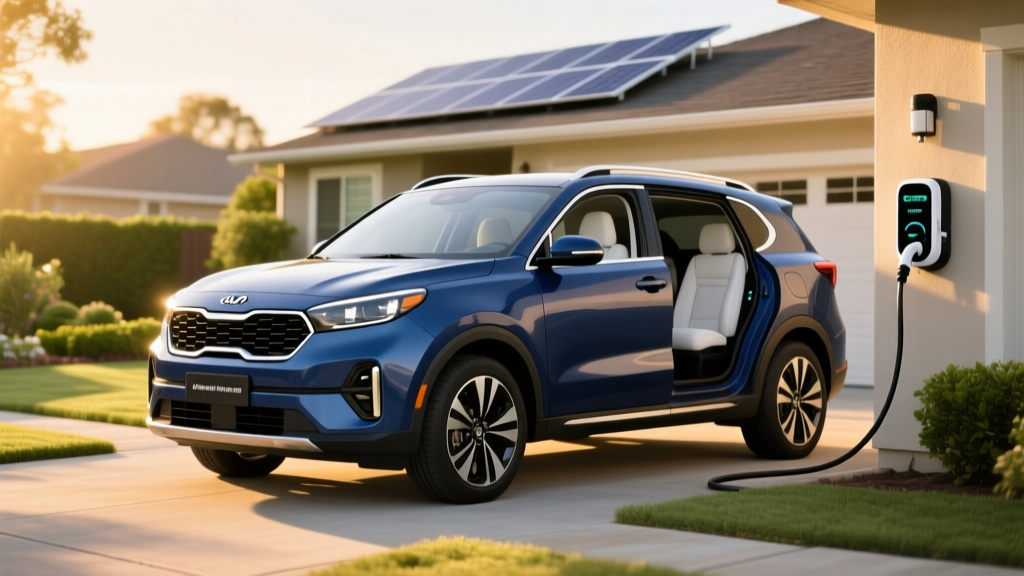
The 2025 Kia Sportage Plug-In Hybrid occupies a specific niche: compact-crossover buyers who want daily electric commuting without surrendering the gas-engine safety net for road trips. With 34 miles of EPA-rated electric-only range, 261 combined horsepower, and a starting MSRP around $39,790, it undercuts rivals like the Toyota RAV4 Prime on price while delivering competitive efficiency. But does it qualify for a federal tax credit, and what does real-world ownership actually cost? Here's the data.
HEV vs PHEV: What the Sportage Lineup Actually Offers
Kia sells the 2025 Sportage in three powertrain flavors, and confusing them at the dealership is easy. The distinction matters for your wallet and your daily routine.
| Attribute | Sportage HEV (Hybrid) | Sportage PHEV (Plug-In Hybrid) |
|---|---|---|
| Needs to be plugged in? | No — charges via regenerative braking and engine | Yes — plug in to unlock electric-only driving |
| Battery capacity | 1.49 kWh (small buffer) | 13.8 kWh usable (NMC lithium-ion) |
| Electric-only range | ~1–2 miles at low speed | 34 miles (EPA) |
| EPA combined fuel economy | 38 MPG combined | 84 MPGe (electric+gas) / 35 MPG (gas-only) |
| Combined horsepower | 226 hp | 261 hp |
| Starting MSRP | ~$28,590 | ~$39,790 |
| Federal tax credit (§30D) | No | Up to $7,500 (eligibility varies) |
The conventional HEV is a self-charging hybrid — you never plug it in, and it behaves like a gas car that gets excellent city mileage. The PHEV is fundamentally different: plug it in overnight, drive 30+ miles on electricity alone, and the gas engine only fires when you exceed the battery's range or demand hard acceleration. If you never plug in the PHEV, you're hauling 400+ pounds of dead battery weight for nothing — you'd be better off with the cheaper HEV.
EPA Range, MPGe, and Real-World MPG
The EPA rates the 2025 Sportage PHEV at 34 miles of electric-only range and 84 MPGe when operating in blended electric-gas mode. Once the battery depletes, it functions as a conventional hybrid rated at 35 MPG combined.
| Mode | City | Highway | Combined |
|---|---|---|---|
| Electric + Gas (blended) | — | — | 84 MPGe |
| Gas-only (battery depleted) | 36 MPG | 35 MPG | 35 MPG |
| Electric-only range | 34 miles (EPA estimated) | ||
| Total range (full tank + full charge) | ~430 miles | ||
Once the battery depletes, the 35 MPG combined gas-only figure is respectable for a 4,000-pound AWD crossover. In real-world city driving with frequent stops, PHEVs often exceed their gas-only EPA ratings because regenerative braking recovers energy that friction brakes would waste. Highway drivers should expect closer to 32–33 MPG once the battery is empty, especially at sustained 75+ mph speeds.
Powertrain, Battery, and Charging Specs
The Sportage PHEV pairs a 1.6-liter turbocharged four-cylinder engine with a 72 kW (97 hp) permanent-magnet electric motor integrated into a six-speed automatic transmission. Combined output is 261 horsepower and 258 lb-ft of torque, routed through standard all-wheel drive.
| Specification | Value |
|---|---|
| Engine | 1.6L turbocharged I-4 |
| Electric motor | 72 kW (97 hp) |
| Combined output | 261 hp / 258 lb-ft torque |
| Transmission | 6-speed automatic (no CVT) |
| Drivetrain | AWD (standard) |
| Battery capacity | 13.8 kWh usable (NMC chemistry) |
| Electric-only range | 34 miles (EPA) |
| Onboard charger | 7.2 kW (Level 2 AC) |
| DC fast charging | Not available |
| Level 1 charge time (120V, 12A) | ~11 hours (0–100%) |
| Level 2 charge time (240V, 32A) | ~1 hour 45 minutes (0–100%) |
| Charge port | J1772 (AC only) |
| 0–60 mph | ~7.4 seconds (manufacturer estimate) |
| Cargo volume (rear seats up) | 34.5 cu ft |
| Towing capacity | 2,000 lbs |
The 13.8 kWh battery uses NMC (nickel-manganese-cobalt) chemistry, which offers higher energy density than LFP but is more sensitive to sustained 100% state-of-charge storage. Kia's battery management system includes a top and bottom buffer, so you'll never actually use every kilowatt-hour — this protects long-term health.
Charging is AC-only via a J1772 port. The 7.2 kW onboard charger means a full Level 2 charge takes under two hours, which is practical for midday top-ups at workplace chargers. There is no DC fast-charging capability — a limitation shared with most PHEVs in this class. For a 13.8 kWh pack, the lack of DC charging is not a serious gap; you'll primarily charge at home or at work, and the battery refills quickly enough on Level 2.
Pricing, Trims, and Federal Tax Credit Eligibility
The 2025 Sportage PHEV comes in two trims:
- X-Line: ~$39,790 MSRP (before destination)
- X-Line Prestige: ~$43,390 MSRP (before destination)
Destination charges add approximately $1,375. Both trims include AWD, heated front seats, an 8-inch or available 12.3-inch infotainment display, wireless Apple CarPlay/Android Auto, and Kia's full suite of ADAS features (forward collision avoidance, lane keeping, adaptive cruise).
The Sportage PHEV may qualify for up to $7,500 under the IRS Clean Vehicle Credit, but eligibility depends on multiple factors that change frequently:
- MSRP cap: SUVs/vans/pickups must be under $80,000 MSRP — the Sportage PHEV clears this easily.
- Buyer income cap: Modified AGI must not exceed $150,000 (single), $225,000 (head of household), or $300,000 (joint).
- Battery sourcing: A percentage of critical minerals and battery components must be sourced from the U.S. or FTA partners — thresholds tighten annually. Check the latest IRS guidance and the DOE/IRS qualifying vehicle list before purchasing.
- Point-of-sale transfer: As of 2024+, you can transfer the credit to the dealer for an immediate price reduction at purchase rather than waiting to claim it on your tax return.
- Final assembly: Must occur in North America — the Sportage PHEV is assembled in South Korea, which disqualifies it from the §30D new-vehicle credit under current rules.
Bottom line: Because the 2025 Sportage PHEV is built in South Korea, it does not qualify for the §30D new clean vehicle credit. Some state-level incentives may still apply — check your state's energy office or AFDC state incentive database. Always consult a tax professional for your specific situation.
This South Korea assembly issue is a critical buying consideration. The Toyota RAV4 Prime (assembled in Japan) faces the same disqualification, while the Ford Escape PHEV (assembled in the U.S.) may qualify. If the federal credit is a dealbreaker, cross-shop carefully.
Reliability, Battery Warranty, and Replacement Cost
Kia backs the Sportage PHEV's high-voltage battery with a 10-year/100,000-mile warranty (whichever comes first), which covers defects and capacity loss below a specified threshold — typically around 70% of original capacity. The conventional hybrid components and powertrain carry a separate 10-year/100,000-mile warranty as well. The base vehicle warranty is 5 years/60,000 miles bumper-to-bumper.
- High-voltage PHEV battery: 10 years / 100,000 miles
- Capacity retention threshold: ~70% of original (check your specific warranty booklet)
- Hybrid system components: 10 years / 100,000 miles
- Standard bumper-to-bumper: 5 years / 60,000 miles
- Estimated out-of-warranty battery replacement: $4,000–$6,500 (parts + labor, based on comparable Hyundai-Kia PHEV packs)
On reliability, the 1.6T engine and six-speed automatic are proven across the Hyundai-Kia lineup (Tucson PHEV, Sorento PHEV). The PHEV-specific components — the larger battery, electric motor, and power electronics — add complexity, but Hyundai-Kia's PHEV system has been in production since the Niro PHEV in 2018 with no widespread failure patterns. NHTSA and IIHS crash-test ratings for the Sportage are strong; check IIHS and NHTSA for the latest scores.
Out-of-warranty battery replacement is the fear every hybrid buyer carries. For a 13.8 kWh NMC pack, expect $4,000–$6,500 at a Kia dealer once the warranty expires. However, PHEV batteries experience shallower charge-discharge cycles than full EVs (you're only using ~10–12 kWh per cycle), which generally translates to slower degradation. Most PHEV batteries outlast the vehicle itself under normal use.
Sportage PHEV vs the Competition
The compact PHEV crossover segment is small but competitive. Here's how the Sportage stacks up against its two primary rivals:
| Spec | 2025 Kia Sportage PHEV | 2025 Toyota RAV4 Prime | 2025 Ford Escape PHEV |
|---|---|---|---|
| Electric range (EPA) | 34 miles | 42 miles | 37 miles |
| Combined HP | 261 hp | 302 hp | 210 hp |
| Gas-only MPG (combined) | 35 MPG | 38 MPG | 40 MPG |
| AWD | Standard | Standard | FWD only |
| Battery (kWh) | 13.8 | 18.1 | 14.4 |
| Level 2 charge time | ~1:45 | ~2:30 | ~2:00 |
| Starting MSRP | ~$39,790 | ~$44,590 | ~$39,500 |
| §30D credit eligible | No (Korea-built) | No (Japan-built) | Likely (US-built)* |
*Ford Escape PHEV credit eligibility depends on battery-sourcing rules in effect at time of purchase. Verify at fueleconomy.gov.
The RAV4 Prime wins on electric range and power but costs roughly $5,000 more and is notoriously hard to find at MSRP. The Escape PHEV is the efficiency leader in gas-only mode and may qualify for the federal credit, but it lacks AWD — a dealbreaker in snow-belt states. The Sportage PHEV hits a middle ground: adequate electric range, strong power, standard AWD, and competitive pricing.
- 34-mile electric range covers most commutes
- 261 hp with standard AWD — confident in all weather
- Under $40K starting MSRP (before incentives)
- 10-year/100K-mile battery and powertrain warranty
- Quick Level 2 charging (~1:45 for full pack)
- Spacious 34.5 cu ft cargo area
- No DC fast charging (AC-only via J1772)
- Built in South Korea — no §30D federal tax credit
- Gas-only MPG trails RAV4 Prime and Escape PHEV
- Winter electric range drops to ~22–26 miles
- Only two trims available (limited configuration)
Who Should Buy the Sportage PHEV — and Who Shouldn't
- Your round-trip commute is under 30 miles and you can charge at home overnight.
- You need AWD and take road trips where charging infrastructure is sparse.
- You want EV-like daily driving without committing to a full BEV's range and charging logistics.
- You value Kia's 10-year warranty coverage for long-term peace of mind.
- You have reliable home Level 2 charging and rarely drive more than 250 miles in a day.
- You want to eliminate oil changes, spark plugs, and transmission fluid entirely.
- You want access to the full §30D tax credit (several US-built EVs qualify).
- You can't charge at home or at work — a PHEV without plugging in is a waste of money.
- Your daily driving exceeds 50 miles, making the electric range mostly irrelevant.
- You want a lower purchase price (~$11,000 less than the PHEV).
Frequently Asked Questions
How many MPG does the 2025 Kia Sportage Plug-In Hybrid get?
The EPA rates it at 84 MPGe in blended electric-gas mode and 35 MPG combined (36 city / 35 highway) once the battery is depleted and it operates as a conventional hybrid. In real-world city driving with frequent stops, you may see 37–39 MPG in gas-only mode thanks to regenerative braking. Highway cruising at 75+ mph typically yields 32–33 MPG.
How far can the Sportage PHEV go on electric only?
The EPA rates it at 34 miles of electric-only range. Real-world results vary: expect 28–32 miles on the highway, up to 36+ miles in low-speed city driving, and as low as 22–26 miles in freezing winter weather when the battery is less efficient and cabin heating draws significant power.
Does the 2025 Sportage PHEV qualify for a federal tax credit?
Under current IRS §30D rules, the Sportage PHEV does not qualify for the federal clean vehicle credit because it is assembled in South Korea, not in North America. State-level incentives may still apply — check the AFDC state incentive database. Always verify with a tax professional before purchasing.
How long does it take to charge the Sportage PHEV?
On a 240V Level 2 charger at 7.2 kW, a full 0–100% charge takes approximately 1 hour and 45 minutes. On a standard 120V household outlet (Level 1 at ~1.4 kW), expect about 11 hours — sufficient for overnight charging if you start with a partially depleted battery. There is no DC fast-charging option.
Is the Sportage PHEV reliable, and what does a battery replacement cost?
The Hyundai-Kia PHEV powertrain has been in production across multiple models since 2018 with no widespread failure patterns. Kia covers the high-voltage battery for 10 years/100,000 miles. Out-of-warranty replacement is estimated at $4,000–$6,500, though most PHEV batteries last the life of the vehicle under normal use due to shallow charge cycles.
Should I get the Sportage PHEV or a full EV?
If you have home charging and your daily driving stays under 250 miles, a full EV like the Hyundai Ioniq 5 or Tesla Model Y eliminates maintenance complexity and may qualify for the $7,500 federal credit. The Sportage PHEV is the better choice if you frequently drive beyond EV range, lack reliable public charging on your routes, or need the security of a gas engine for long rural trips.