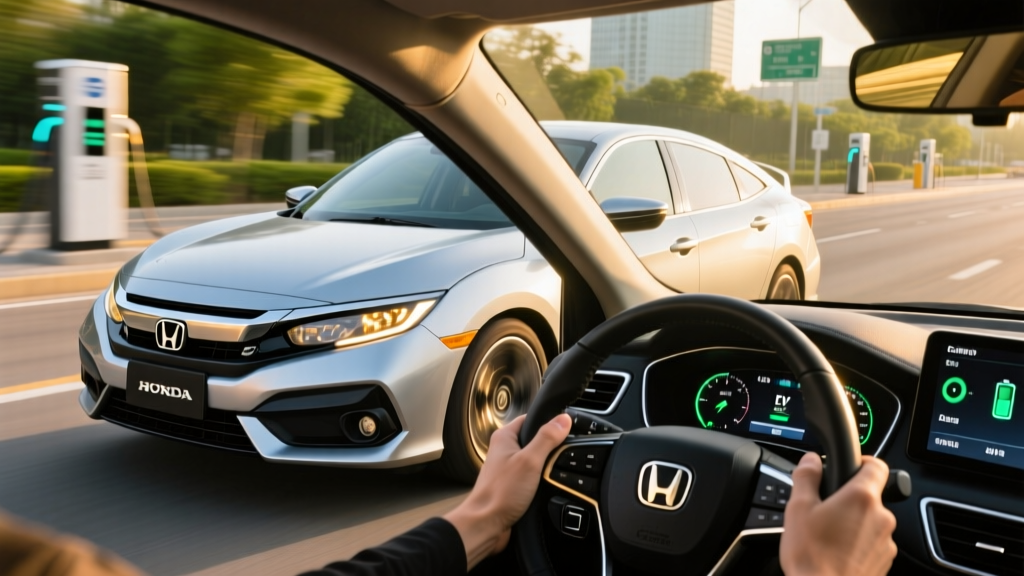
The 2025 Honda Civic Hybrid arrived with a promise: sport-sedan acceleration wrapped in Prius-rivaling efficiency. Honda's two-motor hybrid system pairs a 2.0-liter Atkinson-cycle engine with dual electric motors for a combined 200 horsepower and 232 lb-ft of torque — figures that translate to a 0-60 mph time of approximately 7.2 seconds in independent testing. That's quick enough to merge confidently onto any freeway and quick enough to make this the most engaging hybrid in the compact sedan segment.
But the Civic Hybrid isn't just about the stopwatch. It's about what happens between fill-ups. With an EPA-estimated 49 MPG combined, this conventional hybrid (HEV) requires no plug, no range anxiety, and no behavioral change from its gas-only counterpart. Below, we break down every number that matters — from the real-world MPG you'll actually see to the battery warranty that protects your investment for a decade.
2025 Civic Hybrid Powertrain: Where the 0-60 Time Comes From
Understanding the Civic Hybrid's acceleration requires understanding Honda's fourth-generation two-motor hybrid system. Unlike a traditional parallel hybrid that blends engine and motor through a complex transmission, Honda's system operates primarily as a series hybrid at low-to-moderate speeds: the gasoline engine acts as a generator, producing electricity that feeds the drive motor, which turns the wheels. At highway cruising speeds, a lock-up clutch connects the engine directly to the wheels for efficiency.
| Specification | Value |
|---|---|
| Engine | 2.0L DOHC Atkinson-cycle 4-cylinder |
| Engine Output | 146 hp @ 6,000 rpm / 134 lb-ft @ 4,500 rpm |
| Drive Motor Output | 184 hp / 232 lb-ft |
| Combined System Output | 200 hp / 232 lb-ft |
| 0-60 mph | ~7.2 seconds |
| Transmission | Direct-drive (no traditional CVT or gears) |
| Drivetrain | Front-wheel drive (AWD available on select trims) |
| Lithium-Ion Battery | ~1.0 kWh (HEV, not plug-in capable) |
The key to the 7.2-second 0-60 time is the electric motor's instant torque delivery. From a stoplight, the Civic Hybrid launches on electric torque alone — no turbo lag, no transmission hesitation, no waiting for the engine to climb into its power band. The 232 lb-ft of torque is available from near zero RPM, which is why this 200-hp hybrid feels punchier than its horsepower figure suggests and out-accelerates many turbocharged gas competitors in real-world city driving.
Fuel Economy: EPA Ratings vs. Real-World MPG
The EPA rates the 2025 Civic Hybrid (FWD Sport Touring and Sport trims) at 50 MPG city / 47 MPG highway / 49 MPG combined. The AWD variant drops slightly to 47 city / 44 highway / 46 combined. These are exceptional numbers for a 200-hp sedan, but the real-world story is even more nuanced.
| Drivetrain | City MPG | Highway MPG | Combined MPG |
|---|---|---|---|
| FWD (Sport / Sport Touring) | 50 | 47 | 49 |
| AWD (where available) | 47 | 44 | 46 |
Real-world expectations: Like most hybrids, the Civic Hybrid tends to exceed its EPA city rating in stop-and-go traffic, where regenerative braking recovers energy and the engine shuts off frequently. Owners regularly report 52-55 MPG in urban commuting. Highway efficiency is the opposite story — at sustained 75-80 mph speeds, the engine carries more of the load and aerodynamic drag increases, so expect 42-45 MPG on long interstate trips. In cold weather (below 40°F), the engine runs more frequently to maintain cabin heat and battery temperature, reducing city MPG by roughly 5-8 MPG until the system reaches operating temperature.
For context, the EPA's fueleconomy.gov listing confirms these figures, and the Civic Hybrid's combined rating places it among the most efficient non-plug-in vehicles sold in the United States, trailing only the Toyota Prius and Hyundai Elantra Hybrid in the compact segment.
HEV vs. PHEV vs. EV: Which Powertrain Fits Your Life?
The Civic Hybrid is a conventional hybrid (HEV), meaning it generates all its electricity internally through regenerative braking and the gasoline engine. There is no plug, no electric-only driving range to manage, and no charging infrastructure required. This is fundamentally different from a plug-in hybrid (PHEV) or a battery-electric vehicle (BEV).
| Feature | HEV (Civic Hybrid) | PHEV (e.g., Toyota Prius Prime) | BEV (e.g., Tesla Model 3) |
|---|---|---|---|
| Plug-in Charging | No | Yes | Yes |
| Electric-Only Range | ~1 mile (low speed) | 25-44 miles typical | 250-400+ miles |
| Fuel Source | Gasoline only | Gasoline + grid electricity | Grid electricity only |
| Home Charging Needed | No | Recommended (Level 2) | Essential (Level 2) |
| Federal Tax Credit (§30D) | Not eligible | Up to $7,500 (if qualified) | Up to $7,500 (if qualified) |
| Best For | No home charging, long trips | Short commutes + road trips | Home charging + daily driving |
Choose the Civic Hybrid (HEV) if: You don't have access to home or workplace charging, you drive long highway miles regularly, you want maximum simplicity with no plug-in routine, or you live in an apartment without charging infrastructure. The Civic Hybrid works exactly like a gas car — you just fuel up and drive — while delivering nearly 50 MPG.
Choose a PHEV if: You have a garage or driveway where you can install a Level 2 charger, your daily commute is under 30-40 miles (covering most trips on electricity), but you still want the freedom to take road trips without charging-station planning.
Choose a full BEV if: You have reliable home charging, your daily driving is predictable, you want zero tailpipe emissions and the lowest per-mile fuel cost, and you're comfortable planning DC fast-charging stops on longer road trips.
Pricing, Trims, and Tax Credit Eligibility
The 2025 Honda Civic Hybrid is offered in two primary trims, both well-equipped:
| Trim | MSRP (incl. destination) | Key Features |
|---|---|---|
| Sport Hybrid | ~$29,845 | 200 hp hybrid system, 7" touchscreen, wireless CarPlay/Android Auto, Honda Sensing suite |
| Sport Touring Hybrid | ~$32,845 | Leather seats, Bose 12-speaker audio, 9" touchscreen, wireless charging, heated front seats, navigation |
Federal tax credit status: The Civic Hybrid is a conventional HEV and does not qualify for the IRS §30D Clean Vehicle Credit, which is reserved for plug-in hybrids (PHEVs) and battery-electric vehicles (BEVs) with sufficient battery capacity. The §30D credit requires a minimum 7 kWh battery pack and external charging capability — neither of which applies to the Civic Hybrid's ~1.0 kWh self-charging battery.
However, some states and local utilities offer rebates or incentives for conventional hybrids. Check your state energy office or local utility provider for current programs. The IRS §30D guidelines clearly outline which vehicle types qualify for the federal credit.
Battery Warranty, Longevity, and Replacement Costs
Hybrid battery anxiety remains one of the top concerns for first-time hybrid buyers, but the data is overwhelmingly reassuring. Honda covers the Civic Hybrid's lithium-ion battery pack with a 8-year/100,000-mile warranty (extended to 10 years/150,000 miles in California Air Resources Board states, including CA, CO, CT, MA, MD, ME, NJ, NY, OR, RI, VT, and WA).
Honda Hybrid Battery Warranty Summary
- Standard coverage: 8 years / 100,000 miles (48 states)
- CARB-state coverage: 10 years / 150,000 miles
- Warranty threshold: Battery capacity dropping below ~70% of original
- Estimated out-of-warranty replacement: $2,000 - $4,000 (battery pack + labor)
- Typical hybrid battery lifespan: 150,000 - 200,000+ miles based on historical Honda data
Honda's hybrid systems have proven remarkably durable. The company's earlier IMA (Integrated Motor Assist) systems in the Insight and early CR-Z logged hundreds of thousands of miles with minimal battery degradation. The current two-motor system uses a smaller, less-stressed battery pack (roughly 1.0 kWh) that operates within a narrow state-of-charge window — typically between 40% and 80% — which dramatically reduces cell wear. The battery never fully charges or fully depletes during normal operation, which is the primary reason hybrid batteries outlast their warranty periods by wide margins.
Should a replacement be needed out of warranty, Honda's hybrid battery packs are smaller and less expensive than those in PHEVs or BEVs. Expect a dealer replacement to cost between $2,000 and $4,000, while refurbished or aftermarket options can reduce that to $1,000-$2,500. For context, a full BEV battery replacement can run $10,000-$20,000+.
Driving Dynamics: How the Hybrid System Feels on the Road
The 7.2-second 0-60 time only tells part of the story. What makes the Civic Hybrid feel quick is the immediacy of its electric-motor torque in everyday driving scenarios. Rolling into a gap in traffic, accelerating from a rolling stop, or climbing an on-ramp all benefit from the instant 232 lb-ft that doesn't require a downshift or a turbo spool-up.
Honda has also tuned the regenerative braking system with paddle-mounted selectors behind the steering wheel, allowing the driver to choose from four levels of regen intensity. At the highest setting, the Civic Hybrid approaches one-pedal driving capability in city traffic — lift off the accelerator and the car decelerates briskly, recapturing energy into the battery. It doesn't come to a complete stop without touching the brake pedal (unlike many BEVs), but it significantly reduces brake-pedal use in congestion.
The Sport Touring Hybrid trim adds a more aggressive throttle mapping in Sport mode, firmer steering effort, and a simulated engine note that rises with acceleration. It won't fool anyone into thinking it's a high-revving naturally aspirated engine, but it's a more convincing soundtrack than the monotonous drone associated with older CVT-equipped hybrids. The Civic Hybrid's chassis — shared with the well-regarded 11th-generation Civic platform — delivers composed handling, a comfortable ride, and a level of refinement that makes the hybrid the Civic to get, regardless of fuel prices.
Who Should Buy the 2025 Civic Hybrid (and Who Shouldn't)
Pros
- 0-60 in 7.2 sec — quickest in its hybrid class
- 49 MPG combined EPA, often exceeds in city driving
- No plug required — zero infrastructure dependency
- Honda Sensing ADAS suite standard on all trims
- Strong resale value and proven hybrid reliability
- Practical trunk space (no major battery intrusion)
- Competitive pricing under $33K fully loaded
Cons
- No federal tax credit (HEV, not PHEV/BEV)
- Highway MPG drops to low 40s at 80 mph
- AWD availability limited by trim/region
- Engine drone under hard acceleration (simulated but present)
- Only two trims offered — no base LX Hybrid
- Cold-weather MPG penalty of 5-8 MPG in city
The Civic Hybrid is ideal for: Commuters covering 15,000-25,000 miles per year who want to minimize fuel costs without changing their refueling habits. Apartment dwellers without charging access. Drivers in regions with extreme cold where BEV range loss is a concern. Fleet buyers and rideshare drivers who need maximum uptime and minimal maintenance complexity. Anyone upgrading from an older gas Civic or Corolla who wants a significant efficiency jump without a learning curve.
Look elsewhere if: You have home charging and a short commute — a PHEV like the Prius Prime would let you drive most days on electricity alone, with a lower cost per mile. You want zero tailpipe emissions — only a BEV delivers that. You qualify for the full $7,500 federal tax credit and want to maximize it — that credit applies to qualifying PHEVs and BEVs, not HEVs.
Frequently Asked Questions
How fast is the 2025 Honda Civic Hybrid 0-60?
The 2025 Civic Hybrid accelerates from 0-60 mph in approximately 7.2 seconds. This is enabled by the electric drive motor's instant 232 lb-ft of torque, which provides strong launch performance without waiting for engine revs or transmission response. It's roughly 1.5 seconds quicker to 60 than the non-hybrid 2.0L Civic and competitive with the 1.5T turbo model.
How many MPG does the Civic Hybrid actually get?
The EPA rates the FWD Civic Hybrid at 50 city / 47 highway / 49 combined MPG. In real-world driving, expect to exceed the city rating (52-55 MPG is common in stop-and-go traffic) but fall slightly below the highway rating at sustained 75-80 mph speeds (42-45 MPG). Cold weather below 40°F reduces city efficiency by approximately 5-8 MPG until the powertrain reaches full operating temperature.
Does the 2025 Civic Hybrid need to be plugged in?
No. The Civic Hybrid is a conventional hybrid (HEV), not a plug-in hybrid. It charges its small lithium-ion battery entirely through regenerative braking and the gasoline engine. You never plug it in — just fill up with gasoline as you would with any conventional car.
Does the Civic Hybrid qualify for a federal tax credit?
No. The IRS §30D Clean Vehicle Credit applies only to plug-in hybrids (PHEVs) and battery-electric vehicles (BEVs) that meet battery-capacity, sourcing, MSRP, and buyer-income requirements. The Civic Hybrid's ~1.0 kWh self-charging battery does not meet the minimum 7 kWh threshold. Some state or utility incentives may apply — check local programs.
How long will the Civic Hybrid battery last?
Honda warranties the hybrid battery for 8 years/100,000 miles (10 years/150,000 miles in CARB states). Based on historical data from Honda's hybrid systems, the battery pack typically lasts 150,000-200,000+ miles before significant degradation. The system's narrow state-of-charge operating window (roughly 40-80%) minimizes cell stress and extends longevity well beyond the warranty period.
What does it cost to replace the Civic Hybrid battery?
Out-of-warranty replacement at a Honda dealer typically costs $2,000-$4,000 including parts and labor. Refurbished or aftermarket battery packs can reduce this to $1,000-$2,500. This is significantly less expensive than BEV or PHEV battery replacements due to the Civic Hybrid's smaller (~1.0 kWh) battery pack.
Is the Civic Hybrid better than the Toyota Prius?
It depends on priorities. The Prius delivers higher MPG (up to 57 combined) and offers a PHEV variant (Prius Prime) with 44 miles of electric-only range and potential tax credit eligibility. The Civic Hybrid counters with a quicker 0-60 time (7.2 sec vs. ~7.5 sec for the Prius), a more engaging driving experience, and a more conventional sedan design. If maximum efficiency is paramount, the Prius wins. If driving dynamics matter, the Civic Hybrid has the edge.
Is AWD available on the 2025 Civic Hybrid?
Honda has offered AWD on select Civic Hybrid configurations, but availability varies by trim and market. The AWD variant carries a slight fuel economy penalty (46 MPG combined vs. 49 for FWD). Confirm availability with your local dealer, as Honda's trim and drivetrain offerings can shift between model years.
The 2025 Honda Civic Hybrid occupies a compelling middle ground: it's quick enough to satisfy driving enthusiasts, efficient enough to rival dedicated hybrids, and simple enough to require zero lifestyle changes. For buyers who want electrified efficiency without the complexity of plug-in charging — and who don't qualify for or want to chase federal tax credits — it's one of the smartest sedan purchases available today. Check Honda's official Civic page for current trim availability and build-and-price options in your area.