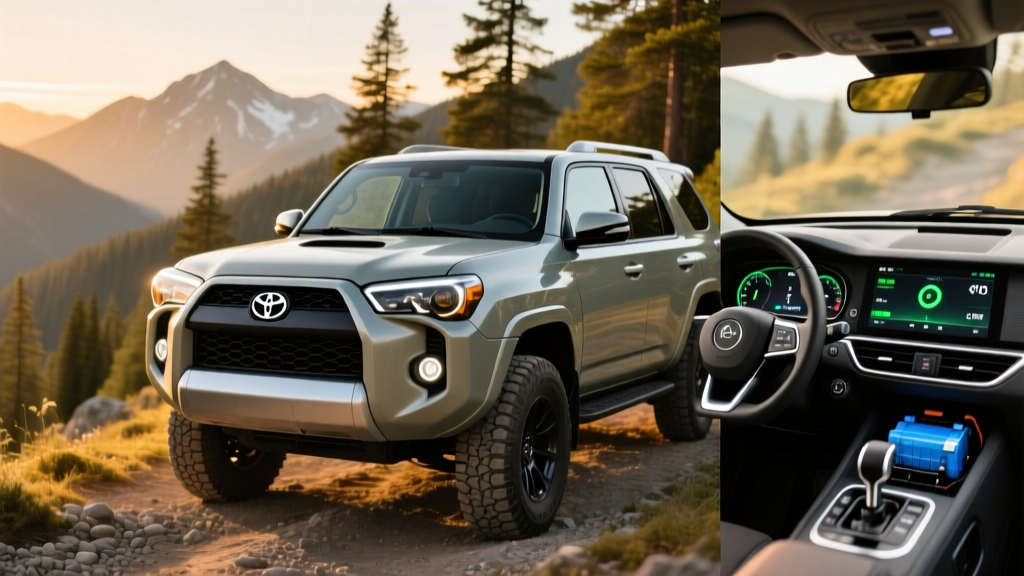
The Toyota 4Runner waited 15 years for a full redesign, and when it finally arrived for the 2025 model year, it brought something the nameplate had never offered: a hybrid powertrain. The 2025 hybrid 4Runner uses Toyota's i-FORCE MAX turbocharged hybrid system — a conventional hybrid (HEV) that requires no plug-in charging — to deliver a meaningful fuel-economy bump over the standard turbo four-cylinder while actually increasing total horsepower and torque.
After examining EPA data, owner reports, and Toyota's published specifications, here's everything you need to know about the 2025 hybrid 4Runner's efficiency, powertrain, pricing, and whether it's the right electrified SUV for your driveway.
HEV vs PHEV: What Kind of Hybrid Is the 2025 4Runner?
Before diving into numbers, it's critical to understand what the 2025 hybrid 4Runner is — and what it isn't.
Conventional Hybrid (HEV) — This Is the 4Runner
- No plug, no charging cable required
- Small battery (~1.87 kWh) recharges via regenerative braking and the engine
- Electric motor assists the gas engine; cannot drive on electric power alone for meaningful distances
- Fuel economy improvement comes from engine optimization, regen, and electric assist
Plug-In Hybrid (PHEV) — NOT the 4Runner
- Requires plug-in charging (Level 1 or Level 2)
- Larger battery (typically 12–20+ kWh) enabling 20–40 miles of electric-only driving
- Can operate as a pure EV for short commutes before the engine engages
- May qualify for federal tax credits up to $7,500 under IRS §30D
Toyota does not currently offer a 4Runner PHEV or 4Runner EV. If you need plug-in electric range from a Toyota SUV, the RAV4 Prime (37 miles electric-only, 94 MPGe) is the closest alternative in the lineup. The 2025 hybrid 4Runner is strictly an HEV — you fill it with gas and never think about a charging cable.
2025 Hybrid 4Runner MPG: EPA Estimates and Real-World Data
The headline number for the 2025 hybrid 4Runner is 27 MPG combined when equipped with rear-wheel drive, according to EPA fuel economy data. That's a substantial improvement over the outgoing 4th-generation 4Runner's 17 MPG combined with its 4.0L V6, and a 3 MPG bump over the non-hybrid 2025 i-FORCE turbo four-cylinder (24 MPG combined, 2WD).
| Powertrain | Drivetrain | City MPG | Highway MPG | Combined MPG |
|---|---|---|---|---|
| i-FORCE MAX Hybrid | 2WD | 24 | 30 | 27 |
| i-FORCE MAX Hybrid | 4WD | 23 | 27 | 25 |
| i-FORCE Turbo (non-hybrid) | 2WD | 21 | 27 | 24 |
| i-FORCE Turbo (non-hybrid) | 4WD | 20 | 24 | 21 |
| 4th-Gen 4.0L V6 (2024) | 4WD | 16 | 19 | 17 |
Real-World MPG: What Owners Actually See
Toyota's hybrid systems tend to perform close to or slightly above EPA estimates in city driving, where regenerative braking and electric assist do the most work. Highway driving is a different story. The 4Runner's boxy shape, 4,800-pound curb weight, and all-terrain tires on TRD trims create significant aerodynamic drag above 70 mph.
Expect the following in real-world driving:
- City/suburban: 25–28 MPG (4WD) — regen braking shines at lower speeds
- Highway (70–75 mph): 22–25 MPG (4WD) — aero drag and weight work against you
- Cold weather: Expect a 1–3 MPG drop in winter; the engine runs more often to provide cabin heat and maintain operating temperature
- Towing: 14–17 MPG when towing near the 6,000-lb max capacity
The hybrid's advantage over the non-hybrid i-FORCE is most pronounced in stop-and-go traffic, where the electric motor handles low-speed propulsion and the engine shuts off at stops. On a steady 75-mph highway cruise, the gap narrows to roughly 2–3 MPG.
i-FORCE MAX Powertrain: Specs and Performance
The i-FORCE MAX pairs a 2.4-liter turbocharged inline-four engine with a 48-horsepower electric motor integrated into the 8-speed automatic transmission housing. A 1.87 kWh nickel-metal hydride (NiMH) battery pack stores energy captured from regenerative braking.
| Specification | Value |
|---|---|
| Engine | 2.4L turbocharged inline-4 |
| Electric Motor | 48 hp, integrated into transmission |
| Combined Net Horsepower | 326 hp |
| Combined Net Torque | 465 lb-ft |
| Transmission | 8-speed automatic (i-FORCE MAX hybrid-specific) |
| Battery Type | NiMH, ~1.87 kWh |
| 0–60 mph (est.) | ~6.5 seconds |
| Max Towing Capacity | 6,000 lbs |
| Fuel Tank | 19.0 gallons |
| Total Driving Range (est.) | ~475–510 miles |
For context, the outgoing 4.0L V6 produced 270 hp and 278 lb-ft. The i-FORCE MAX hybrid nearly doubles torque output while adding 56 horsepower. The result is an SUV that finally has the passing power to match its rugged image — merging onto highways and climbing grades no longer requires a downshift and a prayer.
The electric motor fills in the torque gap at low RPMs before the turbo spools, eliminating the lag that plagues many turbocharged engines in heavy vehicles. It's a clever system Toyota also uses in the Tacoma, Tundra, and Sequoia, and it's proven durable in those applications since 2022.
Pricing, Trims, and Tax Credit Eligibility
The i-FORCE MAX hybrid powertrain is available across multiple 2025 4Runner trims, from the TRD Off-Road Hybrid up through the Platinum. Pricing starts around $52,000 and climbs past $63,000 for fully loaded models.
| Trim | Starting MSRP | Drivetrain |
|---|---|---|
| TRD Off-Road Hybrid | ~$52,675 | 4WD |
| Limited Hybrid | ~$56,375 | 2WD / 4WD |
| TRD Pro Hybrid | ~$58,550 | 4WD |
| Platinum Hybrid | ~$63,070 | 4WD |
Does the 2025 Hybrid 4Runner Qualify for a Federal Tax Credit?
No. The 2025 hybrid 4Runner is a conventional HEV, not a plug-in electric vehicle. The federal §30D Clean Vehicle Credit, as defined by the IRS, applies only to battery electric vehicles (BEVs) and plug-in hybrids (PHEVs) that meet battery capacity, critical-mineral sourcing, MSRP caps, and buyer income limits. Conventional hybrids like the 4Runner i-FORCE MAX do not qualify for §30D or any current federal purchase incentive.
Some states may offer minor incentives for hybrid purchases, but these vary widely by jurisdiction. Check your state's energy or DMV website for current programs. The hybrid premium you pay upfront (roughly $2,000–$3,000 over a non-hybrid equivalent trim) is recovered through fuel savings over time, not through tax credits.
Battery Warranty, Reliability, and Replacement Cost
Hybrid battery longevity is consistently the top concern for buyers considering their first hybrid. Here's what the data shows for Toyota's systems.
2025 4Runner Hybrid Battery Warranty
- Hybrid Battery: 10 years / 150,000 miles (whichever comes first)
- Hybrid System Components: 8 years / 100,000 miles
- Powertrain (engine, transmission): 5 years / 60,000 miles
- Capacity Threshold: Toyota warrants the hybrid battery against defects and abnormal loss of capacity
Toyota's NiMH hybrid batteries have an exceptional track record. The Prius, Camry Hybrid, and Highlander Hybrid have all demonstrated battery lifespans exceeding 200,000 miles in large numbers. The 4Runner's 1.87 kWh pack is small, lightly stressed, and never deeply cycled — it buffers energy in a narrow state-of-charge window, which dramatically extends cell life.
What Does a Hybrid Battery Replacement Cost?
If the hybrid battery fails outside of warranty, replacement costs for Toyota's NiMH packs typically run $2,000–$4,000 for the battery itself, plus $500–$1,000 in labor. Third-party refurbishers and individual cell replacement services can bring that cost below $2,000. Compare this to a full EV battery replacement at $8,000–$20,000+ — the 4Runner's small NiMH pack is relatively inexpensive to service.
Given Toyota's hybrid reliability history and the 10-year warranty, most original owners will never face a hybrid battery replacement. The 4Runner's body-on-frame construction and proven drivetrain components also contribute to strong long-term resale value — historically one of the nameplate's greatest strengths.
Who Should Buy the 2025 Hybrid 4Runner — and Who Shouldn't?
Reasons to Choose the Hybrid 4Runner
- You want a body-on-frame SUV with genuine off-road capability and better fuel economy than the old V6
- Your driving is a mix of city/suburban and highway, where the hybrid system recovers the most fuel
- You tow occasionally (up to 6,000 lbs) and want the 465 lb-ft of torque
- You don't have access to home or workplace charging, ruling out PHEVs and EVs
- You plan to keep the vehicle 8–10+ years and value Toyota's hybrid reliability record
Reasons to Look Elsewhere
- You need a third row — the 4Runner offers one, but it's cramped; the Sequoia hybrid is roomier
- You want electric-only commuting — consider the RAV4 Prime (PHEV) or a full EV like the Ioniq 5
- You primarily drive highway miles at 80+ mph, where the hybrid advantage shrinks
- You want federal tax credits — those require a BEV or qualifying PHEV
- Budget is tight — the hybrid premium and higher starting trim levels push MSRP above $52K
Hybrid vs PHEV vs EV: Which Fits Your Situation?
| Factor | HEV (4Runner Hybrid) | PHEV (RAV4 Prime) | BEV (e.g., Ioniq 5) |
|---|---|---|---|
| Home Charging Needed? | No | Yes (for EV range) | Yes |
| Electric-Only Range | None meaningful | 37–42 miles | 250–320 miles |
| Fuel/Energy Cost per Mile | ~$0.14–$0.17 | ~$0.04 (EV) / ~$0.12 (gas) | ~$0.04–$0.06 |
| Federal Tax Credit | None | Up to $7,500* | Up to $7,500* |
| Off-Road Capability | Excellent | Moderate | Limited |
| Towing | 6,000 lbs | 1,500 lbs | 1,500–2,300 lbs |
*PHEV and BEV tax credit eligibility depends on MSRP caps, buyer income, battery sourcing, and point-of-sale transfer rules. See IRS §30D guidelines for current requirements.
Frequently Asked Questions
How many MPG does the 2025 hybrid 4Runner get?
The EPA rates the 2025 4Runner i-FORCE MAX hybrid at 24 city / 30 highway / 27 combined MPG with 2WD, and 23 city / 27 highway / 25 combined with 4WD. Real-world results cluster around 23–26 MPG combined for 4WD models, with city driving yielding the best numbers and sustained highway driving at 75+ mph reducing efficiency to 22–24 MPG.
Does the 2025 hybrid 4Runner need to be plugged in?
No. The 4Runner hybrid is a conventional HEV. Its small NiMH battery recharges exclusively through regenerative braking and the gasoline engine. There is no charging port, no plug, and no electric-only driving mode of any meaningful distance. You fuel it like any other gas vehicle.
Is the i-FORCE MAX hybrid reliable?
Toyota has used variations of this hybrid system in the Tundra, Sequoia, and Tacoma since 2022 with strong reliability results. Toyota's hybrid technology overall has been refined over 25+ years since the original Prius. The 10-year/150,000-mile hybrid battery warranty reflects Toyota's confidence. Long-term data specific to the 4Runner is still accumulating, but the underlying components are proven.
What does a 4Runner hybrid battery replacement cost?
Out-of-warranty replacement for the 4Runner's NiMH hybrid battery typically costs $2,000–$4,000 for parts, plus $500–$1,000 in labor. Cell-level repair or refurbished packs can reduce this to under $2,000. Given the 10-year/150,000-mile warranty and Toyota's hybrid battery longevity record, most owners will never incur this expense.
How does the hybrid 4Runner compare to a full EV for daily driving?
If you have home charging and a commute under 40 miles, a full EV will cost significantly less per mile to operate (~$0.04–$0.06/mile vs. $0.14–$0.17/mile for the hybrid) and requires less maintenance. However, the 4Runner hybrid offers genuine off-road capability, 6,000-lb towing, and no range anxiety on long trips into areas with sparse charging infrastructure — advantages no current electric SUV fully matches at this price point.
Does the 2025 hybrid 4Runner qualify for any tax credits?
The 4Runner hybrid does not qualify for the federal §30D Clean Vehicle Credit because it is not a plug-in vehicle. It also does not qualify for most state EV incentives. The financial case for the hybrid rests entirely on fuel savings and the vehicle's strong projected resale value. Check your state's energy office for any hybrid-specific programs, but do not expect significant incentives.
Bottom Line: The Hybrid 4Runner Makes the Case for Patience
The 2025 hybrid 4Runner doesn't try to be an EV. It does something more pragmatic: it takes a legendary off-road SUV and fixes its worst attribute — atrocious fuel economy — without sacrificing the body-on-frame toughness, towing capacity, or trail capability that made buyers wait out a 15-year generation cycle. At 25 MPG combined with 4WD, 326 horsepower, and 465 lb-ft of torque, the i-FORCE MAX hybrid is the 4Runner that always should have existed.
If your lifestyle demands a rugged SUV and you lack charging infrastructure, this is one of the most capable hybrid vehicles on the market. If you can charge at home and don't need serious off-road chops, a PHEV or BEV will save you more money at the pump — and may put up to $7,500 back in your pocket via federal tax credits. The right choice depends on your miles, your terrain, and your driveway.