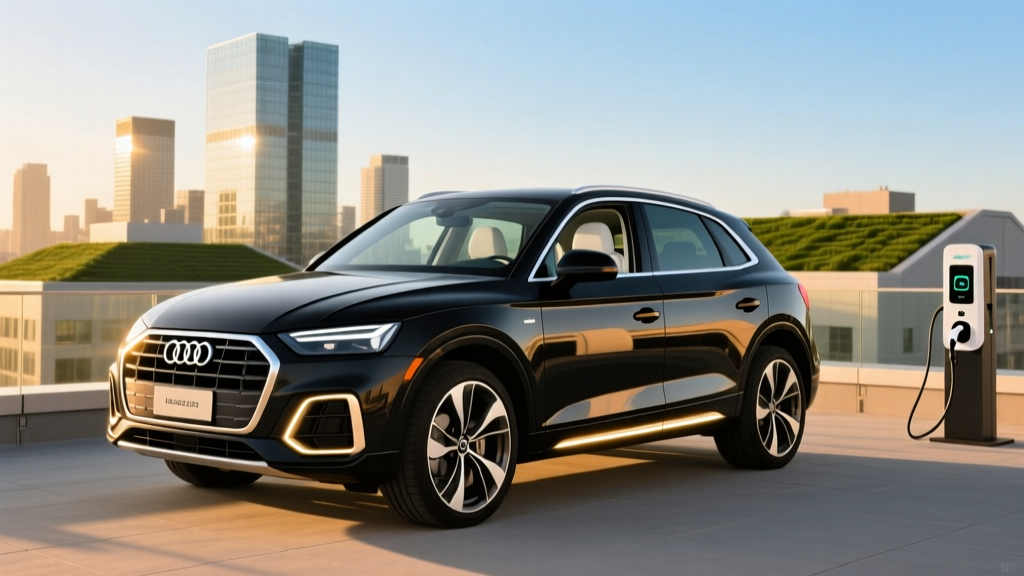
The 2025 Audi Q5 55 TFSI e is a plug-in hybrid (PHEV) that threads a specific needle: luxury SUV comfort with short-distance electric commuting and zero range anxiety for road trips. It is not a conventional hybrid — it requires plug-in charging to unlock its efficiency advantage, and its 17.9 kWh battery delivers a modest but useful electric-only range. For buyers weighing the 2025 Audi Q5 hybrid against a full EV or a gas-only Q5, the math comes down to daily mileage, home charging access, and whether the premium for plug-in hardware pays for itself.
2025 Audi Q5 55 TFSI e: Key Specifications
| Spec | Value |
|---|---|
| Powertrain | 2.0L turbo I4 + electric motor |
| Combined Horsepower | 362 hp / 369 lb-ft torque |
| Battery (usable) | 14.4 kWh (17.9 kWh gross), lithium-ion |
| EPA Electric-Only Range | 23 miles |
| Total Combined Range | ~400 miles |
| EPA MPGe (electric + gas) | 61 MPGe combined |
| EPA MPG (gas only, charge-sustaining) | 26 combined (25 city / 27 highway) |
| 0–60 mph | 5.0 seconds |
| Level 2 Charge Time (0–100%) | ~2.5 hours at 7.2 kW |
| DC Fast Charging | Not available |
| Starting MSRP | $58,295 (Premium Plus S line) |
| Battery Warranty | 8 years / 100,000 miles |
HEV vs PHEV: What the 2025 Audi Q5 Hybrid Actually Is
Audi does not sell a conventional hybrid (HEV) version of the Q5 in the United States. The only electrified Q5 available is the 55 TFSI e, which is a plug-in hybrid electric vehicle (PHEV). The distinction matters for ownership expectations:
| Feature | Conventional Hybrid (HEV) | Plug-in Hybrid (PHEV) — Q5 55 TFSI e |
|---|---|---|
| Plug-in charging required? | No — regenerates while driving | Yes — for electric-only range |
| Electric-only range | 0–2 miles at low speed | 23 miles (EPA) |
| Battery size | ~1–2 kWh | 17.9 kWh gross |
| Federal tax credit eligible? | No | No (see Tax Credit section below) |
| Best for | No home charging access | Home charging + short commute |
If you cannot charge at home or at work, the Q5 PHEV operates as a heavy, slightly less efficient gas vehicle once its battery depletes. The 26 MPG combined charge-sustaining figure is respectable for a 4,600-pound luxury SUV, but a conventional hybrid like the Toyota RAV4 Hybrid (39 MPG combined, per fueleconomy.gov) would deliver better fuel economy without plug-in infrastructure. The Q5 PHEV's value proposition only activates with regular charging.
Electric-Only Range and Efficiency: Real-World Expectations
The EPA rates the 2025 Audi Q5 55 TFSI e at 23 miles of electric-only range and 61 MPGe when operating in EV mode. These figures assume moderate temperatures, mixed driving, and a full charge.
EPA Electric-Only Range: 23 miles
Real-World Expectation: 18–21 miles in mixed driving; 14–17 miles in cold weather (below 40°F) or sustained highway speeds above 70 mph. Cabin heating in winter draws significant energy from the battery, and electric motors are less efficient at highway velocity than in stop-and-go city traffic.
For a commuter with a 15-mile round trip and home Level 2 charging, the Q5 PHEV can operate almost entirely on electricity Monday through Friday, with the gas engine reserved for weekend trips. Audi's MMI system lets you schedule charging and precondition the cabin while plugged in, which preserves battery range by warming or cooling the interior from grid power rather than battery power.
Once the battery depletes to its buffer threshold (approximately 10–12% state of charge, reserved to protect cell longevity), the Q5 switches to charge-sustaining hybrid mode. The 2.0L turbocharged engine takes over, assisted by the electric motor during acceleration. The EPA rates this mode at 26 MPG combined. In real-world city driving with frequent regenerative braking opportunities, owners typically see 27–29 MPG. Highway cruising at 75–80 mph drops to 24–25 MPG, consistent with the aerodynamic drag and weight of a luxury midsize SUV.
Charging the Q5 PHEV: Level 2 Only, No DC Fast Charging
The 2025 Q5 55 TFSI e accepts Level 2 AC charging at a maximum rate of 7.2 kW via its onboard charger. A full 0–100% charge takes approximately 2.5 hours on a 240-volt, 32-amp Level 2 home charger. On a standard 120-volt household outlet (Level 1, ~1.4 kW), a full charge requires roughly 10–12 hours — feasible for overnight replenishment but slow for midday top-ups.
| Charge Level | Power | 0–100% Time | Miles Added per Hour |
|---|---|---|---|
| Level 1 (120V outlet) | ~1.4 kW | 10–12 hours | ~2 miles/hr |
| Level 2 (240V, 32A) | 7.2 kW | ~2.5 hours | ~9 miles/hr |
| DC Fast Charging | N/A | N/A | N/A |
The absence of DC fast charging is typical for PHEVs in this class — the BMW X5 xDrive50e and Mercedes-Benz GLC 350e also lack DC capability. With only 23 miles of electric range, DC fast charging would add cost and weight for marginal benefit. The practical charging routine is simple: plug in at home overnight, wake up to a full battery, and drive your commute on electricity.
Powertrain Performance: 362 HP and a 5.0-Second 0–60
The Q5 55 TFSI e pairs a 261-horsepower 2.0L turbocharged inline-four with a 141-horsepower electric motor integrated into the seven-speed S tronic dual-clutch transmission. Combined system output is 362 horsepower and 369 lb-ft of torque, routed through Audi's quattro all-wheel-drive system.
The result is a 0–60 mph time of 5.0 seconds — substantially quicker than the gas-only Q5 45 TFSI (6.1 seconds) and competitive with sport-tuned rivals. The electric motor provides instant torque fill at low RPMs, eliminating the turbo lag typical of four-cylinder engines. In EV mode, acceleration is limited but adequate for city merging (0–30 mph feels brisk). The transition between electric and gas power is seamless; most drivers will not notice the engine engaging unless they watch the power-flow display.
Driving modes include EV (electric-priority), Hybrid (automatic blending), Battery Hold (reserves charge for later use, such as entering a zero-emission urban zone), and Battery Charge (uses the engine to recharge the battery while driving — inefficient but useful if you forgot to plug in).
Pricing, Trims, and Tax Credit Eligibility
The 2025 Audi Q5 55 TFSI e is offered in two trims:
- Premium Plus S line: $58,295 MSRP (includes destination)
- Prestige S line: $63,095 MSRP
Both trims include the S line exterior package, leather upholstery, virtual cockpit digital instrument cluster, and Audi's MMI infotainment with wireless Apple CarPlay and Android Auto. The Prestige adds a head-up display, adaptive cruise assist, and upgraded LED matrix headlights.
Federal Tax Credit Status: Not Eligible
The 2025 Audi Q5 55 TFSI e does not qualify for the federal §30D plug-in vehicle tax credit (up to $7,500). Under current IRS rules, the credit requires battery components and critical minerals to meet North American sourcing thresholds that Audi's supply chain does not satisfy for this model. Additionally, the §30D credit has MSRP caps ($80,000 for SUVs) and buyer income limits ($300,000 joint / $150,000 individual for new vehicles), but the sourcing requirement is the disqualifying factor here. See the IRS Clean Vehicle Credit page for current eligibility rules.
Some states offer their own PHEV incentives — California's Clean Fuel Reward program, for example, has historically offered up to $750 for PHEVs with batteries above a minimum kWh threshold, though funding varies. Check your state energy office or utility provider for local rebates before purchasing.
Battery Warranty, Reliability, and Replacement Cost
High-Voltage Battery Warranty: 8 years or 100,000 miles (whichever comes first), covering defects and capacity loss below 70% of original capacity. This is mandated by the EPA for emissions-related components and applies in all 50 states. California Air Resources Board (CARB) states extend coverage to 10 years / 150,000 miles.
Audi's lithium-ion battery pack uses pouch cells supplied by Samsung SDI, a proven vendor in the PHEV space. PHEV batteries experience less degradation stress than full EV batteries because the usable window is smaller (roughly 14.4 kWh of the 17.9 kWh gross capacity is accessible; the buffer protects against deep discharge and overcharge cycles). Based on industry data from similar PHEV platforms, owners should expect 85–92% state of health after 8 years of typical use.
Out-of-warranty battery replacement cost for the Q5 PHEV is estimated at $12,000–$16,000 (parts and labor), though this figure is based on comparable BMW and Mercedes PHEV packs — Audi has not published an official replacement price as of early 2026. In practice, PHEV battery failures before 150,000 miles are rare; most degradation is gradual capacity loss rather than catastrophic failure. The 7.2 kW onboard charger and power electronics carry a separate 4-year / 50,000-mile warranty under Audi's standard new-vehicle coverage.
Reliability data specific to the 2025 Q5 PHEV is limited given its recent introduction. The previous-generation Q5 (2018–2024) received mixed reliability ratings from Consumer Reports, with common complaints around infotainment glitches and minor electrical issues rather than powertrain failures. The hybrid-specific components (motor, inverter, battery) have not been a significant failure point in Audi's PHEV fleet.
Who Should Buy the 2025 Audi Q5 Hybrid?
Choose the Q5 55 TFSI e PHEV if:
- Your daily commute is under 20 miles round-trip and you have Level 2 home charging
- You want luxury SUV refinement with the ability to drive most weekdays on electricity
- You take road trips of 200+ miles where a full EV would require DC fast-charging stops
- You value the 362 hp performance upgrade over the gas-only Q5 45 TFSI
Choose a full EV (Audi Q4 e-tron or Q8 e-tron) if:
- You want zero tailpipe emissions and lower per-mile fueling cost
- Your daily driving exceeds 30 miles and you want to avoid gas entirely
- You qualify for the federal §30D credit on a competing EV
Choose the gas-only Q5 45 TFSI if:
- You lack home or workplace charging access
- The $8,000–$10,000 PHEV premium over the gas model does not justify fuel savings at your mileage
- You prefer lower vehicle weight and simpler mechanical complexity
The 2025 Q5 PHEV's total cost of ownership advantage over the gas Q5 45 TFSI depends heavily on electricity cost, gas price, and annual mileage. At 12,000 miles per year with 70% electric driving (8,400 miles on electricity at $0.14/kWh and 3,600 miles on gas at $3.50/gallon), the PHEV saves approximately $800–$1,100 annually in fuel. At that rate, the PHEV premium pays back in roughly 7–9 years — longer than most buyers keep a vehicle. The Q5 PHEV is a lifestyle and performance choice first, a fuel-economy play second.
Pros
- 23 miles electric-only covers most short commutes
- 362 hp and 5.0-second 0–60 outperform the gas Q5
- Seamless transitions between EV and hybrid modes
- No range anxiety on road trips — gas engine covers any distance
- 8-year / 100,000-mile battery warranty
Cons
- No DC fast charging
- Does not qualify for federal §30D tax credit
- 26 MPG charge-sustaining is average for the class
- $58,295 starting price is a significant premium over the gas Q5
- Cargo volume reduced by ~3 cu ft vs gas Q5 due to battery placement
Frequently Asked Questions
How many MPG does the 2025 Audi Q5 hybrid get?
The EPA rates the Q5 55 TFSI e at 26 MPG combined (25 city / 27 highway) when operating on gasoline after the battery is depleted. In electric mode, it achieves 61 MPGe combined. Real-world city driving in hybrid mode often yields 27–29 MPG thanks to regenerative braking; highway driving at 75+ mph drops to 24–25 MPG.
How far can the 2025 Audi Q5 PHEV go on electric only?
The EPA rates it at 23 miles electric-only. Real-world range is typically 18–21 miles in moderate weather and mixed driving, dropping to 14–17 miles in cold conditions or sustained highway speeds above 70 mph.
Does the 2025 Audi Q5 hybrid qualify for a federal tax credit?
No. The Q5 55 TFSI e does not meet the battery component and critical mineral sourcing requirements under IRS §30D rules for the up-to-$7,500 federal clean vehicle credit. Some state and utility incentives may apply — check local programs.
Is the Audi Q5 PHEV reliable, and what does battery replacement cost?
The PHEV powertrain components (battery, motor, inverter) have not been a significant failure point in Audi's fleet. The high-voltage battery is warrantied for 8 years / 100,000 miles (10 years / 150,000 miles in CARB states). Out-of-warranty replacement is estimated at $12,000–$16,000, though catastrophic failure before 150,000 miles is uncommon.
Hybrid vs PHEV vs EV — which should I choose?
If you have home charging and a short commute, the Q5 PHEV lets you drive on electricity most days while retaining gas flexibility for road trips. A conventional hybrid (HEV) suits buyers without charging access who still want improved fuel economy. A full EV (like the Audi Q4 e-tron) offers the lowest per-mile cost and zero tailpipe emissions but requires planning for longer trips around DC fast-charging infrastructure.
Can the Q5 PHEV charge at a DC fast charger?
No. The Q5 55 TFSI e supports only Level 1 (120V) and Level 2 (240V) AC charging, with a maximum onboard charger rate of 7.2 kW. This is standard for PHEVs in this class — the small battery does not justify the added cost and weight of DC fast-charging hardware.