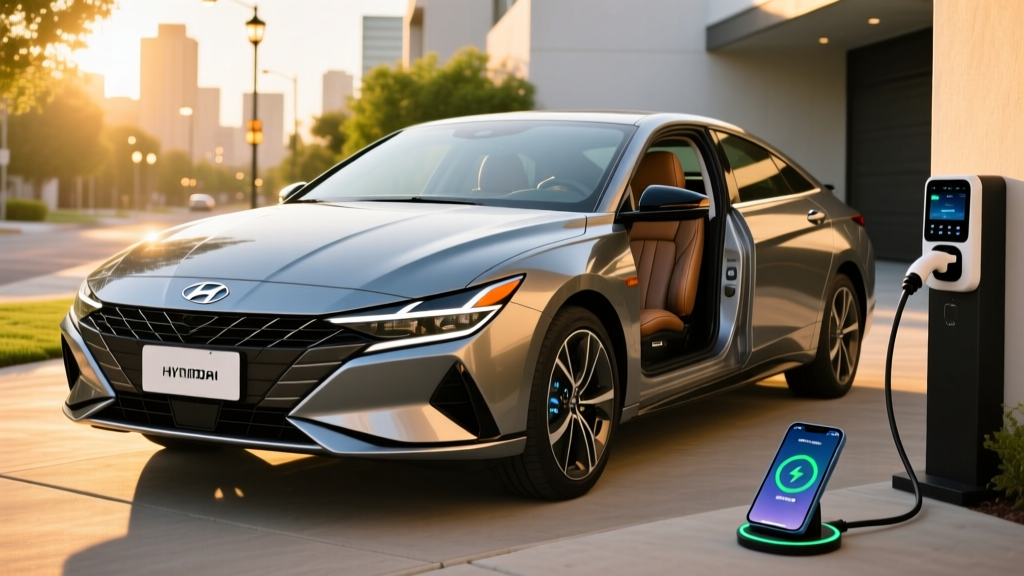
The 2025 Hyundai Elantra Hybrid Limited sits at the top of a compact sedan lineup that quietly delivers some of the best fuel economy in its class — without requiring a plug, a charging routine, or any change to how you drive. With an EPA-rated 54 MPG combined, a tech-heavy cabin, and a price that undercuts many rivals, the Elantra Hybrid Limited makes a compelling case for buyers who want electrified efficiency without the infrastructure demands of a full EV.
But spec sheets only tell half the story. Below, we break down real-world MPG expectations, powertrain details, battery longevity, tax credit eligibility under current IRS rules, and how this conventional hybrid stacks up against plug-in hybrids and battery-electric alternatives.
2025 Elantra Hybrid Limited: Key Specifications
| Specification | Value |
|---|---|
| Powertrain Type | Conventional Hybrid (HEV) — no plug-in |
| Engine | 1.6L GDI 4-cylinder + electric motor |
| Combined Horsepower | 139 HP |
| Combined Torque | 195 lb-ft |
| Transmission | 6-speed dual-clutch automatic (DCT) |
| EPA Fuel Economy (City / Hwy / Combined) | 51 / 58 / 54 MPG |
| Fuel Tank Capacity | 11.1 gallons |
| Total Driving Range (EPA Est.) | ~599 miles |
| 0–60 MPH | ~8.5 seconds (est.) |
| Drivetrain | Front-wheel drive |
| Starting MSRP (Limited trim) | $29,850 |
| Hybrid Battery Warranty | 10 years / 100,000 miles |
Fuel Economy: EPA Ratings vs. Real-World MPG
The Elantra Hybrid Limited carries an EPA rating of 51 MPG city, 58 MPG highway, and 54 MPG combined, according to fueleconomy.gov. The Limited trim's slightly lower city figure versus the Blue and SEL trims (which achieve 53/56/54) reflects its larger 17-inch alloy wheels and additional equipment weight.
Compared to the EPA sticker, real-world owners frequently match or slightly exceed the combined 54 MPG figure in mixed driving. The Elantra Hybrid's DCT setup avoids the "rubber-band" feel of e-CVTs and rewards steady-throttle highway cruising with exceptional efficiency.
Powertrain: How the Hybrid System Works
The Elantra Hybrid pairs a 1.6-liter Smartstream GDI 4-cylinder engine producing 104 HP with a 32 kW (43 HP) electric motor integrated into the transmission housing. Combined system output is 139 HP and 195 lb-ft of torque, routed through a 6-speed dual-clutch transmission to the front wheels.
Unlike a plug-in hybrid, the Elantra Hybrid's 1.56 kWh lithium-ion polymer battery is small — it's not designed for electric-only driving beyond brief low-speed assists. Instead, the battery and motor work to:
- Supplement the gasoline engine during acceleration (reducing fuel consumption)
- Capture energy through regenerative braking
- Enable engine-off coasting and idle stop-start
- Power the vehicle at very low speeds (parking lots, traffic creep) for short distances
This is a conventional hybrid (HEV), meaning you never plug it in. The battery charges exclusively through regenerative braking and engine-driven generation. If you're looking for meaningful electric-only range, you'd need to consider a PHEV or a full BEV.
Hybrid vs. PHEV vs. EV: Which Is Right for You?
| Factor | HEV (Elantra Hybrid) | PHEV (e.g., Toyota Prius Prime) | BEV (e.g., Hyundai Ioniq 6) |
|---|---|---|---|
| Plug-in Required? | No | Yes (for EV range) | Yes |
| Electric-Only Range | N/A (motor assist only) | 25–44 miles typical | 250–360+ miles |
| Total Range | ~599 miles | 400–500+ miles (EV + gas) | 250–360 miles (EV only) |
| Home Charging Needed? | No | Recommended (Level 2 ideal) | Essential (Level 2 strongly recommended) |
| Federal Tax Credit (§30D) | Not eligible | Up to $7,500 (if sourcing/income rules met) | Up to $7,500 (if sourcing/income rules met) |
| Best For | No garage/outlet access; long highway commutes; minimal behavior change | Short daily commute + home charging + occasional road trips | Home charging access + mostly under 250 mi/day + environmental priority |
| Upfront Cost Premium | Low (~$1,500–2,500 over gas equivalent) | Moderate (~$4,000–7,000 over HEV) | Higher (~$8,000–15,000 over HEV) |
Consider a PHEV instead if: You have a garage or driveway with a 120V/240V outlet, your daily commute is under 40 miles round-trip (meaning you'd rarely burn gas), and you want to qualify for the federal tax credit.
Consider a full BEV if: You can install a Level 2 home charger, your daily driving stays under 250 miles, you want to eliminate gasoline entirely, and you want the lowest per-mile "fuel" cost.
Pricing, Trims, and Tax Credit Eligibility
The 2025 Hyundai Elantra Hybrid is offered in three trims:
- Blue: ~$26,250 MSRP — highest MPG (53/56/54), cloth seats, basic infotainment
- SEL: ~$27,900 MSRP — adds SmartSense safety suite upgrades, proximity key, wireless CarPlay/Android Auto
- Limited: ~$29,850 MSRP — leather seats, 10.25" dual screens, Bose premium audio, Highway Driving Assist, navigation, LED projector headlights
Federal tax credit: The Elantra Hybrid is a conventional hybrid (HEV) and does not qualify for the IRS §30D Clean Vehicle Credit. That credit — worth up to $7,500 — is reserved for plug-in vehicles (PHEVs and BEVs) that meet battery capacity, critical-mineral sourcing, MSRP caps, and buyer income thresholds, per IRS.gov. The Elantra Hybrid's efficiency gains come at the pump, not through tax incentives.
Some states and local utilities offer rebates for conventional hybrids, but these vary widely by jurisdiction. Check your state energy office or utility provider for current programs.
Reliability, Battery Warranty, and Long-Term Costs
Hyundai's hybrid systems have proven durable in real-world use. The 1.56 kWh battery pack is small and operates within a conservative state-of-charge window (typically 40–80%), which reduces degradation stress. Unlike full EVs where battery replacement can cost $10,000–$20,000, the Elantra Hybrid's compact battery pack would cost significantly less to replace out of warranty — industry estimates for comparable HEV battery packs range from $2,000 to $4,000 including labor, though most hybrid batteries outlast the vehicle itself.
The 6-speed dual-clutch transmission is a known quantity in Hyundai's lineup, though some owners note it can feel slightly hesitant from a standstill compared to a traditional automatic or e-CVT. Hyundai's DCT has been refined across multiple model years, and long-term reliability data is generally favorable.
Tech, Safety, and Interior Highlights (Limited Trim)
The Limited trim is where the Elantra Hybrid differentiates itself from value-oriented competitors. Standard equipment includes:
- 10.25-inch digital instrument cluster with hybrid energy flow display
- 10.25-inch touchscreen with navigation, wireless Apple CarPlay and Android Auto
- Bose 8-speaker premium audio
- Hyundai SmartSense: Forward Collision-Avoidance Assist (with pedestrian/cyclist detection), Blind-Spot Collision-Avoidance, Rear Cross-Traffic Collision-Avoidance, Lane Keeping Assist, Driver Attention Warning
- Highway Driving Assist (HDA): Combines adaptive cruise control with lane centering — an SAE Level 2 driver-assistance system that requires hands-on-wheel engagement at all times
- Leather-trimmed seats with heated front seats and heated steering wheel
- LED projector headlights with dynamic bending light
Cargo space is 14.2 cubic feet — competitive with the non-hybrid Elantra and adequate for the segment. The hybrid battery is packaged under the rear seat, preserving trunk volume.
Frequently Asked Questions
How many MPG does the 2025 Elantra Hybrid Limited get?
The EPA rates the Limited trim at 51 MPG city, 58 MPG highway, and 54 MPG combined. The Blue and SEL trims achieve 53 city / 56 highway / 54 combined. Real-world results frequently match or exceed these figures, especially on highway routes.
Does the Elantra Hybrid need to be plugged in?
No. The Elantra Hybrid is a conventional hybrid (HEV). Its small battery charges through regenerative braking and the gasoline engine. You fuel it exactly like a standard gas car — at the pump.
Does the 2025 Elantra Hybrid qualify for a federal tax credit?
No. The IRS §30D Clean Vehicle Credit applies only to plug-in electric vehicles (PHEVs and BEVs) meeting specific battery sourcing, MSRP, and buyer income requirements. The Elantra Hybrid, as a conventional HEV, is not eligible. Check with a tax professional for any applicable state incentives.
How long will the hybrid battery last?
Hyundai warranties the hybrid battery for 10 years or 100,000 miles. In practice, most modern hybrid batteries last 150,000–200,000+ miles with normal use. The Elantra Hybrid's small 1.56 kWh pack operates under low stress, contributing to long service life. Out-of-warranty replacement, if ever needed, is estimated at $2,000–$4,000.
Is the Elantra Hybrid reliable?
Hyundai's hybrid powertrain has a solid reliability track record across the Elantra, Sonata, and Tucson Hybrid lineups. The 1.6L GDI engine and 6-speed DCT are proven components. Hyundai's 10-year/100,000-mile powertrain and hybrid battery warranties provide additional long-term peace of mind. Check IIHS for the latest crash-test ratings.
How does the Elantra Hybrid compare to the Toyota Prius?
The Toyota Prius (EPA 57 MPG combined on the LE trim) edges out the Elantra Hybrid on pure fuel economy, but the Elantra Hybrid Limited offers a more premium interior, standard leather, and Hyundai's longer warranty coverage at a competitive price. The Prius uses an e-CVT; the Elantra uses a 6-speed DCT, which feels more natural to drivers accustomed to traditional automatics.
Should I buy the Elantra Hybrid Limited or a full EV?
If you lack reliable home charging access, drive long distances regularly, or want to avoid any charging logistics, the Elantra Hybrid Limited is the pragmatic choice. If you can charge at home, drive mostly under 250 miles per day, and want to eliminate gasoline costs, a full EV like the Hyundai Ioniq 6 or Tesla Model 3 may save more over 5 years — but at a higher upfront cost.