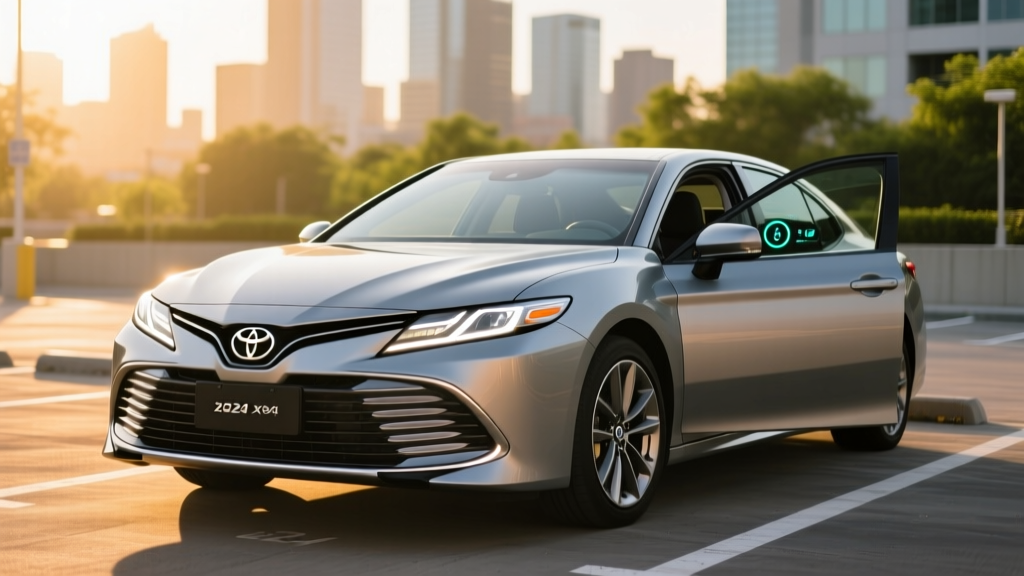
The 2024 Toyota Camry Hybrid occupies a specific niche in the electrified-vehicle market: a conventional hybrid (HEV) that requires no plug, no charging cable, and no behavioral change from the driver — yet delivers fuel economy that rivals many plug-in hybrids in daily driving. With the Camry nameplate moving to an all-hybrid lineup for the 2025 model year, the 2024 Camry Hybrid represents the final iteration of Toyota's proven fifth-generation hybrid system in a midsize sedan format that still offers a V6 gas alternative on upper trims.
This guide breaks down every key spec — EPA MPG, powertrain output, battery warranty, real-world efficiency, and pricing — so you can determine whether this HEV fits your needs versus a plug-in hybrid (PHEV) or a full battery-electric vehicle (BEV).
2024 Toyota Camry Hybrid: Core Specs at a Glance
| Spec | LE FWD | SE/XLE FWD | AWD Trims |
|---|---|---|---|
| Combined System HP | 208 hp | 208 hp | 208 hp |
| Engine | 2.5L 4-cyl Dynamic Force | 2.5L 4-cyl Dynamic Force | 2.5L 4-cyl Dynamic Force |
| Electric Motors | 1 front (88 kW) | 1 front (88 kW) | Front (88 kW) + Rear (40 kW) |
| Transmission | eCVT | eCVT | eCVT |
| Battery | NiMH (1.6 kWh) | NiMH (1.6 kWh) | NiMH (1.6 kWh) |
| EPA City MPG | 51 | 44 | 44 |
| EPA Highway MPG | 53 | 47 | 47 |
| EPA Combined MPG | 52 | 46 | 46 |
| 0–60 mph | ~7.2 sec | ~7.2 sec | ~7.0 sec |
| Drivetrain | FWD | FWD | AWD (electronic rear motor) |
| Fuel Tank | 13.2 gal | 13.2 gal | 13.2 gal |
| Est. Total Range | ~686 mi | ~607 mi | ~607 mi |
The 2024 Camry Hybrid pairs Toyota's 2.5-liter Dynamic Force inline-four (176 hp, 163 lb-ft on its own) with one or two electric motors for a combined system output of 208 horsepower. Unlike a turbocharged gas engine, this hybrid system delivers its torque immediately from the electric motor, making it feel more responsive in city driving than the 0–60 time suggests. AWD models add a separate 40 kW rear electric motor — there is no mechanical driveshaft connecting the front and rear axles.
Fuel Economy: EPA Ratings vs. Real-World MPG
| Trim | City | Highway | Combined |
|---|---|---|---|
| LE (FWD) | 51 MPG | 53 MPG | 52 MPG |
| SE (FWD) | 44 MPG | 47 MPG | 46 MPG |
| XLE (FWD) | 44 MPG | 47 MPG | 46 MPG |
| SE Nightshade AWD | 44 MPG | 47 MPG | 46 MPG |
| XLE AWD | 44 MPG | 47 MPG | 46 MPG |
The LE trim's 52 MPG combined rating stands out — and the reason is weight and wheels. The LE rides on 16-inch wheels with lower rolling-resistance tires and sheds roughly 100 lbs compared to the SE and XLE. Those trims use 18- or 19-inch alloy wheels, sportier tuning, and added features that cost about 6 MPG on the combined cycle, according to fueleconomy.gov.
HEV vs. PHEV: What the 2024 Camry Hybrid Is — and Isn't
The 2024 Camry Hybrid is a conventional hybrid (HEV), not a plug-in hybrid (PHEV). This distinction matters enormously for buyers cross-shopping electrified vehicles:
| Feature | HEV (Camry Hybrid) | PHEV (e.g., RAV4 Prime) | BEV (e.g., Tesla Model 3) |
|---|---|---|---|
| Plug-in Charging | No — self-charging | Yes — 2.5–6.6 kW AC | Yes — up to 250 kW DC |
| Electric-Only Range | ~0.5–1 mi at low speed | 25–42 mi | 250–350 mi |
| Total Range | 600–686 mi | 500–600 mi combined | 250–350 mi |
| Battery Size | 1.6 kWh (NiMH) | 14.9–18.1 kWh (NMC) | 57–82 kWh (NMC/LFP) |
| Federal Tax Credit (§30D) | Not eligible | Up to $7,500* | Up to $7,500* |
| Home Charger Needed | No | Recommended (Level 2) | Essential (Level 2) |
| Best For | Apt/condo dwellers, no charger access | Short commutes + road trips | Home charging + daily EV driving |
The Camry Hybrid's 1.6 kWh nickel-metal hydride (NiMH) battery is small by design. It buffers energy captured from regenerative braking and the engine to assist acceleration and enable brief electric-only operation at very low speeds (typically under 25 mph for less than a mile). You cannot plug it in, and it has no meaningful electric-only range. If you want 30+ miles of pure electric driving for a daily commute, you need a PHEV like the Toyota RAV4 Prime or Prius Prime — or a full BEV.
Toyota discontinued the Camry Hybrid PHEV variant (sold in limited markets in earlier generations) well before 2024. If a plug-in Camry is what you're seeking, the closest Toyota equivalent is the 2024 Prius Prime, which offers 39–44 miles of electric-only range on a 13.6 kWh lithium-ion battery.
Powertrain Deep Dive: How the Hybrid System Works
The 2024 Camry Hybrid uses Toyota's Hybrid Synergy Drive with a series-parallel architecture:
- Gas engine: 2.5-liter A25A-FXS Dynamic Force inline-four, producing 176 hp and 163 lb-ft. This Atkinson-cycle engine prioritizes thermal efficiency (up to 41%) over peak power.
- Front electric motor (MG2): 88 kW (118 hp), 149 lb-ft. This is the primary drive motor and also serves as the regenerative braking generator.
- Generator (MG1): Functions as a starter, generator, and engine-speed controller within the planetary gearset eCVT.
- AWD rear motor (AWD trims only): 40 kW (54 hp), activated on demand for traction — no mechanical connection to the front axle.
- Battery: 245V NiMH pack with 1.6 kWh gross capacity, located under the rear seat to preserve trunk space (15.1 cu ft).
The eCVT is not a belt-driven continuously variable transmission like those in some gas cars. It's a planetary gearset that seamlessly blends engine and motor power with no fixed gear ratios and no clutches to wear out. This simplicity is a key reason Toyota hybrid drivetrains have exceptional longevity.
Pricing, Trims, and Tax Credit Eligibility
| Trim | Drivetrain | MSRP (incl. destination) |
|---|---|---|
| LE | FWD | $29,690 |
| SE | FWD | $31,390 |
| SE Nightshade | AWD | $33,090 |
| XLE | FWD | $33,845 |
| XLE | AWD | $35,245 |
AWD is available on SE, SE Nightshade, and XLE trims for approximately $1,400 over the FWD equivalent. Toyota Safety Sense 2.5+ (pre-collision braking, full-speed adaptive cruise, lane tracing, road sign assist) is standard on every trim — a significant value compared to competitors that reserve ADAS features for upper trims.
Battery Warranty, Reliability, and Replacement Cost
The NiMH battery in the Camry Hybrid is one of the most proven components in Toyota's lineup. Real-world data from fleet operators and long-term owners shows these packs routinely lasting 150,000–200,000+ miles with minimal degradation. Unlike larger lithium-ion packs in BEVs and PHEVs, the Camry's small NiMH pack operates within a narrow state-of-charge window (roughly 40–80%), which dramatically reduces stress and extends cycle life.
If replacement is needed out of warranty, a refurbished NiMH pack costs approximately $2,000–$3,500 installed at a dealership, or $1,200–$2,000 from independent hybrid specialists using reconditioned modules. New OEM packs run $3,500–$5,000 installed. This is far less than the $8,000–$20,000+ replacement cost for large lithium-ion packs in BEVs.
Toyota's hybrid reliability track record is well-documented. The Camry Hybrid consistently earns above-average ratings from Consumer Reports and J.D. Power. The eCVT has no belts, no clutch packs, and no hydraulic valve body — the failure points in conventional automatic transmissions — contributing to lower long-term maintenance costs.
Who Should Buy the 2024 Camry Hybrid — and Who Shouldn't
Choose the Camry Hybrid If:
- You want 46–52 MPG without plugging in or changing habits
- You live in an apartment or condo with no charging access
- You take frequent long road trips and don't want range or charging concerns
- You prioritize low total cost of ownership and proven reliability
- You want AWD availability in a fuel-efficient sedan
- Your daily commute involves stop-and-go traffic (where hybrids shine)
Look Elsewhere If:
- You want electric-only driving for a daily commute (consider a PHEV or BEV)
- You want to qualify for the $7,500 federal tax credit (requires a plug-in vehicle)
- You want zero tailpipe emissions (a BEV eliminates local emissions entirely)
- You want rapid acceleration — the Camry Hybrid's 7.2-sec 0–60 is adequate, not sporty
- You prefer the driving dynamics of a dedicated EV platform (lower center of gravity, instant torque)
Ownership Costs: 5-Year Fuel Savings vs. Gas Camry
At current national average fuel prices (~$3.40/gal regular), the Camry Hybrid LE (52 MPG combined) costs approximately $900/year to fuel at 15,000 miles annually. A comparable 4-cylinder gas Camry (32 MPG combined) costs roughly $1,590/year — a difference of about $690/year or $3,450 over 5 years.
The Hybrid LE's $29,690 MSRP is roughly $2,500 above a gas Camry LE, meaning the fuel savings pay back the price premium in under 4 years. Factor in the hybrid's lower brake wear (regenerative braking extends pad life to 80,000+ miles) and the value proposition strengthens further. Insurance rates are comparable between gas and hybrid Camry trims, with no significant hybrid surcharge from major insurers.
Frequently Asked Questions
How many MPG does the 2024 Camry Hybrid actually get in real driving?
The LE trim achieves 51 city / 53 highway / 52 combined per the EPA. Real-world owners report 48–54 MPG combined, often exceeding the EPA city rating in heavy traffic due to regenerative braking. SE and XLE trims rate at 44/47/46, with real-world averages of 43–48 combined. Highway driving at 75+ mph and cold weather reduce efficiency by 5–12%.
Does the 2024 Camry Hybrid need to be plugged in?
No. The Camry Hybrid is a conventional HEV that charges its battery entirely through regenerative braking and the gas engine. There is no plug, no charging port, and no electric-only driving range beyond very brief low-speed maneuvers.
How long does the Camry Hybrid battery last, and what does replacement cost?
Toyota's NiMH hybrid batteries routinely last 150,000–200,000+ miles. The battery is warranted for 10 years/150,000 miles. Out-of-warranty replacement runs $2,000–$5,000 depending on whether you choose refurbished or new OEM — far less than BEV battery replacements.
Does the Camry Hybrid qualify for any federal tax credit?
No. The IRS §30D Clean Vehicle Credit applies only to plug-in vehicles (PHEVs and BEVs) with batteries above a minimum capacity. The Camry Hybrid's 1.6 kWh NiMH pack and lack of a charging port make it ineligible. Some states or utilities may offer small rebates for hybrids — check your local programs.
Should I buy the Camry Hybrid or wait for the 2025 all-hybrid Camry?
For the 2025 model year, Toyota made the Camry exclusively hybrid and moved to a lithium-ion battery pack with slightly more power (up to 225 hp on AWD). If you want the latest generation with a lithium-ion pack and updated infotainment, the 2025 is worth considering. If you want a proven platform at a potentially lower price (dealers may discount remaining 2024 inventory), the 2024 remains an excellent, reliable choice.
Is the AWD system in the Camry Hybrid a real AWD?
It's an electronic AWD system — a separate 40 kW rear electric motor engages automatically when the front wheels slip or during hard acceleration from a stop. There is no mechanical driveshaft. It's effective for rain, light snow, and low-traction launches, but it is not designed for off-road use or sustained high-speed AWD operation like a traditional mechanical system.